


Red light benefits are often discussed in consumer terms, but professional buyers need a different lens: wavelength tolerance, irradiance at skin distance, thermal design, and the certification route a factory can actually document. This article answers the practical question: how do you compare red light therapy devices by engineering and sourcing criteria, not by marketing adjectives?
What Red Light Benefits Mean in Device Terms
Red light benefits for professional users come from two narrow bands: 630-660 nm red and 810-850 nm near-infrared. A panel that drifts outside these bands by more than ±10 nm delivers less useful photon energy to tissue, so wavelength tolerance is the first spec to check. Reputable LED binning reports show peak wavelength per reel, not just a nominal value.
Irradiance is the second number that matters. Most clinical and wellness protocols use roughly 3-50 mW/cm2 at the treatment surface, with a session dose of roughly 3-20 J/cm2. A device that lists only total power in watts without beam area or distance tells you little; ask for irradiance measured at 6 inches and 12 inches from the panel.
Wavelength Bands and Their Trade-offs
Red light benefits differ by band, and the choice affects panel design, cost, and target use. 630-660 nm penetrates a few millimeters and is commonly used for surface-level applications; 810-850 nm reaches deeper tissue and is more common in professional recovery and wellness settings. Many panels mix both bands, but the ratio matters.
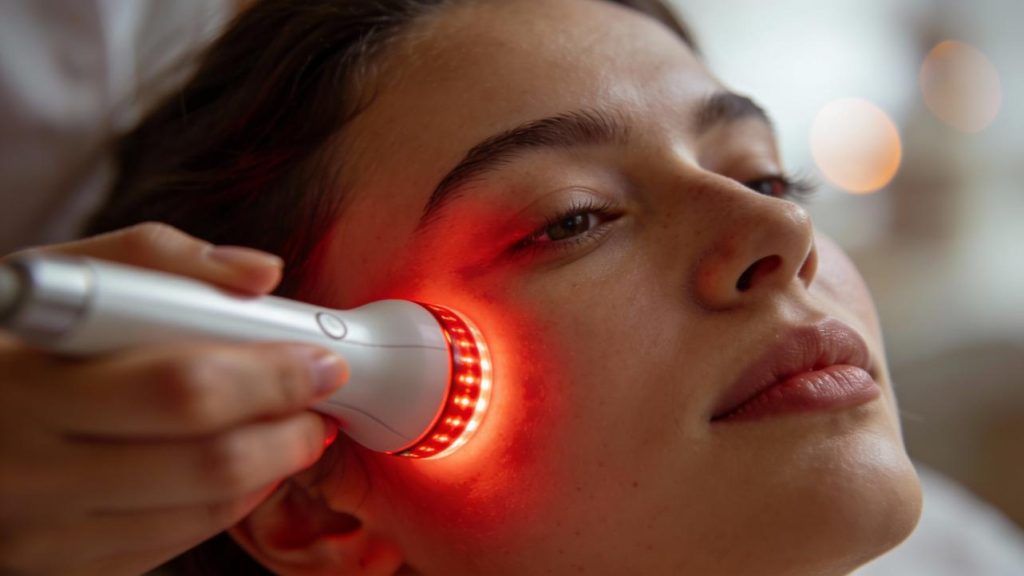
- 630 nm: lower cost LEDs, good for skin-focused protocols, but shallow penetration.
- 660 nm: slightly deeper than 630 nm, widely available, and often the default red wavelength.
- 810 nm: near-infrared with good tissue penetration, but less visible light for user comfort.
- 850 nm: deepest penetration in the near-infrared window, but higher thermal load per LED.
A mixed panel with 660 nm and 850 nm at a 1:1 or 1:2 ratio is a common professional configuration. Check whether the driver runs each wavelength on a separate channel; independent dimming lets a clinic adjust the red-to-infrared balance without changing hardware.
Panel vs Bed vs Handheld: A Decision Table
Red light benefits scale with treatment area and irradiance uniformity, but not every clinic needs a full-body bed. The table below compares three device classes by measurable criteria and a consequence you can act on.

| Device class | Typical irradiance at 6 in | Coverage area | Certification route | Consequence for buyer |
|---|---|---|---|---|
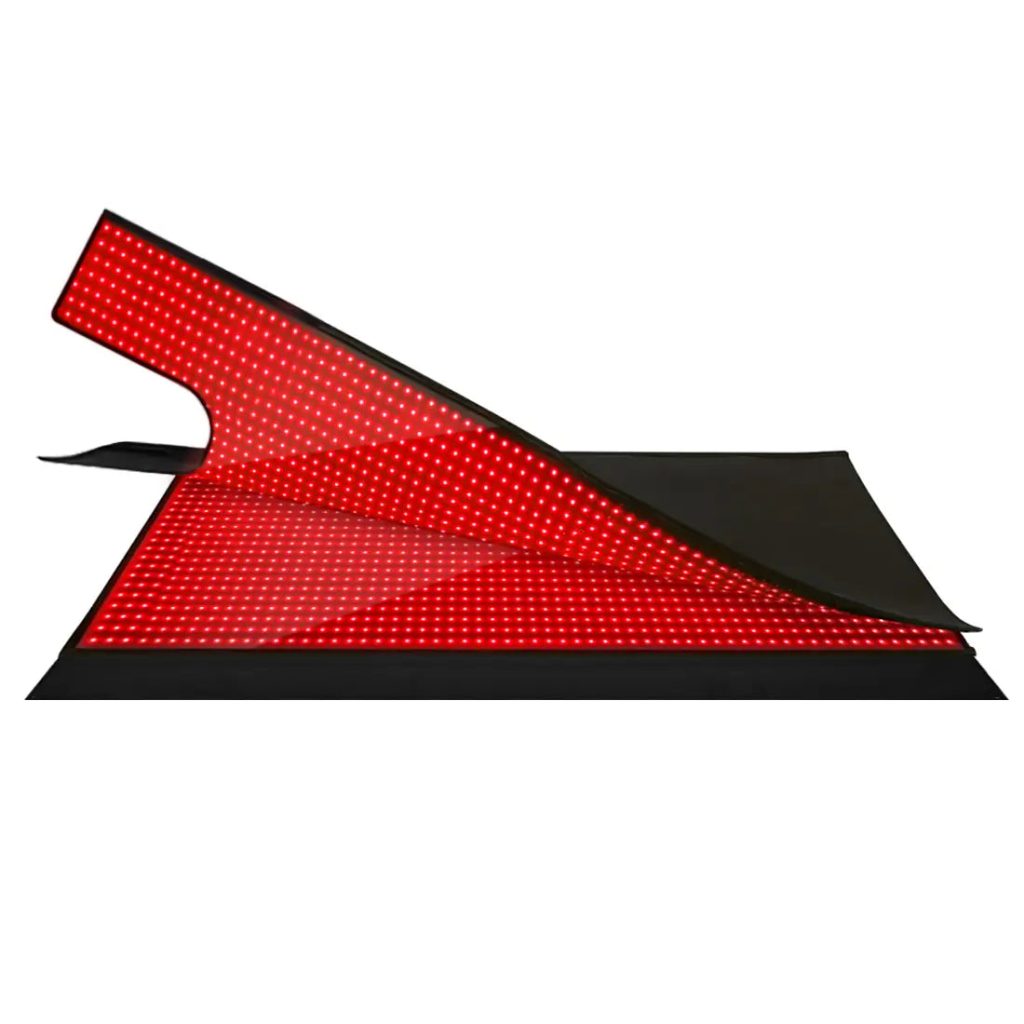
| LED panel (300-1500 W) | 20-50 mW/cm2 | 12 x 24 in to 24 x 48 in | CE, RoHS, IEC 62471 | Best balance of cost and flexibility; verify uniformity with a solar power meter before bulk order. |
| Full-body bed or pod | 10-30 mW/cm2 at skin | Full body | CE, RoHS, IEC 60601-1 if medical | Higher price tier and longer lead time; reserve for wellness franchises or high-throughput clinics. |
| Handheld or targeted device | 30-80 mW/cm2 at 1-2 in | 2-6 in diameter | CE, RoHS, sometimes FCC | Low MOQ but limited clinical throughput; good for pilot programs or add-on sales. |
Irradiance drops with distance, so a panel rated at 100 mW/cm2 at the LED surface may only deliver 30 mW/cm2 at 6 inches. Always ask for an irradiance map, not a single peak number.
Certification Routes: CE, RoHS, ISO, and What They Actually Cover
Red light benefits are only as credible as the factory’s documentation. CE marking under the Low Voltage Directive and EMC Directive is a self-declaration for non-medical wellness devices; it is not a safety guarantee. RoHS restricts hazardous substances in the LEDs and drivers. ISO 9001 covers quality management, not device performance.
Rule of thumb: if a supplier claims FDA approval for a red light therapy panel, ask for the 510(k) number. Most wellness panels are not FDA-cleared medical devices, and a factory that blurs this line is a sourcing risk.
For medical claims, the route is IEC 60601-1 compliance and a separate medical device file. That adds cost and lead time, but it is the only defensible path for clinical use. For wellness and aesthetic markets, CE + RoHS + IEC 62471 photobiological safety is the standard package.
Supplier Questions That Separate Serious Factories from Trading Companies
Red light benefits for a distributor or private-label brand depend on the factory’s engineering depth, not just its catalog. Ask these questions before paying for samples.
- Can you provide a binning report for the exact LED reels used in my order, showing peak wavelength and radiant flux per reel?
- What is the measured irradiance at 6, 12, and 24 inches from the panel face, and under what ambient temperature?
- Do you run constant-current drivers with independent channel control, or a cheaper constant-voltage design?
- What is the thermal rise after 30 minutes of continuous operation, and what heat sink material is used?
- Can you provide the IEC 62471 test report for the exact model, not a similar model?
- What is your MOQ for OEM branding, and does it change if I supply my own aluminum frame design?
A factory that answers all six with documents is worth a sample order. A trading company that answers with marketing slides is not.
OEM/ODM and Market Structure: What to Expect
Red light benefits are now a commodity at the low end, so differentiation comes from build quality and documentation. Typical market structure for a 300-600 W panel: MOQ 10-50 units for OEM logo, 100-300 units for custom housing, lead time 25-45 days after deposit, and price tiers roughly $80-150 per panel at 100 units, $60-100 at 500 units, and $40-70 at 1000 units. These are general ranges, not quotations.
Custom wavelengths, mixed ratios, and medical-grade drivers push the price up by 20-40%. The biggest failure mode buyers hit is not LED quality but driver overheating: a constant-voltage driver pushed near its limit will flicker or shut down after 20 minutes. Specify constant-current drivers with at least 20% headroom over the rated panel wattage.
Maintenance and After-Sales: The Hidden Cost of Red Light Benefits
Red light benefits decline if the panel is not maintained. LED output degrades roughly 3-5% per 1000 hours of use, so a panel used 8 hours a day loses 10-15% irradiance in the first year. Ask the supplier for an L70 rating: the hours until output drops to 70% of initial. A quality panel should have an L70 of 50,000 hours or more.
After-sales terms matter as much as the hardware. A serious factory offers a 2-year warranty on drivers and LEDs, a 1% spare parts kit with bulk orders, and a documented return process for DOA units. If the supplier cannot provide a wiring diagram and a spare driver within 7 days, walk away.
FAQ: Red Light Benefits for Professional Buyers
What is the difference between 630 nm and 850 nm for a clinic?
630-660 nm red light is absorbed more superficially, while 810-850 nm near-infrared penetrates deeper. A clinic that wants both effects should choose a panel with independent channel control for each band, not a fixed single-wavelength panel.
How do I verify irradiance claims before ordering?
Ask for an irradiance map measured with a calibrated spectrometer or solar power meter at 6, 12, and 24 inches. A single peak number at the LED surface is not a usable specification.
Can I import a red light therapy panel without a medical device license?
In most countries, a wellness device with no medical claims can be imported under general product safety rules, but you must have CE/RoHS documentation and an IEC 62471 photobiological safety report. If you make medical claims, the regulatory path is different and requires clinical evidence.
What is a realistic MOQ for a private-label red light panel?
For OEM logo only, 10-50 units is common. For custom housing or wavelength ratios, expect 100-300 units. Lead time is typically 25-45 days after deposit, plus shipping.
Conclusion: Turning Red Light Benefits into a Defensible Product
Red light benefits are real, but they are not magic. A professional buyer wins by demanding wavelength binning reports, irradiance maps, constant-current drivers, and documented certification routes. The difference between a $60 panel and a $120 panel is rarely the LEDs; it is the driver quality, thermal design, and the factory’s willingness to show test data.
Before you place an order, get one sample, run it for 30 minutes, measure the surface temperature, and check the irradiance at your intended treatment distance. Then ask for the L70 rating and the spare parts policy. If the supplier hesitates on any of these, find another factory. Confirm any clinical protocol or device choice with a qualified clinician.
Post time: 11-20-26