


Blue light treatment equipment is often evaluated on marketing claims rather than measurable hardware performance. This article answers a practical question for importers, distributors and clinic owners: which wavelength, irradiance and build-quality specifications actually determine whether a blue light panel performs consistently in professional use. We focus on device engineering and sourcing criteria, not medical outcomes.
Why Blue Light Wavelength Tolerance Matters More Than Peak Wavelength
A datasheet may list 450 nm, but the real question is the spectral width and binning tolerance of the LEDs. Low-cost panels often use LEDs with a dominant wavelength tolerance of ±10 nm or worse, which shifts the delivered spectrum and reduces repeatability between units. Reputable suppliers bin LEDs to ±5 nm or tighter, and they can provide the binning report from the chip vendor.
For blue light treatment hardware, three bands dominate the market: 415 nm, 450 nm and 470 nm. The 415 nm band is common in dermatology-oriented devices, while 450–470 nm is more typical for general phototherapy panels. Ask the supplier for a spectral power distribution graph measured with a calibrated spectrometer, not a marketing illustration.
Rule of thumb: if a supplier cannot provide the LED binning code or a measured spectrum, the wavelength claim is not yet verifiable.
Irradiance Specifications: What the Numbers Actually Mean
Irradiance for blue light treatment panels is usually stated in mW/cm² at a specific distance, often 10 cm or 15 cm from the device surface. A panel advertising 100 mW/cm² at 5 cm may deliver only 30 mW/cm² at 15 cm, so the measurement distance is a critical spec-sheet line. Professional buyers should request irradiance maps, not single-point values, because LED arrays often show 20–30% variation between center and edge.
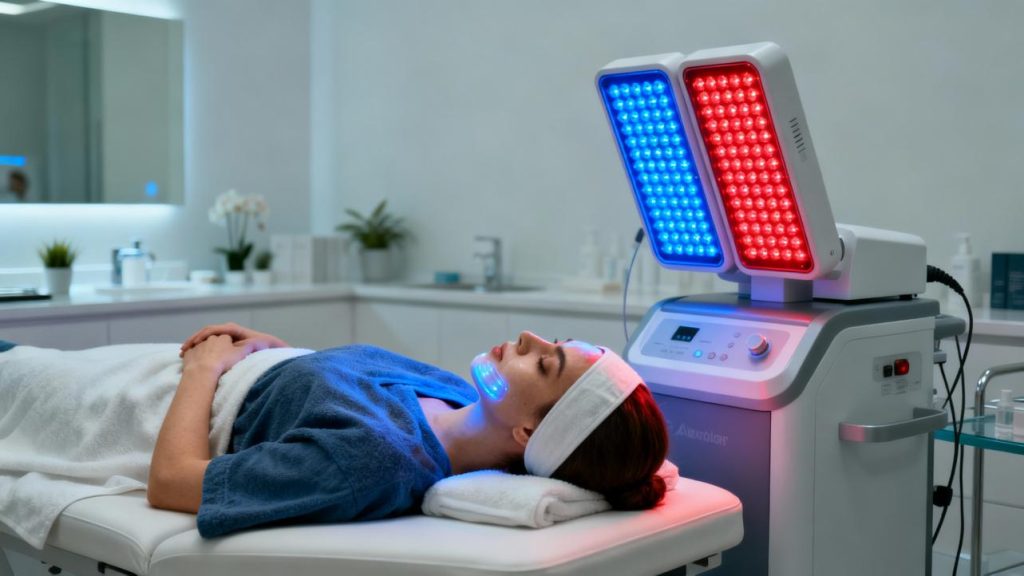
Typical target ranges for professional blue light devices are 10–50 mW/cm² at the working distance, with session doses commonly between 3 and 20 J/cm². The driver design determines whether irradiance stays stable as LEDs heat up: constant-current drivers with thermal feedback hold output within ±5%, while simple constant-voltage boards can drift by 15% or more over a 20-minute session.
Thermal Design: The Hidden Failure Mode in Blue Light Panels
Blue LEDs are less efficient than red or near-infrared emitters, so more input power becomes heat. Without adequate heatsinking, junction temperature rises, output drops, and the dominant wavelength shifts by several nanometers. Over months of daily clinic use, this accelerates lumen depreciation and can make two identical-looking panels perform very differently.
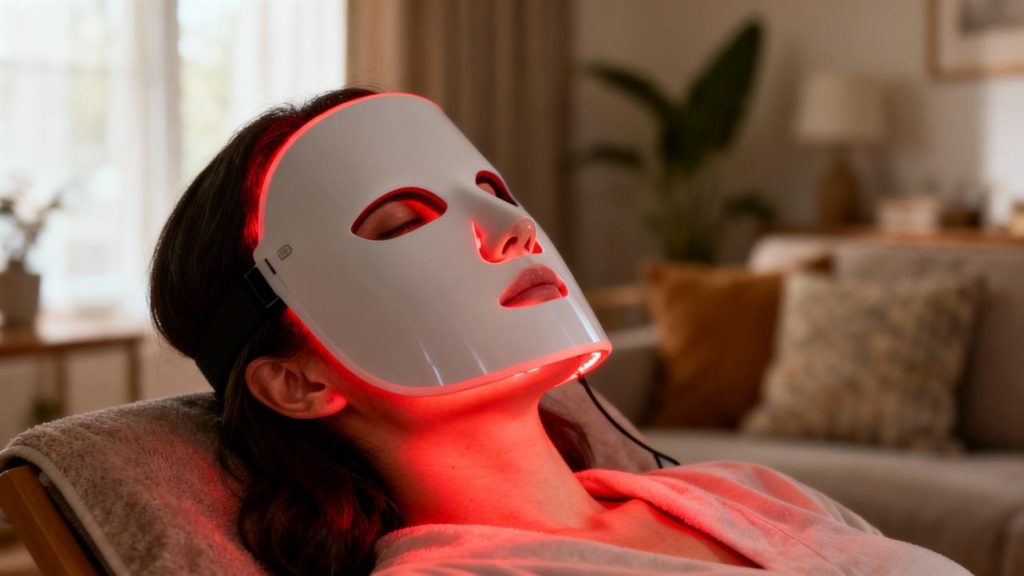
Look for aluminum PCB substrates, finned heatsinks, and active cooling in panels above roughly 50 W total power. A well-designed unit will specify a maximum case temperature, often 45–50 °C, and include thermal cutoff protection. Ask the factory for a thermal test report at the rated duty cycle, not just a short bench test.
Driver Electronics and Flicker: A Spec Worth Checking
Flicker percentage is rarely printed on a datasheet, but it affects both user comfort and measurement consistency. Low-frequency pulse-width modulation below 200 Hz can produce visible flicker and complicate irradiance readings with certain light meters. Professional blue light treatment devices should use constant-current drivers with high-frequency PWM, typically above 1 kHz, or true linear current regulation.
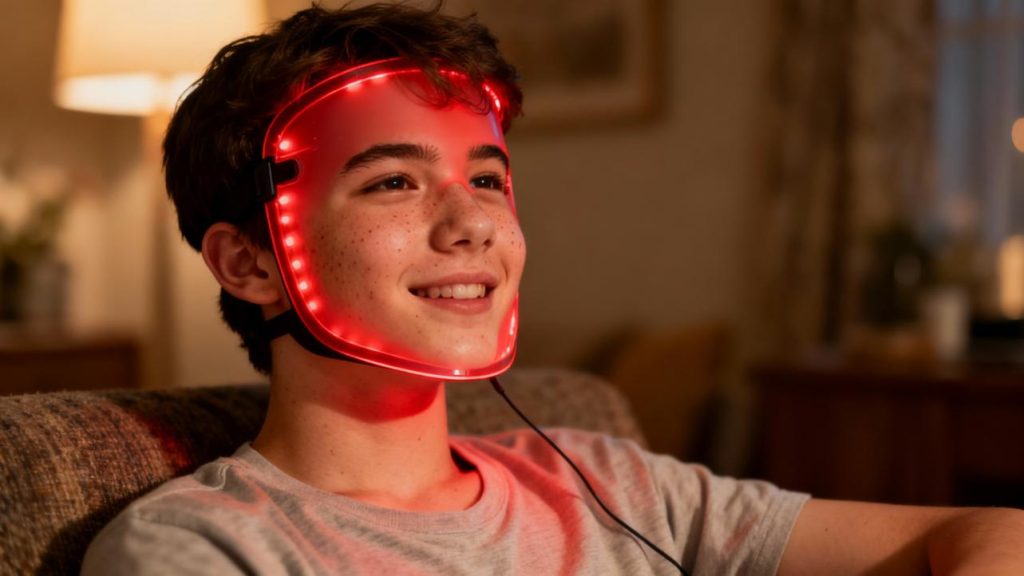
Ask for the driver topology, output current tolerance, and efficiency. A driver efficiency below 85% means more heat inside the enclosure and shorter component life. For OEM/ODM buyers, the driver is often the first place factories cut cost, so request a teardown photo or a bill of materials for the power stage.
Comparing Blue Light Device Classes for Professional Buyers
The table below compares four common hardware formats. Each row includes a decision consequence that affects purchase or deployment.
| Device class | Typical wavelength | Irradiance at working distance | Key consequence for buyers |
|---|---|---|---|
| Handheld spot device | 415 or 450 nm | 20–80 mW/cm² at 2–5 cm | Low unit cost, but treatment area is small; impractical for full-body or large-surface use. |
| Single panel (30×30 cm) | 450 or 470 nm | 15–40 mW/cm² at 15 cm | Good entry point for clinics; check edge uniformity before committing to multiple units. |
| Full-body panel array | 450 nm, sometimes mixed with 630 nm | 10–30 mW/cm² at 20–30 cm | Higher capital cost; thermal management and driver quality become decisive for daily duty cycles. |
| Overhead bed or canopy | 450–470 nm | 5–20 mW/cm² at 30–50 cm | Longer session times due to lower irradiance; verify IEC 62471 photobiological safety classification. |
Safety Standards and Factory Certifications for Blue Light Equipment
Blue light wavelengths require attention to ocular safety, and professional buyers should confirm the device carries a test report under IEC 62471 for photobiological safety. The risk group classification, such as Exempt or Risk Group 1, tells you whether the panel is suitable for unsupervised use or requires operator controls and protective eyewear.
Factory certifications such as CE, RoHS, ISO 9001 and ISO 13485 indicate that the production facility follows quality management and materials compliance processes. These are factory-level certifications, not product performance guarantees. Request copies of the actual certificates and verify the scope covers the device category you are buying.
Blue Light Treatment Sourcing: MOQ, Lead Time and OEM/ODM Structure
For importers and distributors, the typical minimum order quantity for a standard blue light panel is 50–200 units, depending on whether the housing is shared with existing red light therapy models. Custom wavelengths, mixed red/blue arrays, or private-label branding usually raise the MOQ to 300–500 units. Lead times for standard models run 30–45 days, while full ODM projects with new tooling take 60–90 days.
Price tiers generally follow the driver and LED quality more than the enclosure. A panel using binned LEDs from a major chip vendor, a constant-current driver with thermal feedback, and an aluminum heatsink will cost 40–80% more than a visually similar panel using unbinned chips and a constant-voltage board. Ask for a side-by-side bill of materials comparison before negotiating on price alone.
- Request the LED binning code and spectral graph for every wavelength offered.
- Ask for irradiance maps at three distances, not a single center-point value.
- Confirm the driver topology, flicker percentage and thermal cutoff behavior.
- Verify IEC 62471 risk group classification and required operator controls.
- Get the factory’s ISO 9001 or ISO 13485 certificate scope in writing.
FAQ: Blue Light Treatment Device Evaluation
What wavelength should a professional blue light treatment panel use?
Most professional panels use 450 nm or 470 nm, while 415 nm appears in dermatology-oriented handhelds. The more important specification is the binning tolerance, which should be ±5 nm or tighter, and the measured spectral graph from the supplier.
How much irradiance is typical for a clinic-grade blue light panel?
Expect 10–50 mW/cm² at the stated working distance, usually 10–15 cm. Always ask for an irradiance map across the treatment surface, because edge values can be 20–30% lower than the center.
What is the most common failure mode in budget blue light devices?
Driver overheating from constant-voltage designs and undersized heatsinks. This causes output drift, wavelength shift, and early LED degradation. Request a thermal test report and driver efficiency rating above 85%.
What certifications should a blue light treatment device factory hold?
Look for CE, RoHS, ISO 9001 and ISO 13485 factory certifications. For photobiological safety, confirm an IEC 62471 test report with a risk group classification appropriate for the intended use environment.
Conclusion: Buy the Measurable Specs, Not the Marketing Copy
Blue light treatment devices are only as consistent as their LED binning, driver design and thermal management. Before placing an order, obtain the spectral graph, irradiance map, driver schematic and IEC 62471 report. These documents reveal more about long-term performance than any wavelength claim on a product page.
For importers and clinic owners, the practical next step is to shortlist factories that can provide full test documentation at the sampling stage. Compare two or three units side by side under the same measurement conditions, then negotiate on the bill of materials, not just the unit price. Confirm any intended use or health-related expectations with a qualified clinician before deploying equipment in a professional setting.
Post time: 11-20-26