


Red light therapy for inflammation is a growing category for professional buyers, but selecting the right device requires more than a wavelength claim. This article answers the concrete question: which specifications, certifications, and sourcing decisions separate a reliable panel from an underperforming unit? We cover wavelength tolerance, irradiance measurement, thermal design, and supplier qualification.
Why Wavelength and Irradiance Drive Device Performance
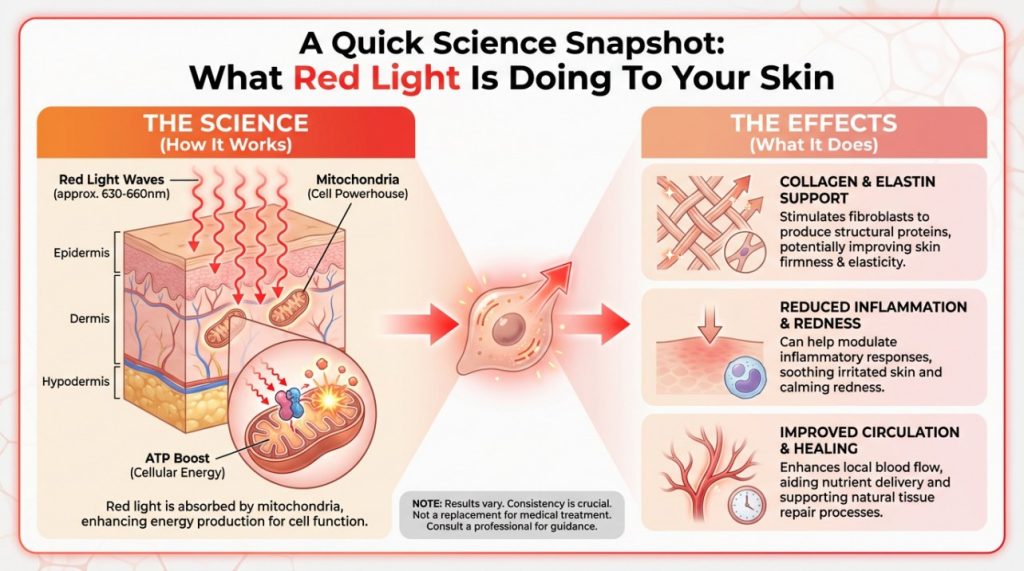
Photobiomodulation devices for inflammation support typically use two bands: red light at 630-660 nm and near-infrared (NIR) at 810-850 nm. Red wavelengths are absorbed primarily by cytochrome c oxidase in the mitochondrial respiratory chain, while NIR penetrates deeper into tissue. For a professional device, the wavelength tolerance should be no more than ±10 nm from the nominal peak, because a 20 nm shift can move the emission outside the target absorption window.
Irradiance at the treatment surface is the second non-negotiable specification. Most clinical and commercial protocols fall between 3 mW/cm2 and 50 mW/cm2, with a per-session dose of 3-20 J/cm2. A panel that claims high power but only delivers 80 mW/cm2 at 2 inches may still be usable, but it will require shorter treatment times and careful thermal management. Always ask for irradiance measured with a calibrated spectrometer or a solar power meter at the intended treatment distance, not at the LED surface.
Rule of thumb: if a supplier cannot provide an irradiance map at 6 inches and 12 inches, assume the LED binning is uncontrolled and the panel will underdeliver.
Red Light Therapy for Inflammation: What the Device Spec Sheet Must Show
When you evaluate a panel, bed, or handheld device for inflammation support, the spec sheet should list at least five parameters: peak wavelength with tolerance, irradiance at a defined distance, beam angle, LED count and drive current, and cooling method. A missing beam angle is a red flag because a 30-degree lens concentrates energy in a small area, while a 120-degree lens spreads it thin. For whole-body applications, a wider beam angle with higher total LED count usually provides more uniform coverage.

The drive current matters because it determines LED junction temperature and lifetime. Quality panels run LEDs at 50-70% of their maximum rated current to reduce thermal droop and maintain wavelength stability. If a supplier advertises 5 W LEDs but runs them at 1.5 W each, the panel may still perform well, but the marketing is misleading. Ask for the actual electrical power draw per LED and the total wall-plug power consumption.
| Specification | What to Look For | Consequence if Ignored |
|---|---|---|
| Peak wavelength | 630-660 nm red, 810-850 nm NIR, ±10 nm tolerance | Wavelength drift outside absorption window reduces biological effect |
| Irradiance at 6 inches | 3-50 mW/cm2, verified with calibrated meter | Underdosing leads to no effect; overdosing wastes energy and may heat skin |
| Beam angle | 30-120 degrees, matched to treatment area | Narrow beam creates hot spots; wide beam may require longer sessions |
| LED drive current | 50-70% of maximum rated current | Overdriving shortens LED life and shifts wavelength |
| Cooling method | Active fan or passive heatsink with thermal cutoff | Overheating causes irradiance drop and premature failure |
Panel vs. Bed vs. Handheld: Matching Form Factor to Use Case
For clinic owners and distributors, the form factor determines both the treatment workflow and the price tier. Full-body panels with 300-1500 LEDs typically cost $800-$5,000 at wholesale, depending on power and build quality. They are best for professional settings where a client stands or lies at a fixed distance for 10-20 minutes. Beds and half-body pods offer greater coverage but require more floor space and often carry a 30-50% price premium.
Handheld devices are the entry point for consumers and small clinics, but their irradiance drops sharply with distance. A 100 mW/cm2 handheld at 0 inches may deliver only 10 mW/cm2 at 6 inches, so the user must hold it close and move it slowly. For inflammation support across a large area, a panel is usually more practical. When sourcing handhelds, check battery capacity in mAh and whether the device maintains constant current as the battery drains.
- Panel: best for whole-body or large-area use, fixed distance, consistent dose
- Bed or pod: highest coverage but highest cost and space requirement
- Handheld: portable and affordable, but dose depends heavily on user technique
- Targeted pad or wrap: flexible for joints, but check irradiance uniformity across the pad
Thermal Design and LED Lifetime: The Hidden Cost Drivers
Heat is the main enemy of LED longevity and wavelength stability. A well-designed panel uses an aluminum PCB, a finned heatsink, and either a quiet fan or a large passive thermal mass. Junction temperatures above 85°C accelerate lumen depreciation and can shift the peak wavelength by 5-10 nm over a few hundred hours of use. For a professional device, ask for the expected L70 lifetime—the number of hours until output drops to 70% of initial—which should be at least 20,000 hours for quality mid-power LEDs.
Thermal management also affects safety. A panel that reaches 50°C on the housing surface is uncomfortable for close use and may trigger a thermal cutoff. Look for a built-in temperature sensor that reduces current or shuts off the device above a safe threshold. This is a simple feature that separates professional equipment from consumer toys.
Factory Certifications and What They Actually Mean
For importers and distributors, factory certifications are the baseline for due diligence. CE marking indicates conformity with European safety and EMC requirements, while RoHS restricts hazardous substances. ISO 9001 covers quality management, and ISO 13485 is specific to medical device quality systems. None of these certifications guarantee clinical efficacy, but they demonstrate that the factory has documented processes and has passed third-party audits.
When you request a quotation, ask for the certificate numbers and verify them on the issuing body’s database. A supplier that cannot provide a valid CE certificate or ISO 9001 audit report is likely a trading company without manufacturing control. For OEM/ODM projects, also request a factory audit report or plan a video inspection of the SMT line, LED binning area, and aging test room.
Sourcing Red Light Therapy Devices: MOQ, Lead Time, and Price Tiers
Typical MOQs for OEM/ODM panels range from 10 to 100 units, depending on customization. Standard off-the-shelf panels may have an MOQ of 1-10 units for samples, but wholesale pricing usually starts at 50 units. Lead times for customized orders are 30-60 days after design approval, while stock orders ship in 7-15 days. Price tiers are roughly: $50-$150 per unit for basic handhelds, $200-$600 for mid-size panels, and $800-$2,000 for high-power full-body panels at 100-unit quantities.
The biggest sourcing failure mode is buying on price alone and receiving panels with mismatched LEDs, thin aluminum PCBs, and no thermal protection. Always request a pre-production sample, test it with your own irradiance meter, and confirm the exact LED bin and driver model before mass production. A written specification sheet with tolerances is your best protection against bait-and-switch.
Frequently Asked Questions
What irradiance is needed for red light therapy for inflammation?
Most protocols use 3-50 mW/cm2 at the skin surface, with a total dose of 3-20 J/cm2 per session. The exact value depends on wavelength, treatment area, and device form factor, so verify the irradiance map at your intended distance.
Which wavelength is better for inflammation: 660 nm or 850 nm?
660 nm red light is absorbed more superficially, while 850 nm near-infrared penetrates deeper. Many professional devices combine both bands to cover a wider range of tissue depths, but the optimal choice depends on the target area and treatment goal.
How do I verify a supplier’s wavelength claim?
Request a spectrometer test report for the exact LED bin used in production, and confirm the tolerance is ±10 nm or better. You can also purchase a handheld spectrometer for $200-$500 to spot-check incoming units.
What is a realistic LED lifetime for a professional panel?
Quality mid-power LEDs driven at 50-70% of maximum current should achieve an L70 lifetime of 20,000-50,000 hours. Overdriven LEDs may fail within 5,000 hours and shift wavelength, so check the drive current and thermal design.
What to Do Next: Build a Shortlist Based on Specs, Not Marketing
Start by defining your target use case and the required treatment area. Then request spec sheets from at least three suppliers and compare wavelength tolerance, irradiance at 6 inches, beam angle, LED drive current, and cooling method. Eliminate any supplier that cannot provide a calibrated irradiance map or a valid factory certification.
For OEM/ODM buyers, order a pre-production sample and test it with your own meter before committing to a 50-100 unit order. Negotiate a written specification sheet with tolerances and a penalty clause for non-conformance. This approach will help you avoid the most common sourcing pitfalls and build a product line that professionals can trust.
Post time: 11-22-26