


Does red light help you sleep? The short answer is that many users report better sleep quality after evening sessions, but the effect depends heavily on wavelength, dose, timing, and device build quality. This article gives buyers and clinic owners a practical framework for evaluating red light therapy devices intended to support sleep, without overstating what the hardware can do.
How Red Light May Influence Sleep Regulation
Red and near-infrared light in the 630-660 nm and 810-850 nm bands are absorbed by cytochrome c oxidase in mitochondria, which may increase cellular energy production and modulate oxidative stress. For sleep specifically, the proposed mechanism is indirect: evening exposure to dim red light does not suppress melatonin the way bright blue or white light does, and some users find that a 10-20 minute session helps them wind down. However, the clinical evidence is mixed, and most studies use small samples or self-reported outcomes.
From a hardware standpoint, the key variable is not the light color but the spectral purity and irradiance. A panel that claims 660 nm but actually emits a broad peak from 640-680 nm may still be useful, but it will deliver less energy at the target wavelength. Buyers should ask suppliers for a spectral power distribution graph, not just a single peak wavelength number.
Wavelength Bands That Matter for Sleep Support
Red light therapy devices for sleep typically use two bands: visible red around 630-660 nm and near-infrared around 810-850 nm. The visible red is easier to perceive and may help signal the brain that it is evening, while the near-infrared penetrates deeper into tissue and is often used for general photobiomodulation. For sleep-focused use, many users prefer red-only panels because near-infrared can feel warming and may be overstimulating for some people late at night.
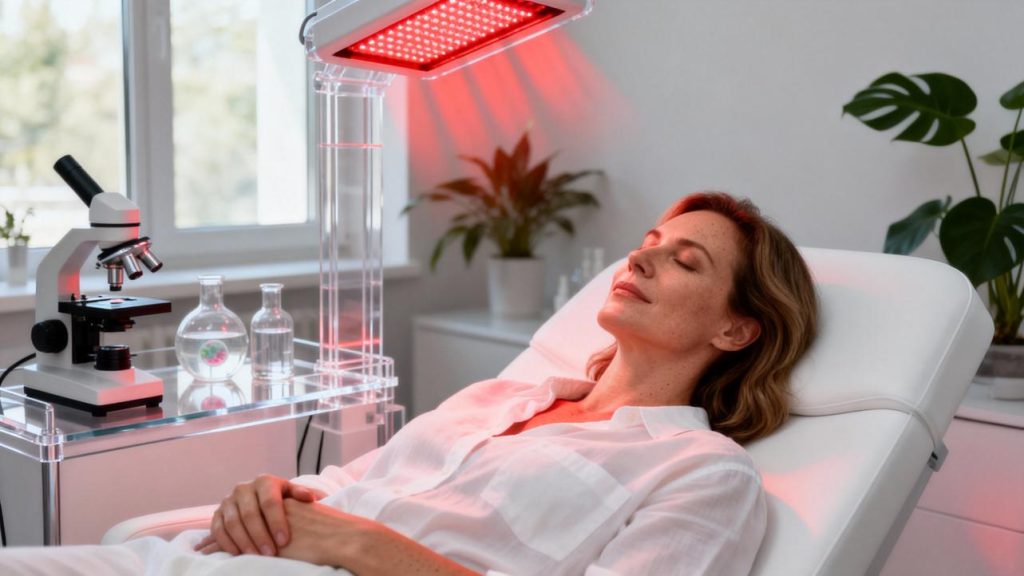
When comparing devices, check the ratio of red to near-infrared LEDs. A 1:1 ratio of 660 nm to 850 nm is common in general-purpose panels, but a sleep-specific panel might use 100% 660 nm or a 4:1 red-to-NIR ratio. There is no universal standard, so the decision should be based on user tolerance and the supplier’s spectral data.
| Wavelength option | Typical use case | Consequence for sleep buyers |
|---|---|---|
| 630-660 nm red only | Evening wind-down, melatonin-friendly | Lower heat sensation; may be less effective for deep tissue but often preferred for sleep |
| 810-850 nm NIR only | General photobiomodulation | Invisible and warming; may disrupt sleep if used too close to bedtime |
| Mixed 1:1 red/NIR | Full-body panels | Versatile but harder to isolate sleep-specific effects |
| Pulsed 10-40 Hz | Experimental protocols | Limited evidence for sleep; verify driver and frequency accuracy |
Irradiance and Dose: The Numbers Behind the Claim
Irradiance is measured in mW/cm2 at the treatment surface, and most home panels deliver 20-100 mW/cm2 at 6 inches. For sleep support, a lower irradiance of 10-30 mW/cm2 for 10-20 minutes is often recommended, yielding a dose of roughly 6-18 J/cm2 per session. Higher irradiance does not mean better sleep; it can cause overstimulation or simply waste energy as heat.
Buyers should verify whether the supplier’s irradiance figure is measured at the LED surface or at a typical user distance. A panel rated at 100 mW/cm2 at the surface may deliver only 30 mW/cm2 at 12 inches. Ask for an irradiance map or a third-party test report, and be wary of suppliers who list only the LED chip rating rather than the panel output.
A practical rule of thumb: for sleep-focused use, start with 10 minutes at 20-30 mW/cm2 of red-only light, two to three hours before bed, and adjust down if you feel more alert afterward.
Session Timing and Device Placement for Sleep
The timing of a red light session matters more than the total daily dose. Evening use, roughly 1-3 hours before bedtime, is the most common pattern among users who report sleep benefits. Morning use is less likely to affect sleep directly, though it may help regulate circadian rhythm through general light exposure. Avoid using bright red or NIR panels within 30 minutes of lying down, as the light itself can be alerting.
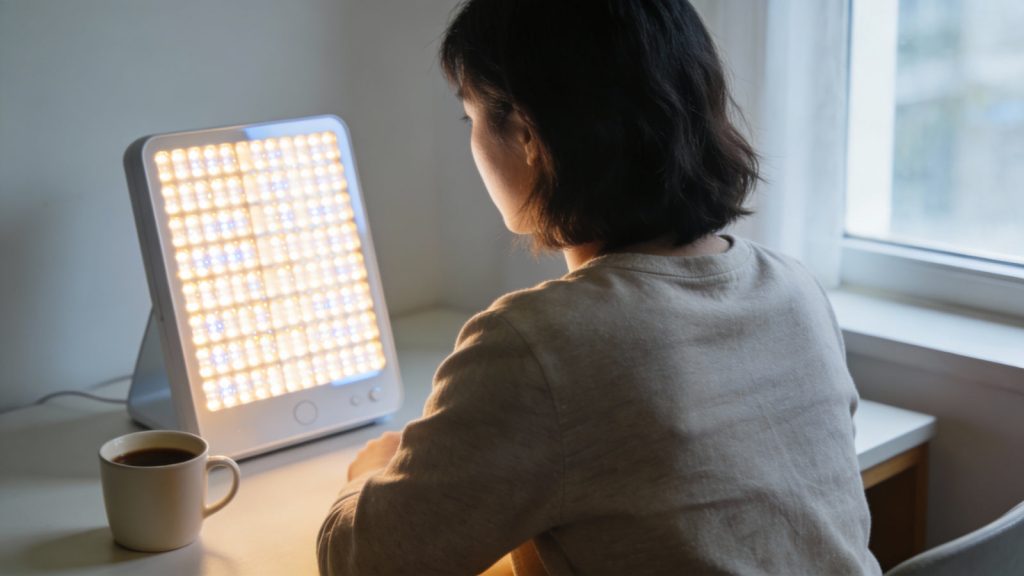
Device placement also affects the dose. A large panel placed 12-18 inches from the body will deliver a more uniform, lower irradiance than a small handheld pressed against the skin. For sleep support, a full-body panel at a distance is often more comfortable than a targeted device, but it requires more space and a higher upfront cost.
Evaluating Device Quality for Sleep Applications
Not all red light panels are built to the same standard. The three most important hardware factors are LED binning, driver stability, and thermal design. LED binning refers to the manufacturer sorting chips by wavelength tolerance; a tight bin of ±5 nm around 660 nm is far better than a loose bin of ±20 nm. Constant-current drivers prevent flicker and maintain stable irradiance over a 20-minute session, while poor drivers can cause output drift of 10-20% as the panel warms up.
Thermal management matters because LED efficiency drops as junction temperature rises. A panel with passive cooling only may lose 15% of its output after 15 minutes, while an actively cooled panel holds steady. Buyers should ask for a temperature-output curve or at least a maximum case temperature rating under continuous use.
- Request a spectral graph with peak wavelength and full width at half maximum (FWHM) for each LED type.
- Confirm the driver is constant-current, not constant-voltage, and ask for flicker percentage at 100 Hz.
- Check the panel’s irradiance at 6, 12, and 18 inches, not just at the surface.
- Ask about LED binning tolerance and the supplier’s incoming QC procedure for wavelength verification.
Sourcing Red Light Therapy Devices: OEM, MOQ, and Lead Times
For importers and distributors, the sourcing decision hinges on factory certifications, minimum order quantities, and after-sales support. A reputable supplier will hold ISO 9001 for quality management and ISO 13485 for medical device quality systems, plus CE and RoHS for the European market. These are factory certifications, not product approvals, but they indicate a controlled production process.
Typical MOQs for private-label panels range from 50 to 200 units, with lead times of 30-60 days after artwork approval. Custom wavelength ratios or housing designs may push the MOQ to 500 units or more. Price per unit for a mid-size 300-LED panel with dual wavelength and CE certification usually falls between $80 and $200 EXW, depending on irradiance and cooling design.
Does Red Light Help You Sleep? A Buyer’s Decision Framework
Does red light help you sleep? The honest answer is that the device can support a sleep routine, but it is not a standalone solution. The most defensible position for a seller or clinician is to recommend red-only, low-irradiance evening sessions as part of a broader wind-down protocol, while being transparent about the limited clinical evidence.
When choosing hardware, prioritize spectral accuracy over raw power. A 660 nm panel with a tight bin and stable driver at 20 mW/cm2 will likely serve sleep users better than a 100 mW/cm2 mixed panel with loose wavelength control. Verify the supplier’s test reports, ask for a sample unit, and measure the actual output with a calibrated spectrometer or irradiance meter before placing a bulk order.
Frequently Asked Questions
Can I use a red light therapy panel right before bed?
It is generally better to finish your session at least one hour before bedtime. Some users feel more alert immediately after exposure, especially with near-infrared or high irradiance, so allow a buffer period.
What irradiance is best for sleep support?
Most sleep-focused protocols use 10-30 mW/cm2 for 10-20 minutes. Higher irradiance does not improve sleep and may cause overstimulation or heat discomfort.
Should I choose red-only or red plus near-infrared for sleep?
Red-only panels are often preferred for evening use because near-infrared is invisible but warming, and some users find it more alerting. If you want a general-purpose panel, a 4:1 red-to-NIR ratio is a reasonable compromise.
How do I verify a supplier’s wavelength claim?
Ask for a spectral power distribution graph from a calibrated spectrometer, not just a datasheet. Check the peak wavelength, FWHM, and whether the test was done on the actual panel or a single LED chip.
Conclusion: Sourcing for Sleep Without Overpromising
The market for sleep-support red light devices is growing, but it is filled with inflated irradiance numbers and vague wavelength claims. A disciplined buyer will focus on spectral accuracy, driver stability, and honest dosing guidance rather than marketing adjectives. Request third-party test reports, compare panels at equal distances, and choose a supplier with ISO 9001 and ISO 13485 factory certifications.
If you are sourcing for a clinic or distribution channel, start with a sample order of 5-10 units and run your own irradiance and temperature tests. Document the results, set realistic customer expectations, and build your sleep protocol around timing and consistency rather than a promise of instant results. The devices that sell well in this category are the ones that are built well and explained honestly.
Post time: 11-23-26