


Is red light therapy bad for your eyes? The short answer is that red and near-infrared LED panels are generally low-risk for the eyes when used correctly, but that answer hides real engineering and sourcing decisions. This article explains the optical safety standards, the failure modes that create glare or thermal discomfort, and the exact questions an importer, distributor, or clinic owner should ask a manufacturer before placing an order.
What the Optical Safety Standard Actually Says
Any serious red light therapy device should be tested against IEC 62471, the international standard for photobiological safety of lamps and lamp systems. The standard classifies devices into four risk groups: Exempt, RG1, RG2, and RG3. For a typical 630-660 nm red and 810-850 nm near-infrared panel operating at 20-50 mW/cm2 at the treatment plane, the expected classification is Exempt or RG1 for ocular exposure at normal viewing distances.
The key measurement is not total power but radiance, expressed in W/m2/sr, which accounts for the apparent size of the light source. A large diffuse panel spreads light over a wide area, reducing radiance and therefore reducing retinal hazard. A small high-power LED chip or a focused lens can push the same total power into a much higher radiance class.
Ask the supplier for the IEC 62471 test report, not just a CE declaration. The report should state the risk group and the measurement distance. A panel tested at 200 cm may look safe, but the same panel at 20 cm could be RG2, requiring a warning label and a recommendation to avoid staring directly into the LEDs.
Where Eye Discomfort Actually Comes From
Most complaints about red light therapy and the eyes are not retinal burns or thermal injury. They are glare, afterimages, and dry-eye sensation from staring at a bright panel for 10-20 minutes. A 100 mW/cm2 panel at 660 nm is visually bright, even though the eye does not perceive near-infrared wavelengths at all.
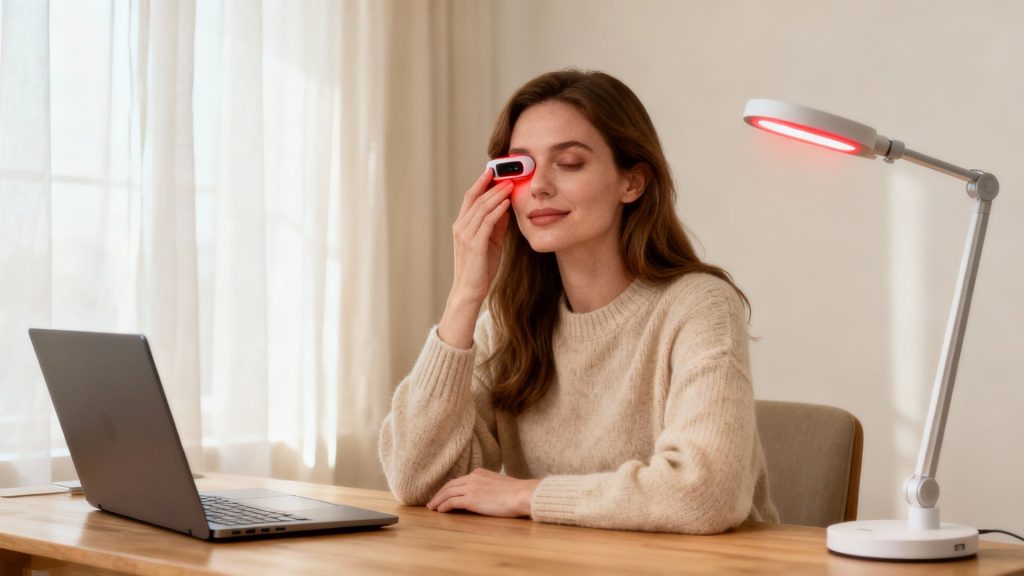
Near-infrared light at 810-850 nm is invisible, so the blink reflex and pupil constriction do not protect the eye the way they do with visible red light. This is why the standard treats near-infrared differently: the retina can absorb energy without the user feeling discomfort. A poorly designed panel with high near-infrared irradiance and no diffuser can exceed the RG1 limit for the 810-850 nm band even when the visible red light looks mild.
Failure modes to watch for in production include missing diffuser plates, LED chips with wide wavelength tolerance that spill into the 900+ nm range, and drivers that overdrive the near-infrared channel. Each of these can change the risk group after the initial sample was tested.
Is Red Light Therapy Bad for Your Eyes? The Practical Answer
For a compliant panel used at the recommended distance with eyes closed or with supplied goggles, red light therapy is not considered harmful to the eyes. The risk appears when users open their eyes and stare directly at the LEDs from close range, or when a device is modified or sourced without proper optical testing.

The decision rule for a buyer is simple: if the supplier cannot produce an IEC 62471 report showing Exempt or RG1 at the intended treatment distance, do not import the device. If the report shows RG2, the device may still be acceptable for professional use, but it must carry the RG2 warning label and the user manual must specify a minimum viewing distance and recommend protective eyewear.
Cheap consumer panels often skip the optical safety test entirely. They may use the same LED chips as a tested panel, but a different lens, diffuser, or housing changes the radiance profile. A sample that passes in one configuration does not guarantee the mass production batch passes.
Comparing Device Classes for Eye Safety
Different form factors create different ocular exposure profiles. The table below compares the main device classes an importer or clinic owner will evaluate.

| Device class | Typical irradiance at treatment plane | Eye safety consequence | Buyer action |
|---|---|---|---|
| Handheld spot device | 50-150 mW/cm2 over small area | High radiance, easy to exceed RG1 if focused | Require IEC 62471 report at 10 cm distance |
| Large LED panel (60×30 cm or larger) | 20-50 mW/cm2 | Low radiance, usually Exempt or RG1 | Confirm diffuser plate is included in every unit |
| Full-body bed or pod | 10-30 mW/cm2 at skin surface | Long exposure time, but large source area reduces radiance | Check near-infrared channel separately, not just total irradiance |
| Wearable mask or eye-area device | 5-20 mW/cm2 very close to eyes | Highest ocular risk due to proximity | Demand Exempt classification and built-in eye shields |
The consequence of ignoring this table is not just a regulatory problem. A distributor who imports 500 RG2 panels without warning labels may face returns, negative reviews, or liability claims from users who experienced afterimages or eye strain.
Specifying Protective Eyewear and Diffusers
Most professional red light therapy panels ship with simple black goggles or eye shields. These are not medical devices; they are opaque barriers that block visible red and near-infrared light. The key specification is optical density, usually expressed as OD4 or OD5 at the relevant wavelengths. OD4 blocks 99.99% of incident light; OD5 blocks 99.999%.
For a panel operating at 50 mW/cm2, OD4 goggles reduce transmitted irradiance to 0.005 mW/cm2, far below any concern. The failure mode is not the goggle material but the fit. Goggles with gaps around the nose or temples let light leak in at an angle, which can be more uncomfortable than no goggles at all because the pupil dilates behind the dark lens.
Diffuser plates are equally important. A polycarbonate or PMMA diffuser with a haze value of 80-95% spreads each LED point source into a uniform glowing surface. This reduces peak radiance by a factor of 10 or more and usually brings a panel from RG2 down to RG1 or Exempt. Ask the supplier whether the diffuser is optical-grade or just a frosted plastic sheet; the difference shows up in the IEC 62471 report.
Supplier Questions That Prevent Ocular Liability
When you evaluate a red light therapy manufacturer, the following checklist separates serious suppliers from trading companies that rebrand generic panels.
- Request the IEC 62471 test report for the exact model and configuration you will import, including the measurement distance and risk group for both the 630-660 nm and 810-850 nm bands.
- Ask for the LED chip binning data. A wavelength tolerance of ±5 nm is acceptable; ±20 nm means the near-infrared channel may drift into a higher-risk band.
- Confirm the diffuser plate material and haze value. Optical-grade polycarbonate with haze ≥90% is the minimum for a low-radiance panel.
- Check the driver current stability. A constant-current driver with ±2% tolerance prevents near-infrared overdrive that can change the risk group.
- Ask whether protective eyewear is included in every carton and whether the user manual states a minimum viewing distance in centimeters, not just ‘use as directed’.
Typical OEM/ODM minimum order quantities for tested panels range from 50 to 200 units, with lead times of 30-60 days. Adding a custom diffuser or branded goggles may add 2-3 weeks and $1-3 per unit, a small cost compared to the liability of an untested device.
A rule of thumb: if a supplier cannot show you an IEC 62471 report within 48 hours of your request, assume the device has not been tested and negotiate accordingly.
Maintenance and Long-Term Eye Safety
Eye safety is not a one-time certification. LED output degrades over time, but the degradation is not uniform across wavelengths. Near-infrared chips often degrade slower than red chips, shifting the spectral balance and potentially increasing the relative near-infrared radiance after 5,000-10,000 hours of use.
Diffuser plates yellow with age, especially under continuous near-infrared exposure. A yellowed diffuser absorbs more blue and red light while transmitting more near-infrared, which changes the radiance profile and may push a panel from RG1 to RG2 over time. Schedule diffuser replacement every 3-5 years for professional devices in daily use.
For clinic owners, the practical maintenance rule is to re-test a sample unit every 12 months or after 2,000 hours of operation, whichever comes first. A handheld spectrometer with a cosine corrector can verify total irradiance, but only a full IEC 62471 test can confirm the risk group.
FAQ: Eye Safety for Red Light Therapy Buyers
Do I need to wear goggles during red light therapy?
For a panel classified as Exempt or RG1 at the intended distance, goggles are optional but recommended for comfort. For RG2 panels, the manufacturer must supply goggles and the user manual must state a minimum viewing distance.
Can near-infrared light damage the eyes even if I feel no heat?
Yes. Near-infrared light at 810-850 nm is invisible and does not trigger the blink reflex, so the eye can absorb energy without any sensation. This is why the IEC 62471 standard evaluates near-infrared separately and why radiance, not just irradiance, matters.
What is the difference between RG1 and RG2 for eye safety?
RG1 is safe under normal behavioral limitations, including brief accidental viewing. RG2 is safe because the aversion response to bright light or thermal discomfort limits exposure, but staring directly at the source should be avoided. RG2 devices require a warning label.
How can I verify a supplier’s eye safety claims?
Request the full IEC 62471 test report from an accredited laboratory, not a self-declaration. Check the report date, the model number, the measurement distance, and the risk group for both the 630-660 nm and 810-850 nm bands.
Conclusion: Eye Safety Is a Sourcing Decision
Is red light therapy bad for your eyes? For a properly designed, tested, and diffused panel, the answer is no. The risk is not the therapy itself but the untested device, the missing diffuser, the overdriven near-infrared channel, or the user who stares into the LEDs from 10 cm away.
Your job as an importer, distributor, or clinic owner is to make eye safety a specification, not an assumption. Require the IEC 62471 report, check the risk group at the actual treatment distance, and verify that every production unit includes the same diffuser and driver as the tested sample.
If your current supplier cannot answer these questions, it may be time to evaluate a manufacturer that treats optical safety as a core engineering requirement rather than a marketing afterthought.
Post time: 11-23-26