


NIR light therapy in the 810-850 nm band is one of the most requested specifications in professional photobiomodulation equipment, yet buyers often compare panels on wattage alone. This article answers the concrete question: which engineering and sourcing details actually determine whether a NIR panel performs consistently, passes factory inspections, and holds its value in a clinic or distribution channel. We focus on device selection, measurement, and supplier qualification rather than biological outcomes.
Why 810-850 nm NIR Dominates Professional Panel Specs
Near-infrared wavelengths between 810 nm and 850 nm sit in a window where water absorption is low relative to shorter red bands, so more photons reach deeper tissue layers. Panel manufacturers therefore list NIR irradiance separately from 630-660 nm red irradiance, because the two bands have different penetration profiles and different LED binning costs. A panel that claims 100 mW/cm2 total irradiance may deliver only 30 mW/cm2 in the NIR band, which changes the session time required to reach a target dose of 10-20 J/cm2.
From a sourcing perspective, 810 nm and 850 nm LEDs are not interchangeable. 850 nm chips are typically cheaper and more available, while 810 nm chips often have tighter wavelength bins and a higher unit price. A dual-chip panel using both wavelengths is common, but the ratio matters: a 50/50 split at 810 nm and 850 nm behaves differently from an 80/20 split, and the spec sheet should state the ratio explicitly.
Reading a NIR Panel Spec Sheet: The Five Lines That Matter
Most supplier brochures lead with LED count and total power. Those numbers tell you almost nothing about clinical consistency. Instead, check these five lines in order:

- Wavelength tolerance: Look for ±5 nm or tighter on the NIR peak. A ±10 nm bin can shift a nominal 850 nm LED to 840 nm or 860 nm, altering the optical penetration and making batch-to-batch consistency poor.
- Irradiance at a stated distance: A serious supplier lists mW/cm2 measured at 6 inches or 15 cm, not at the LED surface. Surface irradiance numbers are routinely 3-5 times higher than the value at working distance.
- Beam angle: 30-degree and 60-degree lenses produce very different coverage. A 60-degree panel may need 30% more power to match the central irradiance of a 30-degree panel, but it covers a larger treatment area.
- Driver type and ripple: Constant-current drivers with less than 5% current ripple extend LED life and keep irradiance stable. Cheap constant-voltage drivers cause thermal runaway and early lumen depreciation.
- Cooling method: Passive aluminum heatsinks are silent but limit power density. Active fan cooling allows higher irradiance but introduces a failure point and noise; check the fan’s rated lifetime in hours.
If any of these lines is missing, ask the supplier for the raw LED bin report and the irradiance test certificate before quoting.
NIR Light Therapy Panel Classes Compared
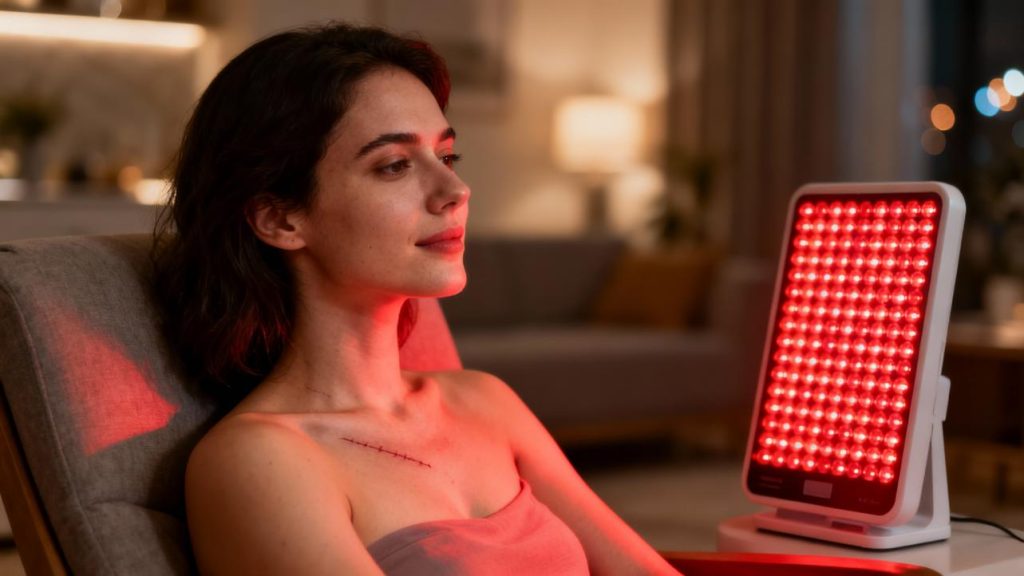
Panels fall into roughly three classes based on size, power density, and intended use. The table below shows the trade-offs a buyer faces when choosing among them for a clinic, gym, or distribution channel.
| Panel class | Typical NIR irradiance at 15 cm | Best fit | Consequence of wrong choice |
|---|---|---|---|
| Small handheld / mini panel (100-300 LEDs) | 20-40 mW/cm2 | Targeted use, travel, entry-level retail | Long session times for large areas; users may abandon the device |
| Mid-size panel (300-900 LEDs) | 40-80 mW/cm2 | Single-user clinic rooms, home prosumers | May require multiple units for full-body coverage, raising total cost |
| Full-body panel or bed (900+ LEDs) | 60-120 mW/cm2 | Wellness centers, gyms, high-throughput clinics | High power draw and heat load; needs dedicated circuit and ventilation |
A common failure mode is buying a mid-size panel for full-body use and then discovering that the irradiance drops below 20 mW/cm2 at the edges. Always request an irradiance map, not a single center-point number.
Factory Certifications and What They Actually Cover
When a supplier says a NIR panel is certified, ask which certificate applies to the finished device and which applies only to the factory process. CE marking under the Low Voltage Directive and EMC Directive is a self-declaration for electrical safety and electromagnetic compatibility; it is not a performance certificate. RoHS restricts hazardous substances in components. ISO 9001 covers quality management, while ISO 13485 extends that to medical device quality systems, but neither certifies a specific wavelength or dose.
Rule of thumb: if a supplier cannot show a third-party irradiance test report with the panel’s serial number and measurement distance, treat the wavelength and power claims as unverified.
For OEM and ODM buyers, the more useful documents are the LED binning report from the chip maker, the driver’s MTBF rating, and the factory’s incoming quality control procedure for LEDs. These tell you whether the 810 nm or 850 nm peak will stay within tolerance across production batches.
OEM and ODM Sourcing: MOQ, Lead Time, and Hidden Costs
NIR light therapy panels are typically sourced through three routes: white-label stock, semi-custom OEM, and full ODM. White-label stock has the lowest MOQ, often 10-50 units, and lead times of 2-4 weeks, but you cannot change the wavelength ratio or housing. Semi-custom OEM usually starts at 100-300 units with 6-10 week lead times and allows logo, color, and firmware changes. Full ODM starts at 500-1000 units, takes 3-6 months, and covers new mechanical design, custom PCB layout, and certification support.
Hidden costs concentrate in three areas. First, shipping: a full-body panel can weigh 15-25 kg, and air freight may exceed the unit cost for small orders. Second, certification: if you need a specific country’s electrical safety mark, budget $2,000-$10,000 and 4-8 weeks for testing. Third, after-sales: LED panels have a realistic service life of 20,000-50,000 hours, but fans and drivers often fail first, so negotiate a warranty that covers those parts separately.
Maintenance and Failure Modes Buyers Overlook
Most NIR panel failures come from heat, not from LED burnout. In a fan-cooled panel, dust accumulation on the heatsink fins raises the LED junction temperature, which accelerates lumen depreciation and can shift the peak wavelength by several nanometers. A panel that starts at 850 nm may drift to 855 nm or 860 nm after 5,000 hours if the cooling path is not maintained.
Check whether the supplier publishes a lumen maintenance curve, such as L70 at 25,000 hours. Also ask how the driver handles a single LED failure: a constant-current driver with series strings may shut down an entire string if one LED opens, while a design with parallel protection keeps the rest of the panel running. For clinics, a panel that fails one string silently is worse than one that fails visibly, because the operator may not notice the irradiance drop.
FAQ: NIR Light Therapy Panel Buying
What is the difference between 810 nm and 850 nm in a NIR panel?
810 nm sits closer to the absorption peak of cytochrome c oxidase, while 850 nm has slightly deeper tissue penetration and is often cheaper to source. A panel with both wavelengths gives broader coverage, but the ratio must be stated and verified, not guessed.
How much irradiance do I actually need for professional use?
For most professional applications, 30-80 mW/cm2 at the working distance is a practical range. Below 20 mW/cm2, session times become impractical for busy clinics; above 100 mW/cm2, heat management and eye safety become the dominant design constraints.
What MOQ should I expect for a custom NIR panel?
White-label stock starts around 10-50 units. Semi-custom OEM typically requires 100-300 units. Full ODM with new tooling usually starts at 500-1000 units, with tooling costs amortized into the unit price.
How do I verify a supplier’s wavelength claim?
Request the LED binning report from the chip manufacturer and a third-party spectrometer test of a production sample. The peak wavelength should be within ±5 nm of the claimed value, and the test should state the measurement distance and ambient temperature.
What to Do Next
Before you request a quote, write down your three non-negotiable specs: NIR wavelength tolerance, irradiance at your working distance, and the factory certification you actually need for your market. Then ask every supplier the same five questions: bin report, irradiance map, driver ripple, fan lifetime, and warranty terms for fans and drivers separately.
NIR light therapy panels are a long-term capital purchase, not a commodity. The difference between a panel that holds its spec for 20,000 hours and one that drifts after 3,000 hours is almost never visible in a brochure photo, but it shows up in the test report and the after-sales terms. Use those documents as your primary filter.
Post time: 11-24-26