


Red light therapy eye protection is a sourcing decision, not an accessory afterthought. This article answers one concrete question: what specifications, standards, and supplier checks separate a legitimate pair of protective goggles from a cosmetic accessory when you are buying panels, beds, or handheld devices in volume?
Why Eye Protection Is a Hardware Requirement, Not a Marketing Add-On
LED-based red light therapy devices emit concentrated optical radiation, typically in the 630–660 nm red and 810–850 nm near-infrared bands. Even at the common treatment irradiance of 20–50 mW/cm², direct ocular exposure can exceed comfortable viewing limits within seconds. The eye’s natural aversion response—blinking and looking away—protects against brief visible glare, but near-infrared wavelengths trigger almost no aversion reflex, so a user can stare into an 850 nm array without realizing the exposure is happening.
For importers and clinic owners, this creates a liability and a specification problem. A panel that passes electrical safety can still be photobiologically unsafe if the manufacturer ships it with no eye protection or with unbranded goggles that lack a documented optical density curve. The practical rule is simple: if the supplier cannot provide a spectral transmission report for the goggles, treat the goggles as unverified.
Never accept eye protection that is described only as “blocks harmful light.” Ask for the wavelength range blocked, the optical density at 630–850 nm, and the test standard used.
Reading the Spec Sheet: Optical Density, Wavelength Range, and Fit
Optical density (OD) is the logarithmic measure of attenuation. An OD of 3 transmits 0.1% of incident light; an OD of 4 transmits 0.01%. For red light therapy panels operating at up to 50 mW/cm², an OD of 3 or higher across 600–900 nm is a defensible minimum for direct viewing, while an OD of 4 or higher is preferred for high-power beds or close-range handhelds.
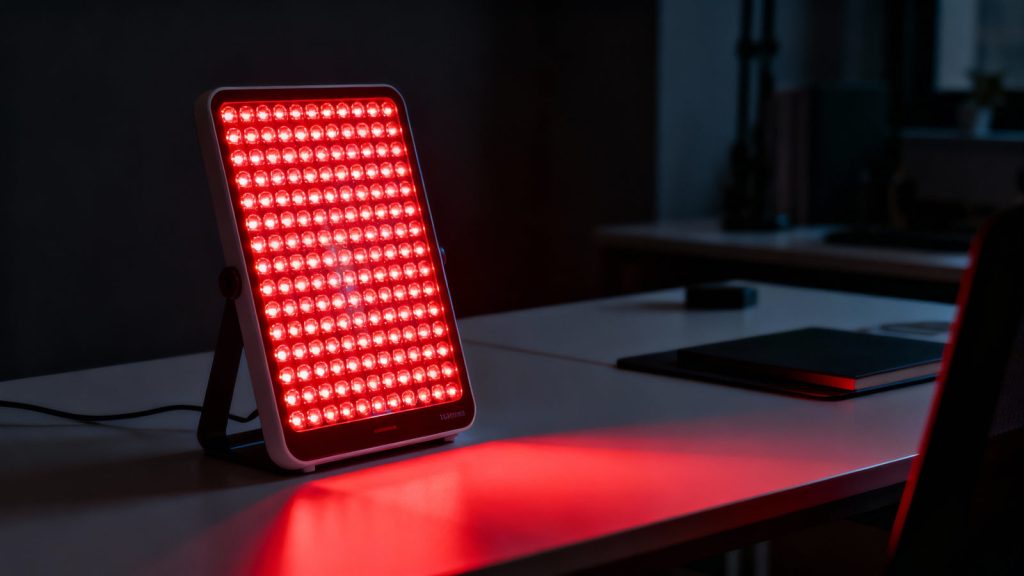
The wavelength range matters as much as the peak OD. A goggle that blocks 650 nm but transmits 850 nm is useless for a dual-wavelength panel. Look for a transmission curve, not a single number, and confirm that the blocking range covers the full emission band of the device, including any LED binning tolerance. Fit is the third variable: rigid side shields or a wraparound frame prevent oblique light from entering around the lens, which is a common failure mode in clinic settings where users recline under overhead panels.
| Eye protection type | Typical OD at 630–850 nm | Best use case | Consequence of wrong choice |
|---|---|---|---|
| Clear polycarbonate filter with selective coating | 1–2 | Low-irradiance handhelds under 10 mW/cm² | Insufficient attenuation for panels; user squints or closes eyes, reducing treatment consistency |
| Amber or orange molded goggles | 2–3 | Mid-power panels, 10–30 mW/cm² | May transmit near-infrared; verify 850 nm blocking before buying |
| Dark green or black wraparound goggles | 3–4 | High-power panels and beds, 30–50 mW/cm² | Overkill for low-power devices; may reduce visible red light so much that users remove goggles mid-session |
| Full-face shield with OD 4+ | 4+ | Whole-body beds, OEM bundles | Higher unit cost and storage burden; justified only where users cannot control gaze direction |
IEC 62471 and Factory Certifications: What Actually Applies
IEC 62471 is the international standard for photobiological safety of lamps and lamp systems, including LED arrays. It classifies sources into Risk Groups 0, 1, 2, and 3 based on exposure limits for skin and eyes. A red light therapy panel that is Risk Group 2 or lower can be used with simple warning labels and normal aversion responses, while Risk Group 3 requires engineered controls such as interlocks, distance guards, or mandatory eye protection.

Factory certifications such as CE, RoHS, ISO 9001, and ISO 13485 are process and materials certificates, not product safety approvals. A CE mark on a panel means the manufacturer declares conformity with applicable EU directives, which may include the Low Voltage Directive and EMC Directive, but photobiological safety is often assessed separately under IEC 62471. When sourcing, request the actual IEC 62471 test report for the exact model and LED configuration, not a generic certificate for the factory.
- Ask for the spectral transmission curve of the goggles, measured by an accredited lab, not a supplier-generated PDF.
- Confirm the OD at 630 nm, 660 nm, 810 nm, and 850 nm separately; a single average OD can hide a near-infrared leak.
- Check whether the goggle frame is CE-marked as personal protective equipment under the relevant EU regulation, not just as a general accessory.
- Request a sample pair and test it against your own panel with a simple irradiance meter placed behind the lens.
Panel vs. Bed vs. Handheld: Different Exposure Geometries, Different Protection
A handheld device used at 10 cm from the face creates a small, intense beam that is easy to avoid by closing the eyes or turning the head. A full-body bed or a 300-LED panel mounted 15 cm above a reclining user creates a large, diffuse field where gaze direction is hard to control. The protection strategy must match the geometry.
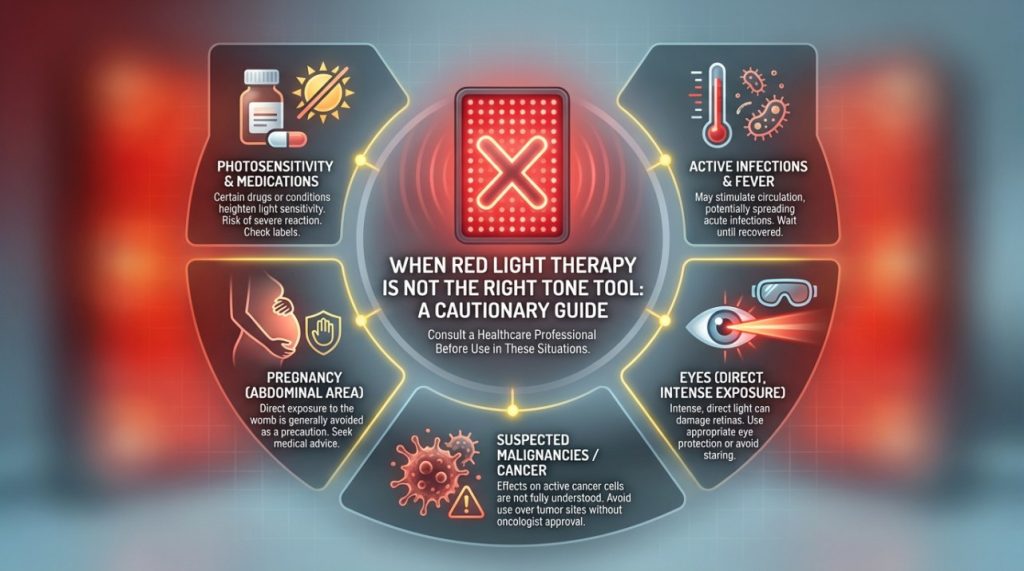
For panels, the main risk is a user opening their eyes mid-session out of curiosity or discomfort. Wraparound goggles with side shields are the minimum. For beds, a full-face shield or a rigid goggle with a strap is more practical because users may move or fall asleep. For handhelds, a simple pair of amber goggles is often sufficient, but the supplier should still provide an OD curve because handhelds can deliver surprisingly high irradiance at close range—some models exceed 100 mW/cm² at the aperture.
Sourcing Eye Protection for OEM and ODM Projects
If you are importing finished devices, eye protection is usually bundled as an accessory. The failure mode here is substitution: a supplier quotes a branded goggle with an OD 4 filter, then ships an unbranded lookalike with no test data. To prevent this, write the goggle specification into the purchase order: wavelength blocking range, minimum OD at three reference wavelengths, frame material, and required test report.
For OEM and ODM buyers, eye protection can be customized with logo, color, and case, but the optical filter itself should not be customized unless you are willing to pay for new photobiological testing. Typical MOQs for custom-printed goggles are 500–2,000 units, with lead times of 30–60 days after artwork approval. Stock goggles with existing test reports can often ship in 1–2 weeks. Price tiers vary widely: basic amber goggles cost $0.50–$2.00 per unit at 1,000 units, while OD 4 wraparound goggles with side shields and a hard case run $3.00–$8.00 per unit.
Red Light Therapy Eye Protection: Common Failure Modes and How to Avoid Them
The most common failure is not the goggle itself but the user. In a clinic, clients remove goggles because they want to see the red light or because the goggles are uncomfortable. This is a training and design problem, not a photobiology problem. Choose goggles with soft nose bridges and adjustable straps, and provide a written protocol that states when eye protection is mandatory.
The second failure is spectral mismatch. A supplier may test goggles against a 660 nm laser and report OD 4, but the same goggles transmit 40% at 850 nm. Always request a broadband transmission curve from 400 nm to 1,100 nm, not a single-wavelength certificate.
The third failure is regulatory overreach. Some suppliers claim their goggles are “certified safe” without specifying the standard. Eye protection for LED panels is not a single harmonized category; it may fall under personal protective equipment rules, general product safety rules, or nothing at all depending on the market. Ask for the exact standard and test lab, and if the answer is vague, treat the claim as unverified.
FAQ: Eye Protection Decisions in Practice
What optical density do I need for a 50 mW/cm² panel?
An OD of 3 reduces 50 mW/cm² to 0.05 mW/cm² at the eye, which is below the typical exposure limit for continuous viewing of near-infrared sources. For a safety margin with direct, close-range viewing, specify OD 4.
Can I use regular sunglasses instead of dedicated goggles?
No. Sunglasses are designed for visible light and may transmit 50% or more in the near-infrared band. They also lack side shields, so oblique light enters around the lens. Use only goggles with a documented transmission curve covering 630–850 nm.
How do I verify a supplier’s eye protection claims without a lab?
Request the spectral transmission report from an accredited test lab, then order a sample pair and measure the irradiance behind the lens with a handheld meter. If the measured attenuation is less than 90% of the claimed OD, reject the batch.
Do all red light therapy devices require eye protection?
Not all, but the decision should be based on the device’s Risk Group under IEC 62471 and the exposure geometry. A low-irradiance handheld used briefly with eyes closed may not require goggles, while a high-power panel or bed almost always does. Confirm with a clinician and the device’s photobiological safety report.
What to Do Next: Build Eye Protection into Your Sourcing Checklist
Before you place the next order, add three lines to your supplier questionnaire. First, request the IEC 62471 test report for the exact panel model and LED bin. Second, request the goggle spectral transmission curve from 400 nm to 1,100 nm, with OD values at 630, 660, 810, and 850 nm. Third, ask whether the goggles are tested as personal protective equipment and under which standard.
If the supplier cannot answer all three within a week, consider that a signal about their documentation discipline. Eye protection is a small line item, but it is the one accessory that turns a professional device into a defensible, safe installation. Treat it as a specification, not a freebie.
Post time: 11-24-26