


Red light therapy for back pain is a growing category for clinics and distributors, but device quality varies widely. This article answers the practical question: which specifications and supplier checks actually matter when sourcing panels and handheld units for back-focused applications? We cover wavelengths, irradiance, build quality, certifications, and the B2B terms you should negotiate.
Why Wavelength and Irradiance Matter More Than Brand Claims
For back pain, the most commonly used bands are 630-660 nm red and 810-850 nm near-infrared. These ranges penetrate skin and muscle tissue to different depths: red light reaches roughly 5-10 mm, while near-infrared can reach 20-50 mm depending on skin tone and tissue density. A device that combines both bands gives you flexibility for superficial versus deeper back muscles.
Irradiance, measured in mW/cm2, determines how much energy reaches the skin per second. For back panels, a useful working range is 30-50 mW/cm2 at the treatment surface. Below 20 mW/cm2, sessions become impractically long; above 100 mW/cm2, you risk thermal discomfort and must add cooling or distance management. Always ask for an irradiance map, not just a single center-point number, because LED arrays drop off at the edges.
Reading a Spec Sheet Like an Engineer
- Wavelength tolerance: Request ±5 nm binning data. A 660 nm LED that actually emits at 650 or 670 nm changes the penetration profile.
- Irradiance at distance: Ask for measurements at 6 inches (15 cm) and 12 inches (30 cm). Many sellers list irradiance at the LED surface, which is unusable.
- Beam angle: 30-degree lenses concentrate energy for deeper tissue; 60-degree lenses spread it for larger back areas. Choose based on treatment zone.
- Driver type: Constant-current drivers maintain stable output as LEDs heat up. Cheap constant-voltage drivers cause irradiance to sag after 10-15 minutes.
Rule of thumb: if a supplier cannot provide an irradiance map at a specified distance, treat the device as a cosmetic lamp, not a therapeutic panel.
Panel, Handheld, or Bed: Matching Form Factor to Back Treatment
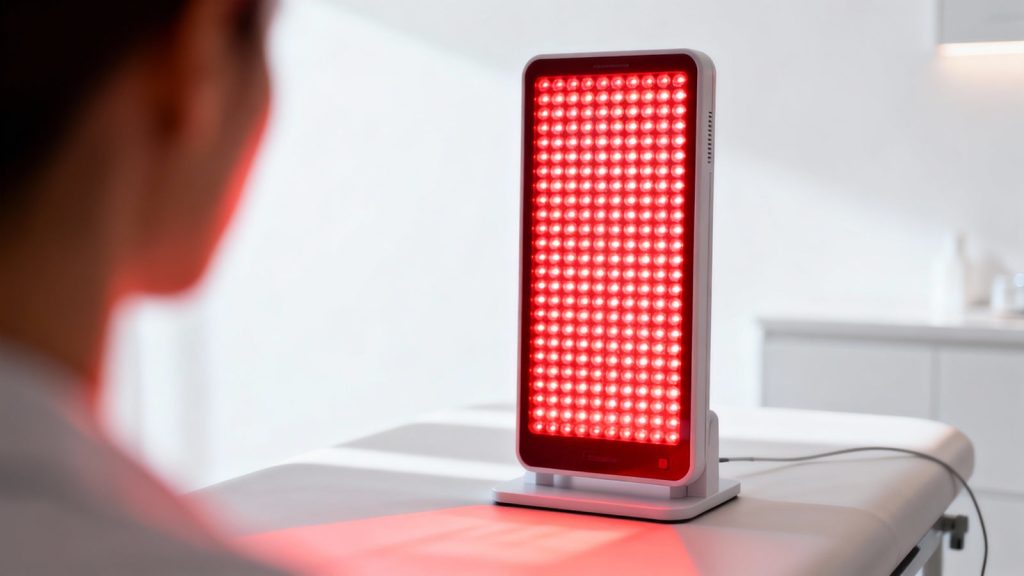
Back pain requires covering a large surface area, so flat panels are the most common choice. A 300-LED panel measuring roughly 30 x 60 cm can treat the lumbar or thoracic region in one session. Handheld units are portable but require multiple placements and longer total time for a full back.
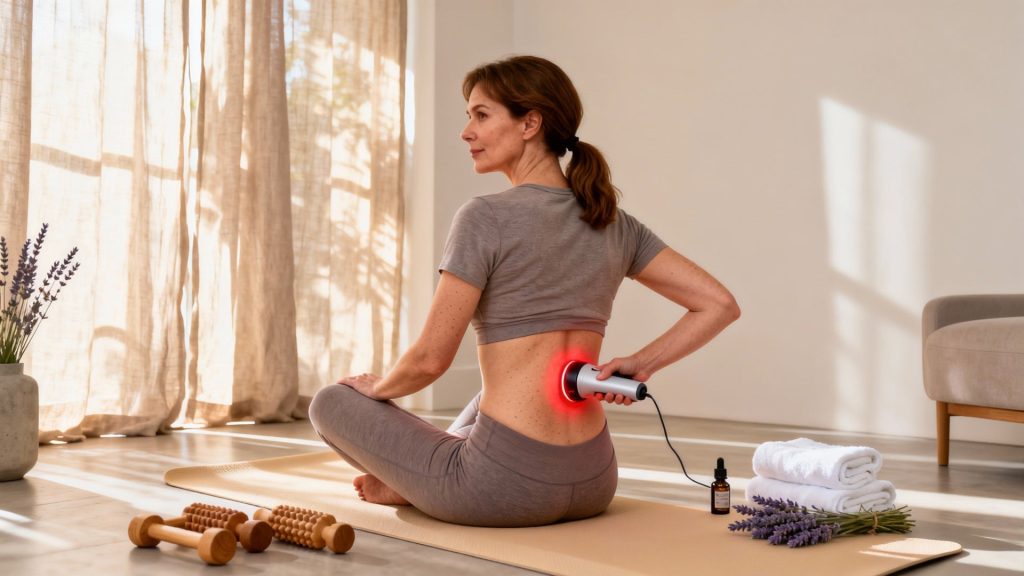
Full-body beds or half-body pods exist but carry higher cost and floor-space requirements. For a clinic, a panel on a rolling stand with adjustable height and tilt is usually the most practical. For home users, a tabletop panel or a flexible wrap-style device may be easier to store.
| Device Type | Typical Irradiance | Coverage | Best For | Key Consequence |
|---|---|---|---|---|
| Large panel (300+ LEDs) | 30-50 mW/cm2 at 15 cm | 30 x 60 cm or larger | Clinic back treatment | Highest upfront cost but fastest session time |
| Mid-size panel (100-200 LEDs) | 20-40 mW/cm2 at 15 cm | 20 x 30 cm | Home or small clinic | Needs two placements for full back |
| Handheld / torch | 50-100 mW/cm2 at 5 cm | 5-10 cm spot | Targeted trigger points | Long total session time for large areas |
| Flexible wrap / belt | 10-30 mW/cm2 at contact | Conforms to back curve | Home use, hands-free | Lower irradiance but better skin contact |
Thermal Design and Build Quality: The Failure Points Buyers Miss
LED panels generate heat, and heat kills LEDs and drivers. A well-built panel uses aluminum PCB substrates, finned heatsinks, and quiet fans. Without active cooling, a 300-LED panel at 50 mW/cm2 can exceed 50°C on the housing within 20 minutes, which shortens LED lifespan and creates a burn risk.
Check the fan noise specification: anything above 45 dB is distracting in a treatment room. Ask about the LED chip brand—Epistar, Seoul Semiconductor, and Osram are common mid-to-high tier suppliers. Generic unbranded chips often have wider wavelength tolerance and faster lumen depreciation.
For B2B buyers, request a teardown photo or video. Look for strain relief on cables, proper thermal paste between LED board and heatsink, and a grounded power supply. These details separate OEM-grade devices from consumer toys.
Factory Certifications and What They Actually Mean
When sourcing from Asia, you will see CE, RoHS, ISO 9001, and ISO 13485 listed. CE marking indicates conformity with European electrical safety and EMC directives, but it is a self-declaration for most LED panels—ask for the test report, not just the logo. RoHS certifies that hazardous substances like lead and cadmium are below limits.
ISO 9001 covers quality management systems, while ISO 13485 is specific to medical device manufacturing. Neither certifies the device itself; they certify the factory’s processes. A supplier with ISO 13485 is more likely to have traceability and change control, which matters if you plan to private-label the device for clinical use.
Do not accept a certificate without verifying the scope. Some factories hold ISO 9001 for a different product line. Ask for the certificate number and check it against the issuing body’s public database.
Sourcing Terms: MOQ, Lead Time, and Price Tiers
For OEM/ODM panels, typical minimum order quantities range from 50 to 500 units depending on customization. A stock design with your logo printed may have an MOQ of 50-100 units. Full ODM with custom housing, firmware, and packaging usually starts at 300-500 units.
Lead times for stock panels are 15-30 days after deposit. Custom ODM projects run 45-90 days including tooling and sample approval. Price per unit for a 300-LED dual-wavelength panel ranges from $80 to $250 FOB depending on LED brand, driver quality, and cooling design. Handheld units are $15 to $40 FOB at similar MOQs.
Always ask about after-sales terms: warranty period (12-24 months is standard), spare parts availability, and whether the factory provides a repair manual or video. A supplier that cannot supply replacement LED boards is not a long-term partner.
Frequently Asked Questions
What wavelength is best for back pain?
Most clinical and commercial devices use 660 nm red and 850 nm near-infrared. The combination covers both superficial and deeper tissue. If you must choose one, 850 nm penetrates deeper into back muscles, but 660 nm is better for skin-level issues.
How many LEDs should a back panel have?
For a full-back panel, 200-300 LEDs is a practical minimum. Fewer LEDs means either lower total irradiance or higher current per LED, which shortens lifespan. A 300-LED panel at 30 mW/cm2 can treat a 30 x 60 cm area in 10-15 minutes.
Can I import red light therapy devices without medical certification?
Yes, if you market them as general wellness or cosmetic devices and make no disease claims. However, many clinics prefer devices from factories with ISO 13485 because it indicates stronger quality controls. Check your target country’s import rules for electrical safety and EMC requirements.
What is a realistic lifespan for a red light therapy panel?
Quality LEDs are rated for 50,000 hours at 70% lumen maintenance, but the driver and fan usually fail first. Expect 3-5 years of daily clinic use before needing driver replacement. Ask the factory for the MTBF (mean time between failures) of the driver, not just the LED rating.
What to Do Next: A Sourcing Checklist
Before you order red light therapy for back pain devices, request these five items from any supplier: an irradiance map at 15 cm and 30 cm, a wavelength binning report, a teardown photo showing thermal design, a copy of the CE test report and ISO certificate with scope, and a sample unit for your own testing.
Test the sample for 30 minutes at full power and measure housing temperature with an infrared thermometer. If the surface exceeds 45°C, the cooling is inadequate. Compare the measured irradiance against the spec sheet using a solar power meter or a dedicated LED radiometer—a 10% deviation is acceptable, more is not.
Finally, negotiate warranty terms that cover the driver and fan, not just the LEDs. A 24-month warranty with replacement parts included is a sign of a confident factory. Start with a small trial order of 20-50 units before committing to a container.
Post time: 11-24-26