


Red light therapy for cold sores is a growing category for importers, distributors, and clinic owners, but device quality varies widely. This article answers the concrete question: what should a professional buyer check before stocking a red light therapy device intended for cold sore support? We cover wavelength bands, irradiance, form factors, factory certifications, and sourcing pitfalls, all without medical claims.
Why Device Specs Matter for Cold Sore Support
Cold sores are a common skin concern, and some users apply red light therapy with the aim of supporting skin comfort. The mechanism proposed is photobiomodulation: light in the 630-660 nm red and 810-850 nm near-infrared bands is absorbed by cytochrome c oxidase in mitochondria, which may support cellular energy production. For a device to deliver that light consistently, the LED chip binning, driver current, and housing design must be controlled.
A device that drifts outside the target wavelength band may still look bright but deliver less useful energy. For example, a 660 nm LED with a tolerance of ±10 nm could peak anywhere from 650 to 670 nm, and some of that output falls outside the commonly cited red window. Buyers should request a spectral power distribution report from the factory, not just a marketing wavelength number.
Rule of thumb: if a supplier cannot provide an irradiance map and a spectral graph for the exact model you are buying, treat the wavelength and power claims as unverified.
Wavelength Bands: 630-660 nm vs 810-850 nm
Red light therapy for cold sores typically uses two bands. The 630-660 nm red band penetrates roughly 1-3 mm into skin and is often chosen for surface-level support. The 810-850 nm near-infrared band penetrates deeper, up to about 5-10 mm, and may reach tissues below the skin surface. Some devices combine both bands, while others use only red.
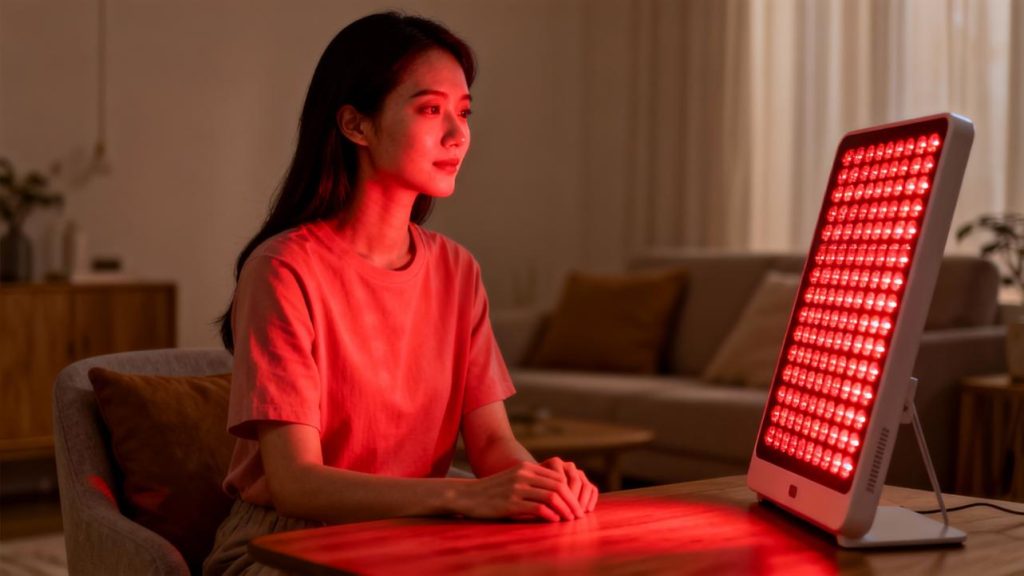
The choice affects cost and thermal design. Near-infrared LEDs generate more heat per optical watt than red LEDs, so a dual-band panel needs a larger heatsink or active cooling. A handheld device with both bands may run hotter and require a shorter duty cycle. Buyers should compare the irradiance at the treatment distance, not just the total LED count.
| Wavelength band | Typical penetration depth | Common device types | Buyer consequence |
|---|---|---|---|
| 630-660 nm red | 1-3 mm | Handheld wands, small panels, lip-specific devices | Lower heat, simpler driver, often lower cost; check for adequate irradiance at 2-5 cm distance |
| 810-850 nm near-infrared | 5-10 mm | Large panels, full-body beds, clinical systems | Higher heat, needs better cooling; verify fan noise and thermal shutdown threshold |
| Dual band (red + NIR) | Combined | Mid-size panels, professional esthetic devices | More flexible but more complex; confirm independent control of each band |
Irradiance and Dose: The Numbers That Matter
Irradiance is the power density delivered to the skin, measured in mW/cm2. For red light therapy devices, a useful range is roughly 20-50 mW/cm2 at the intended treatment distance. Below about 10 mW/cm2, session times become impractically long; above about 100 mW/cm2, the device may heat the skin and require shorter exposure, which complicates consistent use.
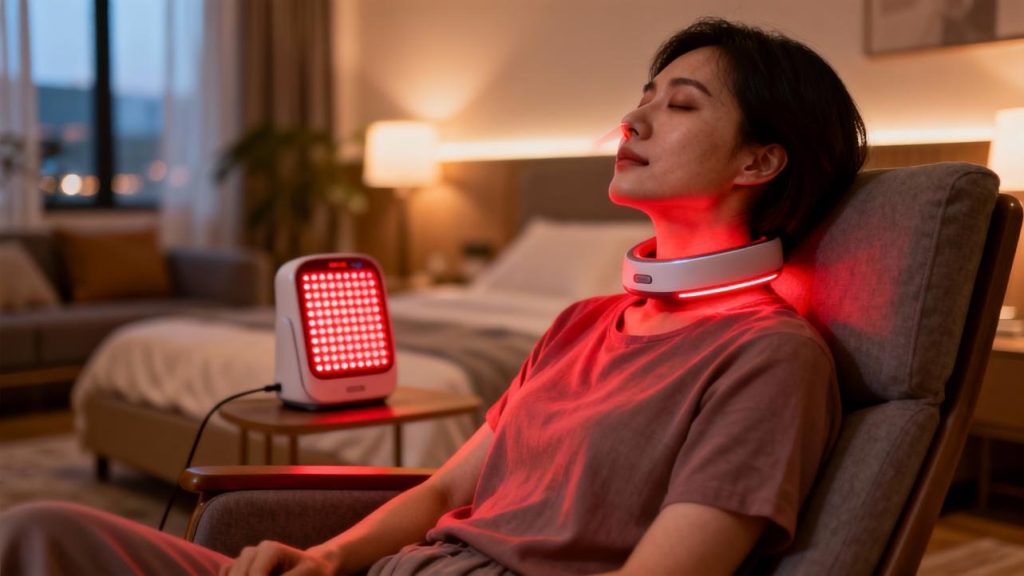
Dose is irradiance multiplied by time. A common session dose range is 3-20 J/cm2. For example, a device delivering 30 mW/cm2 would need about 3.3 minutes to reach 6 J/cm2. Buyers should ask for an irradiance map measured with a calibrated spectrometer or power meter at 5 cm, 10 cm, and 15 cm, because LED panels have hot spots and edge falloff.
Many factories quote irradiance at the LED surface, which is misleading. A panel rated at 100 mW/cm2 at the surface may deliver only 30 mW/cm2 at 15 cm. Always request the measurement distance and the instrument used.
Form Factors: Handheld, Panel, or Bed
The right form factor depends on the buyer’s market. A handheld wand is portable and inexpensive, typically 5-20 W total electrical power, but it covers a small area and may have low irradiance beyond 2 cm. A tabletop panel of 30-100 W can cover the face or a larger skin area, but it requires a stand or mounting and is less portable. A full-body bed or half-body panel is a clinic investment, often 500-1500 W, with significant thermal and electrical requirements.

For cold sore support specifically, a small handheld or lip-targeted device is common, but some users prefer a small panel for hands-free use. Buyers should consider the duty cycle: a handheld with passive cooling may need to rest after 10 minutes, while a fan-cooled panel can run continuously. The fan itself introduces noise and a failure point.
- Handheld wand: low cost, easy to ship, but check battery life and irradiance drop-off.
- Tabletop panel: hands-free, larger coverage, but needs a stable stand and may have fan noise.
- Full-body bed: high revenue per unit, but requires electrical installation and after-sales service.
- Flexible wrap or pad: conforms to skin, but LEDs may be lower density and harder to clean.
Factory Certifications and Quality Control
Professional buyers should verify factory certifications before placing an order. CE marking indicates conformity with European safety and electromagnetic compatibility requirements, but it is a self-declaration for many device classes, so ask for the test report. RoHS restricts hazardous substances in electronics. ISO 9001 covers quality management systems, and ISO 13485 is specific to medical device manufacturing, though it does not by itself authorize a medical claim.
Photobiological safety is another key point. The IEC 62471 standard classifies lamps and LED products by their risk of optical radiation. A device intended for skin exposure should be tested and fall into Exempt or Risk Group 1 at the intended distance. Ask the factory for the IEC 62471 test report and the exact measurement conditions.
Common failure modes include LED wavelength drift over time, driver current instability, and overheating that triggers premature shutdown. A factory with in-house integrating sphere testing and burn-in aging can provide more consistent units than one that only assembles purchased modules.
Sourcing and OEM/ODM Considerations
If you are importing or private labeling, the typical MOQ for a handheld red light therapy device is 500-1000 units, with a unit cost of $15-40 depending on LED count and housing. A tabletop panel of 60-150 LEDs may have an MOQ of 100-300 units and cost $50-150 per unit. Full-body beds are often made to order with MOQs of 10-50 units and prices from $800 to $3000 per unit. These are general market ranges, not quotations.
Lead times vary from 30 to 60 days for standard products, plus shipping. Custom housing or wavelength changes can add 30-90 days. Ask the supplier about after-sales support: warranty period, replacement LED modules, and whether they stock spare drivers. A supplier that only sells complete units and cannot provide spare parts will create service problems later.
For OEM/ODM, specify the exact wavelength tolerance (e.g., ±5 nm), the irradiance at a defined distance, the driver current stability (e.g., ±2% over input voltage range), and the thermal shutdown threshold. These numbers should be written into the purchase agreement and verified on a pre-production sample.
Red Light Therapy for Cold Sores: Buyer Checklist
Before placing an order, run through this checklist. Each item is a decision rule that separates reliable suppliers from marketing-only operations.
- Request a spectral power distribution graph for the exact LED bin used, not a generic datasheet.
- Request an irradiance map at 5 cm, 10 cm, and 15 cm, measured with a calibrated instrument.
- Confirm the driver is constant-current, not constant-voltage, with a stated current tolerance.
- Ask for the IEC 62471 test report and the risk group classification at the intended use distance.
- Verify factory certifications: CE test report, RoHS, ISO 9001, and ISO 13485 if applicable.
- Check the warranty terms and spare part availability for LED modules and drivers.
FAQ: Red Light Therapy Devices for Cold Sore Support
What wavelength is best for cold sore support?
The most commonly cited bands are 630-660 nm red and 810-850 nm near-infrared. Red light is often used for surface-level skin support, while near-infrared penetrates deeper. A dual-band device offers flexibility, but verify that each band can be controlled independently and that the spectral output matches the claimed wavelengths.
How much irradiance do I need?
A practical range is 20-50 mW/cm2 at the treatment distance. Below 10 mW/cm2, sessions become very long; above 100 mW/cm2, skin heating becomes a concern. Always ask for the measurement distance, because many factories quote irradiance at the LED surface, which is not the same as at the skin.
Is a handheld or a panel better for cold sores?
A handheld wand is convenient and inexpensive, but it covers a small area and may have low irradiance beyond 2 cm. A small tabletop panel allows hands-free use and more consistent distance, but it costs more and may need a stand. The choice depends on your target customer and price point.
What certifications should a factory have?
Look for CE with a test report, RoHS, ISO 9001, and ideally ISO 13485. Also request the IEC 62471 photobiological safety report. These are factory and system certifications, not product approvals for any medical purpose, and they help verify build quality and safety testing.
What to Do Next
Red light therapy for cold sores is a viable product category if you select devices with verifiable wavelength, irradiance, and safety data. Start by shortlisting three suppliers and requesting the same set of documents: spectral graph, irradiance map, IEC 62471 report, and factory certificates. Compare the numbers side by side, not the marketing language.
If you are sourcing for a clinic or distribution channel, order a pre-production sample and test it with a calibrated power meter at the distances your customers will use. The difference between a $20 handheld and a $60 handheld is often invisible in photos but obvious in a 10-minute irradiance test. Choose the supplier that can document its claims.
Post time: 11-24-26