


Red light therapy for eczema is an area of growing interest among device importers, distributors, and clinic owners. This article answers a practical question: which device specifications and sourcing decisions actually matter when evaluating panels for eczema support? We focus on verifiable hardware parameters—wavelength, irradiance, dose, certification, and supplier capability—rather than clinical outcomes.
How Red Light Therapy for Eczema Is Positioned in the Market
Eczema is a chronic inflammatory skin condition, and some users report that red light therapy may support skin comfort and appearance. The mechanism proposed is photobiomodulation: photons in the 630-660 nm red and 810-850 nm near-infrared bands are absorbed by cytochrome c oxidase in mitochondria, which may modulate cellular energy production and oxidative stress. This is a mechanistic hypothesis, not a proven treatment claim, and anyone considering red light therapy for a medical condition should confirm with a clinician.
For B2B buyers, the commercial opportunity lies in supplying devices that deliver consistent, measurable light output. Clinics and informed consumers increasingly ask for spectral power distribution reports, irradiance maps, and third-party safety certificates. A distributor who can provide these documents has a structural advantage over sellers offering only vague marketing language.
Wavelength Selection: 630-660 nm vs 810-850 nm
Red light in the 630-660 nm range penetrates roughly 1-3 mm into skin, which is sufficient to reach the epidermis and upper dermis where eczema lesions typically occur. Near-infrared light at 810-850 nm penetrates deeper, often 5-10 mm, but for skin surface conditions the added depth is not always necessary. Many panel manufacturers offer dual-chip designs that combine both bands, giving the end user flexibility.
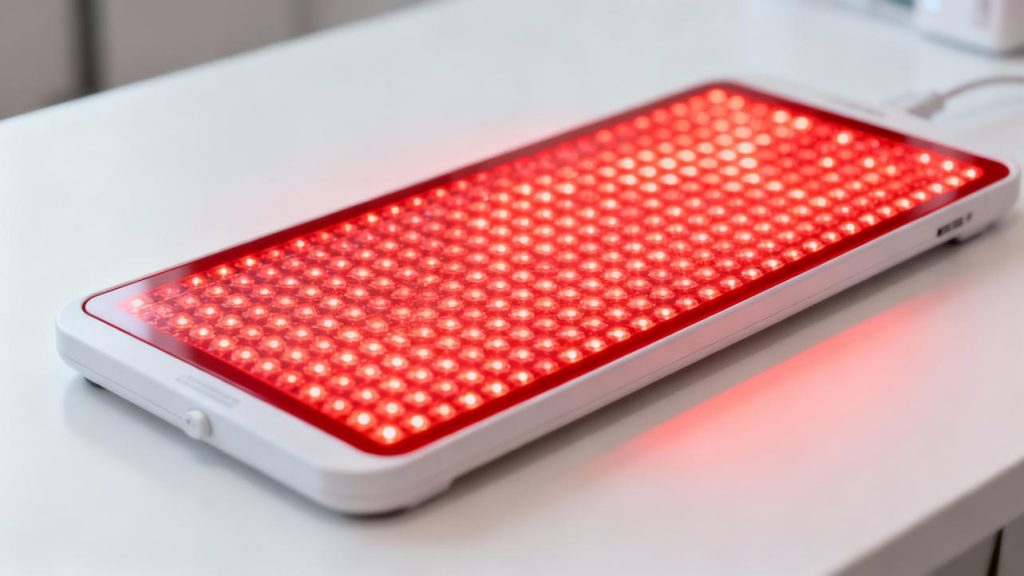
A key decision rule for buyers: if the target use is primarily facial or hand eczema, a 630-660 nm dominant panel is often adequate and less expensive. If the device will also be marketed for general wellness or larger body areas, a mixed 630/850 nm panel broadens the appeal. Always ask the supplier for the actual LED binning data—not just the nominal wavelength—because a 660 nm LED can vary by ±10 nm depending on bin and drive current.
Irradiance, Dose, and the Numbers That Matter
Irradiance is the power density delivered to the skin, measured in mW/cm2. For red light therapy devices, typical values range from 3 mW/cm2 to 50 mW/cm2 at the treatment surface. The session dose, measured in J/cm2, is calculated as irradiance multiplied by time in seconds divided by 1000. For example, 20 mW/cm2 for 10 minutes (600 seconds) delivers 12 J/cm2.

Commonly cited doses for skin support fall in the 3-20 J/cm2 range per session. Below 3 J/cm2, the effect may be too weak to trigger a biological response. Above 50 J/cm2, some studies suggest a biphasic response where benefit plateaus or reverses. For device buyers, this means the panel should allow dose control through adjustable irradiance or timer settings, not just a fixed on/off switch.
A practical failure mode: many low-cost panels advertise 100 mW/cm2 or higher, but that figure is often measured at the LED surface, not at the intended treatment distance of 6-12 inches. Always request an irradiance map at the recommended working distance, ideally from an independent integrating sphere or spectrometer test.
Device Classes: Panel, Bed, and Handheld Trade-offs
| Device class | Typical irradiance at 6 in | Best for | Key consequence for buyers |
|---|---|---|---|
| Handheld (single LED cluster) | 5-15 mW/cm2 | Spot treatment, travel kits | Low unit cost, but slow coverage and high return rate if users expect full-body results |
| Small panel (12×12 in) | 10-30 mW/cm2 | Facial and hand eczema, clinic starter | Good price-to-area ratio; check cooling fan noise and timer granularity |
| Full-body panel (36×12 in or larger) | 20-50 mW/cm2 | Whole-body sessions, premium clinics | Higher freight and certification cost; requires floor stand or wall mount |
| LED bed or wrap | 10-40 mW/cm2 | Spas, wellness centers | Highest price tier; longer lead time and more complex after-sales support |
For eczema-focused buyers, a small to medium panel is usually the most practical entry point. It covers the typical affected areas—hands, wrists, inner elbows, face—without the shipping and installation burden of a full bed. Handheld devices are attractive for retail margins but generate more support tickets related to battery life and inconsistent dosing.
Certification and Safety: What to Verify Before Importing
Factory certifications such as CE, RoHS, ISO 9001, and ISO 13485 are the baseline for professional equipment. CE indicates conformity with European electrical safety and electromagnetic compatibility requirements. RoHS restricts hazardous substances in components. ISO 13485 is a quality management standard specific to medical devices, though many red light panels are sold as general wellness devices rather than medical devices.
Photobiological safety is covered by IEC 62471, which classifies lamps and lamp systems by their risk of optical radiation hazards. For skin-focused devices, the relevant risk group is usually Exempt or Risk Group 1, meaning no photobiological hazard under normal use. Ask the supplier for an IEC 62471 test report from an accredited lab, not just a self-declaration.
Never accept a certificate without a matching test report number and issue date. A CE mark alone tells you nothing about optical safety or irradiance accuracy—it only means the manufacturer declared conformity for electrical safety and EMC.
OEM and ODM Sourcing: MOQ, Lead Time, and Price Tiers
For importers and private-label brands, the typical MOQ for a custom red light panel is 50-200 units, depending on whether you need custom housing, logo printing, or software changes. Standard OEM lead time is 30-45 days after deposit, plus 15-25 days for sea freight to North America or Europe. Air freight cuts transit to 5-7 days but adds $15-30 per unit for a medium panel.
Price tiers in the current market, as general context: handheld devices land at $15-40 FOB, small panels at $60-150 FOB, full-body panels at $200-500 FOB, and LED beds at $1,500-4,000 FOB. These ranges vary with LED chip quality, driver type, and casing material. A constant-current driver adds $5-15 per panel compared to a constant-voltage design, but it prevents irradiance drift as LEDs heat up—a common cause of inconsistent dosing.
Questions to ask any supplier before placing an order:
- Can you provide a spectral power distribution report for the exact LED bin used in production?
- What is the measured irradiance at 6 inches and 12 inches from the panel surface, with the cooling fan running?
- Do you use constant-current or constant-voltage LED drivers, and what is the specified current per string?
- Can you share an IEC 62471 test report and the corresponding risk group classification?
- What is your warranty policy for LED degradation—do you guarantee at least 70% output after 10,000 hours?
Common Failure Modes and How to Avoid Them
The most frequent complaint from end users is that a panel feels weak or produces no noticeable effect. This usually traces back to one of three engineering issues: low-quality LED bins with wide wavelength tolerance, insufficient cooling that causes thermal throttling, or an inflated irradiance spec measured at the LED surface rather than the treatment plane.
A second failure mode is uneven light distribution. Panels with sparse LED spacing or poor diffuser optics create hot spots and cold spots, so the delivered dose varies by 30% or more across the treatment area. Ask for an irradiance uniformity map—a good panel should stay within ±15% across the central 80% of the surface.
Finally, verify the power supply and driver reliability. A panel that fails after 500 hours destroys your brand reputation more than a panel that costs $10 more per unit. Constant-current drivers with aluminum PCB substrates and active fan cooling are the minimum baseline for professional equipment.
FAQ: Red Light Therapy for Eczema Devices
What wavelength is best for eczema support?
Most devices marketed for skin support use 630-660 nm red light, which penetrates the epidermis and upper dermis where eczema lesions occur. Some panels add 810-850 nm near-infrared for deeper tissue, but for surface skin conditions the red band alone is often sufficient. Confirm the actual LED bin wavelength from the supplier, not just the advertised number.
How long should a session last?
Session length depends on irradiance. At 20 mW/cm2, a 10-minute session delivers 12 J/cm2, which falls within the commonly cited 3-20 J/cm2 range. At 50 mW/cm2, the same dose takes only 4 minutes. Devices with adjustable timers and irradiance settings give users more control to stay within a reasonable dose range.
Can I import red light panels without any certification?
Legally, you may be able to import uncertified panels as general wellness devices, but you will face customs delays, retailer rejection, and liability exposure. CE and RoHS are the minimum for European and many other markets. ISO 13485 is expected by clinic buyers. An IEC 62471 report is the only way to demonstrate photobiological safety.
What is the difference between a $100 panel and a $400 panel?
The price difference usually reflects LED bin quality, driver type, cooling design, and certification documentation. A $100 panel often uses wide-tolerance LEDs, a constant-voltage driver, passive cooling, and no third-party test reports. A $400 panel should include tight-bin LEDs, a constant-current driver, active cooling, and complete spectral and safety documentation.
What to Do Next: A Sourcing Checklist
If you are evaluating red light therapy devices for eczema support, start with the measurable parameters: wavelength bin, irradiance at the treatment distance, dose control, and thermal stability. Request the three documents that separate professional equipment from commodity panels: a spectral power distribution report, an IEC 62471 test report, and an irradiance uniformity map.
Then compare suppliers on the commercial terms that affect your margin and lead time: MOQ, FOB price, driver type, warranty on LED output, and after-sales support for firmware or driver failures. A supplier that cannot answer a question about constant-current versus constant-voltage design is unlikely to deliver consistent irradiance over the life of the product.
Finally, remember that red light therapy for eczema is a support tool, not a medical treatment. Position your product with honest, verifiable specifications and let clinicians and end users make informed decisions. That approach builds a distribution channel that lasts longer than any single marketing campaign.
Post time: 11-24-26