


Red light therapy for horses is a growing category in veterinary and equine rehabilitation equipment, but the hardware varies widely in wavelength accuracy, irradiance, and build quality. This article answers the concrete question: what should a professional buyer check before importing or stocking an equine photobiomodulation device? We focus on device engineering, sourcing, and safety documentation rather than therapeutic claims.
Why Device Specifications Matter More Than Marketing
Equine red light therapy devices are marketed with wavelengths from 630 nm to 850 nm, but the actual LED output depends on binning and driver design. A panel labeled 660 nm may contain LEDs that peak anywhere from 650 nm to 670 nm unless the supplier provides binning data. For professional buyers, that tolerance affects dose calculations and repeatability across units.
Irradiance is the second number to verify. Many handheld units advertise 100 mW/cm2 or more at the lens, but the useful treatment area at 10 cm distance often drops to 20–40 mW/cm2. Ask for an irradiance map, not a single peak reading, because horses are treated over large muscle groups where uniformity matters more than a hot center spot.
Thermal design separates clinic-grade panels from consumer toys. A 300 W LED panel running for 20 minutes will heat the housing and the LEDs themselves, shifting peak wavelength by 1–2 nm and reducing output if heat sinking is inadequate. Look for aluminum substrates, active fan cooling, and a stated operating temperature range of 0–40 °C.
Wavelength Bands and What They Mean for Equine Devices
Equine photobiomodulation devices typically use two bands: red around 630–660 nm and near-infrared (NIR) around 810–850 nm. Red wavelengths penetrate a few millimeters into skin and are often used for surface-level applications, while NIR reaches deeper tissue. Some devices combine both bands in a single panel, which offers flexibility but requires separate current channels to avoid uneven output.
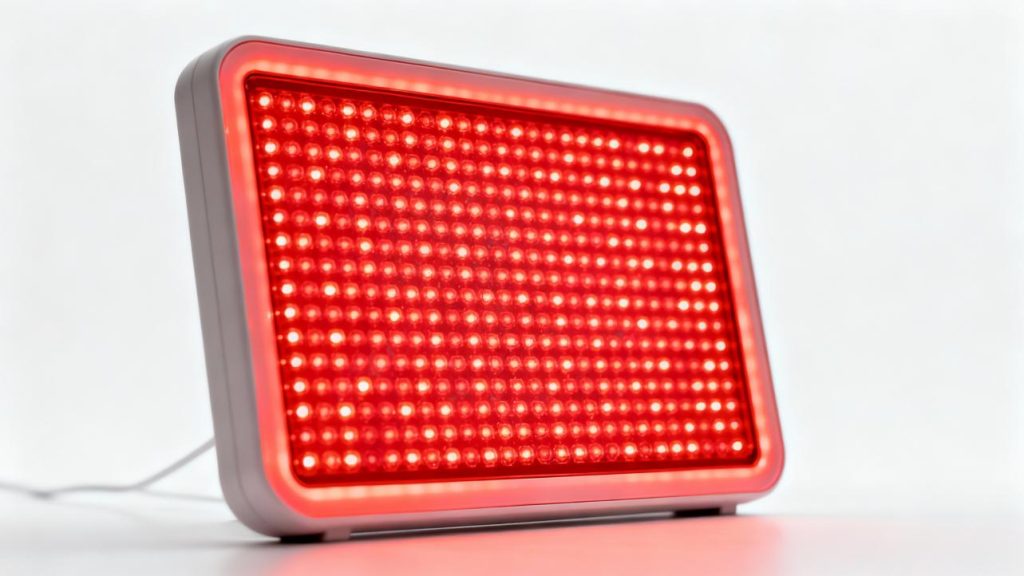
Wavelength tolerance is a key spec-sheet line. A reputable supplier will state ±5 nm or tighter for each LED bin. Cheaper panels may use mixed bins with ±10 nm variation, which can shift the delivered dose outside the intended absorption window. For horses, where treatment areas are large and sessions may run 10–20 minutes, consistent wavelength across the panel is more important than a single peak value.
Dose is usually expressed in joules per square centimeter (J/cm2). Common equine protocols fall in the 3–20 J/cm2 range per session, but the device must deliver that dose evenly. A 100 cm2 treatment head at 50 mW/cm2 delivers 3 J/cm2 in 60 seconds, while a 10 cm2 head at the same irradiance treats only a fraction of the area in the same time. Buyers should calculate treatment time from the stated irradiance and the target area, not from marketing claims.
Comparing Device Classes: Handheld, Panel, and Bed Systems
Three device classes dominate the equine market: handheld units, LED panels, and full-body bed or wrap systems. Each has a different cost structure, maintenance profile, and clinical workflow. The table below summarizes the trade-offs a buyer should weigh.
| Device class | Typical irradiance at 10 cm | Treatment area | Key failure mode | Buyer consequence |
|---|---|---|---|---|
| Handheld (single head) | 30–80 mW/cm2 | 10–50 cm2 | Overheating after 10 min continuous use | Low unit cost but slow for large muscle groups; check duty cycle |
| LED panel (60–300 W) | 20–60 mW/cm2 | 300–1200 cm2 | Uneven irradiance at edges | Best balance of cost and coverage; request an irradiance map |
| Bed or wrap system | 10–30 mW/cm2 | 2000+ cm2 | Driver failure in flexible circuits | High upfront cost; verify warranty on drivers and connectors |
Handheld units are portable and inexpensive, but treating a horse’s back or hindquarters with a 10 cm2 head is time-consuming. Panels cover more area and can be mounted on stands or gantry arms, making them the most common choice for clinics. Bed systems offer the largest coverage but require more floor space and a higher capital outlay, typically 3–5 times the cost of a panel.
Factory Certifications and What They Actually Cover
When sourcing equine red light therapy devices, buyers often ask for certifications. The relevant factory certificates are CE, RoHS, ISO 9001, and ISO 13485. CE marking indicates conformity with European electrical safety and electromagnetic compatibility directives, not a performance claim. RoHS restricts hazardous substances in components. ISO 9001 covers quality management, while ISO 13485 is specific to medical device quality systems and is a stronger signal for suppliers building photobiomodulation equipment.
Ask the supplier for the certificate number and the issuing body, then verify it on the certifier’s database. A common failure mode is a supplier showing a CE certificate for a different product family or an expired ISO certificate. For OEM/ODM projects, request the factory audit report or schedule a video inspection of the production line, including the LED binning station and the integrating sphere used for irradiance testing.
Rule of thumb: if a supplier cannot provide a wavelength bin report and an irradiance map for the exact model you are buying, treat the device as unverified regardless of the logo on the housing.
Red Light Therapy for Horses: Sourcing and MOQ Structure
Importers and distributors evaluating red light therapy for horses should understand the typical OEM/ODM structure. Most Chinese manufacturers offer three tiers: stock models with low MOQ, semi-custom with logo and housing color changes, and full custom with wavelength mix, driver current, and software control. MOQs generally range from 10 to 50 units for stock panels, 100 to 300 units for semi-custom, and 500+ for full custom.
Lead times follow the same pattern. Stock models ship in 7–15 days, semi-custom in 30–45 days, and full custom in 60–90 days after design freeze. Payment terms are usually 30% deposit and 70% before shipment for new buyers, with better terms after a purchase history. Unit pricing for a 100 W panel ranges from $80 to $150 FOB for stock models, $150 to $250 for semi-custom, and $250 to $400 for full custom with higher binning tolerance and better drivers.
After-sales support is a differentiator. Ask about the warranty period for LED arrays and drivers, typically 1–2 years, and whether the supplier stocks replacement parts. A common failure mode is a driver failure in the first six months due to poor thermal management; a supplier that offers a 2-year driver warranty and ships replacements within 7 days is preferable to one with a longer but unenforceable warranty.
Thermal Management and Electrical Safety in Equine Environments
Equine clinics are dusty, humid, and sometimes outdoors, so the device must handle more than a clean human clinic. Look for an IP rating of at least IP20 for indoor use and IP54 or higher for portable or outdoor use. The power supply should be a medical-grade or industrial-grade constant-current driver with over-temperature and short-circuit protection, not a commodity LED driver.
Constant-current drivers are essential because LED forward voltage changes with temperature. A constant-voltage driver can cause current spikes as the panel heats up, leading to premature LED failure. Check the driver’s stated current tolerance, typically ±5% or better, and ask for a thermal test report showing the LED junction temperature after 30 minutes of continuous operation. Junction temperatures above 85 °C will shorten LED life significantly.
Electrical safety for equine devices follows the same principles as human devices but with added mechanical stress. Cords and connectors must withstand being stepped on or pulled by a horse. Look for strain relief on all cable exits, locking connectors, and a housing that can survive a 1-meter drop onto concrete. These details are rarely in marketing materials but matter in daily clinic use.
What to Ask a Supplier Before You Commit
A short list of questions will filter out most unsuitable suppliers quickly. Use these in your first email or call.
- Can you provide an irradiance map at 10 cm and 20 cm distance for the exact model, not a prototype?
- What is the LED binning tolerance for each wavelength, and can you share the bin report from the LED manufacturer?
- What is the driver current tolerance and the thermal test result after 30 minutes of continuous operation?
- Do you have CE, RoHS, ISO 9001, or ISO 13485 certificates for this product family, and can I verify them online?
- What is the MOQ, lead time, and warranty for LED arrays and drivers for the model I am evaluating?
- Can you provide a sample unit for testing, and what is the cost and shipping time for one sample?
Suppliers that answer these questions with specific numbers and documents are more likely to deliver consistent quality. Those that respond with marketing language or vague assurances should be deprioritized, especially for a professional equine market where repeat purchases depend on device reliability.
FAQ: Red Light Therapy for Horses
What wavelength is best for equine red light therapy devices?
Most professional devices use 630–660 nm red and 810–850 nm near-infrared. The best choice depends on the target tissue depth and the supplier’s binning tolerance, not a single magic number.
How much irradiance do I need for a horse panel?
For large muscle areas, 20–60 mW/cm2 at 10 cm is practical. Higher irradiance shortens session time but increases heat and driver stress, so check the thermal design before buying a high-power panel.
What is a reasonable MOQ for a first order?
Stock panels often have an MOQ of 10–50 units, while semi-custom starts at 100–300 units. Start with a stock model to test the market, then move to custom once you have sales data.
How long should an equine red light therapy session last?
Session length depends on the device’s irradiance and the target dose. At 30 mW/cm2, a 6 J/cm2 dose takes about 200 seconds per area. Always calculate from the measured irradiance, not the marketing number.
Conclusion: Buy the Spec Sheet, Not the Story
Red light therapy for horses is a professional equipment category where the difference between a reliable device and a disappointing one is in the details: wavelength binning, irradiance maps, driver quality, and thermal design. Importers and clinic owners who evaluate these specs before ordering will avoid the most common failure modes and build a product line that lasts.
Start with a stock panel from a supplier that provides full documentation, test it in a real equine setting for at least 30 days, and then scale to semi-custom or full custom once you have usage data. The market rewards buyers who treat photobiomodulation hardware as engineering, not as a lifestyle accessory.
Post time: 11-26-26