


Red light therapy mask before and after photos circulate widely, but they rarely tell you whether a device can deliver the stated dose. This article answers the practical question: what can a buyer verify on a spec sheet, in a test report, or on a production line before trusting any before-and-after claim?
Why Before and After Claims Need Hardware Context
A mask can produce a visible change in skin appearance only if it delivers enough photons at the right wavelengths for a long enough time. Marketing images do not show irradiance drift, LED bin variation, or thermal throttling. Those are the variables that separate a consistent device from a one-off demo unit.
For a red light therapy mask, the relevant bands are 630–660 nm red and 810–850 nm near-infrared. A typical session uses 3–20 J/cm², which means the mask must sustain roughly 10–50 mW/cm² at the skin surface for 3–20 minutes depending on distance and duty cycle.
What a Red Light Therapy Mask Before and After Photo Cannot Show
Before and after photos are often taken under different lighting, angles, or compression settings. They cannot show whether the mask maintained its stated irradiance across the full 10-minute session or whether the LEDs shifted wavelength as the board heated up.
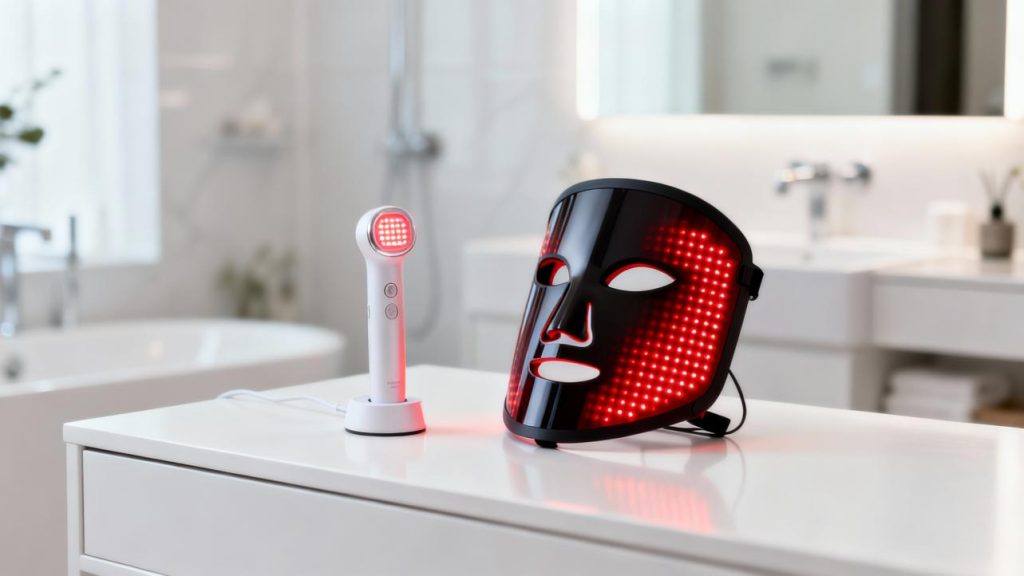
Three hardware checks matter more than any photo. First, ask for the LED binning report: a tight bin means the peak wavelength stays within ±5 nm of nominal. Second, request an irradiance map taken with a spectrometer or calibrated photodiode at the actual skin distance, not at the LED surface. Third, confirm the driver is constant-current, because voltage-driven LED strings fade unevenly as temperature rises.
Spec Sheet Lines That Predict Consistent Results
When comparing masks, ignore total LED count as a primary metric. A mask with 300 low-bin LEDs can deliver less useful dose than a 120-LED mask with tight wavelength tolerance and a proper diffuser. Focus on these lines instead:
- Peak wavelength and tolerance: 630 nm ±5 nm or 660 nm ±5 nm for red; 830 nm ±5 nm or 850 nm ±5 nm for near-infrared. Wider tolerance means some LEDs fall outside the therapeutic window.
- Irradiance at skin plane: stated in mW/cm² at a defined distance, usually 10–20 mm from the LED array. If no distance is given, the number is meaningless.
- Thermal derating curve: shows irradiance drop after 10, 20, and 30 minutes. A good mask loses less than 10% from cold start to steady state.
- Driver type: constant-current IC per string, not a resistor-limited board. Resistor-driven masks are cheaper but drift with temperature and battery voltage.
| Comparison Factor | Low-Cost Mask | Professional-Grade Mask | Consequence for Buyer |
|---|---|---|---|
| Wavelength tolerance | ±10 nm or unspecified | ±5 nm with binning report | Wide tolerance wastes energy outside the target band |
| Irradiance spec | Total output in mW, no distance | mW/cm² at 15 mm skin plane | Without distance, dose per session is unverifiable |
| Driver | Resistor-limited, voltage source | Constant-current per LED string | Resistor boards fade unevenly after 5–10 minutes |
| Thermal design | No heatsink, PCB only | Aluminum core PCB or active cooling | Overheating reduces LED lifetime and shifts wavelength |
| Factory certifications | None or self-declared | CE, RoHS, ISO 9001, optionally ISO 13485 | Certifications give a baseline for quality systems, not medical claims |
Rule of thumb: if a supplier cannot provide an irradiance map at skin distance and a wavelength binning report, assume the before and after photos were produced by a different unit than the one you will receive.
Measuring Dose: The Number Behind the Photos
Dose in J/cm² equals irradiance in W/cm² multiplied by time in seconds. A mask delivering 30 mW/cm² for 10 minutes gives 18 J/cm². That is a verifiable number if you measure the mask yourself with a calibrated sensor.
Importers should spot-check at least three units per batch: one from the start, one from the middle, and one from the end of production. Measure irradiance at the center and four corner points of the mask. A variation of more than 15% across the face area means the user gets uneven exposure, which undermines any before and after comparison.
OEM and ODM Sourcing Checks for Mask Buyers
If you are sourcing masks under your own brand, the before and after evidence you publish depends on the consistency of the factory’s process. Ask for the following before placing a trial order:
- LED reel traceability: supplier name, bin code, and date code for each production lot. Mixed bins on one reel cause wavelength scatter.
- In-line photometric test: does the factory test every mask for total flux and wavelength, or only sample test? 100% testing adds cost but removes outliers.
- Burn-in procedure: 24–48 hour powered burn-in at elevated temperature catches early LED failures before shipping.
- Minimum order quantity and lead time: typical MOQ for private-label masks is 500–1,000 units, with 30–45 days production plus 15–25 days sea freight. Small trial orders of 50–100 units usually cost 20–40% more per unit.
Thermal Management and Long-Term Stability
LED masks run close to the face, so heat builds up in a small enclosure. Without a thermal path, junction temperature rises and the peak wavelength shifts by roughly 0.1–0.3 nm per degree Celsius. Over a 30°C temperature rise, a 660 nm LED can drift to 665–670 nm, reducing photon absorption in the target chromophore.
Look for an aluminum-core PCB or a thin graphite heat spreader. Active cooling with micro fans adds noise and cost but keeps irradiance stable. Passive designs are acceptable if the mask shell has ventilation slots and the duty cycle is limited to 20 minutes or less.
Factory Certifications and What They Actually Cover
CE marking under the Low Voltage Directive and RoHS compliance are standard for LED masks sold in Europe. ISO 9001 covers quality management; ISO 13485 indicates a quality system designed for medical device manufacturing, but it is a factory certification, not a product approval.
Request copies of the actual certificates and verify the scope matches the product category. A supplier with ISO 13485 for a different product line does not automatically extend that quality system to your mask order. Ask for a copy of the most recent audit summary or a certificate validity check with the issuing body.
FAQ: Red Light Therapy Mask Before and After Evaluation
How long does it take to see a visible change with a red light therapy mask?
Most published protocols use 3–5 sessions per week for 4–8 weeks, with 10–20 J/cm² per session. Hardware consistency matters more than the exact number of sessions; a mask that drifts in irradiance will produce variable results even with perfect compliance.
Can I trust before and after photos from a supplier?
Treat them as marketing, not evidence. Request the irradiance map, wavelength binning report, and a sample unit for independent measurement. If the supplier refuses, that is a stronger signal than any photo.
What is the most common failure mode in low-cost masks?
LED string failure due to resistor-limited drivers and poor thermal design. One dead string creates a dark stripe across the face, and the user may not notice until the before and after comparison shows uneven tone.
Does higher irradiance always mean better results?
No. Beyond roughly 50 mW/cm², tissue heating increases and the risk of discomfort rises. The useful range for most mask designs is 10–50 mW/cm² at the skin plane, with session time adjusted to keep the total dose under about 20 J/cm².
Conclusion: Verify the Device, Not the Photo
Red light therapy mask before and after claims are only as good as the hardware behind them. A buyer who checks wavelength tolerance, irradiance at skin distance, driver type, and thermal derating can predict consistency better than any photo.
Before your next order, request the three documents that matter: an irradiance map, a binning report, and a factory certificate scope. Then measure one sample yourself. That sequence will tell you more in an afternoon than a hundred before and after images.
Post time: 11-27-26