


Blue light phototherapy devices are a growing category for importers, distributors, and clinic owners, but the hardware varies widely in wavelength accuracy, irradiance, and build quality. This article answers the concrete question: how do you evaluate a blue light phototherapy panel before committing to a purchase order? We focus on engineering specifications, factory certifications, and sourcing terms that determine whether a device performs as claimed and survives daily use.
Blue Light Phototherapy: Wavelength and Irradiance Basics
Blue light phototherapy typically uses LEDs with peak wavelengths between 415 nm and 470 nm. The most common clinical wavelength cited in device literature is 450 nm, though some panels offer 415 nm or 470 nm options. Irradiance at the treatment surface usually ranges from 10 mW/cm² to 50 mW/cm², and a session dose of 3–20 J/cm² is achieved by adjusting time and distance.
The key specification to verify is the actual spectral output, not the nominal LED bin. A supplier may advertise “450 nm” but ship LEDs with a peak at 440 nm or 460 nm, which changes the photobiological effect. Ask for a spectroradiometer test report from the batch, not a datasheet from the LED manufacturer. The full width at half maximum (FWHM) should be under 20 nm for a tight blue peak; wider bins reduce wavelength precision.
Irradiance claims also need scrutiny. Some suppliers quote irradiance at the LED surface, not at the working distance of 10–20 cm. A panel rated 100 mW/cm² at the surface may deliver only 15 mW/cm² at 15 cm. Request an irradiance map showing uniformity across the panel, with a variance of less than 20% across the central 80% of the treatment area.
LED Chip Quality and Binning for Blue Light Phototherapy
Blue LEDs degrade faster than red or near-infrared LEDs, so chip quality directly affects device lifespan. Look for chips from established fabs with a minimum L70 lifetime of 20,000 hours at rated current. L70 means the LED retains 70% of its initial output; below that, irradiance drops enough to require longer sessions or recalibration.
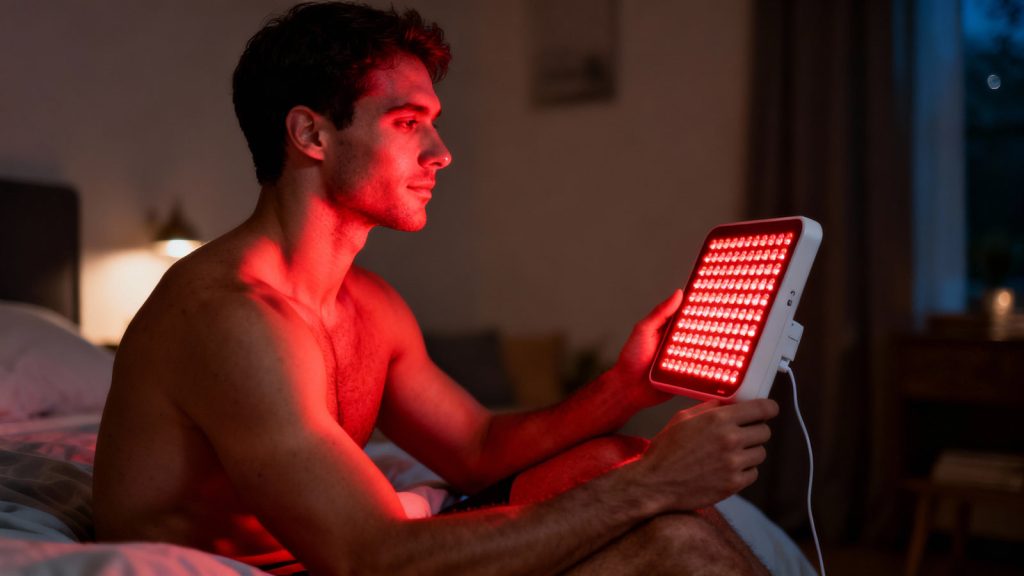
Binning is the process of sorting LEDs by peak wavelength and luminous flux. For blue light phototherapy, the bin should be specified as a range, such as 445–455 nm, not a single number. A tight bin reduces color variation across the panel and ensures that every LED contributes to the intended wavelength band. Ask the supplier which binning standard they use—common ones include ANSI C78.377A for chromaticity and internal fab bins for wavelength.
Thermal management is the main failure mode for blue LEDs. Junction temperatures above 85°C accelerate lumen depreciation and wavelength drift. A well-designed panel uses an aluminum PCB, adequate heat sinking, and either active cooling or a derated drive current. Check the thermal test report: the LED junction temperature at 25°C ambient should stay below 70°C after 30 minutes of continuous operation.
Driver Electronics and Safety Standards
The LED driver determines flicker, current stability, and electrical safety. Constant-current drivers are mandatory for phototherapy; constant-voltage drivers cause current spikes and uneven output. Look for drivers with a ripple current below 10% and a power factor above 0.9. Flicker percentage should be under 5% at all dimming levels, measured according to IEEE 1789 recommendations for low-risk flicker.
Factory certifications matter for importers. A reputable blue light phototherapy manufacturer should hold ISO 9001 for quality management and ISO 13485 for medical device quality systems, even if the device itself is not marketed as a medical device. CE marking under the Low Voltage Directive and EMC Directive is standard for the European market, and RoHS compliance is expected. These are factory certifications, not product approvals, and they indicate that the production process meets basic safety and consistency requirements.
Photobiological safety is covered by IEC 62471. Blue light in the 415–470 nm range can be classified as Risk Group 1 or Risk Group 2 depending on irradiance and exposure time. A Risk Group 2 device requires a warning label and a recommended maximum exposure time. Ask the supplier for the IEC 62471 test report and confirm the risk group classification for the specific panel configuration you are buying.
Panel, Handheld, and Tabletop Form Factors
Blue light phototherapy devices come in three main form factors: large panels, handheld units, and tabletop lamps. Panels are suited for clinics and professional use, with treatment areas from 300 cm² to over 2,000 cm². Handheld units are portable but have smaller treatment areas and often lower irradiance due to battery constraints. Tabletop lamps fall in between, with a fixed height and a focused beam.

The choice depends on the intended use case and the buyer’s distribution channel. Importers selling to clinics usually stock panels because they offer higher throughput and better build quality. Handheld units have a lower price point but higher return rates due to battery failure and LED degradation. Tabletop lamps are a niche product for estheticians and smaller practices.
When comparing form factors, look at the power supply and duty cycle. A panel with an external constant-current driver is easier to service than a handheld with an integrated battery. The duty cycle—how long the device can run before overheating—should be at least 30 minutes continuous for professional use. Handheld units often specify a 10-minute duty cycle, which limits their practicality.
OEM/ODM Sourcing: MOQ, Lead Time, and Customization
For importers and distributors, OEM/ODM terms determine profitability. Typical MOQs for blue light phototherapy panels range from 50 to 200 units for standard models, with custom branding requiring 500 units or more. Lead time for a standard order is 30–45 days after deposit, while full ODM projects with custom housing or firmware can take 90–120 days.
Customization options include logo printing, housing color, wavelength selection, irradiance settings, and control interface. Some manufacturers offer a software development kit for app-controlled devices, but this adds cost and complexity. Ask about the minimum order for each customization tier and whether tooling costs are amortized or charged upfront.
Price structure follows a tiered model. A basic 45 W blue light panel with 60 LEDs and a simple timer might cost $80–$120 per unit at 200-piece MOQ. A 300 W panel with 600 LEDs, digital controls, and a spectroradiometer test report per batch can reach $250–$400 per unit. Handheld units are cheaper, often $20–$50 at 500-piece MOQ, but margins are thinner and warranty claims higher.
| Supplier Type | Typical MOQ | Lead Time | Certifications | Consequence for Buyer |
|---|---|---|---|---|
| Trading company | 10–50 units | 15–30 days | CE, RoHS (often copied) | Low price but no control over LED binning or driver quality; higher defect rate. |
| Small factory | 50–100 units | 30–45 days | ISO 9001, CE | Better customization but limited R&D; may not have spectroradiometer testing in-house. |
| Mid-size OEM/ODM | 100–500 units | 45–60 days | ISO 9001, ISO 13485, CE, RoHS | Consistent binning and documentation; higher MOQ but lower long-term failure rate. |
| Large contract manufacturer | 500+ units | 60–90 days | ISO 13485, full IEC 62471 reports | Best for high-volume brands; requires upfront engineering fees and longer lead time. |
Quality Control and Incoming Inspection Checklist
Before accepting a shipment, importers should perform incoming inspection on a sample of units. The checklist below covers the most common failure modes we see in blue light phototherapy devices. A 10% sample size with an AQL of 1.0 is a reasonable starting point for a first order.
- Verify peak wavelength with a handheld spectrometer; reject if outside the specified bin by more than ±5 nm.
- Measure irradiance at the stated working distance with a calibrated light meter; reject if below 90% of the spec sheet value.
- Check for flicker using a smartphone camera at 240 fps; visible banding indicates a poor driver.
- Run the device for 30 minutes and measure housing temperature; reject if surface exceeds 45°C.
- Inspect solder joints and cable strain relief; look for cold joints or loose connectors.
- Confirm the IEC 62471 risk group label is present and matches the test report.
Document every inspection with photos and a signed report. If more than 2% of the sample fails, reject the lot or negotiate a rework. Suppliers are more willing to fix problems before the balance payment is released.
A cheap blue light phototherapy panel that drifts 10 nm off spec or flickers at 20% is not a bargain—it is a warranty liability. Pay for the spectroradiometer report before you pay for the container.
Warranty, After-Sales, and Spare Parts
Warranty terms reveal a supplier’s confidence in their product. Standard warranty for blue light phototherapy panels is 12–24 months, covering LED failure and driver defects. Some manufacturers offer 36 months on the driver but only 12 months on LEDs because blue LEDs degrade predictably. Read the warranty exclusions carefully; many exclude damage from voltage spikes or improper ventilation.
Spare parts availability is critical for clinic owners. A panel with a failed driver or a burnt LED should be repairable, not disposable. Ask the supplier to include a spare driver, a set of replacement LEDs from the same bin, and a repair manual with the first order. The cost is small—typically 2–3% of the order value—but it prevents downtime and negative reviews.
After-sales support varies widely. Trading companies often disappear after the order ships, while OEM/ODM factories maintain a service team. Before signing, test the supplier’s responsiveness: send a technical question about binning or driver specs and measure how long they take to answer with real data. A supplier that cannot explain their own LED binning will not support you when a customer complains.
FAQ: Blue Light Phototherapy Device Sourcing
What wavelength should I choose for a blue light phototherapy panel?
The most common specification is 450 nm with a tolerance of ±5 nm, but some applications use 415 nm or 470 nm. Choose based on your target market’s expectations and verify the actual output with a spectroradiometer report, not the LED datasheet.
What is a reasonable MOQ for a first order?
For a standard panel with your logo, expect an MOQ of 50–200 units. If you need custom housing or firmware, the MOQ rises to 500 units or more. Start with a standard model to test the market before investing in tooling.
How do I verify that the irradiance claim is real?
Request an irradiance map measured at the working distance you will use, typically 10–20 cm. The map should show uniformity within 20% across the treatment area. Reject any supplier that quotes only surface irradiance.
What certifications should a factory have?
Look for ISO 9001 and ISO 13485 as factory quality system certifications, plus CE and RoHS for the European market. An IEC 62471 photobiological safety report is essential for blue light devices, and the risk group classification should be clearly stated.
Conclusion: What to Do Next
Blue light phototherapy is a competitive category, and the difference between a reliable device and a return-prone one comes down to specifications you can verify. Wavelength binning, irradiance at working distance, driver quality, and thermal design are the four areas where suppliers cut corners. Ask for test reports, not marketing claims.
Before placing an order, request a pre-production sample and run the incoming inspection checklist above. Compare at least three suppliers on MOQ, lead time, and after-sales support, and do not choose on price alone. A $20 difference per unit disappears after one warranty claim.
If you are evaluating blue light phototherapy panels for import or clinic use, start with the spec sheet and the spectroradiometer report. The hardware decisions you make now determine your margin and your reputation for the next two years.
Post time: 11-22-26