


Infrared light therapy benefits are often described in marketing language that skips the engineering details buyers actually need. This article answers a concrete question: how do you evaluate an 810-850 nm LED device for import, distribution, or clinic use without falling for vague claims? We cover wavelength tolerance, irradiance measurement, thermal design, factory certifications, and the sourcing decisions that affect long-term reliability.
What Infrared Light Therapy Devices Actually Deliver
Infrared light therapy uses LEDs or laser diodes to deliver photons in the near-infrared range, commonly 810-850 nm. Unlike red light at 630-660 nm, near-infrared penetrates deeper into tissue because longer wavelengths scatter less in the skin and underlying layers. A well-built device delivers a stated irradiance, usually between 3 and 50 mW/cm2 at the treatment surface, and a session dose of roughly 3-20 J/cm2.
For a buyer, the real question is not whether the technology works, but whether the device you import will deliver that irradiance consistently over its rated lifespan. LED chips degrade, drivers drift, and cooling fans fail. A device that measures 30 mW/cm2 on day one may measure 22 mW/cm2 after 2,000 hours if the thermal design is poor. That drop changes the dose and the user experience.
Infrared Light Therapy Benefits: The Wavelength and Irradiance Equation
Most infrared light therapy panels are built around 810 nm, 830 nm, or 850 nm LEDs. The choice matters because each wavelength has a slightly different absorption profile in tissue, but the difference between 810 nm and 850 nm is often smaller than the tolerance of the LEDs themselves. A typical LED bin may be specified as ±5 nm or ±10 nm, meaning an 850 nm chip can actually emit anywhere from 840 to 860 nm.

Ask your supplier for the LED binning report, not just the nominal wavelength. A panel advertised as 850 nm may contain a mix of 830 nm and 850 nm chips to broaden the spectrum, which is a legitimate design choice but changes the effective dose. The spec sheet should state the peak wavelength, the full width at half maximum (FWHM), and the tolerance.
Irradiance is the other half of the equation. A common failure mode is quoting the irradiance at the LED surface rather than at the treatment distance. A panel that claims 100 mW/cm2 may deliver only 20 mW/cm2 at 15 cm from the user. Always ask for the measurement distance and the instrument used. A solar power meter is not the same as a spectroradiometer, and the two can disagree by 20% or more on near-infrared readings.
| Wavelength band | Typical penetration depth | Common use in panels | Buyer consequence |
|---|---|---|---|
| 630-660 nm red | 1-3 mm, mostly skin surface | Combined with NIR in full-body panels | Lower cost, but less deep tissue coverage |
| 810 nm NIR | 3-5 mm, deeper tissue | Often paired with 830 nm for broader spectrum | Check binning tolerance; ±10 nm is common |
| 850 nm NIR | 3-5 mm, slightly less scattering | Most common NIR wavelength in panels | Verify actual peak wavelength with a spectrometer |
| Dual red + NIR | Combined surface and deep coverage | Typical in professional panels | Higher price, but wider application range |
Panel vs Bed vs Handheld: Which Form Factor Holds Up
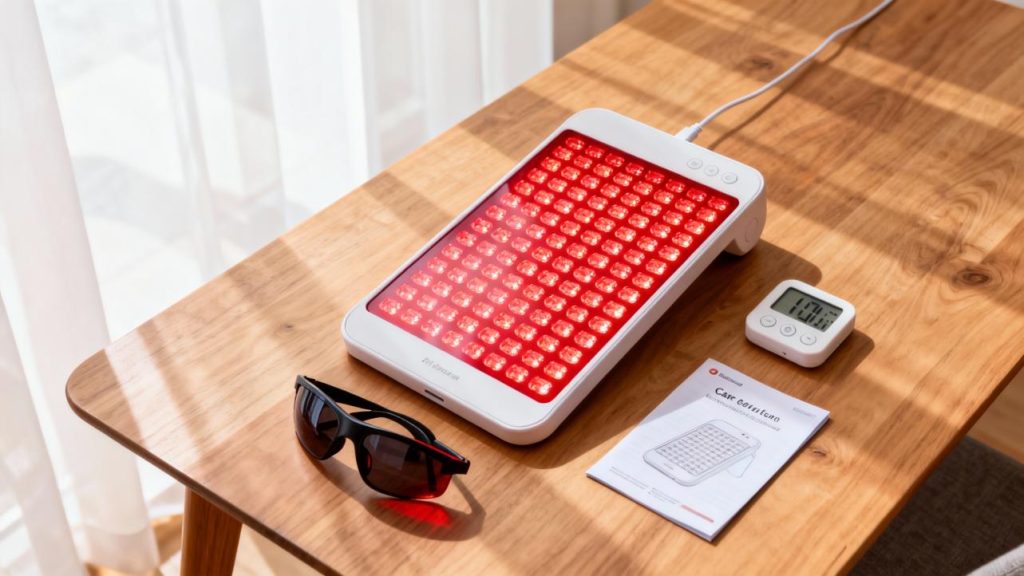
Full-body panels are the workhorse for clinics and wellness centers. They use arrays of 100 to 1,500 LEDs, draw 300 W to 3,000 W, and require active cooling. The failure points are the cooling fans and the constant-current drivers. A panel with passive cooling only will throttle output after 10-15 minutes as the LED junction temperature rises, reducing irradiance by 10-20%.
Beds and pods offer full-body coverage but cost 3-5 times more than a comparable panel. They are harder to service because the LED modules are embedded in a curved shell. Handheld devices are portable but typically deliver only 20-50 mW/cm2 over a small area, so they suit targeted use rather than whole-body sessions.
For importers, panels offer the best balance of price, serviceability, and shipping volume. A 1,500-LED panel ships in a wooden crate of roughly 0.5 cubic meters, while a bed may require 2-3 cubic meters and a liftgate. That difference alone can add $200-500 to freight per unit.
Factory Certifications and What They Do Not Cover
CE, RoHS, ISO 9001, and ISO 13485 are factory and system certifications, not product performance guarantees. CE marking for LED panels typically falls under the Low Voltage Directive and EMC Directive, meaning the device is safe from electrical and electromagnetic hazards, not that it delivers a specific irradiance. RoHS confirms the absence of restricted substances like lead and mercury in the components.
ISO 13485 is a quality management system for medical devices, but many red light therapy panels are sold as wellness or cosmetic devices, not medical devices. Ask your supplier which certification applies to the exact model you are buying, and request the certificate number and issuing body. A certificate that expired in 2024 or belongs to a different factory is a red flag.
A practical rule of thumb: if a supplier cannot provide a spectroradiometer test report for the exact panel you are ordering, assume the stated irradiance is optimistic by at least 30%.
OEM and ODM Sourcing: MOQ, Lead Time, and Price Tiers
Most infrared light therapy panels are manufactured in Shenzhen, Guangzhou, or Ningbo. MOQs vary by model: standard panels often start at 10-50 units, while custom ODM projects may require 200-500 units to amortize tooling and certification costs. Lead time for a standard panel is 15-30 days after deposit; a custom design can take 60-90 days.
Price tiers are driven by LED quality, driver design, and housing material. A basic 300-LED panel with unbranded chips and a plastic housing may cost $80-150 per unit at 100 pieces. A 1,500-LED dual-wavelength panel with branded LEDs, aluminum housing, and a 5-year driver warranty may cost $400-700 per unit at the same quantity. The difference is not just marketing; it shows up in irradiance stability and failure rate after 1,000 hours.
- Request the LED brand and bin code, not just the wavelength.
- Ask for a thermal test report showing irradiance at 0, 15, and 30 minutes of continuous use.
- Confirm the driver is constant-current, not constant-voltage, and ask for the ripple specification.
- Check the warranty on fans and drivers; these fail before the LEDs.
- Order a pre-production sample and measure it with your own meter before committing to a container.
Thermal Design and Driver Quality: The Two Hidden Cost Drivers
LEDs convert only 30-40% of electrical power into light; the rest becomes heat. A panel that runs hot will lose irradiance quickly and may shut down to protect the LEDs. Good thermal design uses aluminum PCBs, heat sinks, and multiple fans with independent power circuits. A common failure mode is a single fan failure that causes the whole panel to throttle or shut off.
The LED driver is equally important. Constant-current drivers maintain a stable output even as the LED forward voltage changes with temperature. Constant-voltage drivers are cheaper but allow current to drift, which shortens LED life and changes the output spectrum. Ask for the driver’s ripple current specification; anything above 5% ripple will cause visible flicker and may reduce photon delivery efficiency.
FAQ: Infrared Light Therapy Device Selection
What is the difference between 810 nm and 850 nm for a buyer?
The difference is smaller than most marketing suggests. Both wavelengths fall within the near-infrared window, and the actual emission depends on the LED bin tolerance. A panel labeled 850 nm may emit from 840 to 860 nm. For a buyer, the more important question is whether the supplier provides a spectroradiometer report showing the actual peak and FWHM for the batch you are buying.
How much irradiance do I need for a professional panel?
Most professional panels deliver between 20 and 50 mW/cm2 at the treatment surface, measured at a distance of 10-15 cm. Higher irradiance shortens session time but increases heat and the need for cooling. A panel that claims 100 mW/cm2 at the surface may deliver only 20 mW/cm2 at the user’s skin. Always confirm the measurement distance.
What factory certifications should I require?
At minimum, require CE and RoHS for the specific model, and ISO 9001 for the factory. If the device is positioned for clinical or medical-adjacent use, ISO 13485 is a stronger quality system signal. Request the certificate numbers and verify them with the issuing body. Certifications do not guarantee performance; they confirm the factory follows a documented quality process.
What is a realistic MOQ for a custom infrared panel?
For a standard panel with your logo, MOQ is often 10-50 units. For a custom housing, custom LED layout, or new driver design, expect 200-500 units and a 60-90 day lead time. The tooling cost for a custom aluminum housing can be $5,000-15,000, which is amortized over the order.
What to Do Next Before You Commit
Infrared light therapy benefits depend on the device delivering the stated wavelength and irradiance over hundreds of hours of use. Before you place an order, request the LED binning report, a spectroradiometer test at your intended treatment distance, and a thermal stability test over 30 minutes of continuous operation.
Compare at least three suppliers on those three documents, not on brochure photos or claimed wattage. The cheapest panel often fails on thermal design or driver quality, and that failure shows up in your customers’ hands within the first year. A slightly higher unit cost for a constant-current driver and aluminum housing is usually cheaper than a warranty claim and a damaged reputation.
Post time: 11-23-26