


This myredlight com review answers one concrete question: what should a professional buyer check before committing to a red light therapy device order? The market is full of panels quoting impressive wavelengths and power figures, but a usable purchase decision depends on irradiance at a defined distance, LED driver current, thermal design, and verifiable factory certifications. This article walks through those checks without medical claims, focusing on device engineering, sourcing terms, and after-sales support.
What Myredlight com Lists and What to Verify
A typical myredlight com product page will state wavelength bands such as 630-660 nm red and 810-850 nm near-infrared, total LED count, and a maximum irradiance figure. Those numbers are only useful when tied to a measurement distance and a defined aperture. A panel claiming 100 mW/cm2 at the surface may deliver 30 mW/cm2 at 15 cm, and that second number is the one that matters for realistic use.
Buyers should ask for an irradiance map, not a single peak value. A reputable supplier will provide measurements at 5 cm, 15 cm, and 30 cm from the panel face, with uniformity stated as a percentage across the treatment area. If the supplier cannot produce that map, treat the irradiance claim as unverified.
Wavelength Tolerance and LED Binning
LED chips are not all identical even within the same reel. Reputable manufacturers bin LEDs so that the dominant wavelength stays within plus or minus 5 nm of the stated peak. A panel labeled 660 nm may actually contain chips from 655 to 665 nm, which is acceptable for most photobiomodulation applications. Wider tolerance, such as plus or minus 10 nm, indicates lower-grade chips or mixed production lots.
Ask for the LED manufacturer name and bin code. Common suppliers include Seoul Semiconductor, Osram, and Epistar, but the bin code matters more than the brand. A 660 nm chip binned as “660-665 nm” is a tighter specification than one binned as “650-670 nm.”
Irradiance, Power Density, and the 3-50 mW/cm2 Window
Most red light therapy research uses irradiance values between roughly 3 mW/cm2 and 50 mW/cm2 at the skin surface. Below 3 mW/cm2, the dose per session becomes impractically long. Above 50 mW/cm2, thermal effects start to dominate, and the device may heat the skin rather than deliver a controlled photobiomodulation dose.

Dose is the product of irradiance and time. A panel delivering 30 mW/cm2 for 10 minutes gives 18 J/cm2, which falls within the commonly used 3-20 J/cm2 per session range. A buyer evaluating myredlight com should calculate dose at the intended working distance, not at the panel surface.
Rule of thumb: if a supplier quotes irradiance without stating the measurement distance, divide the claim by at least two and re-check the math before ordering samples.
Driver Current, Cooling, and Panel Lifespan
LED panels fail in predictable ways. The most common failure is not a dead chip but a driver that overheats and drops current, reducing output silently over months. Constant-current drivers are preferred over constant-voltage designs because they hold each LED string at the same current even as forward voltage shifts with temperature.
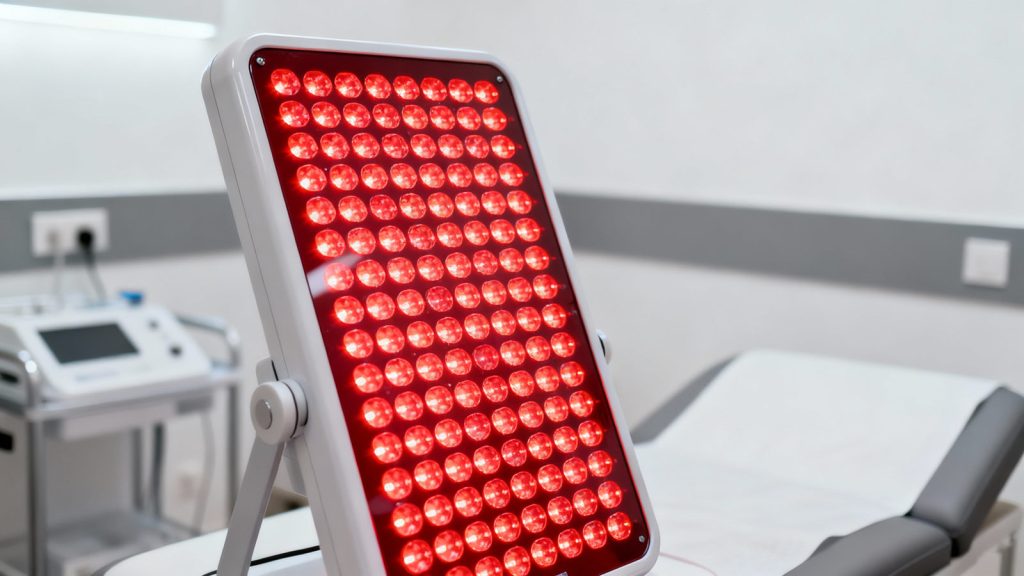
Ask whether the driver is integrated or external. External drivers are easier to replace and keep heat away from the LEDs. Internal drivers make a slimmer panel but concentrate heat, which shortens capacitor life. A well-designed panel will state an operating temperature range, typically 0-40 degrees Celsius, and include thermal cutoff protection.
Cooling Design: Fan versus Passive
Panels above roughly 200 W of electrical input almost always need active cooling. A fan-cooled panel can maintain higher irradiance without LED junction temperature exceeding the manufacturer’s rating, usually 85-100 degrees Celsius. Passive cooling works for lower-power handhelds and small panels but limits sustained output.
Check the fan noise specification. A panel producing 45 dBA at 1 meter is acceptable in a clinic; 60 dBA is not. Also confirm whether the fan is user-replaceable, because fan bearings fail before LEDs do.
Factory Certifications and What They Actually Cover
For B2B buyers, factory certifications matter more than marketing language. Request copies of CE, RoHS, ISO 9001, and ISO 13485 certificates. CE and RoHS address electrical safety and hazardous substance limits. ISO 9001 covers quality management consistency. ISO 13485 is specific to medical device quality systems and indicates the factory can maintain traceability and process control.
These are factory certifications, not product approvals. They do not mean a device is cleared for any medical indication. They mean the production facility has been audited against a defined standard. Verify certificate validity dates and the scope statement, which should list the relevant product category.
| Certification | What it checks | Consequence for buyer |
|---|---|---|
| CE | Electrical safety, EMC, basic performance | Required for EU import; ask for the technical file reference |
| RoHS | Lead, mercury, cadmium and other restricted substances | Needed for EU and many other markets; non-compliant stock can be seized |
| ISO 9001 | Quality management system consistency | Reduces batch-to-batch variation but does not cover medical claims |
| ISO 13485 | Medical device quality management, traceability | Stronger signal for clinic buyers; ask for scope to include light therapy devices |
Comparing Panel, Handheld, and Bed Formats
Format choice depends on treatment area and workflow, not just price. A full-body bed or half-body panel covers a large area in one session but costs more and requires dedicated space. A handheld device is portable and inexpensive but treats only a small area at a time, so session time per client increases.
For a clinic seeing 20 clients per day, a panel with 300-600 LEDs and an irradiance of 30-50 mW/cm2 at 15 cm is a practical middle ground. For a distributor selling to home users, a 60-120 LED panel or a handheld with a rechargeable battery may be easier to ship and support.
| Format | Typical irradiance at 15 cm | Best for | Main trade-off |
|---|---|---|---|
| Handheld | 10-30 mW/cm2 | Targeted use, travel, low budget | Small treatment area, longer session time |
| Small panel (60-120 LEDs) | 20-40 mW/cm2 | Home users, small clinics | Limited coverage, may need multiple placements |
| Large panel (300-600 LEDs) | 30-50 mW/cm2 | Clinics, professional use | Higher cost, needs floor or wall mount |
| Bed or half-body | 20-40 mW/cm2 | Full-body sessions, high throughput | Large footprint, higher shipping cost |
OEM/ODM Sourcing: MOQ, Lead Time, and Price Tiers
Most myredlight com inquiries from importers and distributors are OEM or ODM requests. Typical minimum order quantities for private-label panels range from 50 to 200 units, depending on customization depth. A simple logo print may have an MOQ of 50 units; a custom housing mold can push MOQ to 500 units or more.
Lead times cluster around 30-60 days for standard panels with logo customization, and 60-90 days for ODM projects requiring new tooling. Price per unit falls sharply with volume: a 300-LED panel that costs $180 per unit at 50 units may drop to $120 per unit at 500 units, excluding shipping and import duties.
- Request a sample before placing a bulk order, and test irradiance at three distances.
- Ask for the BOM (bill of materials) to confirm LED bin, driver type, and fan brand.
- Negotiate a warranty of at least 24 months on drivers and LEDs.
- Clarify after-sales support: who handles returns, spare parts, and firmware updates.
FAQ: Myredlight com Buying Decisions
What irradiance should I expect from a 300-LED panel?
At 15 cm from the panel face, a well-designed 300-LED panel with 3 W LEDs typically delivers 30-50 mW/cm2 across the central treatment area. Values above 60 mW/cm2 at that distance are unusual and should be verified with an independent meter.
How do I verify a factory’s CE and ISO certificates?
Ask for the certificate number and issuing body, then check the issuing body’s online database. Certificates can be faked or expired. The scope statement on the certificate must match the product category you are buying.
What is a realistic MOQ for a private-label panel?
For standard panels with a printed logo, expect an MOQ of 50-100 units. Custom housing, custom PCB layout, or custom firmware can raise the MOQ to 300-500 units because of tooling and setup costs.
Should I choose fan-cooled or passive-cooled panels?
For panels above 200 W electrical input, choose fan-cooled. Passive cooling cannot sustain high irradiance without exceeding LED junction temperature limits, which shortens lifespan. For handhelds and small panels under 100 W, passive cooling is acceptable.
Conclusion: What to Do Next with Myredlight com
This myredlight com review reduces the sourcing decision to five verifiable items: irradiance map at 5, 15, and 30 cm; LED bin code and wavelength tolerance; driver type and cooling design; CE, RoHS, ISO 9001, and ISO 13485 certificates with valid scope statements; and MOQ, lead time, and warranty terms in writing.
Before placing an order, request a sample and measure it yourself. A $200 irradiance meter can prevent a $20,000 container of underperforming panels. If the supplier cannot answer the five items above, move to the next factory.
Post time: 11-21-26