

Near infrared light therapy devices are now a standard category for professional wellness equipment, but the difference between a reliable panel and an underperforming import comes down to measurable specifications. This article answers the concrete question every importer and clinic owner faces: which wavelength, irradiance, build quality, and supplier checks actually predict a device that performs consistently over years of daily use.
Why 810-850 nm Is the Core Near Infrared Band
Near infrared light therapy in the 810-850 nm range is the most common specification for professional panels because it penetrates deeper than red light while still being produced efficiently by standard LED emitters. A typical panel will list peak wavelength at 830 nm or 850 nm with a tolerance of ±10 nm, and that tolerance matters more than the marketing number. If a supplier cannot provide a spectral test report showing the actual peak and full-width half-maximum, you are buying a label, not a specification.
The practical decision rule is simple: for general professional use, choose 830 nm or 850 nm emitters with a stated binning tolerance of ±5 nm or better. Wider bins cost less but create uneven spectral output across the panel face, which leads to inconsistent session results between devices from the same production run.
Irradiance and Dose: The Numbers That Separate Real Panels from Toys
Irradiance, measured in mW/cm², is the single most abused specification in near infrared light therapy marketing. A supplier may quote 100 mW/cm² at the LED surface, but a clinic needs the irradiance at the working distance of 15-30 cm, where the value typically drops to 20-50 mW/cm² for a well-built panel. Always ask for the test distance and the instrument used; a solar power meter is not a substitute for a calibrated spectroradiometer.
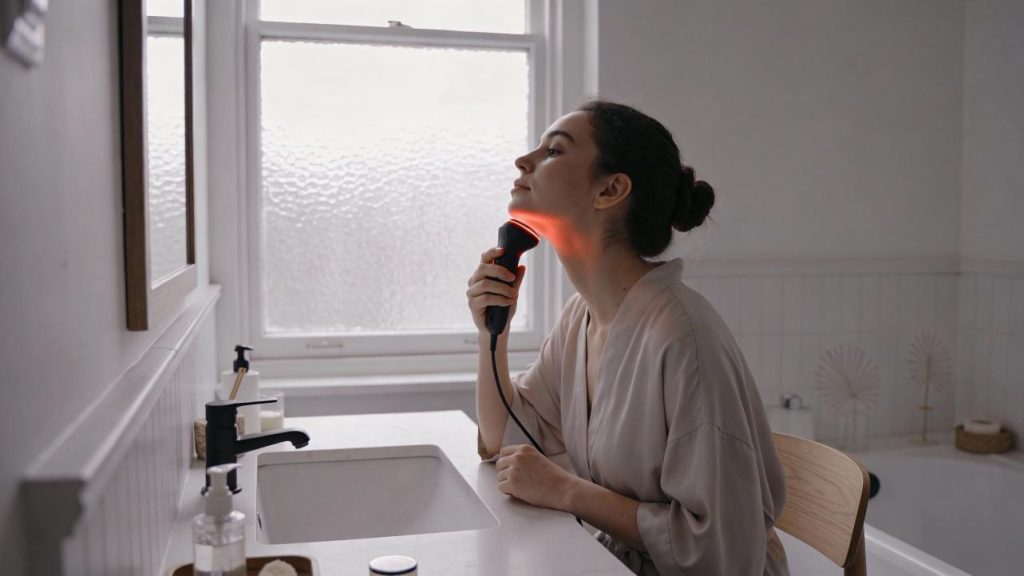
Session dose in J/cm² is calculated as irradiance multiplied by time in seconds divided by 1000. A common professional protocol targets 10-20 J/cm² per area, which at 30 mW/cm² means a session of roughly 6-11 minutes. The failure mode to watch for is thermal drift: cheap drivers let output fall by 15-25% after 20 minutes as the LEDs heat up, so the delivered dose is lower than the timer suggests.
| Specification | Weak device | Professional device | Consequence for buyer |
|---|---|---|---|
| Peak wavelength tolerance | ±20 nm or unspecified | ±5 nm with spectral report | Wide bins create uneven output and unpredictable session consistency |
| Irradiance at 15 cm | Below 15 mW/cm² | 25-50 mW/cm² | Low irradiance doubles session time and reduces throughput in a clinic |
| Driver type | Constant voltage | Constant current | Constant voltage drivers cause current hogging and early LED failure |
| Thermal management | Thin PCB, passive only | Aluminum substrate plus active cooling | Overheating drops output and shortens emitter life below 20,000 hours |
| Certification documentation | None or photocopied | CE, RoHS, ISO 9001, ISO 13485 factory certificates | Without verifiable certificates, import clearance and liability coverage become risky |
Panel, Bed, or Handheld: Matching Form Factor to Use Case
Near infrared light therapy equipment comes in three main form factors, and the right choice depends on throughput and treatment area, not on marketing preference. A full-body panel of 300-1500 LEDs covers a large area in one session and is the standard for clinics and wellness centers. A bed or pod design offers 360-degree coverage but costs three to five times more and requires dedicated floor space.
Handheld devices are portable and inexpensive, but their small emitter array means irradiance drops sharply beyond 5 cm, so session time per area increases dramatically. For a distributor, panels offer the best balance of margin, shipping cost, and perceived value. For a clinic, the decision rule is throughput: if you need more than eight sessions per day, a panel pays for itself in labor time within a few months.
- Panel: 100-1500 LEDs, irradiance 25-50 mW/cm² at 15 cm, best for full-body or large-area sessions.
- Bed or pod: 360-degree coverage, 2000+ LEDs, high cost and space requirement, best for premium clinics.
- Handheld: 10-50 LEDs, irradiance drops below 10 mW/cm² beyond 5 cm, best for spot use or travel.
- Modular panel: linkable units of 300-600 LEDs, allows custom wall or stand configurations, simplifies inventory.
LED Binning, Drivers, and Thermal Design: What Actually Determines Lifespan
A near infrared light therapy panel is only as reliable as its LED binning and driver topology. Reputable manufacturers bin emitters by peak wavelength and radiant flux, then use constant-current drivers to keep each string at the designed forward current. Constant-voltage designs are cheaper but allow current to concentrate in the lowest forward-voltage LEDs, which causes early burnouts and uneven output.
Thermal design is the second silent killer. LEDs convert roughly 60-70% of electrical power into heat, and without an aluminum substrate and active cooling, junction temperature rises until output drops and the emitter degrades. Ask the supplier for the thermal resistance figure from junction to ambient; a professional panel should be below 10°C/W, while budget panels often exceed 20°C/W.
A practical rule of thumb: if a supplier cannot provide a spectral test report, an irradiance map at the working distance, and a driver schematic, the device is a commodity import regardless of the brand printed on the housing.
Factory Certifications and What They Do Not Mean
When evaluating near infrared light therapy devices for import or clinic use, factory certifications are a baseline, not a performance guarantee. CE marking indicates conformity with European safety and electromagnetic compatibility directives, RoHS restricts hazardous substances, and ISO 9001 or ISO 13485 show that the factory has a quality management system. These are factory and system certificates, not product performance endorsements.
The failure mode buyers hit is accepting a photocopied certificate without verifying it against the issuing body’s public database. A legitimate ISO certificate has a registration number that can be checked online. Also ask whether the certificate covers the specific factory address where your order will be produced; subcontracting to an uncertified facility is common in low-cost sourcing.
OEM and ODM Sourcing: MOQ, Lead Time, and Price Tiers
For importers and distributors, near infrared light therapy panels are typically sourced through OEM or ODM arrangements. General market context, not a specific quotation, shows three price tiers. Entry-level panels with 300-600 LEDs, basic drivers, and no spectral report range from $80 to $150 per unit at MOQs of 50-100 pieces. Mid-tier panels with constant-current drivers, aluminum substrates, and CE/RoHS documentation run $150 to $300 per unit at MOQs of 20-50 pieces.
Premium panels with 1000+ LEDs, active cooling, individual spectral reports, and ISO 13485 factory certification start around $300 and can exceed $800 per unit at MOQs of 10-20 pieces. Lead times are typically 30-45 days for production plus 15-25 days for ocean freight to North America or Europe. Always confirm whether tooling, logo printing, and packaging design are included in the unit price or charged separately.
Near Infrared Light Therapy Device Selection Checklist
Before placing an order, run every candidate device through this checklist. Each item is a decision rule that separates professional equipment from commodity imports, and skipping any one of them is how buyers end up with a warehouse full of panels that underperform the spec sheet.
- Request a spectral test report showing peak wavelength, tolerance, and FWHM for the exact LED bin used in production.
- Request an irradiance map at 15 cm and 30 cm, measured with a calibrated spectroradiometer, not a solar power meter.
- Confirm the driver topology is constant current, and ask for the schematic or a photo of the driver PCB.
- Ask for the thermal resistance from junction to ambient and the heatsink material and thickness.
- Verify CE, RoHS, ISO 9001, and ISO 13485 certificates against the issuing body’s public database.
- Get a written warranty covering at least 24 months and a stated LED lifespan of 50,000 hours at 70% output.
FAQ
What wavelength is best for near infrared light therapy devices?
For professional equipment, 830 nm or 850 nm with a binning tolerance of ±5 nm is the most defensible choice. The key is not the marketing peak but the actual spectral test report showing the full-width half-maximum and the tolerance across the production run.
How much irradiance do I need at the working distance?
Aim for 25-50 mW/cm² at 15-30 cm from the panel face. Below 15 mW/cm², session times become impractical for clinic throughput, and above 60 mW/cm², thermal management becomes a serious engineering challenge that budget panels rarely solve.
What is a realistic MOQ for a custom-branded panel?
Most factories quote MOQs of 20-50 units for standard panel designs with logo printing, and 100-300 units for fully custom housing or emitter layouts. Below 20 units, expect to pay a setup fee or accept a higher unit price.
How can I verify a factory’s ISO certificate is real?
Every legitimate ISO certificate carries a registration number and the name of the certification body. Check that number on the body’s public certificate database, and confirm the certificate lists the exact factory address where your order will be manufactured.
What to Do Next
Near infrared light therapy is a maturing B2B category, and the buyers who succeed are the ones who treat it as an engineering purchase, not a marketing one. The wavelength, irradiance, driver, and thermal specifications in this guide are all verifiable with a single email to the supplier, and any vendor who cannot answer them is telling you something important.
Before you commit to an order, get the spectral report, the irradiance map, and the driver schematic for the exact model you plan to import. Then verify the factory certifications and negotiate the warranty in writing. Those four documents will tell you more about the device than any brochure or sales call ever will.
Post time: 11-21-26