


A red light mask before and after comparison is the first thing most buyers ask for, but the honest answer depends on irradiance, dose, wavelength tolerance, and session consistency, not on a single photo pair. This article explains what changes are realistic over 4–8 weeks, how to measure the parameters that drive those changes, and what importers and clinic owners should check before ordering a mask in volume.
What a Red Light Mask Before and After Comparison Actually Shows
Most before and after images from consumer brands are taken under different lighting, angles, or skin hydration levels, which makes them unreliable as clinical evidence. A more useful approach is to look for repeatable changes in skin tone evenness and surface texture, which some users report after 4–8 weeks of consistent use. The key variables are wavelength, irradiance at the skin surface, and total energy delivered per session.
For a mask with 630–660 nm red and 810–850 nm near-infrared LEDs, a typical session delivers 3–10 J/cm² at an irradiance of 20–40 mW/cm². If a supplier cannot state these numbers, the before and after claim has no engineering basis. Ask for the mask’s spectral power distribution and the measured irradiance at the nominal treatment distance of 1–2 cm from the face.
Device Parameters That Determine Repeatable Results
Three parameters separate a professional mask from a cosmetic toy: wavelength binning, irradiance uniformity, and driver current stability. A mask with LEDs binned to ±5 nm around 633 nm and 830 nm will deliver a more consistent photobiomodulation dose than one with a ±15 nm tolerance. Irradiance should be measured with a calibrated spectrometer or photometer, not a phone app, and should not vary by more than 20% across the treatment area.
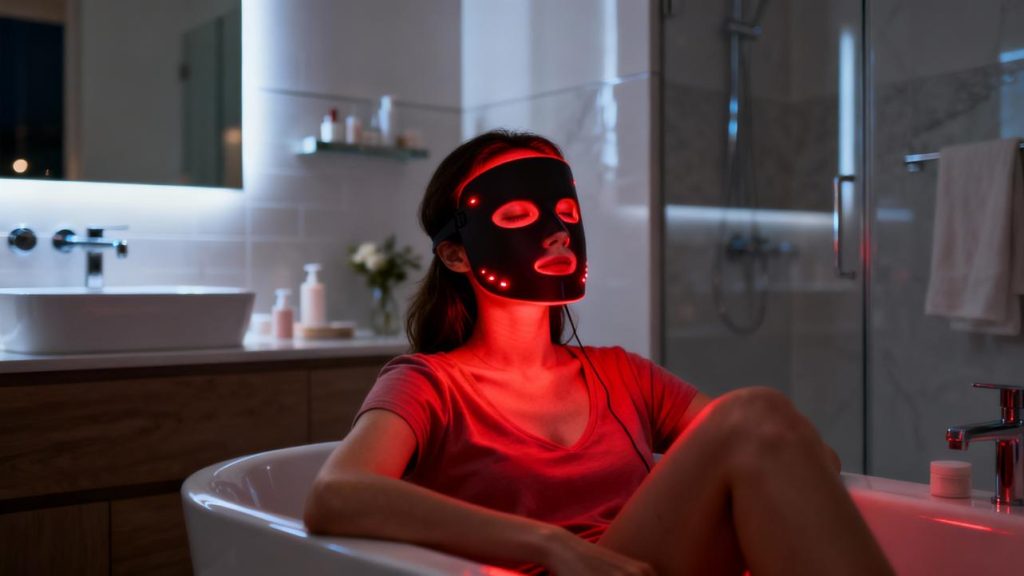
Constant-current drivers are non-negotiable for repeatable sessions. A cheap mask with resistor-limited LEDs will drop output as the battery voltage sags, so the user gets a different dose in minute one versus minute ten. Look for a driver that holds current within ±2% over the full session, and ask for a test report showing irradiance drift over a 20-minute run.
| Parameter | Weak spec | Strong spec | Consequence for buyer |
|---|---|---|---|
| Wavelength tolerance | ±15 nm | ±5 nm | Wider tolerance shifts the absorption peak and reduces dose accuracy |
| Irradiance uniformity | Not stated | ±20% across mask | Uneven output creates hot spots and under-dosed areas |
| Driver type | Resistor-limited | Constant-current, ±2% | Current drift changes dose during a session and between sessions |
| Session timer accuracy | ±30 seconds | ±1 second | Timer error directly changes total energy delivered |
| Peak irradiance at 2 cm | 10 mW/cm² | 30–40 mW/cm² | Lower irradiance requires longer sessions to reach the same dose |
Red Light Mask Before and After: What Changes in 4–8 Weeks
Users who follow a consistent protocol of 10–15 minutes per session, 4–5 times per week, often report more even skin tone and a smoother surface texture after about four weeks. These are subjective observations, not medical outcomes, and they vary with baseline skin condition, age, and environmental factors. The photobiomodulation mechanism involves photon absorption by cytochrome c oxidase in mitochondria, which may support cellular energy production, but the visible change is gradual and cumulative.
For a clinic or distributor, the more important before and after is the device’s output before and after 500 hours of use. LED output degrades over time, typically 3–5% per 1,000 hours for quality mid-power LEDs, but poor thermal design can accelerate this to 10% or more in the first 200 hours. Ask the factory for an LM-80 test report or an in-house accelerated life test showing irradiance retention after 1,000 hours at 25°C ambient.
A practical rule of thumb: if a supplier shows before and after photos but cannot state irradiance, dose, and wavelength tolerance, the photos are marketing, not evidence.
How to Compare Masks for Import or Clinical Use
When evaluating a red light mask for OEM or distribution, compare the full bill of materials, not just the LED count. A mask with 66 LEDs at 20 mW/cm² can outperform a mask with 132 LEDs at 10 mW/cm², because the dose per session is what matters. Check the mask’s weight, flex PCB design, and heat dissipation path: a mask that runs above 40°C on the skin surface will be uncomfortable and may reduce session compliance.
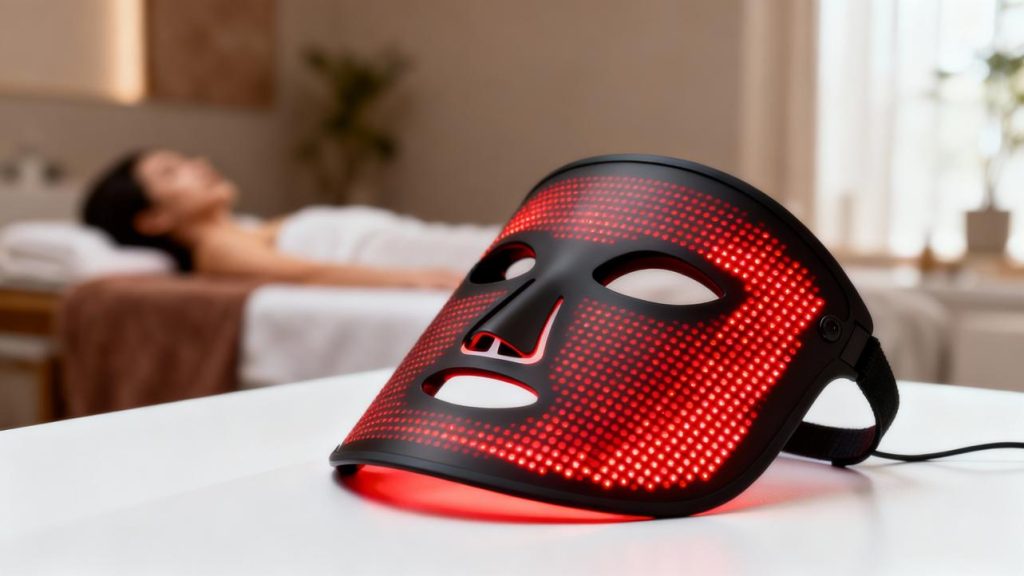
- Request a spectral irradiance plot for both red and near-infrared channels, measured at the nominal treatment distance.
- Ask for the LED manufacturer and bin code; brands like Seoul Viosys, Luminus, or Nichia provide tighter bins than unbranded chips.
- Confirm the driver is constant-current, not constant-voltage, and ask for the current tolerance over input voltage range.
- Check the mask’s IP rating if it will be used in a clinic with cleaning protocols; IP22 is common, IP54 is better for wipe-down disinfection.
- Ask for the factory’s ISO 13485 certificate if the mask is marketed for professional use; CE and RoHS alone do not cover quality management.
OEM and ODM Sourcing: What Changes Before and After Customization
For importers, the before and after of an OEM project is the difference between a generic mask and a branded device with custom wavelength ratios, irradiance profiles, and firmware. A typical OEM mask project starts at 500–1,000 units, with tooling costs of $3,000–$10,000 for a custom shell and $1,000–$3,000 for custom packaging. Lead time is usually 45–60 days after sample approval, plus 10–15 days for sea freight to the US or EU.
The most common failure mode in OEM masks is not the LEDs but the flex PCB connectors and the battery management system. A mask that flexes repeatedly can crack solder joints at the LED pads, causing dead zones after a few hundred hours. Ask the factory for a flex-cycle test report: 10,000 cycles at a 30-degree bend angle is a reasonable minimum. Also confirm the battery has over-discharge and over-temperature protection, and that the charging circuit meets IEC 62133 for lithium cells.
Certifications and Factory Documentation to Request
A professional red light mask should ship with a CE declaration of conformity, RoHS compliance, and ideally an ISO 13485 certificate for the factory’s quality management system. These are factory certifications, not product approvals, but they indicate that the manufacturing process is controlled and audited. For photobiological safety, request an IEC 62471 test report that classifies the mask as Exempt or Risk Group 1 at the intended use distance; a mask that falls into Risk Group 2 may require additional user warnings.
Do not accept a supplier’s claim of “clinically tested” without seeing the study protocol, sample size, and the exact device used. Many clinical studies use professional panels with irradiance of 50–100 mW/cm², which is far higher than most consumer masks. If the mask you are buying delivers only 15 mW/cm², the study results do not transfer to your device.
FAQ: Red Light Mask Before and After
How long before I see a noticeable change with a red light mask?
Most users report noticing a change in skin tone evenness or texture after 4–8 weeks of consistent use at 3–10 J/cm² per session, 4–5 times per week. Results vary with baseline condition and device output; a mask with lower irradiance will require longer sessions or more weeks to reach the same cumulative dose.
What is the minimum irradiance a red light mask should have?
For a practical session length of 10–15 minutes, the mask should deliver at least 20 mW/cm² at the skin surface. Below 10 mW/cm², the session time to reach a 3 J/cm² dose exceeds 30 minutes, which most users will not maintain consistently.
Can I trust before and after photos from the manufacturer?
Only if the manufacturer also provides measured irradiance, wavelength tolerance, and session dose. Photos without these numbers are not evidence of device performance, because lighting, camera settings, and skin hydration can create misleading differences.
What should I check before ordering a mask in bulk?
Request a spectral plot, an irradiance uniformity map, a constant-current driver test report, and a flex-cycle test report. Also confirm the factory’s ISO 13485 certificate and the IEC 62471 photobiological safety classification. These documents protect you from dead zones, dose drift, and regulatory surprises after the shipment lands.
What to Do Next
A red light mask before and after comparison is only as good as the device parameters behind it. Before you commit to a supplier, ask for the three numbers that matter: irradiance at the treatment distance, wavelength tolerance, and dose per session. If the factory cannot provide these, move on.
For importers and clinic owners, the next step is to request a sample with a written test report, not a photo album. Run the mask for 20 minutes and measure the irradiance at minute one and minute twenty; a drop of more than 5% indicates a weak driver or poor thermal design. That single test will tell you more about the before and after than any marketing image ever will.
Post time: 11-24-26