


Red light therapy for healing is a growing category in the professional light therapy market, but not all devices deliver the same performance. This article answers the practical question: which specifications, certifications, and supplier practices actually matter when evaluating or sourcing a healing-focused red light therapy device?
How Red Light Therapy for Healing Works at the Device Level
Red light therapy for healing relies on delivering specific wavelengths of light to tissue, typically in the 630-660 nm red and 810-850 nm near-infrared bands. These wavelengths penetrate skin to different depths, with red light reaching roughly 1-3 mm and near-infrared reaching 5-10 mm depending on skin type and optical properties. The mechanism is photobiomodulation: photons are absorbed by cytochrome c oxidase in mitochondria, which may increase ATP production and modulate cellular signaling.
For a device to support healing, the key engineering challenge is consistent irradiance across the treatment area. Irradiance is measured in mW/cm2, and most clinical and commercial devices operate in the range of 3-50 mW/cm2 at the skin surface. A device that claims high power but delivers uneven irradiance can create hot spots or under-dose regions, reducing repeatability.
Wavelength Bands and Their Practical Consequences
Healing-focused devices typically use two bands: 630-660 nm red and 810-850 nm near-infrared. The choice affects penetration depth, heat generation, and perceived brightness. Red light is visible and creates a bright treatment environment, while near-infrared is invisible and can feel warm at higher irradiance.
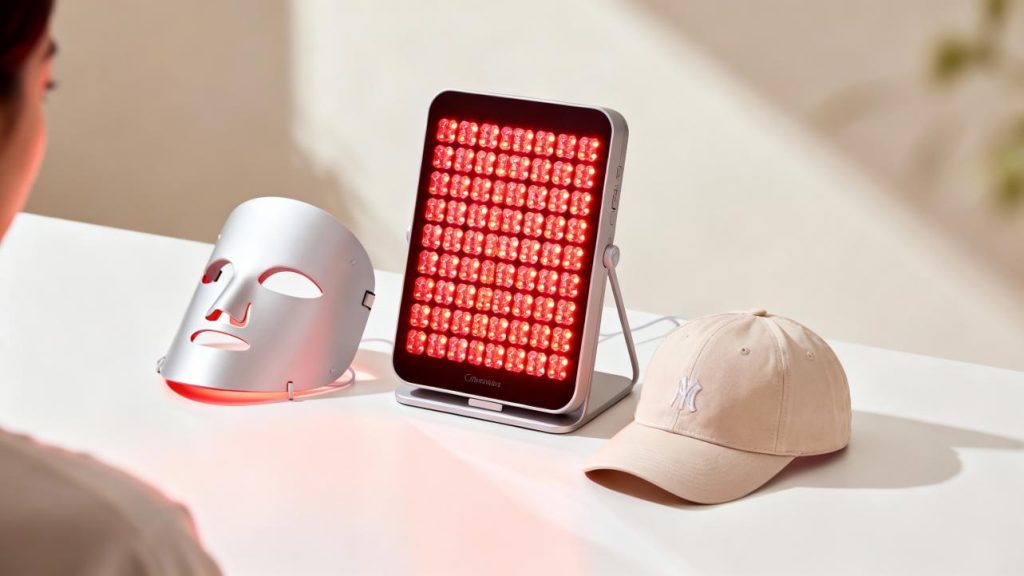
- 630-660 nm red: absorbed more superficially, good for skin-level support, visible light allows easy positioning verification.
- 810-850 nm near-infrared: penetrates deeper, may support muscle and joint tissue, but requires careful thermal management because invisible light can cause overheating without user awareness.
- Dual-chip panels: combine both bands, but the ratio matters. A 1:1 red to NIR ratio is common, while 2:1 or 3:1 red-dominant ratios are preferred for skin-focused healing applications.
When comparing devices, ask for the spectral power distribution, not just the peak wavelength. A low-cost LED may have a peak at 660 nm but a wide tolerance of ±20 nm, meaning a significant portion of output falls outside the therapeutic window. Reputable manufacturers bin LEDs to ±5 nm or tighter and provide test reports.
Irradiance, Dose, and the Measurement Problem
Irradiance is the most misreported specification in red light therapy. Some suppliers quote the LED chip output rather than the irradiance at the treatment plane, which can overstate performance by 50% or more. The relevant number is irradiance measured with a calibrated spectrometer or photometer at the intended treatment distance, usually 6-12 inches from the panel.
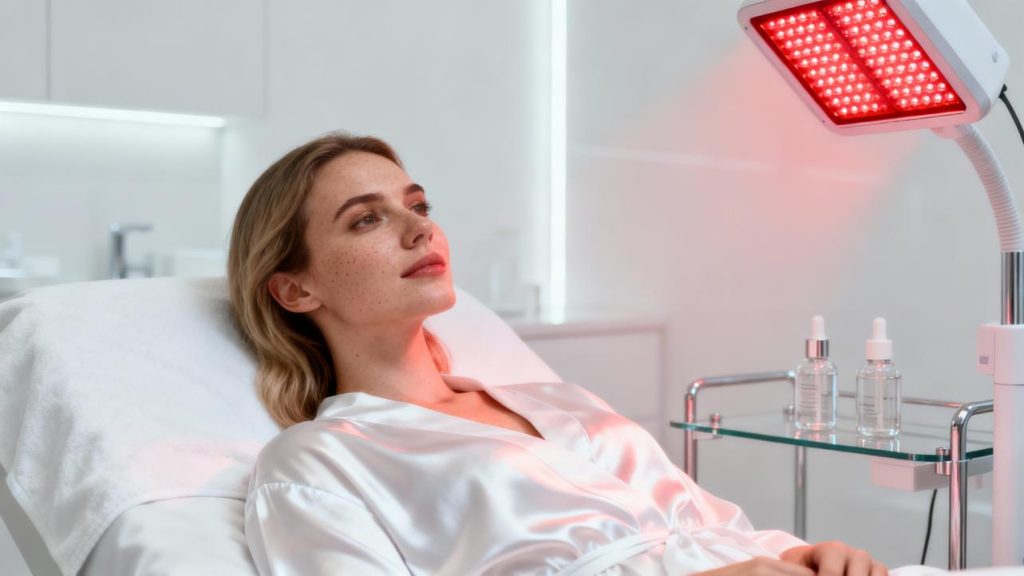
Dose, measured in J/cm2, is irradiance multiplied by time in seconds. For healing support, common session doses range from 3-20 J/cm2, which at 20 mW/cm2 means 2.5-16.7 minutes. Higher irradiance shortens session time but increases heat and potential discomfort. A device with 100 mW/cm2 is not automatically better; it may simply force shorter sessions and raise the risk of thermal injury if not properly cooled.
Rule of thumb: if a supplier cannot provide an irradiance map at multiple distances, treat the specification as unverified. A single center-point measurement hides edge drop-off that can exceed 30% on poor panels.
Device Classes: Panel, Bed, and Handheld Compared
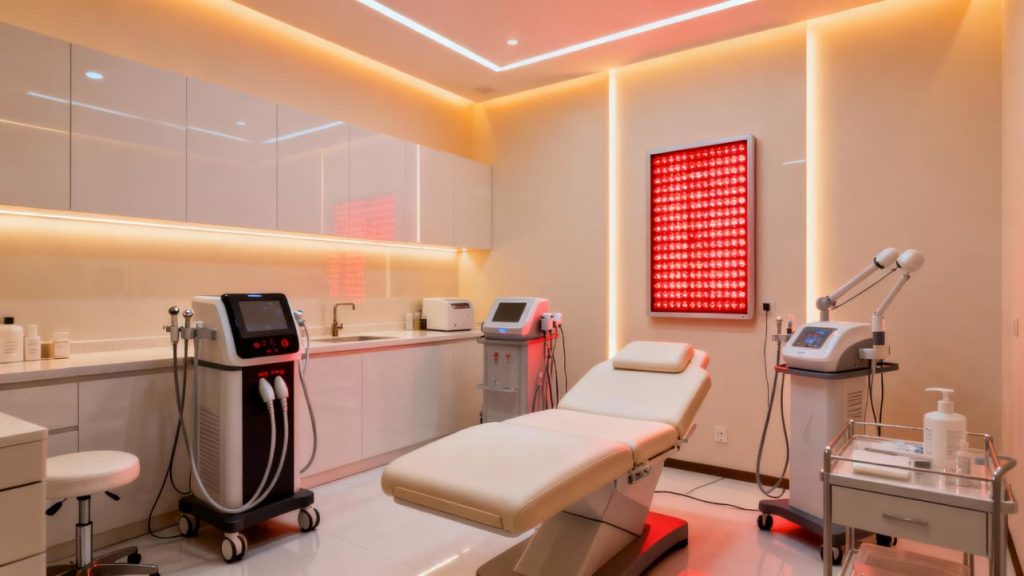
Healing-focused devices come in three main form factors, each with different trade-offs for clinics and distributors. The table below summarizes the practical consequences of each choice.
| Device Class | Typical Irradiance | Coverage Area | Key Consequence for Buyers |
|---|---|---|---|
| LED panel (large) | 10-50 mW/cm2 | 300-1200 cm2 | Best for full-body or large-area healing support; requires mounting and ventilation planning. |
| LED panel (targeted) | 20-80 mW/cm2 | 50-200 cm2 | Good for localized applications; higher irradiance means shorter sessions but closer skin contact needed. |
| LED bed or mat | 5-20 mW/cm2 | 1000-2000 cm2 | Uniform low-dose exposure; long sessions, lower thermal load, but difficult to verify dose per body region. |
| Handheld device | 30-100 mW/cm2 | 5-30 cm2 | Portable and low cost, but very small coverage; session time for large areas becomes impractical. |
For clinic owners, large panels offer the best throughput but require dedicated space and electrical circuits. Distributors should note that beds and mats are heavier and costlier to ship, while handhelds have high return rates due to unrealistic user expectations about coverage.
Build Quality, Thermal Design, and Lifespan
A healing device that overheats will drift in wavelength and lose irradiance over time. LED junction temperature directly affects output: a rise of 10°C can reduce output by 3-5% and shift peak wavelength by 1-2 nm. Quality panels use aluminum PCBs, active fan cooling, and thermal cutoff switches that shut down the device if internal temperature exceeds 60-70°C.
Driver quality is equally important. Constant-current drivers maintain stable output across voltage fluctuations, while cheap constant-voltage drivers can cause flicker and uneven LED brightness. Ask for the driver brand and mean time between failures (MTBF) rating; reputable drivers are rated for 50,000 hours or more. The LED chips themselves should be from known suppliers such as Osram, Seoul Semiconductor, or Epistar, with binning data provided.
Lifespan claims of 100,000 hours are common but meaningless without specifying the L70 point—the time at which output drops to 70% of initial. For healing applications, a device should maintain at least 80% of initial irradiance for 20,000 hours of use, which is roughly 5 years at 10 hours per week.
Certifications and Factory Documentation
When sourcing healing-focused devices, factory certifications are the primary evidence of quality and consistency. Look for CE marking for electrical safety and electromagnetic compatibility in the European market, RoHS compliance for restricted substances, and ISO 9001 for quality management. For medical-grade manufacturing, ISO 13485 indicates a quality system designed for medical devices, though it does not by itself authorize sale in any specific country.
Request the following documents before placing an order:
- IEC 62471 photobiological safety test report, which classifies the device as Exempt or Risk Group 1 for eye and skin exposure.
- Irradiance uniformity map at the stated treatment distance, measured with a calibrated spectrometer.
- LED binning certificate showing wavelength tolerance of ±5 nm or tighter.
- Driver MTBF report and thermal test data at maximum rated ambient temperature.
A supplier that cannot provide these documents is likely reselling generic panels without quality control. The cost difference between a certified and uncertified panel is typically 20-40%, but the failure rate and performance drift make uncertified units more expensive in the long run.
OEM/ODM Sourcing: MOQ, Lead Time, and Price Tiers
For importers and distributors, sourcing healing-focused red light therapy devices involves three main tiers. The table below shows typical market ranges as of 2026, not specific quotations.
| Sourcing Tier | Typical MOQ | Lead Time | Price per Unit (FOB) | Consequence |
|---|---|---|---|---|
| Generic stock panel | 10-50 units | 7-15 days | $80-$250 | Fastest but no customization; variable LED quality and no irradiance map. |
| OEM with logo and minor changes | 50-200 units | 30-45 days | $150-$400 | Requires deposit and artwork approval; supplier handles certification transfer. |
| Full ODM custom design | 200-1000 units | 60-120 days | $300-$800+ | Highest control over wavelengths, form factor, and software; tooling costs apply. |
Lead times assume the supplier has components in stock. During LED shortages, lead times can double. Always confirm whether the price includes packaging, user manual translation, and any required electrical plugs for your target market. Shipping costs for large panels are significant: a 300-panel order can require a 20-foot container, adding $2,000-$5,000 in freight.
Common Failure Modes and How to Avoid Them
Healing-focused devices fail in predictable ways, and most failures trace back to three root causes: poor thermal design, cheap drivers, and uncalibrated LEDs. The most common field failure is fan noise or fan failure, which leads to overheating and accelerated LED degradation. A second common issue is irradiance drop-off at the panel edges, which users notice as uneven results across the treatment area.
To avoid these problems, require a 72-hour burn-in test before shipment. This test runs the device at full power and catches early component failures. Also request a sample unit for independent testing before committing to a bulk order. A reputable supplier will provide one sample at a discount or free with a deposit against the main order.
After-sales support is a differentiator. Ask about warranty terms: 2 years is standard for panels, 1 year for handhelds. Clarify who pays for return shipping on warranty claims and whether the supplier provides replacement parts or full unit exchange. A supplier with no local service partner will create logistics headaches for clinic customers.
FAQ: Red Light Therapy for Healing Device Selection
What irradiance level is best for a healing-focused device?
For most healing support applications, 20-40 mW/cm2 at the treatment distance is practical. Lower irradiance requires longer sessions, while higher irradiance increases heat and the risk of discomfort. Verify the measurement distance and method before comparing devices.
Should I choose a panel with only red light or both red and near-infrared?
A dual-wavelength panel with 630-660 nm and 810-850 nm offers flexibility for different tissue depths. However, the ratio matters: a 1:1 ratio is balanced, while red-dominant panels are better for skin-focused healing. Check the spectral output, not just the marketing description.
How do I verify a supplier’s irradiance claims?
Request an irradiance map measured with a calibrated spectrometer at the stated distance, not a lux meter or a smartphone app. A single center-point number is insufficient. If the supplier cannot provide this, treat the specification as unverified and consider another source.
What is a realistic lifespan for a healing-focused LED panel?
Expect at least 20,000 hours of use before output drops below 80% of initial irradiance, assuming proper thermal management. This translates to roughly 5 years at 10 hours per week. Warranties of 2 years are common, and any claim of 100,000 hours without an L70 specification is marketing language.
Next Steps for Buyers and Distributors
Selecting a red light therapy device for healing support comes down to verified specifications, not marketing claims. Start by defining the treatment area and session time your customers expect, then work backward to the required irradiance and panel size. Request the four documents listed in the certifications section before any purchase commitment.
For importers and clinic owners, the most reliable path is to order a sample unit, test it independently for irradiance uniformity and thermal stability, and only then negotiate bulk pricing. A device that performs consistently and lasts five years will build trust with end users, while a cheap panel that drifts or overheats will damage your reputation faster than any marketing campaign can repair.
Post time: 11-26-26