


What does green light therapy do from a hardware and sourcing perspective? This article answers that question by examining the 520–540 nm green LED band, typical irradiance and dose ranges, and the practical differences between green, red, and near-infrared panels. You will leave with a concrete checklist for evaluating green light therapy devices before committing to an OEM or distribution agreement.
What Does Green Light Therapy Do at the Device Level?
Green light therapy devices emit visible light centered near 520–540 nm, with a typical full width at half maximum of 20–30 nm. Most panels deliver 3–50 mW/cm² at the treatment surface, and a common session dose ranges from 3 to 20 J/cm². Unlike near-infrared panels, green light is fully visible and does not produce noticeable heat at these irradiance levels.
From an engineering standpoint, green LEDs have lower wall-plug efficiency than red or infrared emitters. A 525 nm LED may convert only 20–30% of electrical power into light, while a 660 nm red LED often exceeds 40%. This means a green panel needs more diodes or higher drive current to reach the same irradiance, which raises thermal management requirements.
Some users report that green light produces a calming visual effect, but the measurable output remains simple: photons in the green band. The device does not emit meaningful UV or infrared unless the manufacturer adds separate diode channels. Always confirm the spectral power distribution from the supplier, not just the marketing wavelength.
Wavelength Bands Compared: Green, Red, and Near-Infrared
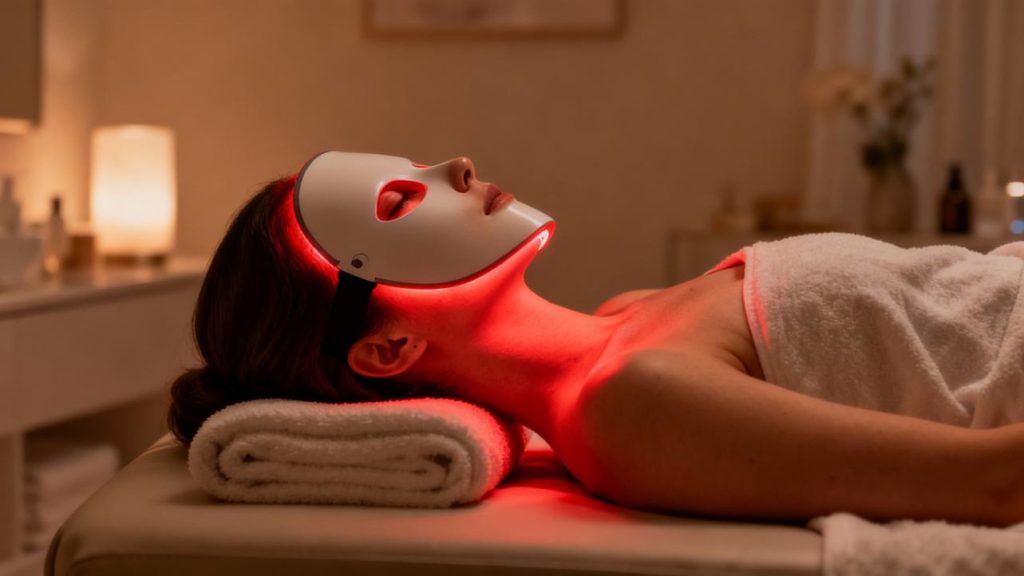
Green light sits between blue and red on the visible spectrum. In photobiomodulation devices, the three most common bands are 520–540 nm green, 630–660 nm red, and 810–850 nm near-infrared. Each band penetrates tissue to a different depth, which is the main reason buyers stock multiple panels.
| Band | Typical Wavelength | Penetration Depth | Primary Hardware Consequence |
|---|---|---|---|
| Green | 520–540 nm | Shallow, mostly epidermis | High visible brightness; lower LED efficiency; often used for skin-surface applications |
| Red | 630–660 nm | Deeper dermal layers | Best balance of efficiency and visible output; most common panel type |
| Near-infrared | 810–850 nm | Deepest, reaches muscle | Invisible output; requires careful eye safety labeling; higher electrical efficiency |
| Combination | Mixed bands | Depends on ratio | Flexible but complicates dose calculation and thermal design |
The table shows a direct consequence: green panels are often chosen for surface-level applications, while red and NIR panels are selected for deeper coverage. If a client asks for a single panel that does everything, the honest answer is that no single wavelength band covers all depths equally.
Key Specifications to Check Before Buying Green Light Therapy Devices
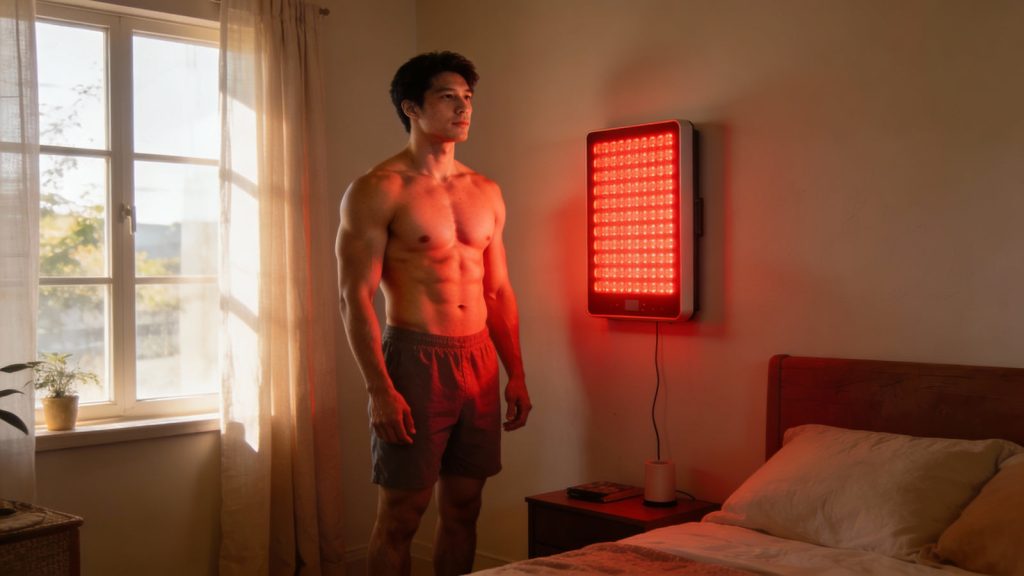
When evaluating a green light therapy panel, request the supplier’s spectral test report, not just a datasheet. The report should show the peak wavelength, spectral half-width, and irradiance measured at a stated distance, usually 6 or 12 inches. A missing test report is a red flag, because LED binning tolerances can shift the peak by ±5 nm or more.
- Peak wavelength and tolerance: Accept ±5 nm around 525 nm for most applications; reject panels with unspecified binning.
- Irradiance at working distance: Confirm mW/cm² at 6 inches and 12 inches; many suppliers only list contact irradiance, which overstates real-world output.
- Beam angle: A 30° lens concentrates light and increases central irradiance but reduces coverage area; a 60° or 90° lens spreads light more evenly.
- Driver type: Constant-current drivers maintain stable output over a session; constant-voltage drivers can cause irradiance drift as LEDs heat up.
- Thermal design: Look for aluminum PCB substrates and active cooling if the panel runs above 50°C case temperature after 30 minutes.
One common failure mode is thermal droop: as the LED junction temperature rises, light output drops by 10–20% within the first 15 minutes. A well-designed panel uses a constant-current driver with thermal feedback or oversized heat sinking to keep output stable.
Green Light Therapy Device Classes: Panel, Handheld, and Bed
Green light therapy devices come in three main form factors, each with different manufacturing costs and target customers. The choice affects your MOQ, certification route, and after-sales support burden.

A large panel, typically 300–1500 LEDs, is the most common B2B product. It offers uniform coverage over a wide area and is easier to certify because the light source is stationary. Handheld units are cheaper to produce but have lower irradiance and shorter battery life, which limits session duration. Full-body beds or pods are the most expensive to build and ship, with lead times often exceeding 60 days for custom designs.
For importers, panels usually have an MOQ of 50–200 units, handhelds 500–1000 units, and beds 10–50 units. Lead times range from 30 to 90 days depending on whether the housing is off-the-shelf or custom-molded. Always ask whether the supplier owns the mold or uses a shared mold, because shared molds limit your ability to differentiate the product.
Factory Certifications and Quality Control for Green Light Panels
When sourcing green light therapy devices, factory certifications matter more than marketing claims. Look for CE marking under the Low Voltage Directive and Electromagnetic Compatibility Directive, plus RoHS compliance for lead-free soldering. ISO 9001 indicates a quality management system, while ISO 13485 is relevant if the device is marketed as medical-grade in some regions.
A practical rule of thumb: if a supplier cannot provide a spectral test report and a copy of their ISO 9001 certificate within 48 hours, walk away. Legitimate factories keep these documents on file and share them before you place a sample order.
Incoming quality control should include a 100% functional test of every LED channel, not just a visual inspection. Ask for the factory’s AQL sampling plan and their policy on dead-on-arrival units. A typical industry standard is AQL 1.5 for major defects and AQL 4.0 for minor cosmetic issues.
OEM and ODM Sourcing: What to Ask a Green Light Therapy Supplier
If you plan to private-label a green light therapy panel, the first question is whether the supplier offers true ODM or only logo printing. True ODM means the factory can modify the PCB layout, lens angle, housing color, and firmware settings. Logo-only OEM limits you to the supplier’s existing design, which may already be sold by competitors.
Request a detailed bill of materials before signing a contract. The BOM should list the LED manufacturer and bin code, driver IC part number, heat sink material, and connector types. A supplier that refuses to share the BOM is likely hiding low-quality components or planning to substitute parts later.
Typical price tiers for a 300-LED green panel range from $80 to $150 per unit at 200-unit MOQ, depending on housing quality and driver type. Handheld units run $15–$40 at 1000-unit MOQ. Shipping costs for panels are high due to size, so negotiate FOB terms carefully and consider regional warehousing if your market is large.
Safety, Maintenance, and After-Sales for Green Light Therapy Devices
Green light at 3–50 mW/cm² is generally considered low-risk for skin exposure, but eye safety still matters. The bright visible output can cause discomfort or afterimages, so panels should include a built-in timer and a warning label advising users to close their eyes or wear protective goggles. Some manufacturers add a motion sensor that pauses the session if someone moves too close.
Maintenance for green panels is simpler than for NIR panels because the LEDs are visible, making dead diodes easy to spot. A good after-sales policy covers LED replacement for at least 12 months and provides a repair manual for the driver board. Ask about spare part availability: a panel with a proprietary driver that cannot be replaced is a liability for your service team.
Battery-powered handhelds require a replacement battery program. Lithium-polymer cells degrade after 300–500 charge cycles, so plan for a spare battery SKU and clear disposal instructions. For panels, the main failure points are the power supply and the cooling fan, so stock those parts in your warehouse.
FAQ: Green Light Therapy Device Sourcing and Use
What is the difference between green light and red light therapy devices?
Green light uses 520–540 nm LEDs with shallow tissue penetration, while red light uses 630–660 nm LEDs that reach deeper dermal layers. Green LEDs are less electrically efficient, so a green panel needs more diodes or higher current to match red panel irradiance.
Can I combine green and red LEDs in one panel?
Yes, many manufacturers offer dual-band or tri-band panels. The trade-off is that each channel needs its own constant-current driver, which increases cost and PCB complexity. You must also specify the irradiance ratio, such as 50% green and 50% red, because the supplier cannot guess your intended use.
What MOQ and lead time should I expect for green light panels?
For a standard 300-LED green panel, expect an MOQ of 50–200 units and a lead time of 30–45 days for existing designs. Custom housing or firmware changes can push lead time to 60–90 days. Handheld units typically require 500–1000 units MOQ with 30–60 day lead times.
How do I verify the actual wavelength of a green light therapy device?
Request a spectral power distribution report from an integrating sphere measurement. The report should show the peak wavelength, full width at half maximum, and irradiance at a stated distance. If the supplier cannot provide this, order a sample and test it with a calibrated spectrometer before placing a bulk order.
What Does Green Light Therapy Do for Your Product Line?
What does green light therapy do for a distributor or clinic owner? It adds a visible, surface-focused wavelength band that complements red and near-infrared panels. The hardware trade-offs are clear: lower LED efficiency, higher thermal load, and the need for precise spectral binning.
Before you commit, compare at least three suppliers on spectral test reports, driver topology, and after-sales spare part availability. A green panel that drifts 10 nm from its spec or loses 20% output after 15 minutes will generate returns and damage your brand. Ask for the BOM, the AQL plan, and a sample unit with a full test report.
If the supplier can answer those technical questions clearly, you have a viable product. If they deflect to marketing language, keep looking. The green light therapy market rewards buyers who treat wavelength and irradiance as measurable specifications, not adjectives.
Post time: 11-27-26