

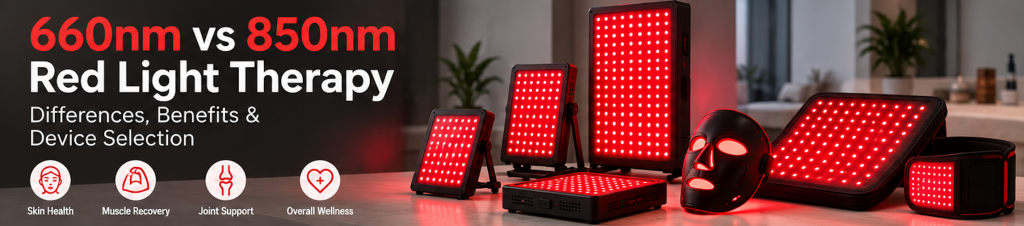
When comparing red light therapy devices, two wavelengths appear frequently: 660nm red light and 850nm near-infrared light.
But what is the difference between 660nm and 850nm red light therapy? Which wavelength penetrates deeper? And should clinics, gyms, wellness centers, and private-label brands choose one wavelength or combine both?
The answer depends on the intended application, tissue characteristics, irradiance, treatment distance, exposure time, and device design.
For businesses sourcing professional equipment, understanding these differences is important when evaluating product specifications and selecting an appropriate red light therapy panel.
This guide compares 660nm and 850nm, explains their optical characteristics, and provides a practical framework for professional device selection.
What Is the Difference Between 660nm and 850nm Red Light Therapy?
The primary difference is wavelength.
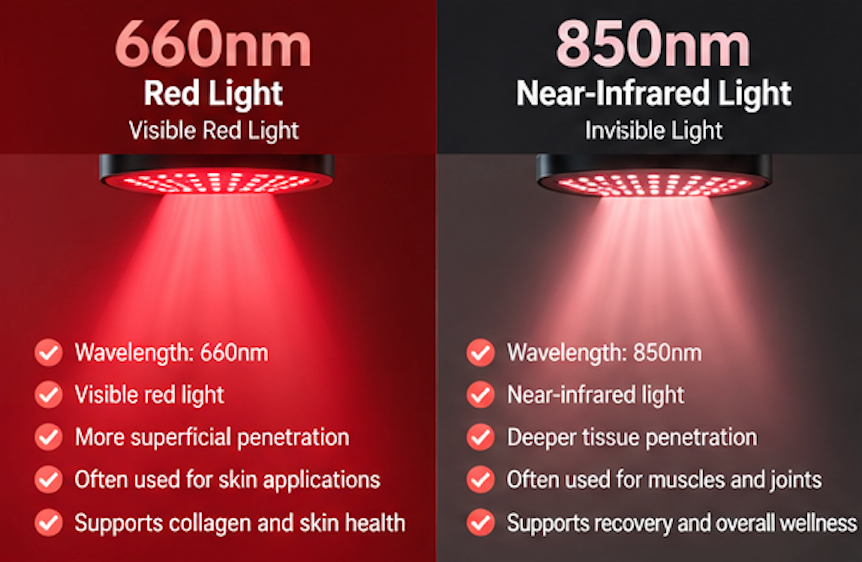
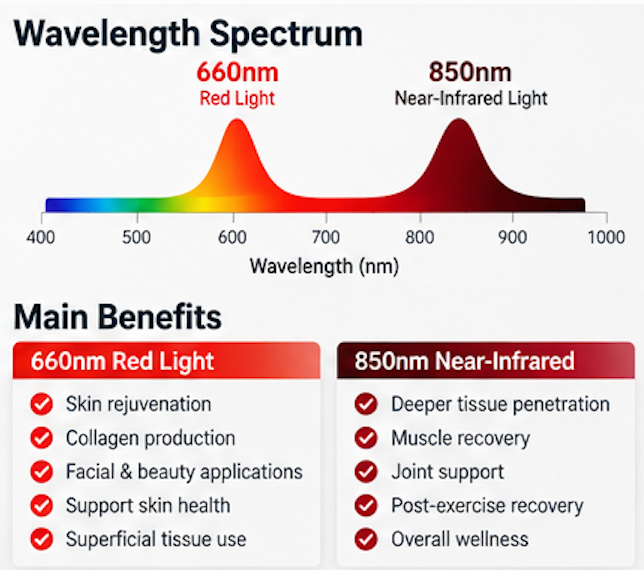
660nm belongs to the visible red portion of the electromagnetic spectrum, while 850nm belongs to the near-infrared spectrum.
Both wavelengths are used in photobiomodulation (PBM) research and commercial LED systems.
However, they interact with biological tissue differently because absorption and scattering vary with wavelength.
660nm vs 850nm Comparison Table
| Feature | 660nm Red Light | 850nm Near-Infrared |
|---|---|---|
| Wavelength | 660 nanometers | 850 nanometers |
| Light spectrum | Visible red | Near-infrared |
| Human visibility | Visible | Mostly invisible |
| Tissue penetration | Often associated with more superficial applications | Generally offers greater penetration potential |
| Common research applications | Skin and superficial tissues | Deeper tissue and musculoskeletal applications |
| Commercial device formats | Masks, targeted panels, professional panels | Targeted panels, full-body panels, NIR systems |
| Professional use | Depends on device intended use | Depends on device intended use |
| Combined configuration | Can be paired with 850nm | Can be paired with 660nm |
Neither wavelength should be considered universally superior.
The appropriate selection depends on the application and complete device specifications.
What Is 660nm Red Light Therapy?
660nm red light is a visible wavelength commonly incorporated into LED photobiomodulation devices.
It is frequently discussed in research involving skin and relatively superficial tissues.
How Does 660nm Red Light Work?
When red light enters biological tissue, some photons are absorbed, some are scattered, and some are reflected.
Photobiomodulation research investigates how light exposure may influence cellular signaling and biological processes.
Mitochondrial chromophores, including cytochrome c oxidase, have been proposed as possible participants in some PBM mechanisms, although the underlying biology is complex and not fully established.
The response depends on wavelength, optical dose, tissue characteristics, and treatment conditions.
Common Applications of 660nm Red Light
660nm is often considered for devices intended for:
- Skincare-focused applications
- Facial LED systems
- Superficial tissue illumination
- Beauty and aesthetic equipment
- Targeted red light therapy panels
- Professional wellness systems
These are application categories, not guarantees of particular medical or cosmetic outcomes.
660nm for Beauty Centers and Spas
Beauty centers often prioritize compact devices, comfortable positioning, and consistent illumination across a defined treatment area.
A 660nm-inclusive device may be relevant to a skincare-oriented product line.
However, businesses should evaluate the device’s intended use, supporting evidence, safety instructions, and applicable regulatory requirements before making treatment claims.
Explore our Beauty Red Light Therapy Solutions for commercial equipment considerations.
What Is 850nm Near-Infrared Light Therapy?
850nm is a near-infrared wavelength commonly used in professional photobiomodulation equipment.
Unlike visible red light, 850nm radiation cannot normally be seen directly by the human eye.
Some infrared LEDs may show a faint visible glow, but this is not a reliable indicator of their optical output.
How Does 850nm Light Interact With Tissue?
Near-infrared wavelengths can exhibit different absorption and scattering characteristics from visible red wavelengths.
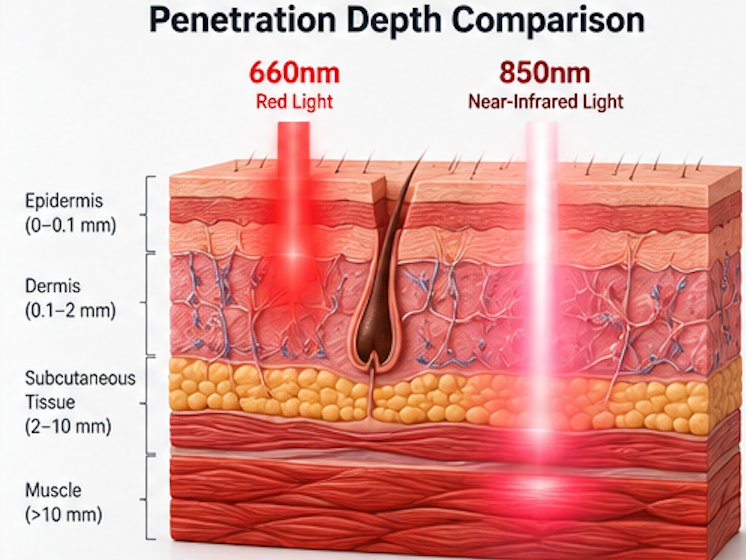
Under comparable conditions, 850nm light generally has greater potential to reach deeper tissue than 660nm light.
However, penetration is not a fixed depth.
It varies with:
- Tissue composition
- Skin pigmentation
- Blood content
- Optical properties
- Irradiance
- Beam geometry
- Treatment distance
- Measurement method
A device should not be advertised as reaching a specific tissue depth without appropriate supporting evidence.
Common Applications of 850nm Near-Infrared Light
850nm is commonly incorporated into equipment intended for:
- Fitness and wellness facilities
- Musculoskeletal research applications
- Large-area illumination
- Recovery-oriented wellness equipment
- Full-body light therapy systems
- Professional red and near-infrared panels
Clinical effectiveness for a specific condition must be evaluated separately from the fact that a device emits 850nm light.
660nm vs 850nm: Which Wavelength Penetrates Deeper?
In general, 850nm near-infrared light has greater penetration potential than 660nm visible red light under comparable conditions.
However, the amount of light that reaches a particular tissue depends on multiple variables.
Why Wavelength Matters
Biological tissues contain components that absorb and scatter light.
These include water, blood, melanin, and other tissue structures.
Different wavelengths interact with these components differently.
This changes how optical energy is distributed within tissue.
Does Deeper Penetration Mean Better Results?
Not necessarily.
Greater penetration does not automatically mean a better biological or clinical outcome.
For example, a superficial application may not require the same optical characteristics as a deeper-tissue research application.
The appropriate wavelength should be selected according to the intended use and supporting evidence.
For B2B buyers, the important question is:
Does the device deliver the appropriate wavelength and optical exposure for the intended application?
660nm vs 850nm for Skin, Muscles and Wellness Applications
Different business segments may have different equipment requirements.
660nm for Skin-Focused Applications
Visible red light around 660nm is commonly included in skincare-oriented photobiomodulation research.
Professional buyers should consider:
- Wavelength accuracy
- Irradiance
- Coverage uniformity
- Treatment distance
- Device positioning
- Eye safety
- Intended-use documentation
850nm for Musculoskeletal Applications
Near-infrared wavelengths such as 850nm are often investigated in musculoskeletal and recovery-related research.
However, evidence and protocols vary by condition.
Businesses should avoid claiming that a wavelength alone guarantees muscle recovery, pain relief, or tissue healing.
Dual-Wavelength Systems for Commercial Flexibility
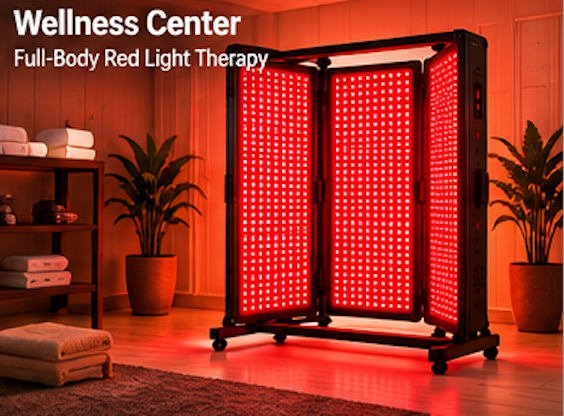
A panel combining 660nm and 850nm can provide both visible red and near-infrared output.
This can offer flexibility for businesses that require more than one optical configuration.
Whether both wavelengths should operate simultaneously or independently depends on the product design and intended application.
Why Do Red Light Therapy Panels Combine 660nm and 850nm?
Many commercial panels use dual-wavelength configurations.
A typical example is:
660nm Red Light + 850nm Near-Infrared Light
This allows one device to emit light in two different spectral regions.
Advantages of Dual-Wavelength Configurations
Potential product-design advantages include:
- Providing visible red and near-infrared output in one device.
- Supporting different product configurations.
- Offering flexibility for professional equipment buyers.
- Reducing the need for separate single-wavelength devices in some settings.
- Enabling additional OEM/ODM configuration options.
However, dual-wavelength equipment is not automatically more effective than a single-wavelength device.
Performance depends on the optical output, exposure parameters, intended use, and supporting evidence.
Does 660nm or 850nm Require a Longer Treatment Time?
There is no universal treatment duration for either wavelength.
Session time depends on several variables, including irradiance and intended radiant exposure.
The basic relationship is:
Radiant Exposure (J/cm²) = Irradiance (W/cm²) × Time (seconds)
For example, if the irradiance at the target surface is 50 mW/cm²:
50 mW/cm² = 0.05 W/cm²
For a 10-minute exposure:
0.05 × 600 = 30 J/cm²
This calculation describes the radiant exposure at the measured surface under the stated assumptions.
It is not a treatment recommendation.
Actual exposure at deeper tissue locations may differ substantially.
For further information, read our How Long Should Red Light Therapy Sessions Last? guide.
Why Irradiance Matters When Comparing 660nm and 850nm
Wavelength alone does not describe how much optical power reaches the treatment surface.
Irradiance is commonly measured in milliwatts per square centimeter (mW/cm²).
For example, two panels may both use 660nm and 850nm LEDs but deliver different irradiance at the same distance.
This can happen because of differences in:
- LED output
- Optical lenses
- Beam angle
- LED spacing
- Electrical design
- Cooling
- Measurement conditions
What Should Buyers Ask Manufacturers?
Request:
- Irradiance at a defined distance
- Measurement method
- Center and average irradiance, where relevant
- Red and near-infrared output information
- Spectral test data
- Coverage area
- Operating settings
Read our Red Light Therapy Irradiance Guide for more information.
660nm vs 850nm: Which Is Better for Clinics?
Clinics should choose equipment according to the intended clinical application, applicable regulations, and validated operating procedures.
A professional clinic may evaluate:
- Targeted panels
- Tabletop systems
- Larger panels
- Dual-wavelength devices
- Adjustable optical output
- Appropriate documentation
What Should Clinics Compare?
Key considerations include:
- Intended use
- Wavelength
- Irradiance
- Exposure duration
- Treatment area
- Cleaning requirements
- Electrical safety
- Warranty and support
Explore our Red Light Therapy Solutions for Clinics.
660nm vs 850nm: Which Is Better for Gyms?
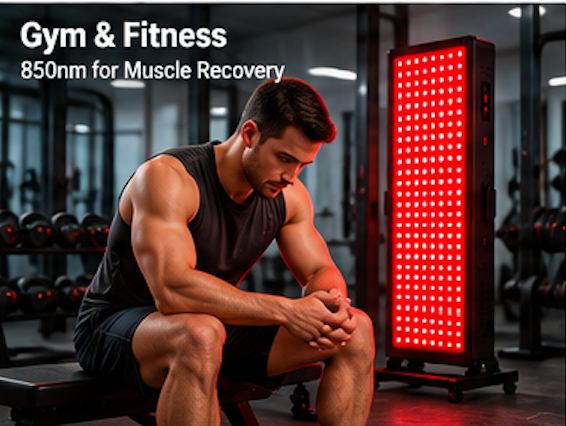
Gyms and fitness centers often prioritize coverage, ease of use, and commercial durability.
An 850nm-inclusive system may be relevant for businesses interested in recovery-oriented wellness equipment.
However, the complete device configuration matters more than the presence of one wavelength.
Important Considerations for Gyms
- Panel dimensions
- Treatment coverage
- Wavelength configuration
- Irradiance
- Controls and timers
- Cooling
- Operating noise
- Equipment durability
- Maintenance
A larger dual-wavelength panel may be more practical than a compact targeted device when the business requires broad-area illumination.
660nm vs 850nm: Which Is Better for Beauty Centers?
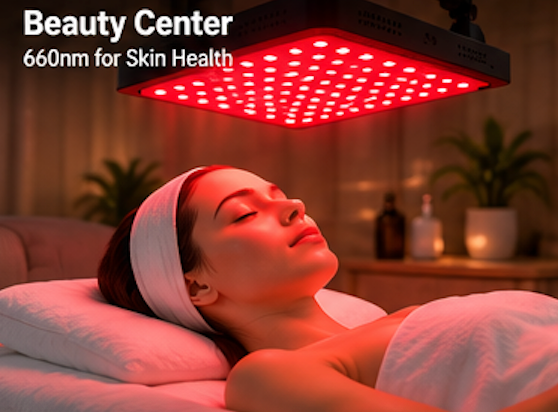
Beauty centers may prioritize visible red-light configurations, compact equipment, and convenient treatment positioning.
A 660nm-inclusive panel may fit certain skincare-focused equipment strategies.
Some businesses may also consider dual-wavelength systems.
Beauty Equipment Selection Checklist
- Intended cosmetic application
- Wavelength configuration
- Coverage area
- Adjustable positioning
- Optical output
- Eye protection requirements
- Customer comfort
- Cleaning procedures
- Product documentation
Learn more through our Beauty Red Light Therapy Solutions.
How to Choose a 660nm + 850nm Red Light Therapy Panel
For professional buyers, selecting a device requires more than comparing wavelengths.
Step 1: Identify the Application
Determine whether the equipment is intended for a clinic, gym, beauty business, wellness facility, or product distribution.
Step 2: Choose the Coverage Area
Compact panels may suit smaller areas, while larger panels provide broader illumination.
Step 3: Verify Wavelength Specifications
Confirm the nominal wavelengths and relevant tolerances.
Step 4: Compare Irradiance
Request measurements at the same distance and under comparable conditions.
Step 5: Review Control Functions
Check whether red and near-infrared channels can be operated independently.
Step 6: Evaluate Product Quality
Review construction, cooling, electrical safety, warranty, and available testing documentation.
Step 7: Assess Commercial Requirements
Consider:
- Minimum order quantity
- Customization options
- Sample availability
- Lead time
- Packaging
- Technical support
Explore our Professional Red Light Therapy Panels to compare available equipment formats.
OEM & ODM 660nm + 850nm Red Light Therapy Customization
For distributors and private-label brands, wavelength configuration is an important part of product development.
Depending on the product platform, an OEM or ODM project may involve customization of:
- 660nm and 850nm LED ratios
- Wavelength combinations
- LED quantity
- Panel dimensions
- Optical configuration
- Controller functions
- Independent wavelength controls
- Housing color
- Brand logo
- Packaging
- Accessories
Why LED Ratio Matters
A device advertised as 660nm + 850nm may use different quantities of LEDs for each wavelength.
For example, a product could use equal numbers of red and near-infrared LEDs or another ratio.
However, LED count alone does not establish the optical power ratio.
Buyers should request measured spectral output rather than assuming equal LED counts mean equal irradiance.
What Should OEM Buyers Confirm?
Before placing an order, ask the supplier:
- What is the exact wavelength configuration?
- What is the LED ratio?
- Can the two wavelengths operate independently?
- What is the measured irradiance?
- What is the measurement distance?
- Can the panel size or housing be customized?
- What is the MOQ?
- Are samples available?
- Which testing documents are available?
- What are the estimated production lead times?
Learn more about our Red Light Therapy OEM & ODM Manufacturing Solutions.
Common Mistakes When Comparing 660nm and 850nm
Mistake 1: Assuming 850nm Is Always Better
Greater penetration potential does not automatically translate into better results.
Mistake 2: Choosing Equipment Based Only on Wavelength
Irradiance, exposure time, coverage, and device design are also important.
Mistake 3: Assuming All Dual-Wavelength Panels Are Identical
Two panels may use the same nominal wavelengths but have different optical outputs and controls.
Mistake 4: Confusing Electrical Wattage With Optical Power
Electrical wattage does not directly describe irradiance at the target surface.
Mistake 5: Ignoring Product Documentation
Professional buyers should request appropriate specifications, test reports, and safety information.
Mistake 6: Making Unsupported Medical Claims
Commercial marketing claims should be consistent with the device’s intended use, available evidence, and applicable regulations.
Frequently Asked Questions
Is 660nm or 850nm better for red light therapy?
Neither is universally better. The appropriate wavelength depends on the intended application, optical output, exposure parameters, and device design.
What is the main difference between 660nm and 850nm?
660nm is visible red light, while 850nm is near-infrared light. They have different optical absorption and scattering characteristics in biological tissue.
Does 850nm penetrate deeper than 660nm?
Under comparable conditions, 850nm generally has greater tissue penetration potential, although actual penetration depends on tissue and optical parameters.
Is 660nm better for skin applications?
660nm is commonly included in devices and research involving skin and superficial tissues. Suitability depends on the specific application and supporting evidence.
Can 660nm and 850nm be used together?
Yes. Many professional red light therapy devices combine both wavelengths in one system.
Is a dual-wavelength panel better than a single-wavelength panel?
Not necessarily. A dual-wavelength device offers different spectral options, but effectiveness depends on the intended application and complete device specifications.
What is the best wavelength for a commercial red light therapy panel?
There is no universal best wavelength. Businesses should evaluate intended use, irradiance, treatment distance, coverage, controls, and documentation.
Can I customize the ratio of 660nm and 850nm LEDs?
Depending on the manufacturer and product design, LED ratios may be customizable. Engineering feasibility, MOQ, cost, and testing requirements should be confirmed.
Final Thoughts: Which Wavelength Should You Choose?
The difference between 660nm and 850nm red light therapy is important, but wavelength alone should not determine equipment selection.
660nm is a visible red wavelength commonly considered for superficial applications.
850nm is a near-infrared wavelength with generally greater tissue penetration potential.
A combined 660nm + 850nm system can offer additional flexibility for professional equipment configurations.
Before purchasing, compare:
Wavelength → Irradiance → Distance → Coverage → Exposure Time → Device Quality → Intended Use
For clinics, gyms, beauty centers, wellness businesses, distributors, and private-label brands, choosing the right equipment requires both technical evaluation and commercial planning.
Request a 660nm + 850nm Red Light Therapy OEM Quote
US Red Light Therapy offers professional red and near-infrared light therapy equipment and OEM/ODM customization options for B2B buyers.
If you are sourcing red light therapy panels or developing your own brand, share your:
- Preferred product type
- Required wavelength configuration
- Panel size
- Intended application
- Target market
- Estimated order quantity
- Branding requirements
- Packaging requirements
Our team can discuss available product configurations and customization options.
Explore Professional Products: Red Light Therapy Panels
Explore OEM/ODM: Red Light Therapy OEM & ODM Manufacturer
Request a Quote: Contact US Red Light Therapy
Post time: 10-10-26