

Physical therapy clinics are continually evaluating equipment that can complement existing rehabilitation services, support consistent clinical workflows, and meet the needs of their patients. Red and near-infrared light therapy equipment is one option that some clinics consider as part of a broader treatment program.
However, choosing the right device involves more than comparing wattage, LED quantity, or product prices. Clinics need to evaluate the intended application, wavelength, irradiance, treatment area, operating controls, safety documentation, and the supplier’s ability to provide reliable technical support.
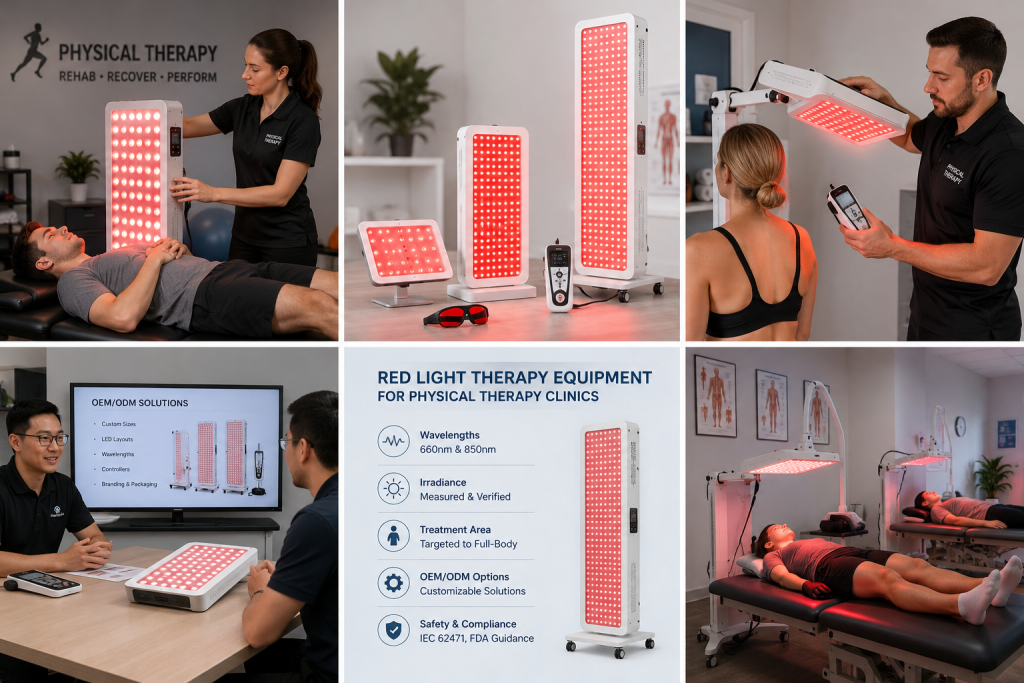
For distributors, clinic groups, and private-label brands, red light therapy equipment for physical therapy clinics OEM projects also require careful planning around product configuration, customization, quality control, and regulatory requirements.
This buyer’s guide explains how physical therapy clinics can evaluate professional red light therapy equipment and how B2B buyers can approach OEM and ODM sourcing with a clear set of technical and commercial requirements.
What Is Red Light Therapy Equipment for Physical Therapy Clinics?
Red light therapy equipment uses light-emitting diodes (LEDs), lasers, or other optical sources to deliver light at specified wavelengths. Photobiomodulation (PBM) is a term commonly used for particular light-based interventions investigated for biological effects.
Different devices use different optical sources, output levels, treatment areas, and delivery methods. Evidence for one device or application should not automatically be applied to another.
For physical therapy clinics, red and near-infrared light equipment may be evaluated as a potential adjunct to an appropriate rehabilitation program. Whether it is suitable depends on the device’s intended use, the patient’s circumstances, applicable clinical evidence, and the relevant regulatory requirements.
It should not automatically replace established rehabilitation interventions, exercise programs, or clinician-directed care.
1. Types of Red Light Therapy Equipment for Physical Therapy Clinics
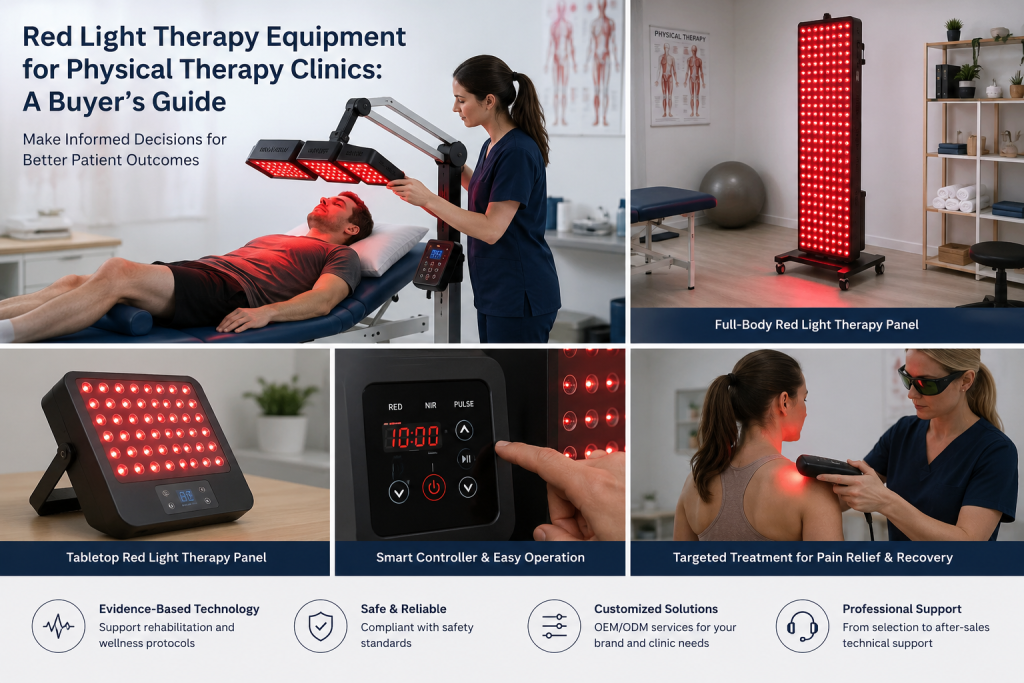
The first step in equipment selection is identifying the area to be treated and the workflow the clinic needs to support.
Different equipment formats offer different advantages.
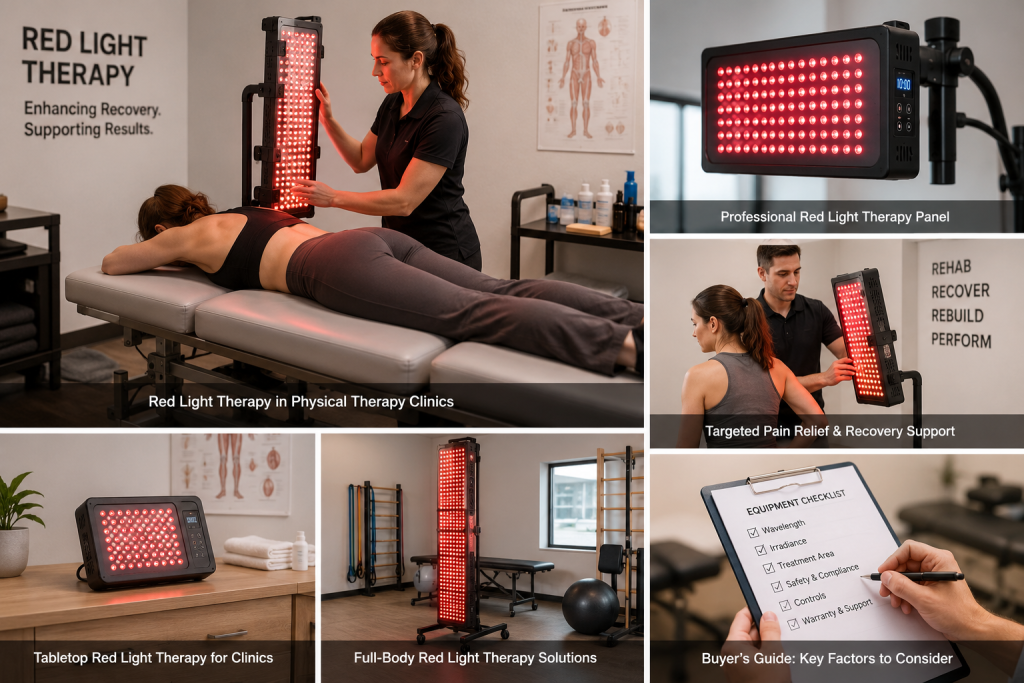
Targeted Red Light Therapy Panels
Targeted panels are designed to deliver light to a more limited area.
They may be considered by clinics that need equipment for localized applications or have limited treatment-room space.
When evaluating a targeted panel, review:
- The effective illuminated area
- Wavelength specifications
- Irradiance at a defined distance
- Positioning and mounting options
- Timer and output controls
- Cleaning and maintenance requirements
A smaller panel is not necessarily less capable for every application. Suitability depends on the intended use and the device’s verified output.
Tabletop Red Light Therapy Panels
Tabletop panels are compact systems that can be placed on a suitable surface or installed according to the manufacturer’s instructions.
They may be useful where a clinic needs a smaller equipment footprint or wants a flexible setup for selected applications.
For example, US Red Light Therapy lists a 110W tabletop panel in its product range. The rated electrical power is a product specification, not a substitute for measured irradiance or proof of clinical effectiveness.
Explore the Red Light Therapy Panel Product Range.
Large and Full-Body Red Light Therapy Panels
Larger panels can provide a broader illuminated area and may reduce the need to reposition equipment between certain applications.
Clinics should evaluate:
- Panel dimensions
- Effective treatment coverage
- Required treatment distance
- Mounting or positioning systems
- Cooling and heat management
- Stability and durability
- Power requirements
- Operator access and patient positioning
A larger panel may be appropriate for a clinic with sufficient space and a suitable intended application. It is not automatically the best choice for every patient or treatment protocol.
Read our guide to Full-Body vs. Targeted Red Light Therapy Panels.
Multi-Panel Configurations
Some facilities may consider multiple panels when they need broader coverage or more flexible positioning.
Before choosing a multi-panel system, confirm whether the panels can operate together as intended, how the power requirements are managed, and whether the combined configuration has been evaluated for safety.
Do not assume that combining individual panels automatically creates a validated treatment system.
Which Equipment Format Should You Choose?
| Clinic Requirement | Equipment to Evaluate | Key Purchasing Considerations |
|---|---|---|
| Limited treatment-room space | Tabletop panel | Footprint, positioning, output |
| Localized applications | Targeted panel | Effective area, distance, controls |
| Broader coverage | Large panel | Coverage, mounting, cooling |
| Flexible positioning | Adjustable panel system | Stability, reach, operator access |
| Multiple treatment stations | Multiple compatible devices | Power, workflow, maintenance |
| Branded equipment program | OEM/ODM-configured devices | Specifications, documentation, quality control |
The right format should be selected according to the clinic’s actual requirements, not solely according to the highest wattage or largest product size.
2. Wavelength: Understanding Red and Near-Infrared Light
Wavelength is an important specification when comparing red light therapy equipment.
Commonly discussed wavelengths include:
- 660nm: Visible red light.
- 810–850nm: Near-infrared wavelengths used in various photobiomodulation devices.
A clinic should not assume that every wavelength is suitable for every application. Selection should be based on the device’s intended use, relevant evidence, and technical documentation.
Red Light vs. Near-Infrared Light
Red light is visible to the human eye, while near-infrared light is generally not visible in the same way.
These spectral regions have different optical characteristics. However, wavelength alone does not establish how much optical energy reaches a particular tissue or whether a device will achieve a specific clinical outcome.
When reviewing a product, ask the supplier for:
- Nominal wavelength and tolerance.
- LED or optical-source specifications.
- Spectral measurement data, where available.
- Operating modes for each wavelength.
- The intended application and supporting evidence.
Should a Clinic Choose a Dual-Wavelength Device?
Some devices combine red and near-infrared wavelengths, such as 660nm and 850nm.
A dual-wavelength configuration may offer additional operating options, depending on the device’s design. It does not automatically provide better results than a single-wavelength device.
Compare the complete specifications and evidence rather than selecting equipment based on the number of wavelengths alone.
3. Irradiance: A Critical Specification for Equipment Buyers
Irradiance describes optical power received per unit area and is commonly expressed in milliwatts per square centimeter (mW/cm²).
For equipment buyers, it is an important parameter because electrical wattage alone does not tell you how much optical power reaches the intended measurement surface.
Two devices with similar rated electrical power can have different optical outputs.
What Should a Red Light Therapy Irradiance Report Include?
When comparing professional panels, request documentation that identifies:
- The measured wavelength or spectral range
- Irradiance values and units
- Measurement distance
- Measurement instrument and method
- Operating mode and intensity setting
- Measurement positions across the illuminated area
- Average and peak values, where applicable
- Relevant test conditions
If a supplier advertises a high irradiance value without stating the measurement distance or method, ask for clarification before comparing it with another product.
A measurement taken very close to the LEDs may not represent the output at the distance used in a clinic.
Why Measurement Distance Matters
Optical output at the treatment surface depends on the device’s optical design and the measurement geometry.
A useful comparison should therefore specify both the reported irradiance and the distance at which it was measured.
Clinics should not assume that a measurement at one distance remains unchanged at another.
Irradiance and Energy Density Are Not the Same
Irradiance is a rate of optical energy delivery per unit area. Energy density, often called fluence, describes energy delivered per unit area over a period of time.
For a simplified continuous-output calculation:
Energy density (J/cm²) = Irradiance (mW/cm²) × Exposure time (seconds) ÷ 1,000
For example, this equation can help explain the relationship between measured irradiance and exposure duration. It is not a recommended treatment prescription.
For pulsed devices, the calculation must account for the relevant output measurement and pulse characteristics. Clinics should use an appropriate, validated protocol for the specific device and intended application.
For additional guidance, read our Red Light Therapy Treatment Time and Device Selection Guide.
4. Treatment Area, Positioning, and Clinic Workflow
A device may have suitable optical specifications but still be inconvenient for a busy physical therapy clinic.
Equipment selection should consider how the system will fit into the clinic’s existing workflow.
Treatment Area
Determine which body areas the clinic intends to address and the approximate coverage required for the intended application.
Review the manufacturer’s effective illuminated area rather than relying only on the external dimensions of the device.
Positioning and Adjustability
Consider whether the equipment can be positioned appropriately without obstructing staff movement.
Depending on the device, useful features may include:
- Adjustable stands
- Stable mounting systems
- Tilting or height adjustment
- Accessible controls
- Appropriate cable routing
- Clear positioning instructions
These features may improve usability, but the clinic should verify the actual equipment configuration before ordering.
Session Management
A controller may include a timer, adjustable output, wavelength selection, or pulse settings.
The clinic should confirm which functions are available on the exact model and whether staff can operate them consistently.
A simple interface with clearly documented settings may be preferable to a more complicated controller that offers functions the clinic does not need.
Cleaning and Maintenance
Equipment used repeatedly in a professional setting should have clearly documented cleaning instructions.
Ask about:
- Suitable cleaning agents
- Surfaces and materials
- Areas that must remain dry
- Cable and connector care
- Routine inspection requirements
- Maintenance and warranty procedures
Do not assume a device is waterproof or suitable for a particular disinfectant unless the manufacturer has documented that capability.
5. Safety and Regulatory Documentation
Physical therapy clinics should review safety documentation before purchasing equipment intended for professional use.
The applicable requirements depend on the product’s design, intended use, classification, and target market.
Photobiological Safety
IEC 62471 — Photobiological Safety of Lamps and Lamp Systems provides methods and criteria for evaluating specified photobiological hazards from relevant optical sources, including LEDs.
Buyers can ask whether an appropriate photobiological safety assessment is available for the exact product configuration.
The standard’s relevance and any additional requirements should be determined for the specific device.
Regulatory Status in the United States
The regulatory status of a light therapy product depends in part on its intended use and claims.
The FDA’s General Wellness: Policy for Low Risk Devices addresses certain low-risk products intended to promote a healthy lifestyle. It should not be treated as a blanket exemption for equipment marketed to diagnose, treat, mitigate, or prevent a medical condition.
If a clinic intends to use a device for a medical purpose, it should verify the product’s applicable regulatory status and permitted indications rather than relying on general wellness marketing.
Health-Related Marketing Claims
The US Federal Trade Commission’s Health Products Compliance Guidance explains the need for appropriate substantiation of health-related advertising claims.
For clinics and distributors, this means avoiding claims that exceed the evidence available for the specific product and application.
A supplier’s general statement about red light therapy is not a substitute for product-specific evidence.
What Documents Should You Request?
Before purchasing, ask for the documentation relevant to the intended use and destination market:
- Technical datasheet
- Operating instructions
- Electrical and optical safety documentation
- Relevant test reports
- Applicable regulatory documentation
- Warranty terms
- Cleaning and maintenance instructions
- Product identification and traceability information
Verify documents against the exact model and configuration. A certificate for another product does not automatically establish compliance for the device being purchased.
6. What Does the Clinical Evidence Say?
Photobiomodulation has been investigated for several musculoskeletal and rehabilitation-related applications, but the evidence varies by condition, device, treatment parameters, and study quality.
For example, a systematic review and meta-analysis of photobiomodulation for knee osteoarthritis included 10 studies and 542 participants. The authors reported a reduction in pain at rest compared with placebo, but rated the certainty of evidence as very low and did not recommend photobiomodulation as a stand-alone intervention on that evidence alone.
Read the study: Effectiveness of Photobiomodulation in Reducing Pain and Disability in Patients With Knee Osteoarthritis — PubMed.
This review concerns a specific condition and cannot establish the effectiveness of every red light therapy panel, LED device, or rehabilitation protocol.
Physical therapy clinics should therefore:
- Review evidence for the specific condition and intended application.
- Distinguish LED-based devices from laser systems when interpreting research.
- Follow applicable clinical guidance and the device’s authorized instructions.
- Consider patient-specific factors and contraindications.
- Evaluate outcomes appropriately rather than assuming benefit from equipment specifications alone.
The purpose of reviewing evidence is to make a better-informed purchasing and clinical decision, not to assume that all devices using red or near-infrared light provide equivalent results.
7. Red Light Therapy Equipment for Physical Therapy Clinics OEM: What Can Be Customized?
For distributors, rehabilitation equipment suppliers, clinic groups, and brands developing their own product lines, OEM and ODM options can help align equipment with specific commercial requirements.
The scope of customization depends on the selected product platform, engineering feasibility, quality requirements, and applicable regulatory considerations.
OEM Customization
OEM projects commonly start with an existing product platform and a defined set of buyer requirements.
Potential options include:
- Logo printing or engraving
- Product labels
- Packaging
- User manuals
- Accessories
- Selected exterior colors
- Available controller configurations
This approach may be appropriate when the buyer wants to establish a branded product line without developing an entirely new device.
ODM Customization
ODM projects may involve more extensive product development or modifications.
Depending on the platform and engineering requirements, these may include:
- Panel dimensions and housing
- LED configuration
- Wavelength selection
- Optical output targets
- Controller functions
- Mounting systems
- Cooling design
- Power requirements
- Product appearance
Technical changes may require additional testing and documentation. Changes to a previously evaluated product can also affect the applicability of existing compliance evidence.
OEM vs. ODM for Physical Therapy Equipment
| Requirement | OEM Approach | ODM Approach |
|---|---|---|
| Existing product platform | Usually preferred | May be used as a starting point |
| Logo and packaging | Common option | Available |
| Controller changes | Depends on platform | May require engineering work |
| Housing or structure changes | Limited or model-dependent | May be possible |
| New technical configuration | Depends on existing design | Requires feasibility review |
| Development cost and timeline | Often lower for simple changes | Depends on design complexity |
| Testing and documentation | Confirm for the final configuration | Review any changes and additional requirements |
For a more detailed explanation, see our Red Light Therapy OEM vs. ODM B2B Guide.
8. How to Evaluate an OEM or ODM Supplier
Choosing an equipment supplier requires more than comparing quotations.
For physical therapy clinics and B2B buyers, the supplier should be able to explain product specifications, customization limitations, documentation, quality processes, and after-sales support.
Questions to Ask Potential Suppliers
Product and technical requirements
- What equipment formats are available?
- Which wavelengths are supported?
- What is the measured irradiance at a defined distance?
- Can the supplier provide an appropriate test report?
- Which controller functions are available?
- What are the installation, cleaning, and maintenance requirements?
Quality and documentation
- How is the product inspected before shipment?
- Are critical components and product revisions documented?
- How are product changes controlled?
- What safety and regulatory documents are available?
- Can the supplier provide model-specific records?
Commercial requirements
- What is the MOQ?
- Are samples available?
- What is the expected production lead time?
- Which branding and packaging options are available?
- What warranty and after-sales support are provided?
- How are defective products and quality complaints handled?
Confirm the Final Product Specification
Before placing a bulk order, document the agreed requirements in writing.
The specification should identify the product model, configuration, accessories, packaging, applicable test requirements, acceptance criteria, and warranty terms.
For customized products, the approved sample and the production specification should match the final order.
A written specification reduces ambiguity and makes future orders easier to compare.
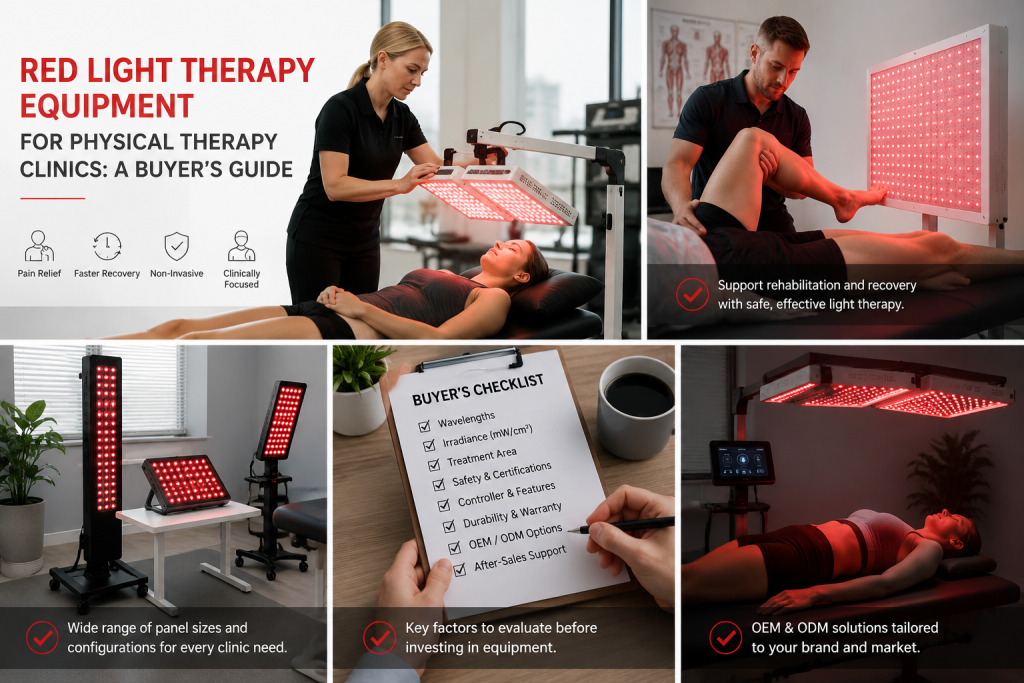
9. Pre-Purchase Checklist for Physical Therapy Clinics
Use this checklist when evaluating a new device or comparing suppliers.
| Evaluation Area | What to Confirm |
|---|---|
| Intended application | Is the device appropriate for the planned use? |
| Equipment type | Targeted, tabletop, large panel, or another format |
| Wavelength | Nominal wavelengths and supporting documentation |
| Irradiance | Value, units, distance, and measurement method |
| Coverage | Effective illuminated area |
| Controls | Timer, output adjustment, modes, and usability |
| Positioning | Stand, mounting, and room layout |
| Safety | Relevant electrical and photobiological documentation |
| Regulatory status | Applicable requirements for the destination market |
| Cleaning | Manufacturer-approved procedure |
| Durability | Construction, maintenance, and warranty |
| OEM/ODM | Available customization and technical limitations |
| Quality control | Inspection criteria and product traceability |
| Commercial terms | MOQ, samples, lead time, and payment terms |
| After-sales service | Technical support and warranty process |
A completed checklist helps clinic owners, purchasing managers, and distributors compare products using consistent criteria.
Frequently Asked Questions
What Is the Best Red Light Therapy Equipment for a Physical Therapy Clinic?
There is no single best device for every clinic. The appropriate equipment depends on the intended application, treatment area, optical specifications, available space, operating workflow, and applicable clinical and regulatory requirements.
What Wavelengths Should Clinics Look For?
660nm red light and near-infrared wavelengths such as 810–850nm are common in photobiomodulation equipment. The appropriate configuration depends on the intended application and supporting evidence.
Is Higher Wattage Always Better?
No. Electrical wattage alone does not establish irradiance at the treatment surface or clinical effectiveness. Buyers should compare measured optical output, distance, coverage, and relevant technical documentation.
What Is Irradiance, and Why Does It Matter?
Irradiance is optical power per unit area, commonly expressed in mW/cm². It helps buyers compare optical output when measurement conditions are clearly defined.
Can Physical Therapy Clinics Purchase OEM Red Light Therapy Equipment?
Yes. OEM options may include branding, labels, packaging, manuals, and selected product configurations. More extensive changes depend on engineering feasibility, testing, and regulatory requirements.
What Is the Difference Between OEM and ODM?
OEM projects generally use an existing product platform with agreed customization. ODM projects may involve more extensive product development or design changes. The exact scope depends on the supplier and project.
What Documents Should Clinics Request Before Ordering?
Request the technical datasheet, operating instructions, applicable safety documentation, relevant test reports, regulatory information, warranty terms, and maintenance instructions for the exact model.
Does Red Light Therapy Replace Conventional Physical Therapy?
It should not automatically be treated as a replacement for established rehabilitation care. Whether a light-based intervention is appropriate depends on the evidence for the specific application, the patient’s circumstances, and the clinician’s judgment.
What Should Buyers Include in an OEM Inquiry?
Include the intended application, equipment format, target market, wavelength requirements, irradiance targets, controller functions, branding needs, estimated order quantity, and any documentation requirements.
Conclusion: Choose Professional Equipment Based on Evidence and Practical Requirements
Selecting red light therapy equipment for a physical therapy clinic requires a balanced assessment of technical specifications, intended use, safety documentation, workflow, and supplier support.
The most important purchasing considerations include:
- Appropriate equipment format and treatment coverage
- Verified wavelength and irradiance specifications
- Practical controls and positioning
- Relevant safety and regulatory documentation
- Cleaning, maintenance, and durability
- Clear OEM/ODM customization scope
- Written quality requirements and after-sales support
For distributors, clinic groups, and private-label brands, a clearly defined OEM specification also helps suppliers assess feasibility and provide a more meaningful quotation.
Rather than choosing a device based only on wattage, LED count, or marketing claims, evaluate the complete configuration and the documentation available for the intended application.
Explore Red Light Therapy Equipment and OEM/ODM Options
US Red Light Therapy supports B2B sourcing and OEM/ODM projects for red and near-infrared light therapy equipment through its established product and supply-chain resources.
If you are evaluating equipment for a physical therapy clinic, rehabilitation center, or branded equipment program, share your requirements so the available configurations and customization options can be reviewed.
When making an inquiry, include:
- Your business type and destination market
- Preferred device format
- Required wavelengths and optical specifications
- Controller and positioning requirements
- Branding and packaging needs
- Estimated order quantity
- Sample and documentation requirements
Explore our Red Light Therapy Solutions for Clinics and OEM & ODM Services to review available options.
Request a customized equipment proposal based on your clinic’s actual requirements.
Post time: 10-29-26