

Cold laser therapy, also called low-level laser therapy or photobiomodulation, uses non-thermal light in the 630-850 nm range to support cellular function. This article answers the concrete question importers and clinic owners face: which cold laser therapy device specifications actually matter, and which supplier claims should trigger a request for test data. You will leave with a checklist for comparing panels, beds, and handhelds without relying on marketing adjectives.
What Cold Laser Therapy Is and Is Not
Cold laser therapy delivers light at irradiance levels roughly 3-50 mW/cm2, far below the threshold that heats tissue. The term “cold” distinguishes it from surgical or ablative lasers that cut or coagulate. In practice, most devices marketed for cold laser therapy are LED-based panels, not true lasers, because LEDs are cheaper to produce and cover larger treatment areas.
The mechanism under study is photon absorption by cytochrome c oxidase in mitochondria, which may increase ATP production and modulate reactive oxygen species. This is a proposed mechanism, not a proven clinical outcome for every condition. When a supplier claims a specific disease benefit, ask for the peer-reviewed trial and the device’s exact parameters: wavelength, irradiance at the skin, and treatment time.
Wavelength matters because light penetration depth varies. Red light in the 630-660 nm range is absorbed mostly in the epidermis and upper dermis, while near-infrared light in the 810-850 nm range reaches deeper tissue, roughly 2-5 mm depending on skin type and melanin content. A device that offers both bands gives you flexibility, but the irradiance at each band must be measured separately.
Wavelength Bands and Why Tolerance Matters
LED manufacturers bin chips by dominant wavelength, and a typical bin width is ±5 nm. A panel labeled “660 nm” may actually contain chips ranging from 655 nm to 665 nm, and that is acceptable if the supplier provides binning data. A panel labeled “660 nm” that actually peaks at 640 nm is a different product, because the absorption spectrum of cytochrome c oxidase is not flat.
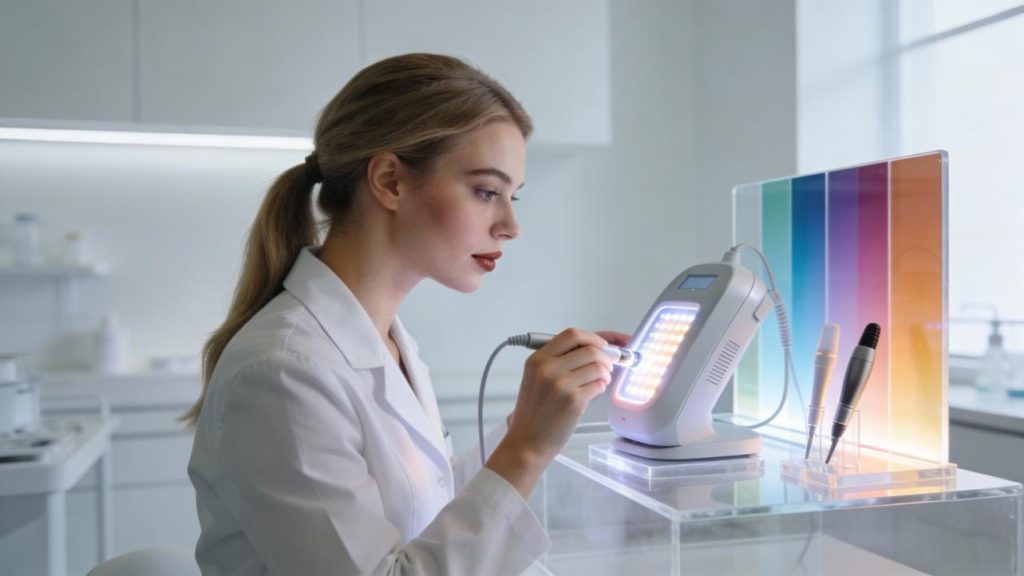
For cold laser therapy, the widely used bands are 630-660 nm red and 810-850 nm near-infrared. Some devices add 780 nm or 1064 nm, but those wavelengths have less published dose-response data for skin and superficial muscle applications. If a supplier claims a unique wavelength, ask for the spectral power distribution measured with a calibrated spectrometer, not a phone camera photo.
Wavelength tolerance also affects dose calculation. If you prescribe 10 J/cm2 at 660 nm but the actual output is 645 nm, the biological effect may differ even if the measured irradiance is the same. This is why reputable manufacturers test each batch and provide a spectral report, not just a datasheet.
Irradiance, Dose, and the Numbers That Matter
Irradiance is power per unit area, measured in mW/cm2 at the treatment surface. Dose is irradiance multiplied by time, measured in J/cm2. A common clinical range for cold laser therapy is 3-20 J/cm2 per session, but the effective dose depends on wavelength, tissue depth, and skin pigmentation. A device that delivers 100 mW/cm2 may cause thermal effects, which moves it outside the “cold” definition.
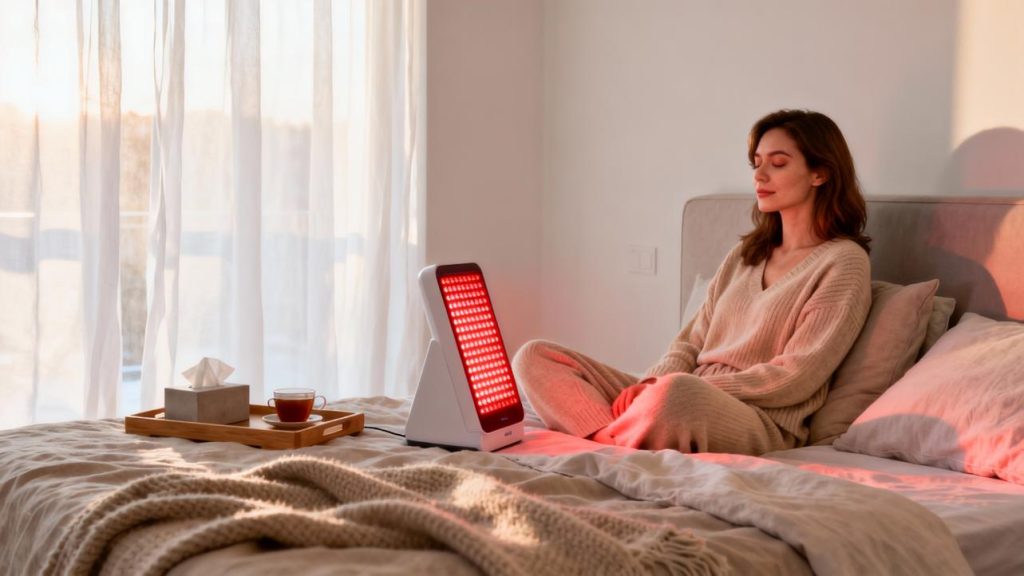
The most common measurement error is using a solar power meter instead of a calibrated optical power meter with a sensor matched to the wavelength. Solar meters are calibrated for broad-spectrum sunlight and can under-report or over-report LED output by 20-40%. Ask the supplier which meter and sensor were used, and whether the irradiance was measured at the panel surface or at a typical treatment distance of 10-15 cm.
Dose is not simply “more is better.” Biphasic dose response is well documented in photobiomodulation: too little light does nothing, and too much light can inhibit cellular activity. For a 660 nm panel at 30 mW/cm2, a 10 J/cm2 dose requires about 5.5 minutes. If a supplier recommends 30 minutes at 100 mW/cm2, that is 180 J/cm2, far outside the typical range and likely to cause heat or discomfort.
Device Classes: Panel, Bed, and Handheld
| Device class | Typical irradiance at 15 cm | Coverage area | Price tier (FOB, general market) | Decision consequence |
|---|---|---|---|---|
| LED panel, 300-600 W | 20-50 mW/cm2 | 60 x 30 cm to 120 x 60 cm | $400-$1,500 | Best for clinics needing full-body or large-area treatment; verify irradiance map for hot spots. |
| LED bed or half-bed | 10-30 mW/cm2 | 180 x 60 cm | $1,500-$4,000 | High patient throughput but difficult to move; check duty cycle and cooling fan noise. |
| Handheld / torch | 50-200 mW/cm2 at 2 cm | 5-10 cm diameter | $80-$300 | Portable and cheap, but irradiance drops rapidly with distance; requires longer treatment time for same dose. |
| Laser diode cluster | 100-500 mW/cm2 | 2-5 cm diameter | $500-$2,000 | True laser, but small spot size means treating large areas is impractical; eye safety is more critical. |
For importers, the panel is the most common entry point because the bill of materials is simpler: aluminum PCB, LED chips, constant-current drivers, and a housing. Handhelds look cheap but often fail EMC testing because the driver is crammed into a small plastic shell. Beds are high-margin but require more warehouse space and after-sales support for hinges and fans.

Thermal Design and Constant-Current Drivers
Even “cold” laser therapy devices generate waste heat from the LEDs and drivers. If the junction temperature exceeds the LED manufacturer’s rating, typically 85-110°C, the output power drops and the wavelength shifts. A well-designed panel uses an aluminum substrate, a finned heatsink, and active cooling fans that turn on at a set temperature, usually 45-50°C on the housing.
The driver is the most common failure point. A constant-current driver keeps the LED current stable as the forward voltage changes with temperature. Cheap panels use constant-voltage drivers with resistors, which cause current to drift and LEDs to burn out unevenly. Ask the supplier for the driver’s datasheet: it should specify output current tolerance of ±5% or better and a mean time between failures of at least 30,000 hours.
Thermal failure mode: a panel that runs for 20 minutes and then dims by 30% has inadequate heatsinking. Test this by measuring irradiance at 5, 10, and 20 minutes with the same meter. The drop should be less than 10% for a quality device.
Safety Standards and Certification Routes
Cold laser therapy devices fall under photobiological safety standard IEC 62471 for lamps and lamp systems. The standard classifies devices into risk groups: Exempt, RG1, RG2, and RG3. For skin treatment panels, RG2 is common and acceptable if the user avoids staring directly at the LEDs. A device classified RG3 requires interlocked enclosures and professional supervision.
In the United States, most red light therapy devices are regulated as Class II medical devices under FDA 510(k) if they make medical claims. Many panels are sold as general wellness products without 510(k), which limits the marketing language to “supports” or “promotes” rather than treating a disease. For the European market, CE marking under the Low Voltage Directive and EMC Directive is the minimum; medical claims require conformity to the Medical Device Regulation.
When sourcing, ask for the IEC 62471 test report from an accredited lab, not a self-declaration. A legitimate report will list the risk group, the measurement distance, and the aperture size. If the supplier cannot provide this, assume the device has not been tested and you are liable for any eye injury claims.
Rule of thumb: if a supplier quotes irradiance without stating the measurement distance and the meter model, the number is not usable for dose calculation. Always ask for the test setup photo.
Supplier Questions and OEM/ODM Sourcing
Typical MOQs for private-label cold laser therapy panels are 50-100 units, with lead times of 30-45 days after deposit. ODM projects that require custom housing or firmware start at 300-500 units and 60-90 days. Price tiers are roughly $150-$250 per unit for a 300 W panel at MOQ 100, $80-$120 for a handheld, and $800-$1,200 for a half-bed, excluding shipping and certification.
Ask these questions before placing an order:
- What is the LED chip brand and bin? Cree, Osram, and Seoul Semiconductor are common; the bin code tells you the wavelength tolerance.
- Can you provide a spectral power distribution graph for each wavelength band?
- What is the driver’s output current tolerance and the electrolytic capacitor’s rated lifetime at 105°C?
- What is the measured irradiance at 10 cm and 15 cm, and with which meter?
- Do you have an IEC 62471 test report from a third-party lab?
A common failure mode is the supplier swapping LED chips after the first order to cut costs. Specify in the purchase order that the LED brand and bin cannot be changed without written approval, and request a golden sample that you can test and keep for reference.
Comparing Cold Laser Therapy Devices for Your Market
If you are importing for resale, the decision comes down to certification burden and after-sales support. A panel with CE and IEC 62471 reports is easier to sell in Europe but costs 10-15% more than a non-certified unit. A handheld with a laser diode requires additional laser safety labeling under IEC 60825, which many suppliers ignore.
For clinic owners, the key metric is treatment time per patient. A panel delivering 30 mW/cm2 at 15 cm can deliver a 10 J/cm2 dose in under 6 minutes. A handheld at 100 mW/cm2 but only 3 cm treatment distance may take 15 minutes for the same area because you must move it continuously. Calculate the dose per minute per square centimeter, not the peak irradiance.
Informed consumers should look for a device that states wavelength, irradiance at a specified distance, and treatment time for a target dose. If the product page only says “powerful” and “deep penetration,” it is not a cold laser therapy device you can evaluate.
Frequently Asked Questions
Is cold laser therapy the same as red light therapy?
Cold laser therapy originally referred to low-power lasers, but the term is now used interchangeably with red light therapy and photobiomodulation. Most consumer devices are LED-based, not true lasers, and the key specification is wavelength and irradiance, not the light source type.
What dose of cold laser therapy is safe?
A dose of 3-20 J/cm2 per session is commonly cited in photobiomodulation research. Doses above 50 J/cm2 may cause thermal effects or biphasic inhibition. Always confirm with a clinician for your specific condition.
How do I verify a device’s irradiance claim?
Measure the output with a calibrated optical power meter at the same distance the supplier used, typically 10-15 cm. If the measured value is more than 20% below the claim, the device is underperforming or the measurement setup differs.
Do I need eye protection for cold laser therapy panels?
For RG2 devices, avoid staring directly at the LEDs. For RG3 or laser diode devices, wear wavelength-specific goggles. Check the IEC 62471 report for the risk group.
What to Do Next
Cold laser therapy device selection is a measurement problem, not a marketing problem. Start by defining your target dose and treatment area, then work backward to the required irradiance and time. A 660 nm panel at 30 mW/cm2 covering 60 x 30 cm is a reasonable baseline for a clinic; a 810 nm handheld at 100 mW/cm2 is a different tool for a different job.
When you contact a supplier, ask for the three documents that separate serious manufacturers from resellers: an IEC 62471 test report, a spectral power distribution graph, and a driver datasheet. If those are missing, the price is irrelevant. The best cold laser therapy device is the one whose numbers you can verify with your own meter.
Post time: 11-17-26