

A red light bed is a full-body photobiomodulation device that uses large arrays of LEDs emitting primarily in the 630-660 nm red and 810-850 nm near-infrared ranges. This article answers the concrete question buyers face: which specifications, safety documents, and supplier practices separate a durable clinical-grade bed from an underpowered cosmetic panel. You will learn how to read irradiance claims, check wavelength tolerance, and evaluate certification routes before committing to a purchase.
Red Light Bed Output: Wavelength, Irradiance, and Dose
A red light bed delivers energy to the skin and underlying tissue through LEDs mounted on flat or contoured surfaces. The two most common wavelength bands are 630-660 nm red light, which is absorbed mainly by cytochrome c oxidase in the epidermis and dermis, and 810-850 nm near-infrared light, which penetrates deeper into muscle and joint tissue. Most full-body beds combine both bands, often in a 1:1 or 2:1 red-to-near-infrared ratio, to balance surface and deep-tissue coverage.
Irradiance, measured in milliwatts per square centimeter (mW/cm²), tells you how much optical power reaches the skin at a given distance. Reputable manufacturers specify irradiance at a defined distance, typically 15-30 cm from the LED surface, because the value drops sharply as the user moves away. A bed advertising 100 mW/cm² at the glass but delivering 20 mW/cm² at the skin is not equivalent to a bed that specifies 30 mW/cm² at the treatment plane. Always ask for the measurement distance and the instrument used.
Session dose is the product of irradiance and time, expressed in joules per square centimeter (J/cm²). For example, 30 mW/cm² for 10 minutes equals 18 J/cm². Most published photobiomodulation studies use doses in the 3-20 J/cm² range per session, with higher doses not necessarily producing better outcomes and sometimes producing inhibitory effects. A bed with adjustable power levels lets you stay within that window without forcing very short or very long sessions.
Wavelength Tolerance and LED Binning
LEDs are not manufactured to a single exact wavelength; they are sorted into bins. A supplier that does not state bin tolerance may ship LEDs that vary by ±10 nm or more from the labeled peak. For a 660 nm bed, that could mean actual output between 650 nm and 670 nm, which changes the depth of penetration and the biological response. Ask for a binning report showing peak wavelength, spectral half-width, and the percentage of LEDs within ±5 nm of the target.
Constant-current drivers are the other half of output stability. A cheap constant-voltage driver lets current drift as LEDs heat up, causing irradiance to fall by 10-20% during a 20-minute session. A constant-current driver holds the current steady, keeping output within a few percent of the cold-start value. This matters for repeatability: a clinic that promises a 10 J/cm² session should deliver 10 J/cm² every time, not 8 J/cm² on a warm day.
Red Light Bed Safety: IEC 62471 and Thermal Design
Any red light bed sold in the US or EU should be tested to IEC 62471, the photobiological safety standard for lamps and lamp systems. The standard classifies devices into risk groups: Exempt, RG1, RG2, and RG3, based on exposure limits for the skin and eyes. A full-body bed that is not Exempt or RG1 may require protective eyewear and controlled access, which changes the user experience and the operator’s liability.
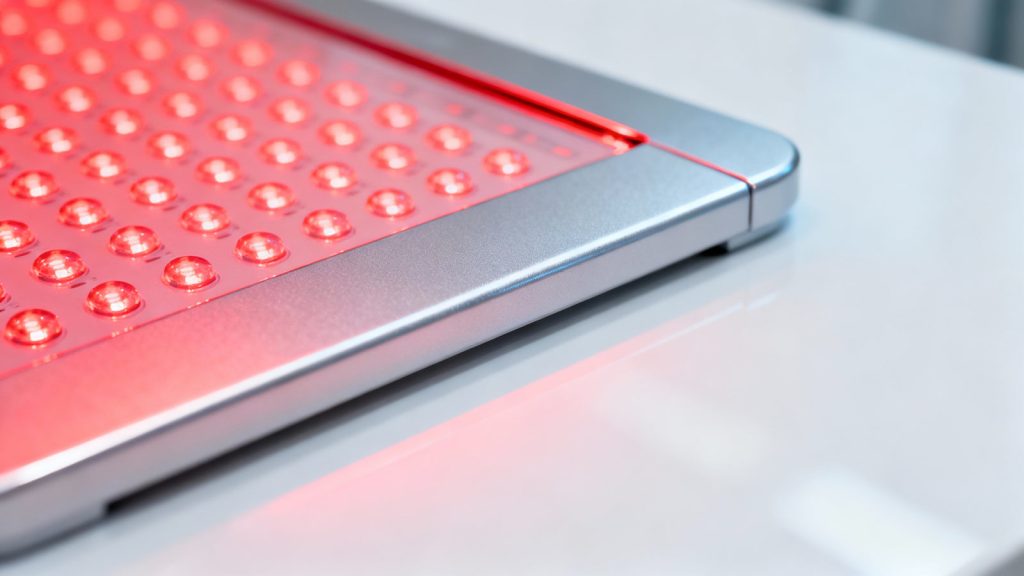
Thermal design is the most common failure mode in budget beds. High-power LEDs generate heat, and without adequate heatsinking, the junction temperature rises, reducing output and shortening LED life. Look for a bed with a stated LED junction temperature at full power, typically below 85°C for a 50,000-hour lifetime claim. Aluminum substrates, active fan cooling, and thermal cutoff switches are signs of a design that was tested, not just assembled.
Skin temperature is a separate concern. A bed that feels hot on the skin is not necessarily delivering more therapeutic light; it may simply be radiating infrared heat from poorly managed LEDs. A well-designed bed keeps the skin surface below 40°C during a 20-minute session, even at maximum irradiance. Ask for a thermal image or a temperature rise test report.
Red Light Bed Classes: Panel, Canopy, and Full Enclosure
Red light therapy devices fall into three main form factors: single panels, half-body canopies, and full-body beds or pods. A single panel covers roughly 60 x 30 cm and is adequate for targeted treatment but requires the user to reposition for full-body coverage. A canopy or half-body bed covers the front or back in one session. A full enclosure surrounds the user with LEDs on all sides, reducing session time but increasing cost and space requirements.
| Device class | Typical coverage | Irradiance at skin | Consequence for buyer |
|---|---|---|---|
| Single panel | 60 x 30 cm | 20-50 mW/cm² at 15 cm | Lowest cost, but full-body session takes 4-6 repositionings |
| Half-body canopy | 180 x 60 cm | 15-40 mW/cm² at 20 cm | Good for clinics; front and back require two sessions |
| Full-body bed | 200 x 70 cm interior | 10-30 mW/cm² at 25 cm | Highest throughput, but needs 3-4 m² floor space and dedicated circuit |
| Modular panel array | Configurable | Varies with distance | Flexible, but irradiance uniformity is harder to verify |
The table shows a key trade-off: full-body beds often have lower irradiance per square centimeter than a single panel held close to the skin, because the LEDs are farther from the body. That is not a defect; it is a design choice. A bed delivering 15 mW/cm² uniformly over the whole body can deliver a 10 J/cm² session in about 11 minutes, while a panel at 50 mW/cm² covers only a small area in the same time.
Certification Routes: FDA, CE, and What They Actually Mean
In the United States, red light therapy beds are regulated by the FDA as Class II medical devices when they make medical claims, and as general wellness products when they make only low-risk claims about relaxation or cosmetic appearance. A manufacturer with a 510(k) clearance has submitted evidence of substantial equivalence to a predicate device, which is a stronger signal than a self-declared wellness product. Ask for the 510(k) number and verify it in the FDA database.
In the European Union, red light beds fall under the Medical Device Regulation (MDR) if they claim a medical purpose, or under the Low Voltage Directive and EMC Directive if they are sold as cosmetic or wellness devices. A CE mark alone is not evidence of safety; it must be accompanied by a Declaration of Conformity and, for medical devices, a Notified Body certificate. Importers should request the technical file summary and the name of the Notified Body.
A practical rule: if a supplier cannot produce an IEC 62471 test report and a Declaration of Conformity within 48 hours of your request, treat the bed as uncertified regardless of what the marketing page says.
Red Light Bed Sourcing: OEM, ODM, and Supplier Questions
Most red light beds sold under Western brand names are manufactured in China, often by OEM or ODM suppliers. OEM means the factory builds to your specifications; ODM means the factory offers an existing design that you can rebrand. Minimum order quantities typically range from 10 to 50 units for ODM beds, while OEM projects may require 100 units or more. Lead times run 30-60 days for ODM and 60-90 days for OEM, excluding shipping.
Price tiers reflect component quality more than brand markup. A budget full-body bed at $2,000-$4,000 ex-works often uses unbinned LEDs, constant-voltage drivers, and plastic housings. A mid-tier bed at $5,000-$8,000 typically includes binned LEDs, constant-current drivers, aluminum heatsinks, and a basic control system. A clinical-grade bed at $10,000-$20,000 adds features like adjustable irradiance, session logging, and third-party safety testing.
- Request the LED manufacturer and bin code, not just the wavelength.
- Ask for an irradiance map at 10 cm intervals from 10 to 50 cm.
- Confirm the driver type: constant-current, not constant-voltage.
- Request the IEC 62471 test report and risk group classification.
- Ask for a sample unit and measure output with your own spectrometer or power meter.
Maintenance and Failure Modes in Red Light Beds
The most common failure mode reported by clinic owners is LED output degradation, not total failure. LEDs lose output gradually; a bed rated for 50,000 hours may deliver only 70% of initial irradiance after 20,000 hours if the thermal design is marginal. Ask the supplier for an LM-80 test report, which measures lumen maintenance over time, or a manufacturer’s lifetime curve showing output at 10,000, 30,000, and 50,000 hours.
Driver failure is the second most common issue. A failed driver may cause a whole row of LEDs to go dark or flicker. Beds with modular driver boards are easier to repair than beds with a single integrated driver. Check whether the supplier stocks replacement drivers and whether they can ship one within 5 business days. A bed that is down for three weeks waiting for a part costs more than the part itself.
Cleaning and hygiene are often overlooked. The acrylic or polycarbonate cover over the LEDs should be cleaned with a non-abrasive, non-alcohol cleaner after each client. Alcohol can craze acrylic over time, reducing light transmission by 5-10%. Ask the supplier for the recommended cleaning agent and the transmission loss after 1,000 cleaning cycles.
Red Light Bed FAQ
What is the difference between a red light bed and a tanning bed?
A red light bed emits only visible red and near-infrared light, typically 630-850 nm, with no ultraviolet output. A tanning bed emits primarily UV-A and UV-B radiation, which damages skin DNA. Red light beds do not tan the skin and are not regulated as tanning devices.
How long should a session in a red light bed last?
Session length depends on irradiance. At 20 mW/cm², a 10 J/cm² dose requires about 8 minutes; at 10 mW/cm², the same dose takes about 17 minutes. Most manufacturers recommend 10-20 minutes per session, 3-5 times per week, but this is a general guideline, not a medical prescription. Confirm any treatment plan with a clinician.
Can a red light bed overheat the skin?
Yes, if the thermal design is poor. A bed that keeps the skin surface below 40°C is safe for a 20-minute session. If the skin feels uncomfortably hot or shows redness after the session, the bed is radiating excess heat, not necessarily delivering more therapeutic light. Check the manufacturer’s temperature rise test report.
Do I need protective eyewear in a red light bed?
If the bed is classified as Exempt or RG1 under IEC 62471, no protective eyewear is required for normal use. If the bed is RG2, the manufacturer must provide eyewear and label the device accordingly. Ask for the risk group classification before purchasing.
What to Do Next When Evaluating a Red Light Bed
Start by defining your use case: a clinic needs throughput and documentation, while a home user may accept a smaller panel with lower irradiance. Write down your required wavelength bands, target irradiance at the skin, and maximum session time. Then request the three documents that separate serious suppliers from resellers: an IEC 62471 test report, an irradiance map, and a driver specification sheet.
If you are importing, order a sample unit and test it with a calibrated spectrometer or optical power meter. Measure output at three distances and compare it to the supplier’s claims. A 10% variance is normal; a 30% variance is a red flag. Finally, confirm the warranty terms, replacement part lead time, and whether the supplier will provide a Declaration of Conformity for your market. A red light bed is a capital investment, and the documentation is as important as the LEDs themselves.
Post time: 11-18-26