

Red Light Therapy OEM vs ODM: What’s the Difference and Which Is Right for Your Business?
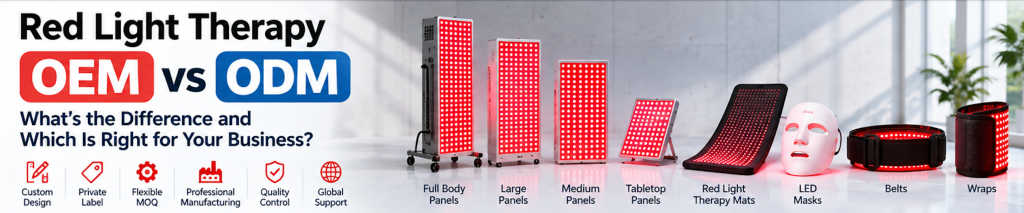
If you are planning to launch a red light therapy brand, expand an existing product line, or source professional photobiomodulation equipment, you will probably encounter two terms very early in the process:
OEM and ODM.
They sound similar.
But they can represent very different levels of product development, customization, cost, project complexity, and control.
For distributors, clinics, wellness businesses, fitness brands, beauty companies, and e-commerce sellers, choosing the right manufacturing model can affect:
- Product development time
- Initial investment
- MOQ
- Product differentiation
- Technical specifications
- Packaging
- Branding
- Intellectual property
- Quality control
- Time to market
- Long-term scalability
So what is the difference between red light therapy OEM vs ODM?
And which model makes more sense for your business?
This guide explains both options from a B2B buyer’s perspective.
If you already know that you need manufacturing support, you can also explore our Red Light Therapy OEM & ODM Manufacturer Solutions.
What Does OEM Mean in Red Light Therapy Manufacturing?
OEM generally stands for Original Equipment Manufacturer.
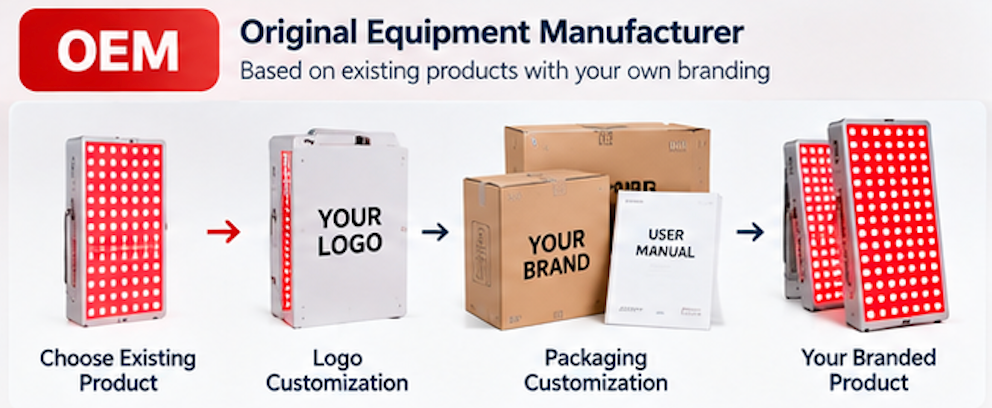
In practical B2B sourcing, OEM commonly means that the buyer starts with an existing product platform or a clearly defined product specification and asks the manufacturer to produce it with agreed modifications.
For example, you may select an existing red light therapy panel and customize:
- Logo
- Product label
- Packaging
- Manual
- Housing color
- Accessories
- Wavelength configuration
- LED configuration
- Control options
- Brand appearance
The basic product architecture may already exist.
That usually makes OEM a relatively efficient way to launch a branded red light therapy product.
Example of a Red Light Therapy OEM Project
Imagine that you want to launch a private-label full-body panel.
You find an existing product with specifications close to your requirements.
You might request:
Existing Product Platform
↓
Your Logo
↓
Custom Packaging
↓
Custom User Manual
↓
Specific 660nm + 850nm Configuration
↓
Branded Product Label
↓
Mass Production
This would typically fall closer to an OEM-style project.
Businesses looking for existing panel platforms can review our Red Light Therapy Panel range.
What Does ODM Mean in Red Light Therapy Manufacturing?
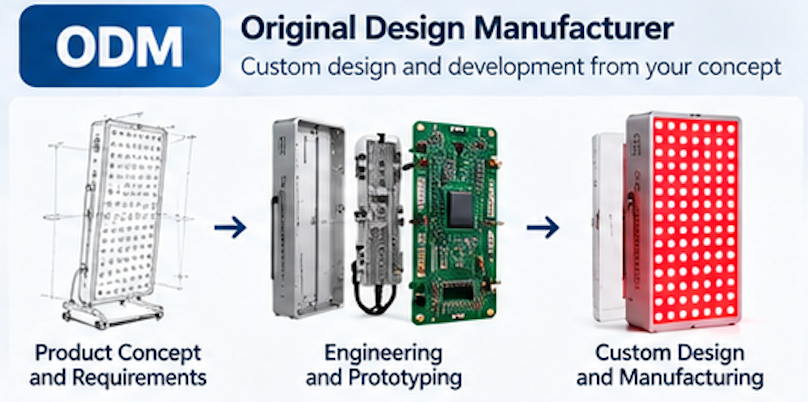
ODM generally stands for Original Design Manufacturer.
ODM projects usually involve deeper product development.
Instead of mainly branding or modifying an existing device, the buyer may require the manufacturer to develop or significantly adapt the product.
ODM can involve changes to:
- Product structure
- Housing dimensions
- Industrial design
- LED arrangement
- Wavelength combinations
- Irradiance targets
- Beam angle
- PCB
- Power system
- Cooling
- Controller
- Firmware
- Touchscreen interface
- App
- Mounting system
- Accessories
- Packaging system
In other words:
OEM usually starts closer to an existing platform.
ODM usually requires more product development.
However, terminology can vary between manufacturers. Before signing an agreement, buyers should define the exact development scope rather than relying on the words OEM or ODM alone.
Red Light Therapy OEM vs ODM: Quick Comparison
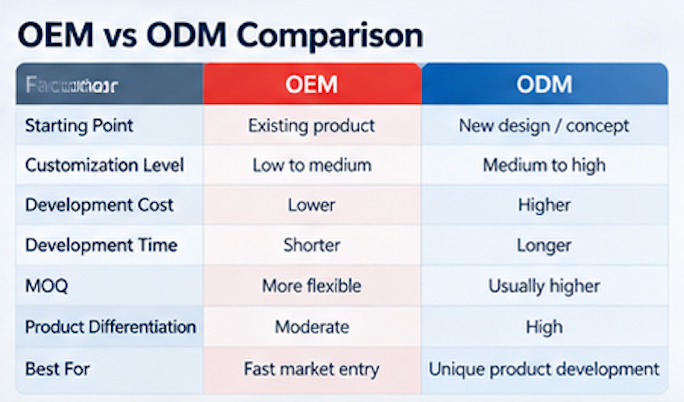
| Factor | OEM | ODM |
|---|---|---|
| Starting Point | Existing product or buyer specification | Product concept or deeper customization |
| Product Development | Low to medium | Medium to high |
| Branding | Yes | Yes |
| Logo Customization | Yes | Yes |
| Custom Packaging | Yes | Yes |
| Wavelength Customization | Often possible | Usually possible |
| Housing Modification | Limited to moderate | More extensive |
| Electronics Changes | Limited/moderate | More extensive |
| Control System | Existing or modified | Can be developed/customized |
| Development Cost | Usually lower | Usually higher |
| Development Time | Usually shorter | Usually longer |
| MOQ | Often more flexible | May be higher depending on development |
| Product Differentiation | Moderate | High |
| Best For | Fast market entry | Unique product development |
The exact capabilities, MOQ, development cost, and project timeline depend on the product and manufacturer.
OEM vs Private Label: Are They the Same?
Not exactly.
Private labeling is usually one form of OEM-style customization.
A private-label red light therapy project may involve taking an existing product and applying your own:
- Brand name
- Logo
- Packaging
- Labels
- Manual
- Color scheme
For example:
A standard tabletop red light therapy panel already exists.
You request:
Your logo + your box + your product label + your manual.
This is a relatively simple private-label project.
OEM can go further.
It may also involve:
- Wavelength changes
- LED quantity changes
- Different accessories
- Modified controls
- Different housing color
- Feature modifications
ODM normally goes further again by involving deeper product design and engineering.
For businesses developing their own product line, see our complete Red Light Therapy OEM & ODM and Private Label Solutions.
When Should You Choose Red Light Therapy OEM?
OEM is often suitable when your priority is getting a branded product to market efficiently.
OEM May Be Right for You If:
1. You Want Faster Market Entry
Using an established product platform can reduce development complexity.
Instead of designing a device from zero, you can focus on:
- Product selection
- Branding
- Packaging
- Marketing
- Distribution
This can be useful for:
- E-commerce brands
- Distributors
- New wellness brands
- Fitness companies
- Beauty businesses
- Clinic suppliers
2. You Want to Test the Market First
Launching a completely new product involves more risk.
OEM allows businesses to start with an established product platform and validate demand before investing in deeper customization.
For example:
Stage 1
Private-label tabletop panel
↓
Stage 2
Custom wavelength configuration
↓
Stage 3
Customized panel series
↓
Stage 4
Fully differentiated ODM product
This gives brands a more gradual product-development path.
3. Your Budget Is More Limited
A completely customized product may require:
- Engineering
- Prototypes
- Tooling
- PCB development
- Firmware
- Industrial design
- Testing
- Packaging development
OEM may allow businesses to avoid some of those costs.
That does not mean OEM products are automatically inexpensive.
Final cost still depends on:
- Product size
- LED quantity
- Wavelength configuration
- Control functions
- Materials
- Packaging
- Order quantity
4. You Mainly Need Branding
If your differentiation comes primarily from:
- Brand positioning
- Marketing
- Customer service
- Sales channels
- Packaging
- Content
rather than a completely unique hardware design, OEM may be sufficient.
When Should You Choose Red Light Therapy ODM?
ODM is more suitable when product differentiation itself is central to your business strategy.
ODM May Be Right for You If:
1. You Need a Unique Product
Perhaps existing red light therapy panels do not meet your requirements.
You may want:
- A different panel shape
- Custom dimensions
- New mounting structure
- Different LED arrangement
- A new control interface
- Different appearance
- Special accessories
ODM gives more room to develop a differentiated product.
2. You Need Specific Technical Requirements
Professional buyers may need equipment designed around specific technical specifications.
Examples include:
Wavelength
Common red and near-infrared wavelengths may include:
- 630nm
- 660nm
- 810nm
- 830nm
- 850nm
Read our 660nm vs 850nm Red Light Therapy Guide for a deeper comparison.
Irradiance
A project may specify a target irradiance range at a defined treatment distance.
When comparing devices, irradiance should always be evaluated together with measurement conditions.
See our Red Light Therapy Irradiance Guide.
Panel Size
A clinic or commercial facility may require a specific treatment area.
ODM development could involve:
- Width
- Height
- LED density
- Panel quantity
- Mounting configuration
- Modular systems
3. You Are Building a Long-Term Product Platform
A serious brand may eventually want multiple products built around one design language.
For example:
Tabletop Panel
↓
Medium Panel
↓
Large Panel
↓
Full-Body Panel
↓
Multi-Panel System
An ODM relationship can help establish a more consistent product family.
Red Light Therapy OEM vs ODM: Which Has a Lower MOQ?
There is no universal answer.
MOQ depends on the degree of customization.
A basic private-label project may have a lower MOQ because the manufacturer is using an existing platform.
A project requiring:
- New molds
- New housing
- Custom PCB
- Custom display
- Unique accessories
- Specialized packaging
may require higher quantities because engineering and supply-chain costs must be spread across the production volume.
Think in Terms of Customization Level
A simple framework is:
Standard Product
Lowest development complexity
↓
Logo + Packaging
↓
Wavelength / Feature Changes
↓
Housing Modification
↓
Electronics Modification
↓
New Product Development
Highest development complexity
As customization increases, MOQ, development cost, and lead time may also increase.
Red Light Therapy OEM vs ODM: Which Costs More?
In most cases, ODM requires more upfront development resources than simple OEM/private labeling.
But project cost should not be evaluated only by unit price.
A complete cost comparison may include:
Product Cost
Sample Cost
Engineering Cost
Tooling
Packaging
Testing
Certification
Inspection
Freight
Warranty Support
OEM may reduce upfront development expense.
ODM may create stronger differentiation.
Which is more valuable depends on your business model.
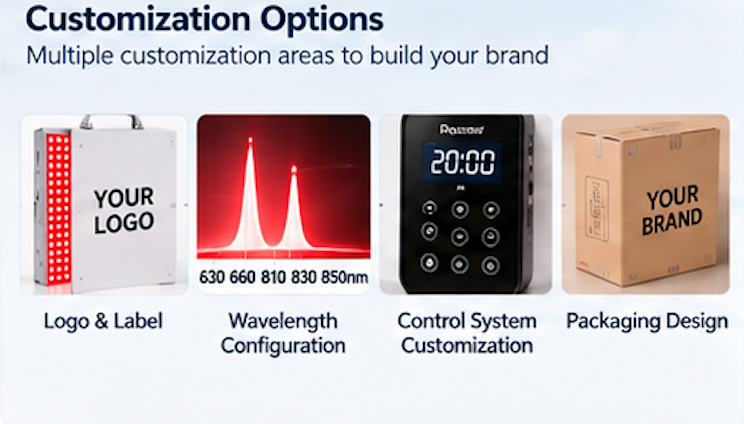
What Can Be Customized in a Red Light Therapy OEM/ODM Project?
The exact options depend on the manufacturer and device.
Typical customization areas include the following.
1. Product Branding
- Logo
- Label
- Nameplate
- Brand colors
- Model number
2. Packaging
- Retail box
- Shipping carton
- Product insert
- User manual
- Brand graphics
3. Wavelength Configuration
For example:
- 630nm
- 660nm
- 810nm
- 830nm
- 850nm
- Multi-wavelength combinations
4. LED Configuration
Possible variables include:
- LED quantity
- LED layout
- Wavelength ratio
- Beam angle
- Optical arrangement
5. Irradiance and Treatment Coverage
Buyers may need to evaluate:
- Irradiance
- Measurement distance
- Treatment area
- Uniformity
- Beam angle
Remember that wattage does not equal irradiance.
For a detailed comparison, read:
Red Light Therapy Panel Wattage vs Irradiance.
6. Housing
ODM projects may allow modifications to:
- Dimensions
- Materials
- Color
- Ventilation
- Shape
- Mounting points
7. Control System
Possible customization can include:
- Timer
- Intensity
- Wavelength control
- Operating modes
- Pulsing
- Touchscreen
- Remote control
- Preset programs
8. App and User Interface
Depending on the project and platform, deeper development may include:
- App interface
- Control logic
- Firmware
- Touchscreen UI
These features should be discussed early because they can significantly affect development scope.
OEM vs ODM for Different Red Light Therapy Products
Different devices may require different sourcing strategies.
Red Light Therapy Panels
Panels are especially suitable for OEM/ODM development because many specifications can potentially be configured.
These include:
- Panel dimensions
- LED count
- Wavelength
- Irradiance
- Controller
- Mounting
- Housing
- Packaging
You can view existing formats in our Red Light Therapy Panel Collection.
Red Light Therapy Mats
Mats may involve customization around:
- Dimensions
- LED density
- Wavelength
- Fabric
- Control system
- Timer
- Branding
- Carry bag
- Packaging
Explore additional product formats through our Red Light Therapy Product Collection.
Red Light Therapy Masks and Beauty Devices
Beauty-focused products may prioritize:
- Appearance
- Comfort
- LED layout
- Controls
- Packaging
- Brand design
These products may be particularly relevant for beauty businesses and private-label consumer brands.
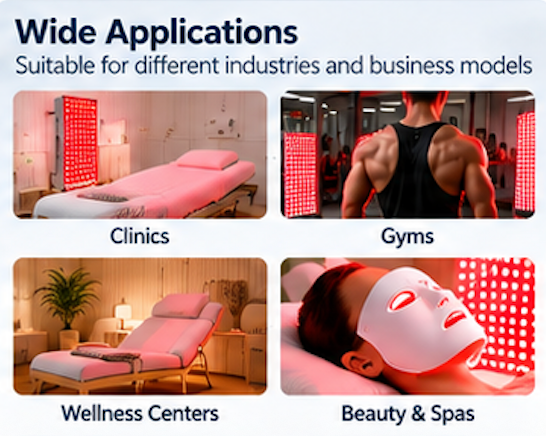
OEM vs ODM for Clinics, Gyms, and Wellness Businesses
The right model can also depend on where the equipment will be used.
Clinics
Clinics may prioritize:
- Defined technical specifications
- Treatment coverage
- Irradiance
- Wavelength
- Repeatable operation
- Documentation
- Professional controls
- Durability
Explore our Red Light Therapy Solutions for Clinics.
Gyms and Fitness Centers
Gyms may prioritize:
- Full-body coverage
- Fast operation
- Durable equipment
- Cooling
- Simple controls
- High-frequency use
- Branding
See our Red Light Therapy Solutions for Gyms.
Wellness Centers
Wellness businesses may need a more flexible equipment portfolio.
They may combine:
- Full-body panels
- Targeted panels
- Mats
- Beauty products
See our Red Light Therapy Solutions for Health and Wellness Centers.
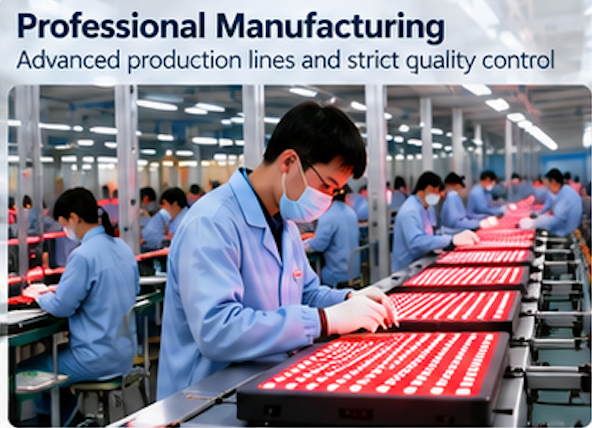
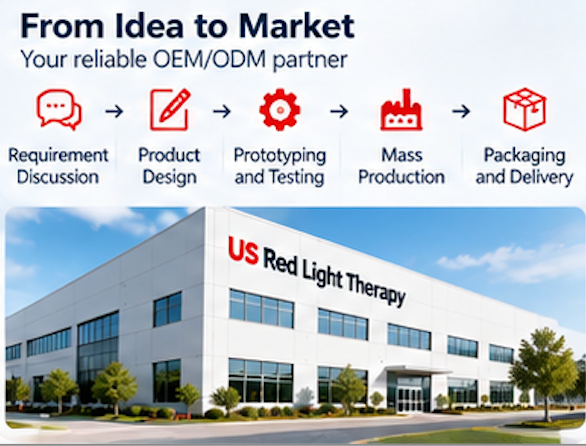
OEM vs ODM Development Process
Although every project is different, a typical workflow may look like this.
OEM Process
Step 1 — Product Selection
Choose an existing product.
↓
Step 2 — Specification Confirmation
Confirm:
- Wavelength
- LED quantity
- Power
- Irradiance
- Controls
↓
Step 3 — Branding
Prepare:
- Logo
- Label
- Packaging
- Manual
↓
Step 4 — Sample
Review the sample.
↓
Step 5 — Approval
Confirm the golden sample.
↓
Step 6 — Mass Production
Begin batch production.
↓
Step 7 — QC and Shipping
Inspect and ship.
ODM Process
ODM normally includes more development stages.
Market Requirement
↓
Product Concept
↓
Technical Specification
↓
Industrial Design
↓
Engineering
↓
Prototype
↓
Testing
↓
Revision
↓
Final Sample
↓
Mass Production
↓
Quality Control
↓
Shipping
ODM projects therefore require stronger communication between buyer and manufacturer.
What Should You Send to a Red Light Therapy Manufacturer?
The more information you provide, the easier it is for a manufacturer to recommend the right model.
Before requesting a quotation, prepare:
Business Information
- Target market
- Sales country
- Customer type
- Distribution channel
Product Information
- Panel / Mat / Mask / Belt
- Target size
- Target price
- Quantity
Technical Requirements
- Wavelength
- Irradiance
- Treatment area
- Controls
- Power requirements
Branding Requirements
- Logo
- Packaging
- Colors
- Manual
Project Information
- Sample quantity
- Target MOQ
- Launch schedule
- Certification requirements
This can make quotation and technical evaluation significantly more efficient.
10 Questions to Ask an OEM/ODM Manufacturer
Before selecting a manufacturing partner, ask:
- Which red light therapy products do you manufacture in-house?
- What is your standard OEM customization scope?
- What ODM engineering capabilities do you have?
- Can you customize wavelengths?
- Can you customize irradiance or LED configuration?
- Can you modify the housing?
- Can you customize the controller or UI?
- What are the MOQ requirements for each customization level?
- How are samples tested before mass production?
- What happens if specifications change during production?
These questions help distinguish basic logo customization from real product-development capability.
OEM vs ODM: What About Product Quality?
OEM and ODM do not automatically indicate quality.
Quality depends on the manufacturer’s processes.
Regardless of which model you choose, evaluate:
- Incoming component inspection
- Assembly control
- Functional testing
- Optical testing
- Irradiance measurement
- Aging tests
- Appearance inspection
- Packaging inspection
- Final QC
For a B2B project, the goal should be repeatability.
The product delivered in batch three should match the approved sample from batch one.
How to Avoid Common OEM/ODM Problems
Several issues can create unnecessary delays.
Problem 1: Vague Product Requirements
Saying:
“I want a powerful red light therapy panel.”
is not enough.
Define measurable specifications.
For example:
- Product dimensions
- Wavelength
- LED count
- Treatment area
- Controls
- Target application
Problem 2: Changing Requirements After Sampling
Changing specifications after sample approval can affect:
- Price
- Lead time
- Tooling
- Packaging
- Testing
Finalize the requirements before production.
Problem 3: Comparing Suppliers Only by Price
One supplier may quote lower because the product uses:
- Different LEDs
- Different power supplies
- Different materials
- Different QC standards
Compare the full specification.
Problem 4: Not Defining the Golden Sample
The approved sample should become the reference for production.
Document:
- Appearance
- Dimensions
- Controls
- Wavelength
- Irradiance
- Accessories
- Packaging
Red Light Therapy OEM vs ODM: Which One Should You Choose?
A simple decision framework can help.
Choose OEM If:
You want:
- Faster launch
- Lower development complexity
- Existing product platform
- Private label
- Logo customization
- Packaging customization
- Moderate technical customization
Choose ODM If:
You want:
- Strong product differentiation
- New product design
- Custom housing
- Unique control system
- New LED configuration
- Deeper engineering
- Long-term proprietary product platform
Choose a Hybrid Approach If:
Many projects fall somewhere between OEM and ODM.
For example:
Take an existing panel platform
Change wavelength configuration
Modify the controller
Customize housing color
Create unique packaging
This type of project may combine elements of both.
That is why buyers should focus on the actual project scope, not only the label OEM or ODM.
Red Light Therapy OEM vs ODM Decision Table
| Business Situation | Recommended Starting Point |
|---|---|
| New brand testing demand | OEM / Private Label |
| Amazon or DTC brand | OEM |
| Distributor expanding product range | OEM |
| Clinic chain with branded equipment | OEM or Hybrid |
| Gym brand requiring custom configuration | OEM or Hybrid |
| Wellness equipment brand | OEM / ODM |
| Established brand seeking unique product | ODM |
| Need custom housing | ODM |
| Need new electronics | ODM |
| Need custom control software | ODM |
| Need fastest possible launch | OEM |
| Need maximum differentiation | ODM |
This table is a general sourcing framework. The right approach depends on your product and market requirements.
Frequently Asked Questions About Red Light Therapy OEM vs ODM
What Is Red Light Therapy OEM?
Red light therapy OEM generally means manufacturing a product according to an existing product platform or defined buyer requirements.
Customization may include branding, packaging, wavelength configurations, product labels, accessories, and selected technical features.
What Is Red Light Therapy ODM?
ODM normally involves deeper product design and development.
It may include housing design, electronics, LED layout, wavelength configuration, control systems, product structure, industrial design, firmware, and accessories.
Is Private Label the Same as OEM?
Private label is commonly a simpler form of OEM.
It usually focuses on adding your own:
- Logo
- Packaging
- Labels
- Manual
- Branding
OEM can include additional product-level modifications.
Is OEM Cheaper Than ODM?
OEM usually requires less development work, so upfront development costs are often lower.
ODM may require additional engineering, prototypes, tooling, testing, and development.
Actual project cost depends on customization depth and quantity.
Which Has a Lower MOQ: OEM or ODM?
Simple OEM/private-label projects can often support more flexible quantities than a fully customized ODM project.
However, MOQ depends on the product, components, tooling, packaging, and customization requirements.
Can I Customize Red Light Therapy Wavelengths?
Depending on the product platform and manufacturer, wavelength combinations may be customizable.
Examples can include 630nm, 660nm, 810nm, 830nm, 850nm, or combinations.
For more information, read our 660nm vs 850nm Guide.
Can I Customize a Red Light Therapy Panel?
Depending on the project, customization may include:
- Logo
- Housing
- Size
- LED configuration
- Wavelength
- Irradiance
- Control system
- Mounting
- Packaging
Explore our Red Light Therapy Panels.
Final Thoughts: OEM or ODM?
The difference between red light therapy OEM vs ODM comes down to one core question:
How much product development do you actually need?
If you want to launch quickly using an established product platform:
OEM may be the better starting point.
If you need a highly differentiated product that requires deeper engineering:
ODM may be more appropriate.
For many businesses, the most practical route is:
Start with OEM → Validate the Market → Collect Customer Feedback → Move Toward Deeper ODM Customization
Before choosing either model, define:
- Target market
- Customer type
- Product category
- Required wavelengths
- Irradiance requirements
- Treatment area
- Product size
- Branding
- MOQ
- Target cost
- Certification requirements
- Launch schedule
A clear product brief helps the manufacturer recommend the correct development path.
Start Your Red Light Therapy OEM or ODM Project
US Red Light Therapy supports B2B projects for:
- Distributors
- Private-label brands
- Clinics
- Gyms
- Wellness businesses
- Beauty businesses
- Professional equipment companies
Depending on the project, customization can cover product selection, branding, packaging, wavelengths, LED configurations, controls, product development, sampling, production, and quality inspection.
Explore Red Light Therapy OEM & ODM Solutions
Browse All Red Light Therapy Products
View Wellness Center Solutions
Post time: 09-30-26