


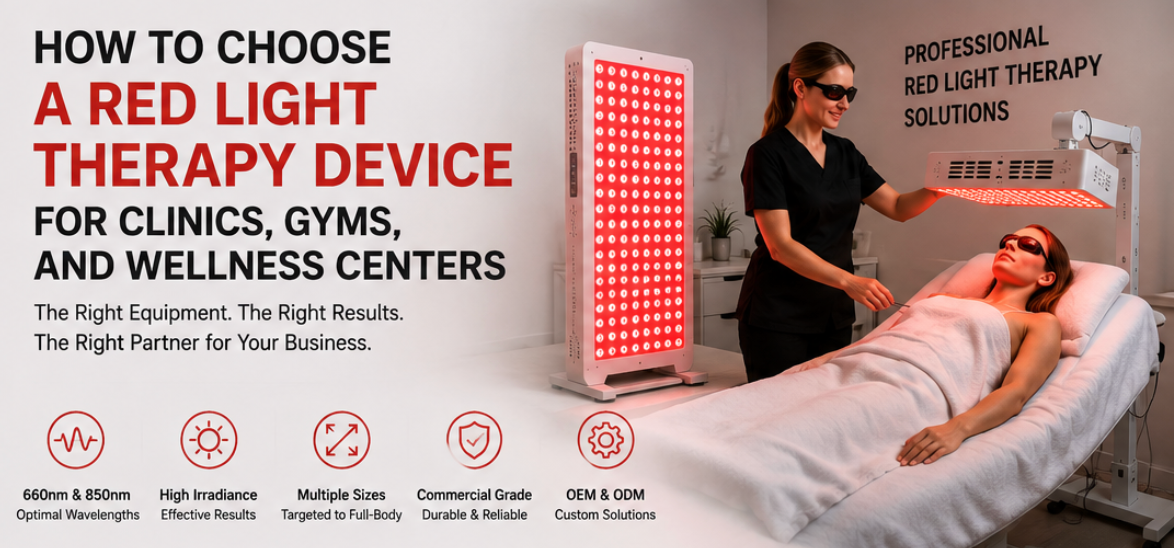
Choosing the right red light therapy device for clinics, gyms, and wellness centers requires more than comparing price and wattage.
Professional businesses need equipment that matches their treatment areas, customer volume, available space, operating environment, and service model.
A small beauty studio may need a compact tabletop panel, while a busy wellness center may require full-body systems or multiple professional panels.
Clinics may focus more on technical specifications, documentation, treatment coverage, and repeatable operation. Gyms may prioritize customer flow, durability, and larger coverage. Wellness centers may want flexible equipment that can support different treatment areas and customer experiences.
This guide explains how to choose the right commercial red light therapy equipment for clinics, gyms, wellness centers, and other professional businesses.
Why Choosing the Right Red Light Therapy Device Matters
A commercial red light therapy device is different from a basic home-use product.
Professional businesses may use equipment repeatedly throughout the day. The device therefore needs to fit the facility’s operational requirements.
Before choosing a system, consider:
- Business type
- Treatment area
- Customer volume
- Available space
- Wavelength
- Irradiance
- Treatment distance
- Coverage area
- Cooling
- Controls
- Durability
- Warranty
- Technical support
- OEM/ODM requirements
A useful starting point is our guide to how to choose the best red light therapy panel for your business, which explains how commercial buyers can compare professional panel specifications.
What Is a Professional Red Light Therapy Device?
A professional red light therapy device uses specific red and/or near-infrared wavelengths and is designed for a defined application.
Commercial equipment can include:
- Red light therapy panels
- Full-body panels
- Tabletop panels
- Targeted panels
- Facial LED devices
- Red light therapy mats
- Multi-panel systems
The appropriate equipment depends on the business and treatment environment.
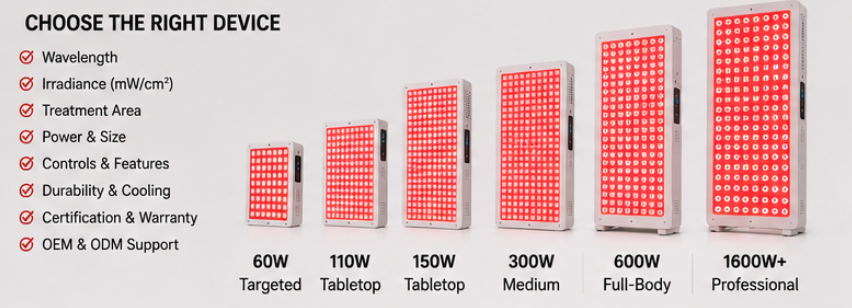
For example, the current Red Light Therapy Panel product range includes 60W, 110W tabletop, 300W, 450W, 600W, 900W, 1600W and 1700W panel configurations.
Step 1 — Define Your Business Type
The first step is to understand how the equipment will be used.
Different businesses have different requirements.
Red Light Therapy Devices for Clinics
Clinics may need equipment for targeted areas, larger treatment areas, or full-body applications.
Important considerations include:
- Treatment area
- Wavelength
- Irradiance
- Treatment distance
- Daily operating volume
- Equipment durability
- Staff operation
- Documentation
- Technical support
Our dedicated Red Light Therapy Solutions for Clinics page provides a more detailed structure for professional clinic equipment and OEM/ODM solutions.
A clinic should also consider whether it needs:
- Targeted panels
- Tabletop equipment
- Full-body systems
- Multi-panel configurations
The equipment should match the clinic’s actual service model rather than simply selecting the highest-powered device.
Red Light Therapy Devices for Gyms
Gyms and fitness centers often have different requirements.
A gym may want to create:
- A recovery area
- A wellness zone
- A dedicated red light therapy room
- A post-workout service
- A premium membership feature
Important considerations include:
- Large-area coverage
- Easy operation
- Customer turnover
- Cooling
- Durability
- Available floor space
- Treatment time
- Installation
For a detailed commercial gym application, see our Red Light Therapy Solutions for Gyms page.
A small fitness studio may start with one or two compact panels, while a larger fitness club may use multiple panels to create a dedicated treatment area.
Red Light Therapy Devices for Wellness Centers
Wellness centers often need flexible equipment configurations because they may offer multiple services.
A wellness facility may consider:
- Full-body panels
- Targeted panels
- Tabletop systems
- Red light therapy mats
- Multi-panel systems
Our Health Center Red Light Therapy Solutions page is designed around health centers, wellness facilities, recovery centers, rehabilitation environments, and integrative wellness businesses.
For a wellness center, flexibility can be more important than simply choosing the highest wattage.
Red Light Therapy Devices for Beauty Centers and Spas
Beauty centers may have more specialized requirements.
They may need equipment for:
- Facial applications
- Targeted areas
- Skincare services
- Wellness services
- Full-body applications
A compact facial device or tabletop panel may be suitable for a small treatment room, while a larger professional panel can provide broader coverage.
Our Beauty Red Light Therapy Solutions page covers professional equipment configurations for beauty clinics, salons, skincare centers, spas, and wellness facilities.
Step 2 — Determine the Treatment Area
After defining your business type, determine what area the device needs to cover.
This is one of the most important decisions when choosing professional equipment.
Targeted Treatment
For smaller treatment areas, a compact panel can be practical.
Potential applications include:
- Face
- Neck
- Shoulders
- Arms
- Legs
- Other targeted areas
Targeted equipment can also be useful when a business has limited treatment-room space.
Large-Area Treatment
If the business wants to cover a larger body area, a larger panel may be more appropriate.
Large panels can reduce the need to reposition the equipment repeatedly.
This can be useful for commercial facilities where customer flow and treatment efficiency matter.
Full-Body Red Light Therapy
For businesses offering full-body applications, larger panels or multi-panel configurations can provide broader coverage.
A full-body setup may include:
- One large panel
- Front and rear panels
- Multiple vertical panels
- Full-body panel systems
The appropriate configuration depends on room size, treatment area, installation requirements, and customer volume.
Step 3 — Compare Wavelengths
Wavelength is another important technical specification.
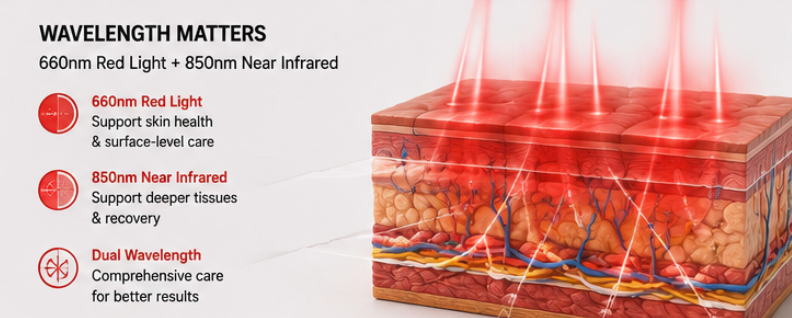
Professional red light therapy equipment commonly uses visible red light and near-infrared light.
Examples include:
- 630nm
- 660nm
- 810nm
- 830nm
- 850nm
A common commercial configuration is:
660nm + 850nm
The appropriate wavelength depends on the device design and intended application.
For a more detailed comparison, read our 660nm vs 850nm Red Light Therapy guide.
660nm Red Light
Red wavelengths around 630–660nm are commonly used in light-based skincare and photobiomodulation research.
They are frequently incorporated into:
- Beauty devices
- Facial LED systems
- Targeted panels
- Professional red light therapy panels
For beauty-oriented businesses, wavelength should be considered together with irradiance, treatment distance, treatment time, and coverage.
850nm Near-Infrared Light
850nm is a near-infrared wavelength that is commonly incorporated into professional red light therapy equipment.
It is invisible to the human eye.
Near-infrared wavelengths are frequently found in:
- Full-body panels
- Fitness recovery equipment
- Professional wellness systems
- Dual-wavelength panels
Why Choose 660nm + 850nm?
A dual-wavelength system can provide both visible red and near-infrared light.
This can make one device more flexible for businesses serving different customer needs.
However, wavelength should not be the only factor used to compare products.
You should also evaluate:
- Irradiance
- Treatment distance
- Treatment time
- Coverage
- LED configuration
- Control system
- Intended use
Step 4 — Check Red Light Therapy Irradiance
Irradiance is one of the most important specifications when comparing professional red light therapy equipment.
It is generally expressed as:
mW/cm²
Irradiance describes optical power delivered over a specific area.
Two panels can have similar electrical wattage but different optical output.
For this reason, buyers should request:
- Irradiance
- Measurement distance
- Measurement method
- Wavelength
- Treatment area
For a more detailed explanation, read our Red Light Therapy Irradiance Guide.
Why Irradiance Measurement Distance Matters
An irradiance number without a measurement distance is difficult to compare.
For example:
150 mW/cm² @ 3 inches
and
150 mW/cm² @ 6 inches
should not automatically be treated as equivalent specifications.
Professional buyers should ask suppliers to clearly define the measurement conditions.
This is particularly important for clinics and wellness centers that need consistent operating procedures.
Step 5 — Do Not Choose a Device Based on Wattage Alone
Wattage describes electrical power.
It does not automatically tell you how much optical power reaches the treatment area.
For example, two 600W panels can have different:
- Irradiance
- LED configuration
- Beam angle
- Coverage
- Cooling systems
- Optical design
- Actual power consumption
This is why our article Red Light Therapy Panel Wattage vs Irradiance is useful when comparing commercial devices.
For professional purchasing, compare:
Wattage + Irradiance + Wavelength + Distance + Coverage
rather than looking at wattage alone.
Step 6 — Choose the Right Panel Size
Panel size should match your treatment area and facility layout.
H3: Compact Panels
Compact panels can be useful for:
- Small clinics
- Beauty rooms
- Boutique fitness studios
- Targeted applications
- Tabletop use
For example, the 60W Red Light Therapy Power Panel provides a compact professional panel configuration.
The 110W Tabletop Red Light Therapy Panel is another option for businesses that need a tabletop format.
Medium Professional Panels
Medium panels can provide more coverage while remaining suitable for individual treatment rooms.
They may be suitable for:
- Clinics
- Wellness centers
- Fitness facilities
- Beauty centers
- Recovery rooms
The 150W Tabletop Red Light Therapy Panel can be considered when a business wants a tabletop professional format.
Large and Full-Body Panels
Larger panels can be useful when the business needs broader coverage.
The product range includes professional systems such as:
- 300W panels
- 450W panels
- 600W panels
- 900W panels
- 1600W panels
- 1700W panels
See the complete Red Light Therapy Panel product range to compare available configurations.
Step 7 — Consider Customer Volume
Customer volume should directly influence equipment selection.
Small Business
A small clinic, boutique gym, or beauty studio may only need one or two devices.
Priorities may include:
- Compact size
- Easy operation
- Flexible installation
- Multi-purpose use
- Lower initial investment
Medium-Sized Facility
A medium-sized business may need multiple panels or a combination of equipment.
For example:
Targeted Panel + Medium Panel + Full-Body Panel
This can create different treatment zones within one facility.
High-Volume Facility
Large clinics, fitness clubs, wellness centers, and chains may require multiple professional systems.
In this situation, consider:
- Cooling
- Durability
- Maintenance
- Warranty
- Replacement parts
- Technical support
- Supply consistency
The goal is to make sure the equipment can support the facility’s operating model.
Step 8 — Evaluate Cooling and Durability
Professional equipment may operate repeatedly throughout the day.
This makes thermal management important.
Look for information about:
- Cooling fans
- Heat sinks
- Aluminum housing
- Ventilation
- Operating temperature
- Continuous-use recommendations
Why Cooling Matters
High-output LED systems generate heat.
A commercial device should have an appropriate thermal-management design for its intended application.
This is particularly important for:
- High-volume clinics
- Large gyms
- Wellness centers
- Recovery facilities
- Multi-panel installations
Step 9 — Check Control Functions
A commercial red light therapy device should be easy for staff and customers to operate.
Depending on the model, useful functions may include:
- Timer
- Intensity adjustment
- Red/NIR selection
- Pulse mode
- Preset programs
- Remote control
- Touchscreen
- App control
The right control system depends on the facility.
A clinic may prioritize repeatable settings.
A gym may prioritize simple customer operation.
A wellness center may prefer flexible treatment programs.
Step 10 — Consider Installation and Space
Before purchasing equipment, measure the treatment area.
Consider:
- Room dimensions
- Ceiling height
- Wall space
- Floor space
- Electrical requirements
- Ventilation
- Customer movement
- Privacy
- Equipment storage
A large panel may provide excellent coverage but may not be practical in a small treatment room.
A compact panel may be easier to install but may require more repositioning.
Therefore, equipment size should always be considered together with coverage area.
Step 11 — Compare Warranty and Technical Support
B2B buyers should look beyond the initial product price.
Ask the manufacturer:
- What is the warranty period?
- Are replacement parts available?
- Is technical support provided?
- Are user manuals available?
- Are technical specifications provided?
- What is the after-sales process?
- Can the supplier support repeat orders?
For a commercial project, long-term supplier support can be as important as the initial equipment specification.
Step 12 — Consider OEM and ODM Requirements
If you are building your own red light therapy brand, standard products may not be enough.
OEM and ODM can allow businesses to customize different aspects of the equipment.
Our Red Light Therapy OEM & ODM Manufacturer page provides information about private-label manufacturing and customization.
Product Customization
Depending on the project, customization may include:
- Housing
- Product dimensions
- Mounting structure
- Appearance
- Logo
- Accessories
Technical Customization
Potential technical customization can include:
- Wavelength
- LED quantity
- Power
- Irradiance
- Timer
- Operating modes
- Control system
- Cooling system
Branding and Packaging
Private-label projects can include:
- Logo printing
- Packaging
- User manuals
- Product labels
- Brand appearance
The site’s OEM/ODM offering specifically lists custom design, private labeling, packaging, custom wavelengths, app/UI customization, and other B2B customization options.
How to Choose a Red Light Therapy Device for a Clinic
Clinics should start with the treatment requirements.
Clinic Selection Checklist
Before purchasing, consider:
- What treatment areas need to be covered?
- Do you need targeted or full-body equipment?
- What wavelengths are required?
- What irradiance is specified?
- At what distance is irradiance measured?
- How many customers will use the equipment each day?
- How much space is available?
- What controls are required?
- What warranty is provided?
- What technical support is available?
For clinics developing their own equipment brand, the clinic solution page also provides OEM/ODM options for customized product structures, LED configurations, wavelengths, power requirements, control systems, treatment areas, and cooling systems.

How to Choose a Red Light Therapy Device for a Gym
Gyms should consider both equipment specifications and customer flow.
Gym Selection Checklist
Consider:
- Number of members
- Expected daily sessions
- Available floor space
- Recovery-area layout
- Treatment coverage
- Ease of operation
- Cooling
- Durability
- Cleaning
- Maintenance
- Warranty
A small gym may start with one or two professional panels.
A larger fitness center may use several panels to create a dedicated red light therapy room.
The site’s gym solution describes configurations ranging from targeted panels and mats to full-body and multi-panel systems.
How to Choose a Red Light Therapy Device for a Wellness Center
Wellness centers often need a flexible product portfolio.
Wellness Center Selection Checklist
Consider:
- Full-body coverage
- Targeted applications
- Multiple treatment areas
- Customer volume
- Equipment flexibility
- Room layout
- Installation
- Controls
- Maintenance
- OEM/ODM possibilities
A wellness center may benefit from combining several equipment formats rather than relying on one device.
For example:
Full-Body Panel + Targeted Panel + Red Light Therapy Mat
This can allow the facility to create different service areas.
Red Light Therapy Device Comparison Checklist
Before placing an order, create a technical comparison sheet.
| Specification | What to Check |
|---|---|
| Wavelength | 660nm, 850nm, or other configuration |
| Irradiance | mW/cm² |
| Measurement Distance | 3″, 6″, 12″, etc. |
| Wattage | Rated and actual power |
| Coverage | Targeted, large-area, or full-body |
| LED Configuration | Quantity and type |
| Controls | Timer, intensity, modes |
| Cooling | Fan, heat sink, ventilation |
| Installation | Tabletop, wall, stand, multi-panel |
| Warranty | Coverage period |
| Certification | Applicable market requirements |
| OEM/ODM | Branding and technical customization |
| Support | Documentation and after-sales |
This approach is more useful than comparing products based only on price or wattage.
Common Mistakes When Choosing Commercial Red Light Therapy Equipment
Choosing the Highest Wattage
Higher wattage does not automatically mean better performance.
Compare irradiance, wavelength, coverage, treatment distance, and actual power consumption.
Ignoring Treatment Distance
Irradiance should be evaluated together with the distance at which it was measured.
Choosing Equipment Without Considering Room Size
A full-body system may not be practical in a small treatment room.
Ignoring Customer Volume
Equipment for five daily sessions may have different requirements from equipment used dozens of times per day.
Focusing Only on Unit Price
A cheaper device may not provide the same configuration, warranty, technical support, or customization options.
Making Unsupported Medical Claims
Businesses should ensure marketing claims match the product’s intended use and applicable regulatory requirements.
What Is the Best Red Light Therapy Device for a Business?
There is no single device that is appropriate for every business.
The right configuration depends on:
Business Type → Treatment Area → Customer Volume → Wavelength → Irradiance → Coverage → Installation → Controls → Durability → Budget
For example:
Clinic
Prioritize professional specifications, treatment coverage, documentation, durability, and technical support.
Gym
Prioritize customer flow, large-area coverage, simple controls, cooling, and durability.
Wellness Center
Prioritize flexible equipment configurations, full-body coverage, targeted systems, and customer experience.
Beauty Center
Prioritize targeted applications, compact designs, treatment-room integration, and customer comfort.
This is why the correct approach is to select the right configuration, rather than simply selecting the highest-powered product.
Frequently Asked Questions
What is the best red light therapy device for a clinic?
There is no single configuration suitable for every clinic.
The appropriate device depends on treatment area, customer volume, available space, wavelength, irradiance, intended use, and technical requirements.
What is the best red light therapy device for a gym?
Gyms should consider coverage area, customer flow, durability, cooling, controls, available space, and expected daily usage.
A large fitness center may require a different configuration from a small boutique gym.
What is the best red light therapy device for a wellness center?
Wellness centers may benefit from flexible equipment configurations, including full-body panels, targeted panels, tabletop systems, and mats.
What wavelength should I choose?
The appropriate wavelength depends on the device and intended application.
Professional systems commonly use red wavelengths around 630–660nm and near-infrared wavelengths around 810–850nm.
A dual-wavelength configuration such as 660nm + 850nm can provide broader configuration flexibility.
Is higher wattage better?
Not necessarily.
Wattage describes electrical power and does not directly indicate the amount of optical power delivered to the treatment area.
Compare wattage with irradiance, wavelength, treatment distance, and coverage.
How important is irradiance?
Irradiance is an important technical specification because it describes optical power delivered over an area.
Always consider the measurement distance and measurement conditions.
Should a clinic choose a full-body panel?
It depends on the clinic’s treatment areas, room size, customer volume, and intended application.
A clinic may use targeted panels, tabletop panels, full-body systems, or a combination.
Can red light therapy equipment be customized?
Yes. Depending on the manufacturer and project, OEM/ODM customization can include product appearance, housing, branding, packaging, wavelength, LED configuration, controls, and other technical specifications.

Final Thoughts: Choose the Device Based on Your Business Requirements
Choosing a red light therapy device for clinics, gyms, and wellness centers should start with your business requirements rather than the product’s wattage or price.
First define:
1. Business Type
Clinic, gym, wellness center, beauty center, spa, or recovery facility.
2. Treatment Area
Targeted, large-area, or full-body.
3. Customer Volume
Determine how frequently the equipment will be used.
4. Technical Specifications
Compare wavelength, irradiance, treatment distance, coverage, LED configuration, and power.
5. Facility Requirements
Consider room size, installation, ventilation, electrical requirements, and customer flow.
6. Long-Term Support
Evaluate warranty, technical support, replacement parts, documentation, and supplier reliability.
7. OEM/ODM Requirements
If you are building a brand, consider customization from the beginning.
The right commercial red light therapy equipment is not necessarily the largest or most powerful system.
It is the equipment configuration that matches your application, customers, facility, operating volume, and business model.
For clinics, gyms, wellness centers, beauty businesses, distributors, and private-label brands, a structured equipment-selection process can make it easier to build a professional red light therapy service.
Post time: 09-28-26