

Private Label Red Light Therapy Guide: How to Build Your Own Brand

Launching a private label red light therapy product line can be an attractive way for wellness brands, fitness companies, distributors, beauty businesses, clinics, and online retailers to enter the red light therapy market without building their own manufacturing facility.
But adding your logo to an existing product is only one small part of building a successful private-label business.
Before mass production, buyers need to consider:
- Target customers
- Product category
- Wavelengths
- Irradiance
- Product size
- Controls
- Packaging
- Branding
- MOQ
- Quality control
- Documentation
- Regulatory requirements
- Warranty
- After-sales support
The best private-label strategy connects product development with your target market.
This guide explains how to build a private label red light therapy brand from product selection to sample approval and mass production.
If you are already planning a project, you can also explore our Red Light Therapy OEM & ODM Manufacturer and Private Label Solutions.
What Is Private Label Red Light Therapy?
Private label red light therapy means selling red or near-infrared light therapy equipment under your own brand while working with an established manufacturer to produce the equipment.
Instead of creating your own factory, production line, supply chain, and engineering department, you work with a manufacturing partner.
Depending on the project, private labeling may include:
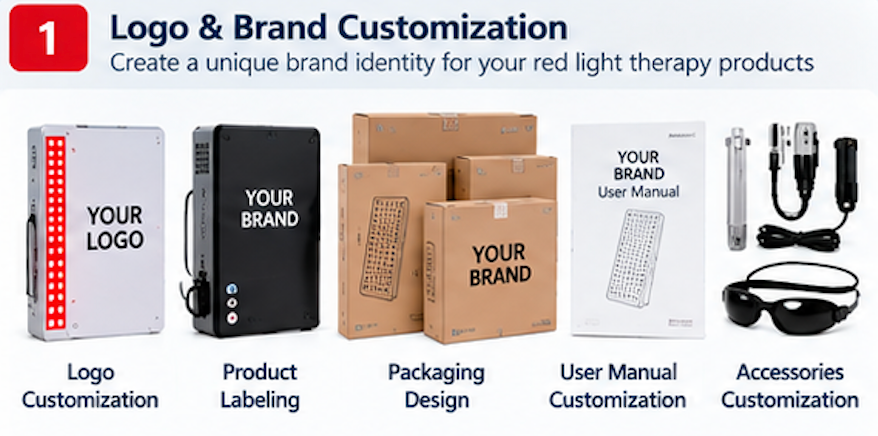
- Brand logo
- Product label
- Model number
- Packaging
- Product color
- User manual
- Accessories
- Housing branding
- Product specifications
- Wavelength configuration
- Control options
Private-label projects can range from very simple branding to much deeper product customization.
For example:
Basic Private Label
Existing product
→ Your logo
→ Your packaging
→ Your manual
→ Your brand
Advanced Private Label
Existing platform
→ Custom wavelengths
→ Modified LED configuration
→ Custom controller
→ Custom appearance
→ Custom packaging
→ Your brand
This is why buyers should define exactly what “private label” means before requesting a quotation.
Private Label vs OEM vs ODM
These terms are often used together, but they are not exactly the same.
What Is Private Label?
Private label generally focuses on applying your brand identity to an existing or slightly modified product.
Typical customization may include:
- Logo
- Packaging
- Labels
- Manual
- Product color
- Accessories
Private label is often the simplest way to enter the market.
What Is OEM?
OEM projects can involve more product-level customization.
In addition to branding, OEM may allow changes such as:
- Wavelength combinations
- LED quantity
- Product configuration
- Controls
- Accessories
- Housing details
- Packaging
What Is ODM?
ODM usually involves deeper product development.
It may include:
- New product structure
- Custom housing
- Electronics
- PCB
- LED layout
- Control system
- Firmware
- Product dimensions
- Industrial design
If you want a deeper comparison, read our guide:
For many new brands, private label or OEM is the most practical starting point.
Why Build a Private Label Red Light Therapy Brand?
Private labeling allows businesses to focus more resources on:
- Branding
- Marketing
- Distribution
- Customer acquisition
- Sales
- Customer service
while the manufacturer handles production.
There are several reasons businesses choose this model.
Faster Market Entry
Building a completely new hardware product from zero can require:
- Engineering
- Tooling
- Electronics development
- Prototyping
- Testing
- Manufacturing setup
Private labeling can reduce some of this development work by using an existing product platform.
Lower Development Complexity
You do not necessarily need your own engineering team to launch the first product.
A new brand may start with:
Existing Red Light Therapy Panel
Your Brand
Custom Packaging
Defined Specifications
This makes private labeling useful for businesses testing demand before investing in larger product-development projects.
Build Your Own Brand Equity
If you only resell another brand, customers remember that manufacturer’s brand.
With private label products, the customer interacts with:
Your brand
Your packaging
Your website
Your warranty
Your customer service
This gives businesses more control over their long-term market positioning.
Step 1: Define Your Target Market
Do not choose a product before understanding who will buy it.
Your target market affects almost every product decision.
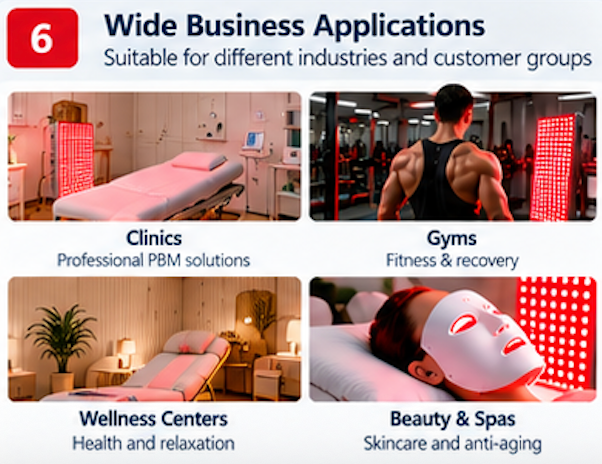
Potential customer groups include:
- Home users
- Clinics
- Fitness centers
- Gyms
- Wellness centers
- Beauty salons
- Spas
- Distributors
- Online retailers
- Recovery centers
Different markets may require very different equipment.
Private Label Products for Clinics
Clinics may focus more heavily on:
- Defined technical specifications
- Irradiance
- Treatment coverage
- Device durability
- Controls
- Documentation
- Maintenance
- Professional appearance
You can review different equipment considerations in our Red Light Therapy Solutions for Clinics.
Private Label Products for Gyms
Fitness businesses may prioritize:
- Full-body coverage
- Simple operation
- Equipment durability
- High-frequency use
- Cooling
- Customer throughput
- Recovery-area integration
Large panels or full-body systems can be more relevant for this market.
Private Label Products for Wellness Centers
Wellness businesses may prefer a broader product mix.
For example:
Full-Body Panel
Targeted Panel
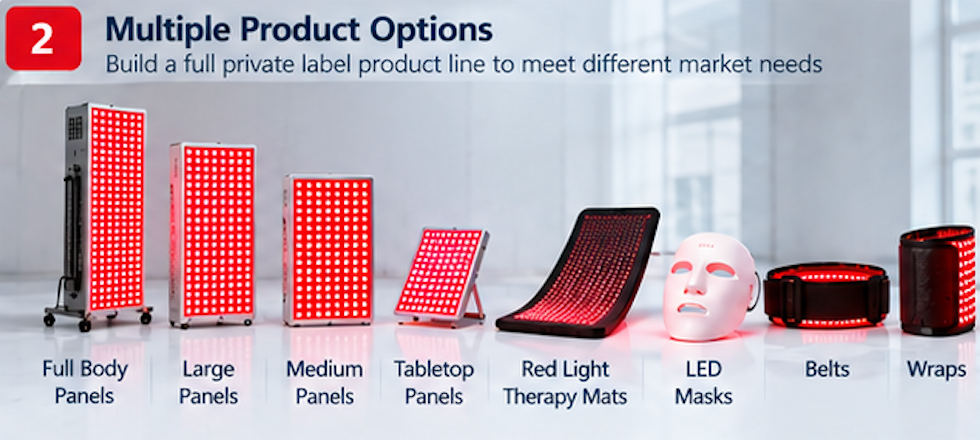
Red Light Therapy Mat
This allows the business to build several service options.
Explore our Health Center Red Light Therapy Solutions.
Private Label Products for Beauty Businesses
Beauty brands may prioritize:
- Product appearance
- Compact size
- LED facial devices
- Packaging
- Brand presentation
- Simple controls
You can also review our Beauty Red Light Therapy Solutions for professional beauty applications.
Step 2: Choose the Right Red Light Therapy Product
Once the customer is clear, choose the correct product category.
A private-label line can include several product types.
Red Light Therapy Panels
Panels are one of the most flexible categories for B2B brands.
Available formats can include:
- Targeted panels
- Tabletop panels
- Medium panels
- Large panels
- Full-body panels
- Multi-panel systems
View our Red Light Therapy Panel Collection.
Panels are suitable for brands targeting:
- Clinics
- Gyms
- Wellness businesses
- Home wellness users
- Distributors
- Professional equipment markets
Red Light Therapy Mats
Mats can offer a different product experience and may be suitable for:
- Wellness
- Recovery
- Home-use markets
- Fitness applications
Possible customization areas include:
- Size
- LED density
- Wavelength
- Controller
- Fabric
- Packaging
- Carry bag
Red Light Therapy Masks
Masks may fit:
- Beauty brands
- Skincare brands
- Salons
- E-commerce
- Consumer wellness markets
Private-label projects can focus heavily on:
- Appearance
- Comfort
- Packaging
- Logo
- Controls
- Accessories
Belts and Targeted Devices
Smaller products can offer:
- Lower shipping volume
- Easier product demonstrations
- Different price positioning
- Targeted product lines
You can view multiple product categories through the Red Light Therapy Products section.
Step 3: Define the Technical Specifications
This is where many new brands make mistakes.
Do not choose a red light therapy product based only on:
Wattage.
Or:
Number of LEDs.
A professional specification should consider several factors together.
Wavelength
Common wavelengths used in red and near-infrared light devices can include:
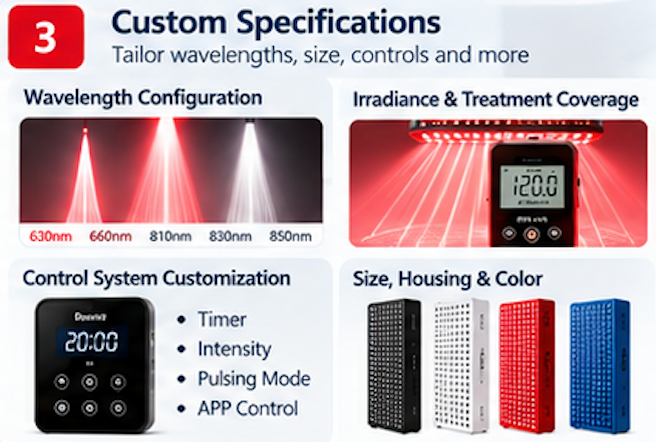
- 630nm
- 660nm
- 810nm
- 830nm
- 850nm
Many products combine red and near-infrared wavelengths.
For example:
660nm + 850nm
The ideal wavelength configuration should be selected based on the intended product design and application.
Irradiance
Irradiance describes optical power delivered over a specific area.
It is commonly expressed as:
mW/cm²
If a manufacturer says:
Our panel provides 150 mW/cm².
Ask:
At what measurement distance?
Also ask:
- Where was it measured?
- What instrument was used?
- Which wavelengths were active?
- Is that peak output or typical treatment-area output?
For a deeper technical explanation, read our Red Light Therapy Irradiance Guide.
Wattage
Wattage and irradiance are not the same thing.
A panel with a higher electrical wattage does not automatically mean proportionally higher useful optical output.
Private-label buyers should evaluate:
Wavelength + Irradiance + Distance + Coverage + LED Configuration + Power
instead of comparing wattage alone.
Treatment Coverage
Coverage can be particularly important for larger panels.
Ask:
- What treatment area does the panel cover?
- At what distance?
- Is irradiance uniform across the area?
- What is the beam angle?
- What is the LED spacing?
A high center reading does not necessarily mean good full-body coverage.
Step 4: Decide How Much Customization You Actually Need
More customization is not always better.
Every additional customization can affect:
- Development cost
- MOQ
- Sample time
- Tooling
- Production complexity
- Lead time
Start by separating customization into levels.
Level 1: Basic Private Label
This is the easiest starting point.
Possible changes:
- Logo
- Label
- Packaging
- Manual
Suitable for:
- New brands
- Market testing
- Smaller initial orders
Level 2: Brand Customization
Add:
- Custom color
- Brand appearance
- Accessories
- Custom carton
- Customized manual
This creates stronger visual differentiation.
Level 3: Technical Customization
Changes may include:
- Wavelength
- LED quantity
- LED ratio
- Controller
- Timer
- Operating modes
- Power configuration
- Accessories
This becomes a deeper OEM project.
Level 4: Product Development
A more advanced project may require:
- New housing
- New electronics
- Custom PCB
- New mounting structure
- Firmware
- Touchscreen UI
- App
- Tooling
This moves closer to ODM.
If you need this level of development, review our OEM & ODM Red Light Therapy Solutions.
Step 5: Create Your Brand Identity
Private-label products should look like part of one brand.
Prepare a brand package before sampling.
This may include:
- Logo files
- Brand colors
- Fonts
- Product naming
- Model naming
- Packaging style
- Photography style
- Manual design
- Product labels
A manufacturer can work more efficiently when these materials are prepared early.
Step 6: Design the Packaging
Packaging is often underestimated.
But for online brands, packaging can strongly influence customer perception.
Consider:
Product Protection
Can the packaging protect:
- LEDs
- Housing
- Controllers
- Cables
- Mounting accessories
during international shipping?
Branding
Your packaging may include:
- Logo
- Product name
- Product image
- Specifications
- Model number
- Contact information
- Warnings
- Required labels
Shipping Efficiency
Large boxes create higher logistics costs.
When developing a product, consider:
Product Dimensions → Carton Dimensions → Pallet Size → Shipping Cost
Packaging design is part of the total product economics.
Step 7: Confirm MOQ
MOQ means minimum order quantity.
Private-label MOQ depends on several factors.
Standard Product + Logo
This may require a relatively flexible MOQ.
Custom Packaging
Printing suppliers may have their own minimum quantities.
Custom Color
Special finishes may increase MOQ.
Custom Electronics
New components or PCBs may require larger production quantities.
New Mold
Tooling investment may make very small production runs impractical.
Therefore, do not ask only:
What is your MOQ?
Ask:
What is the MOQ for this exact customization?
Step 8: Order and Test a Sample
Do not jump directly into a large order.
A sample allows you to evaluate the actual product.
Your sample checklist should include:
Appearance
- Housing
- Finish
- Logo
- Color
- Fit and finish
Technical Function
- Wavelength
- Controller
- Timer
- Intensity
- Operating modes
Optical Performance
- Irradiance
- Measurement distance
- Coverage
User Experience
- Noise
- Heat
- Controls
- Mounting
- Cables
Branding
- Logo
- Label
- Manual
- Packaging
The approved sample should become your production reference.
Step 9: Establish a Golden Sample
A golden sample is the approved unit that represents what mass production should match.
This is extremely important.
Without a clear reference, disagreements can arise later over:
- Color
- Logo size
- Packaging
- Housing
- Controller
- LED output
- Accessories
Document the approved specifications.
For example:
| Item | Approved Specification |
|---|---|
| Model | PL-001 |
| Wavelength | 660nm + 850nm |
| Housing | Black |
| Logo | White |
| Controller | Customized |
| Packaging | Private label |
| Manual | English |
| Accessories | Stand + Goggles |
| Irradiance | Per approved test conditions |
The more clearly the project is documented, the easier mass production becomes.
Step 10: Review Quality Control
Brand reputation depends on consistency.
Your first order should not be excellent while your second and third orders gradually change.
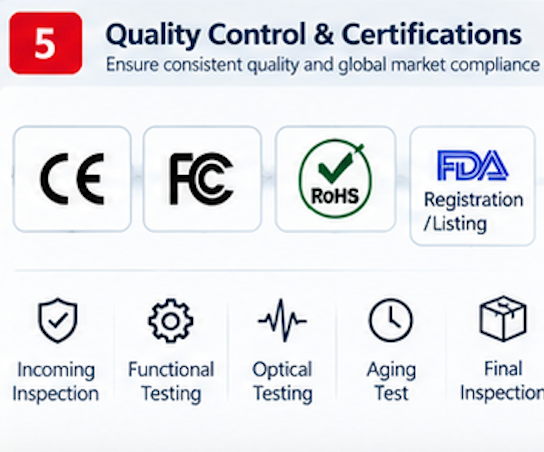
Ask the manufacturer about:
- Incoming material inspection
- LED inspection
- PCB testing
- Assembly testing
- Functional testing
- Irradiance testing
- Aging tests
- Appearance inspection
- Packaging inspection
- Final inspection
If you are placing a larger order, consider:
- Pre-production inspection
- During-production inspection
- Pre-shipment inspection
- Third-party inspection
Step 11: Review Documentation and Compliance
This step should happen before market launch.
Compliance requirements vary based on:
- Country
- Intended use
- Product category
- Marketing claims
- Electrical design
Potential documentation may involve:
- Product test reports
- Electrical safety
- EMC
- RoHS
- FCC-related requirements
- CE-related requirements
- Product labels
- User instructions
Do not rely only on certification logos.
Ask for documentation that applies to the exact model.
Check:
- Product model
- Manufacturer
- Applicant
- Test standard
- Laboratory
- Date
- Scope
Also be cautious with health claims.
A private-label brand should not automatically advertise a product as diagnosing, treating, curing, or preventing diseases unless the specific regulatory status and evidence support those claims in the target market.
Step 12: Calculate the Real Private Label Cost
The factory unit price is only one part of your cost.
A better formula is:
Product Cost
Customization
Packaging
Samples
Testing
Inspection
Freight
Import Costs
Warehousing
Warranty
Marketing
=
Total Landed Business Cost
Suppose one supplier offers a product for $10 less.
But that supplier also has:
- More defects
- Poorer packaging
- No spare parts
- Slow technical support
The apparent saving may disappear quickly.
Private-label buyers should focus on total business value.
How to Choose a Private Label Red Light Therapy Manufacturer
The manufacturer is one of the most important parts of your brand.
Evaluate the supplier across several areas.
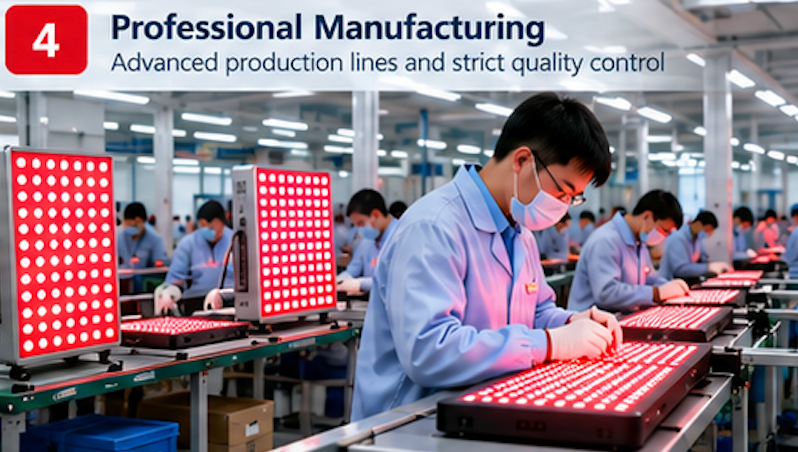
Manufacturing Capability
Ask:
- Do you own the factory?
- What do you manufacture in-house?
- What is outsourced?
- How large is the production facility?
- What equipment is available?
You can learn more about our manufacturing background on the About Us page.
Product Development
Ask whether the manufacturer can support:
- Standard private label
- OEM
- ODM
- Custom wavelengths
- LED changes
- Controllers
- Product structure
- Packaging
Quality Control
Ask for a clear production and QC workflow.
For example:
Incoming Materials
→
Assembly
→
Functional Test
→
Optical Test
→
Aging Test
→
Final Inspection
→
Packaging
Communication
A good manufacturing partner should be able to answer technical questions clearly.
Try asking:
What irradiance does this panel provide at 6 inches?
Can you customize the wavelength ratio?
How are LEDs tested?
What happens if a component changes?
What is your process for defective products?
The quality of the answers often tells you a lot about the supplier.
Private Label Product Strategy for New Brands
A new brand does not need to launch 20 products.
In many cases, starting with a focused product line is better.
For example:
Option A — Professional Panel Brand
Start with:
- Tabletop panel
- Medium panel
- Full-body panel
This creates three price points.
Option B — Wellness Product Brand
Start with:
- Panel
- Mat
- Belt
This provides different product formats.
Option C — Beauty Brand
Start with:
- LED mask
- Targeted device
- Tabletop panel
This creates a more beauty-focused collection.
How Many Products Should You Launch?
For a new private-label brand, a focused range of approximately 2–5 clearly differentiated products can often be easier to manage than a very large catalog.
The goal is not:
More products.
The goal is:
Clear positioning.
Each product should have a reason to exist.
For example:
Small
Entry-level / targeted
Medium
Main product
Large
Professional/full-body
This makes buying decisions easier.
How to Differentiate Your Private Label Brand
Many brands fail because they sell nearly identical products with only a different logo.
Differentiation can come from several areas.
Product
- Better design
- Different product sizes
- Custom features
- Better controls
Technical Transparency
Publish:
- Wavelength data
- Irradiance tests
- Measurement distance
- Product dimensions
- Treatment area
Technical transparency builds stronger B2B trust.
Content
Create detailed resources around topics such as:
- Wavelength
- Irradiance
- Dosage
- Treatment distance
- Panel sizes
- Commercial equipment
For example, understanding Red Light Therapy Irradiance can help buyers compare professional equipment more accurately.
Customer Segment
Instead of trying to sell to everyone, position your brand around a market.
For example:
Red Light Therapy for Fitness Recovery
or
Professional Red Light Therapy for Wellness Centers
or
Private Label LED Beauty Equipment
Specialization can make a brand easier to understand.
Common Private Label Mistakes
Mistake 1: Choosing Only by Price
The cheapest product is not necessarily the lowest-cost business solution.
Mistake 2: Ignoring Technical Specifications
Always understand:
- Wavelength
- Irradiance
- Distance
- Coverage
- Controls
Mistake 3: Launching Too Many Products
Too many SKUs create:
- Inventory pressure
- Marketing complexity
- Higher cash requirements
Start focused.
Mistake 4: Skipping Samples
Never assume the production product will match a photo.
Test a physical sample.
Mistake 5: Ignoring Packaging
Poor packaging can cause:
- Shipping damage
- Customer dissatisfaction
- More returns
Mistake 6: Making Unsupported Claims
Private-label brands should align product claims with applicable evidence, intended use, and regulatory requirements.
Private Label Red Light Therapy Checklist
Before placing a production order, confirm:
| Area | Check |
|---|---|
| Target Market | Clearly defined |
| Product Type | Panel / Mat / Mask / Belt |
| Wavelength | Confirmed |
| Irradiance | Confirmed with distance |
| Coverage | Confirmed |
| Product Size | Confirmed |
| Logo | Approved |
| Packaging | Approved |
| Manual | Approved |
| Product Label | Approved |
| Accessories | Confirmed |
| MOQ | Confirmed |
| Sample | Approved |
| Golden Sample | Confirmed |
| QC Process | Confirmed |
| Documentation | Reviewed |
| Warranty | Confirmed |
| Lead Time | Confirmed |
| Shipping | Planned |
Frequently Asked Questions
What Is Private Label Red Light Therapy?
Private label red light therapy means selling red or near-infrared light therapy devices under your own brand while an established manufacturer produces the equipment.
The branding and customization scope can vary depending on the project.
Can I Put My Own Logo on a Red Light Therapy Panel?
Yes, private-label projects commonly include custom logos and product labels.
Depending on the project, packaging, manuals, colors, accessories, wavelengths, and controls may also be customized.
View our Red Light Therapy Panels.
What Is the MOQ for Private Label Red Light Therapy?
There is no universal MOQ.
It depends on:
- Product
- Logo method
- Packaging
- Color
- Technical customization
- Components
- Tooling
Simple logo customization can generally be easier to support at lower volumes than completely custom product development.
Can Wavelengths Be Customized?
Depending on the product platform and manufacturer, wavelength configurations may be customizable.
Common wavelengths may include:
630nm, 660nm, 810nm, 830nm, and 850nm.
Confirm the exact configuration during sample development.
Can I Customize the Packaging?
Private-label projects commonly allow custom packaging.
This can include:
- Brand logo
- Product images
- Specifications
- Product name
- User instructions
- Color design
Packaging should be evaluated for both branding and shipping protection.
Should I Order a Sample First?
Yes.
A sample allows you to review:
- Product quality
- Technical performance
- Controls
- Branding
- Packaging
- Accessories
before mass production.
What Is the Difference Between Private Label and ODM?
Private label usually starts with an existing product and focuses mainly on branding or moderate customization.
ODM involves deeper product design and engineering.
For deeper development, visit our Red Light Therapy OEM & ODM Solutions.
Final Thoughts: How to Build a Private Label Red Light Therapy Brand
Building a successful private label red light therapy brand involves much more than adding a logo to a standard device.
The strongest projects connect:
Market Positioning
Product Selection
Technical Specifications
Branding
Packaging
Quality Control
Compliance
After-Sales Support
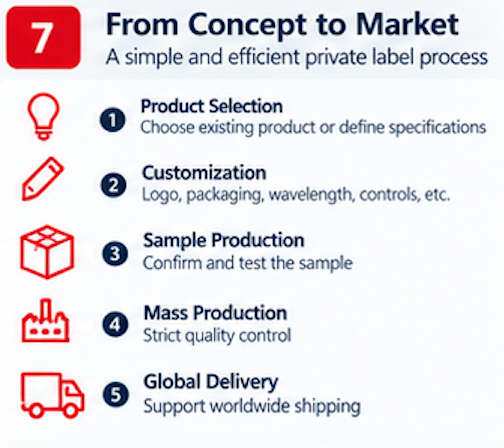
A practical development path is:
Define Your Market
→
Choose the Product
→
Define Specifications
→
Select a Manufacturer
→
Create Branding
→
Develop Packaging
→
Produce Samples
→
Test and Approve
→
Confirm Golden Sample
→
Mass Production
→
Quality Inspection
→
Launch
New brands do not need to begin with a completely custom device.
You can start with private labeling, validate the market, collect customer feedback, and gradually move toward more advanced OEM or ODM products as your business grows.
Start Your Private Label Red Light Therapy Project
If you are planning a red light therapy brand, prepare the following information before contacting a manufacturer:
- Target market
- Product category
- Expected order quantity
- Required wavelengths
- Panel size
- Branding requirements
- Packaging requirements
- Target price
- Required certifications or documentation
- Desired customization level
Then discuss the most suitable manufacturing route.
Explore OEM, ODM & Private Label Red Light Therapy Solutions
Browse Red Light Therapy Products
View Clinic Red Light Therapy Solutions
View Health & Wellness Center Solutions
View Beauty Red Light Therapy Solutions
Post time: 09-30-26