


Red light therapy at home has moved from niche biohacking to a mainstream wellness category, but the devices vary wildly in output, build quality, and regulatory status. This article answers the concrete question: what specifications, safety certifications, and sourcing practices separate a reliable home-use LED panel from a cheap import that underdelivers? You will learn how to read a spec sheet, spot the failure modes that cause real returns, and choose a supplier with defensible claims.
What Red Light Therapy at Home Actually Means
Home-use photobiomodulation devices deliver red and near-infrared light through LED arrays, typically at wavelengths of 630-660 nm for red and 810-850 nm for near-infrared. The goal is to expose skin to a controlled irradiance, usually 3-50 mW/cm2, for a session long enough to reach a dose of roughly 3-20 J/cm2. Unlike laser therapy, LED panels spread light over a larger area with lower peak intensity, which makes them safer for unsupervised use but also easier to build poorly.
The key distinction is between a cosmetic device and a medical device. In the US, most home panels are marketed under general wellness or cosmetic claims, avoiding FDA 510(k) clearance. In the EU, they may fall under the Low Voltage Directive or the Medical Device Regulation depending on the claims. A buyer should always ask the supplier which regulatory pathway the device follows and request the test reports, not just a CE logo printed on the housing.
Wavelength and Irradiance: The Two Numbers That Matter
Wavelength determines penetration depth and which chromophores absorb the light. Red light at 630-660 nm is absorbed mainly by superficial tissue, while near-infrared at 810-850 nm reaches deeper structures such as muscle and joint tissue. A panel that claims “full spectrum” but lacks a spectral power distribution graph is hiding something. Ask for the actual wavelength peak and the full width at half maximum; a tolerance of ±10 nm is typical for quality LEDs, while ±20 nm indicates loose binning.
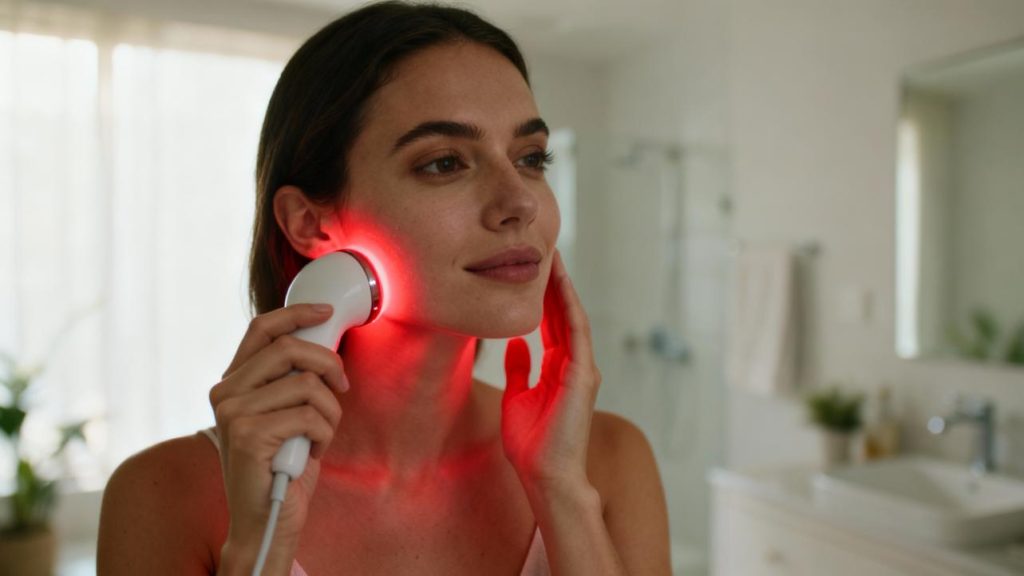
Irradiance, measured in mW/cm2, tells you how much light actually reaches the skin at a given distance. Many sellers quote irradiance at the LED surface, which is useless because it falls off with distance. A panel rated at 100 mW/cm2 at 0 inches may deliver only 30 mW/cm2 at 6 inches. The only honest measurement is with a calibrated solar power meter or spectrometer at the intended treatment distance, usually 6-12 inches. If a supplier cannot provide an irradiance map at multiple distances, treat the spec as unverified.
Calculating Dose from Irradiance and Time
Dose in J/cm2 equals irradiance in mW/cm2 multiplied by time in seconds, divided by 1000. For example, 30 mW/cm2 for 10 minutes (600 seconds) gives 18 J/cm2. Most home protocols target 3-20 J/cm2 per session, but the effective dose depends on wavelength, skin type, and the condition being addressed. A device with very high irradiance may allow shorter sessions, but it also increases the risk of thermal discomfort and photobleaching if used incorrectly.
Device Classes: Panel, Bed, and Handheld Compared
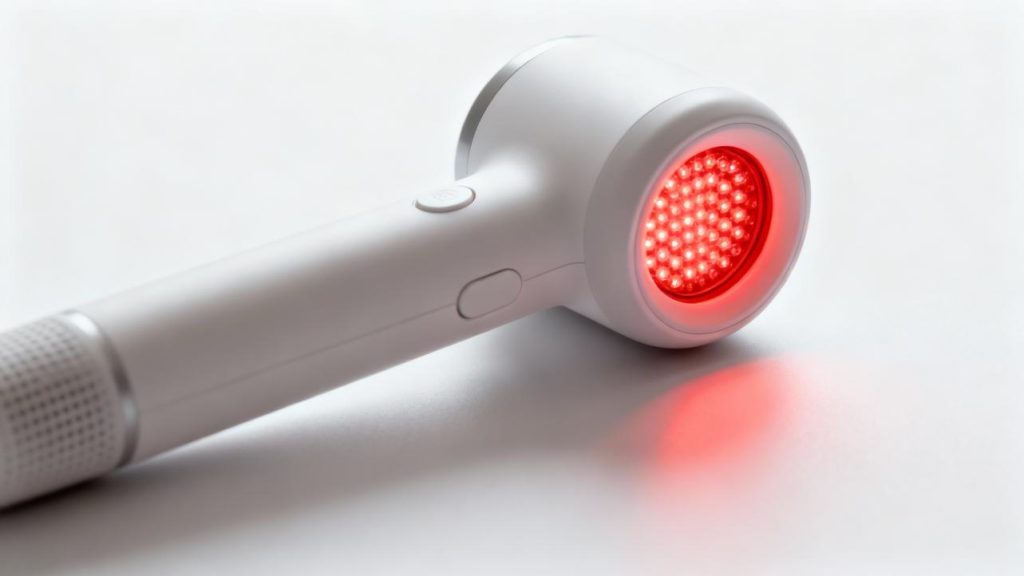
The form factor changes the treatment area, the irradiance uniformity, and the price. A full-body panel or bed covers a large area but costs more and takes up space. A handheld unit is portable and cheap but treats only a small spot, making consistent dosing difficult. The table below summarizes the trade-offs for a buyer evaluating red light therapy at home options.
| Device type | Typical treatment area | Irradiance at 6 inches | Price tier (bulk OEM) | Key consequence |
|---|---|---|---|---|
| Small handheld | 10-20 cm2 | 10-30 mW/cm2 | $15-40 | Hard to reach dose on large areas; high return rate due to unmet expectations |
| Targeted panel (12×12 in) | 200-400 cm2 | 20-50 mW/cm2 | $80-200 | Good for face or single joint; requires multiple placements for full body |
| Half-body panel (24×12 in) | 800-1200 cm2 | 15-40 mW/cm2 | $150-350 | Balanced for home use; check uniformity across the panel edges |
| Full-body bed or pod | 1500-2500 cm2 | 10-30 mW/cm2 | $500-1500 | Highest cost and space; often requires dedicated circuit and thermal management |
For importers, the panel category dominates the market because it balances price, shipping weight, and perceived value. Handhelds are often sold as entry-level products but generate more complaints about “not working” because users do not hold them long enough. Beds are a niche for clinics and high-end home users, with much longer lead times and higher warranty exposure.
Safety Standards and Photobiological Risk
Any serious red light therapy at home device should be tested to IEC 62471, the photobiological safety standard for lamps and lamp systems. This standard classifies devices into risk groups: Exempt, RG1, RG2, or RG3. For home use, the device should fall into Exempt or RG1 at the intended treatment distance. RG2 requires a warning label and is generally not acceptable for unsupervised consumer use. Ask for the IEC 62471 test report from an accredited lab, not a self-declaration.
Electrical safety is equally critical. In the US, look for UL 60601-1 or UL 62368-1 certification; in the EU, EN 60335-1 or EN 60601-1 depending on the device class. A cheap power supply is the most common failure point: overheating, humming, or failing within six months. Constant-current LED drivers are preferred over constant-voltage because they maintain stable output as LEDs heat up, preventing irradiance drift during a session.
A practical rule of thumb: if a supplier cannot produce an IEC 62471 report and a valid electrical safety certificate within 48 hours, the device is not ready for retail in North America or Europe.
Thermal Design and LED Lifetime
LEDs convert only about 30-40% of electrical power into light; the rest becomes heat. Without adequate heat sinking, the junction temperature rises, which reduces light output and shortens LED life. A well-designed panel uses an aluminum PCB bonded to a finned heatsink, with active cooling fans for high-power arrays. Passive cooling is possible for low irradiance panels but limits the maximum power density.
Check the LED manufacturer and binning. Quality suppliers use LEDs from brands like Seoul Semiconductor, Osram, or Lumileds, with tight wavelength bins. A no-name LED may work initially but drift by 10-15 nm within a year, changing the therapeutic effect. The driver should be rated for at least 50,000 hours at 80% lumen maintenance, but the real-world failure is usually the fan or the power connector, not the LED itself.
Sourcing Red Light Therapy at Home Devices: OEM and ODM
Most home-use panels are made by Chinese OEM/ODM factories in Shenzhen, Dongguan, or Ningbo. The price structure depends on volume: a basic 12×12 inch panel with 60 dual-chip LEDs might cost $60-90 at 500 units, dropping to $40-60 at 2000 units. Custom branding, packaging, and firmware add $5-15 per unit. Typical MOQ is 100-500 units for private label, with lead times of 30-45 days after deposit.
When evaluating a supplier, request a pre-production sample and test it yourself with a solar power meter at the intended distance. Check the irradiance uniformity across the panel: a variation of more than 20% from center to edge indicates poor LED placement or optics. Ask for the bill of materials to confirm the LED brand, driver IC, and heatsink material. A supplier that refuses to share the BOM is likely substituting cheaper parts after the sample approval.
- Request IEC 62471 and electrical safety certificates from an accredited lab, not the factory’s own test.
- Specify the wavelength tolerance (±10 nm) and irradiance at a defined distance (e.g., 30 mW/cm2 at 6 inches) in the purchase contract.
- Order a random production sample from the first batch and compare it to the approved golden sample before accepting the shipment.
- Negotiate a warranty that covers LED output drop below 70% of initial irradiance within 24 months, not just total failure.
Frequently Asked Questions
What is the difference between red and near-infrared light in home devices?
Red light at 630-660 nm is absorbed primarily by the skin and superficial tissue, while near-infrared at 810-850 nm penetrates deeper to reach muscle and joints. Many panels combine both wavelengths, but the ratio matters: a 50/50 split is common, while some protocols favor more near-infrared for deep tissue applications.
How do I know if a device’s irradiance claim is real?
Ask for an irradiance map measured with a calibrated spectrometer or solar power meter at the intended treatment distance, not at the LED surface. A legitimate supplier will provide a graph showing irradiance at 0, 6, 12, and 18 inches. If they only quote a single number without distance, the claim is unverifiable.
Can I use a red light therapy panel every day?
Daily use is common for many protocols, but the dose should stay within 3-20 J/cm2 per session. Higher doses do not always mean better results; some studies suggest a biphasic response where excessive light reduces effectiveness. Start with the manufacturer’s recommended time and adjust based on skin response, not marketing claims.
What certifications are mandatory for selling in the US and EU?
In the US, the device must comply with FDA general wellness or cosmetic regulations, plus electrical safety standards like UL 62368-1. In the EU, CE marking under the Low Voltage Directive or Medical Device Regulation is required, along with IEC 62471 photobiological safety testing. A CE mark alone is not proof; request the Declaration of Conformity and test reports.
What to Do Next
Red light therapy at home is a viable product category, but only if you buy on specifications, not on marketing language. The three numbers to verify are wavelength peak and tolerance, irradiance at the intended distance, and the IEC 62471 risk group. The three documents to demand are the spectral power distribution graph, the irradiance map, and the accredited lab test reports.
If you are sourcing panels for import or private label, start with a small pilot order of 50-100 units and test them in real-world conditions before committing to a container. The cost of a failed batch—returns, chargebacks, and brand damage—far exceeds the cost of due diligence. For clinic owners, the same rules apply: buy a device you can measure, not one you have to trust.
Post time: 11-16-26