

Red light therapy is increasingly discussed as a supportive tool for managing herpes outbreaks, but the evidence base is still thin. This article answers a practical question: what device specifications, dosing parameters, and sourcing criteria matter if you are evaluating red light therapy products for herpes-related use. We focus on 630-660 nm red and 810-850 nm near-infrared wavelengths, typical irradiance ranges of 3-50 mW/cm2, and per-session doses of roughly 3-20 J/cm2.
How Red Light Therapy May Affect Herpes Lesions
Herpes simplex virus (HSV) causes recurrent lesions by reactivating in nerve ganglia and traveling to the skin. Red and near-infrared light are proposed to reduce local inflammation and support tissue repair, not to eliminate the virus itself. The mechanism under study is photobiomodulation: photons absorbed by cytochrome c oxidase in mitochondria may increase ATP production and modulate reactive oxygen species, which could shorten lesion duration or reduce discomfort.
Most published studies are small, and many use low-level laser rather than LED panels. A 2013 trial on herpes labialis used 1072 nm light at 7.5 J/cm2 and reported reduced healing time, but that wavelength is outside the common LED range. For LED devices, there is no standardized protocol for herpes; users and clinicians often adapt general wound-healing parameters: 630-660 nm red for surface effects, 810-850 nm near-infrared for deeper tissue penetration.
Treat red light therapy for herpes as an adjunct, not a replacement for antiviral medication. Confirm any treatment plan with a clinician, especially for recurrent or severe outbreaks.
Wavelength Selection: 630-660 nm vs 810-850 nm
Red light in the 630-660 nm band penetrates roughly 2-3 mm into skin, which is sufficient for epidermal lesions and mucosal surfaces. Near-infrared at 810-850 nm reaches 5-10 mm or deeper, potentially affecting dermal layers and local blood flow. Most herpes lesions are superficial, so red wavelengths are the primary choice, but some protocols combine both bands to address inflammation in surrounding tissue.
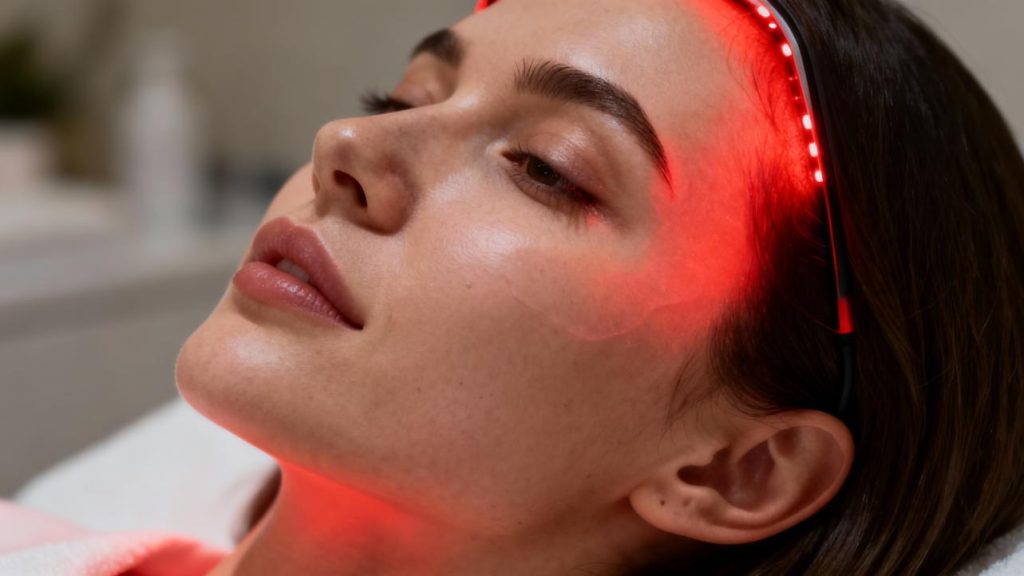
When evaluating devices, check the manufacturer’s stated wavelength tolerance. A panel labeled “660 nm” may actually emit anywhere from 640 to 680 nm depending on LED binning. Reputable suppliers provide a spectral power distribution or at least a peak wavelength with ±5 nm tolerance. For herpes applications, a true peak of 630-660 nm and a secondary peak of 810-850 nm is a reasonable configuration.
| Wavelength Band | Typical Penetration | Practical Consequence for Herpes Use |
|---|---|---|
| 630-660 nm red | 2-3 mm | Best for surface lesions; lower risk of overheating; visible light allows easy positioning. |
| 810-850 nm near-infrared | 5-10 mm | May reach deeper inflammation; invisible so users need a timer or auto-shutoff to avoid overexposure. |
| Combined red + NIR | Mixed | Offers broader coverage but increases cost and complexity; ensure independent control of each band. |
Dosing and Irradiance: What the Numbers Mean
Irradiance, measured in mW/cm2, tells you how much light power reaches the skin. Dose, in J/cm2, is irradiance multiplied by time in seconds divided by 1000. A device emitting 50 mW/cm2 delivers 3 J/cm2 in 60 seconds. For herpes, most user reports and small studies fall between 3 and 20 J/cm2 per session, applied once or twice daily during an outbreak.

Beware of inflated irradiance claims. Some manufacturers state irradiance at the LED surface, not at the treatment distance. A panel rated at 100 mW/cm2 at 0 cm may deliver only 30 mW/cm2 at 15 cm. Ask for an irradiance map or measure with a solar power meter if you are importing for resale. For clinical use, a device that cannot maintain at least 10 mW/cm2 at the intended working distance is unlikely to deliver a meaningful dose in a reasonable time.
- Check irradiance at the actual treatment distance, not at the LED surface.
- Calculate dose: J/cm2 = (mW/cm2 × seconds) / 1000.
- Start with 3-5 J/cm2 per session and increase only if tolerated.
- Limit near-infrared sessions to avoid thermal discomfort; red light has less heating risk.
Device Classes: Panel, Handheld, or Bed
For herpes lesions on the lips or face, a small handheld device or a targeted panel is usually sufficient. Large full-body panels are overkill for a single lesion but may be justified in clinics treating multiple patients or for off-label use in other conditions. Handheld devices offer portability and precise positioning, but their irradiance is often lower and their battery life limits session length.
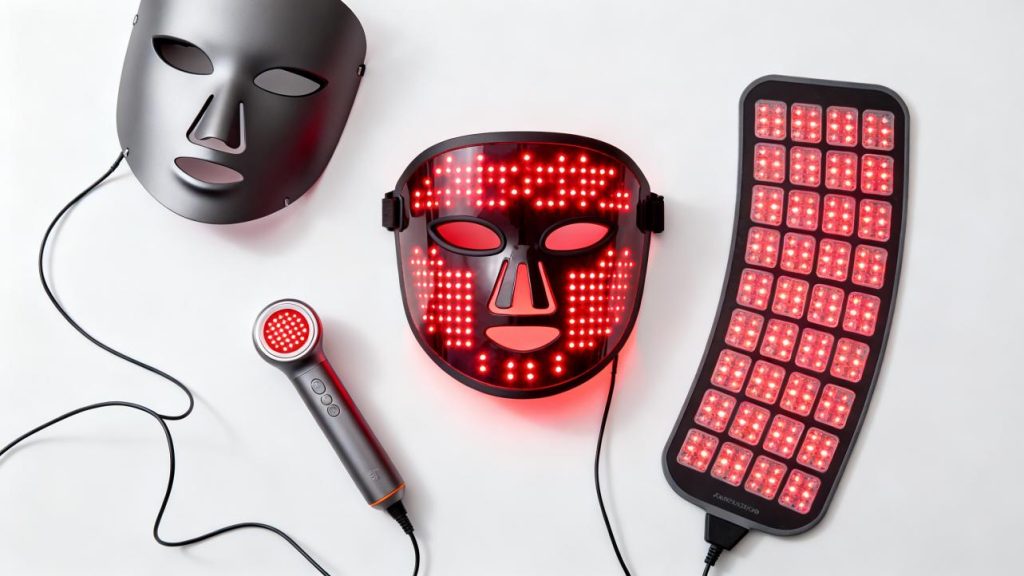
Full-body beds or large panels are not recommended for herpes alone due to cost and the difficulty of targeting a small area. However, if you are a distributor, a mid-size panel (30-60 cm wide) with adjustable height and a timer is a versatile product that covers facial and genital applications. Check that the device has a built-in timer with automatic shutoff; herpes lesions require short, repeated sessions, and user error with manual timing is common.
Safety Standards and Regulatory Compliance
Red light therapy devices fall under photobiological safety standard IEC 62471. For skin exposure, the risk group should be Exempt or Risk Group 1 (low risk). Risk Group 2 devices may be acceptable for short exposures but require warning labels. Never import a device without a valid IEC 62471 test report from an accredited lab; some suppliers provide only a CE mark for electrical safety, which does not cover optical radiation.
In the US, red light therapy devices for herpes are typically Class II medical devices requiring a 510(k) clearance if marketed for treatment of a specific disease. Many devices are sold as general wellness products, which avoids medical claims but also limits how you can advertise them. If you plan to market the device for herpes, you must either obtain clearance or use careful language such as “supports skin health” rather than “treats herpes.”
Always ask for the IEC 62471 test report, not just a CE certificate. A CE mark for electrical safety does not prove photobiological safety.
Supplier Evaluation for Importers and Distributors
When sourcing red light therapy devices for herpes-related use, the supplier’s documentation matters more than the marketing copy. Request the LED binning data, driver specifications, and a sample for independent testing. Typical OEM pricing for a small handheld device ranges from $15-40 per unit at 500-1000 pieces, while mid-size panels run $80-200 per unit at 100-500 pieces. Lead times are usually 30-60 days after deposit.
Ask these questions before placing an order:
- What is the peak wavelength and tolerance for each LED type? (Acceptable: ±5 nm for red, ±10 nm for NIR.)
- What is the irradiance at 10 cm and 20 cm from the device surface? (Must be measured, not calculated.)
- Can you provide an IEC 62471 test report from an accredited lab dated within the last two years?
- What is the warranty period and what are the return terms for defective units? (Typical: 1-2 years, 1-3% defect allowance.)
- Do you offer private labeling and what is the MOQ for custom branding? (Usually 100-500 units.)
What the Evidence Does and Does Not Show
No large randomized controlled trial has established red light therapy as a proven remedy for herpes. The most relevant human study, a 2013 trial using 1072 nm infrared at 7.5 J/cm2, found a reduction in healing time for herpes labialis, but the wavelength is uncommon in LED panels. A few case reports and small series suggest 660 nm red light may reduce pain and crusting, but the sample sizes are too small for clinical recommendations.
For device buyers, this means you should avoid any supplier that claims a “cure” or cites a specific success rate. Instead, position the product as a supportive wellness device that may help manage outbreak symptoms. The honest statement is: red light therapy is non-invasive, has a good safety profile at low doses, and is worth evaluating as an adjunct, but it is not a substitute for antiviral therapy.
FAQ: Remedy Herpes with Red Light Therapy
Can red light therapy cure herpes?
No. Red light therapy cannot eliminate the herpes virus from the body. It may support faster healing of lesions and reduce local inflammation, but it is not a cure.
What wavelength is best for herpes lesions?
630-660 nm red light is the most commonly used band for superficial herpes lesions because it penetrates the epidermis without significant heating. Some protocols add 810-850 nm near-infrared for deeper tissue effects, but evidence is limited.
How long and how often should I use red light for a herpes outbreak?
A typical starting protocol is 3-5 J/cm2 per session, once or twice daily, for 3-7 days during an outbreak. This translates to 1-3 minutes per session with a device delivering 30-50 mW/cm2. Adjust based on skin response and consult a clinician if lesions worsen.
Is red light therapy safe for genital herpes?
Red light at low doses is generally safe for skin and mucosal surfaces, but genital tissue is more sensitive. Use lower irradiance (10-20 mW/cm2) and shorter sessions initially. Always confirm with a healthcare provider before treating genital lesions.
What to Do Next
If you are evaluating red light therapy devices for herpes-related use, start by defining your target user and intended marketing claims. For general wellness positioning, a 630-660 nm handheld or small panel with IEC 62471 Exempt or RG1 classification is sufficient. For clinical use, request a full technical file including wavelength tolerance, irradiance maps, and safety reports.
Request samples from at least three suppliers and test them with a calibrated light meter. Compare irradiance at the actual treatment distance, not the advertised peak. Then decide based on documentation quality, not just price. A device that cannot prove its wavelength and safety claims is not worth importing, regardless of margin.
Post time: 11-17-26