


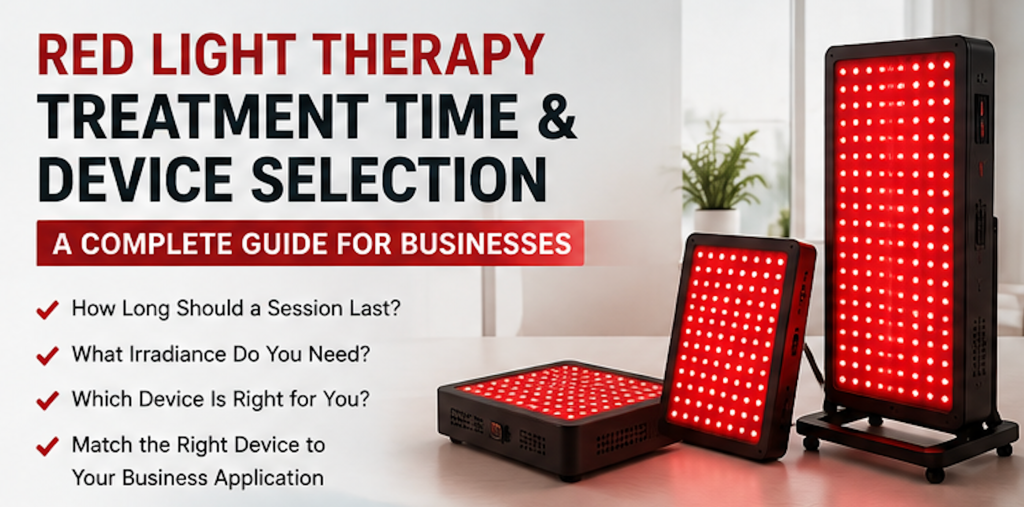
Choosing the right red light therapy device is about more than selecting a panel with a high wattage or a large number of LEDs.
For clinics, gyms, wellness centers, beauty businesses, spas, rehabilitation facilities, distributors, and private-label brands, two questions are especially important:
How long should a red light therapy session last?
And:
How do you choose the right red light therapy device?
Treatment time is closely related to irradiance, treatment distance, wavelength, treatment area, and the intended application. A large full-body panel may have a different operating protocol from a compact targeted panel or tabletop device.
This guide explains how businesses can evaluate red light therapy treatment time and select the appropriate professional device for their application.
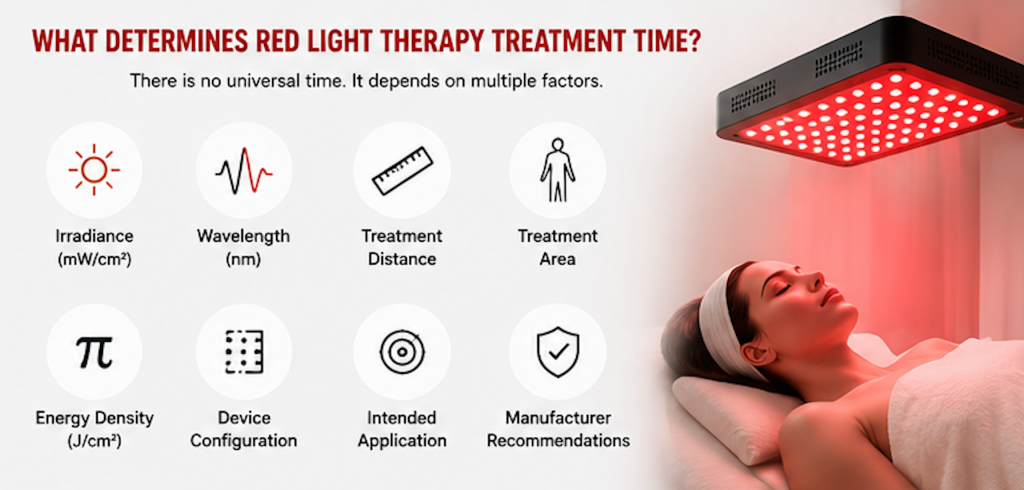
What Determines Red Light Therapy Treatment Time?
There is no universal treatment time that applies to every red light therapy device.
A suitable session duration depends on several technical and application-specific factors:
- Irradiance
- Wavelength
- Treatment distance
- Treatment area
- Energy density
- Device configuration
- Intended application
- Manufacturer recommendations
- Applicable professional protocols
For this reason, businesses should avoid choosing a fixed treatment time simply because another device uses the same session duration.
A 60W targeted panel and a 600W full-body panel can have very different optical characteristics and coverage areas.
The treatment protocol should therefore be based on the actual device specifications.
The Relationship Between Irradiance and Treatment Time
One of the most important concepts when selecting a professional red light therapy device is irradiance.
Irradiance describes the optical power delivered over a specific area and is commonly expressed as:
mW/cm²
Treatment time determines how long the target area receives that optical energy.
A simplified relationship is:
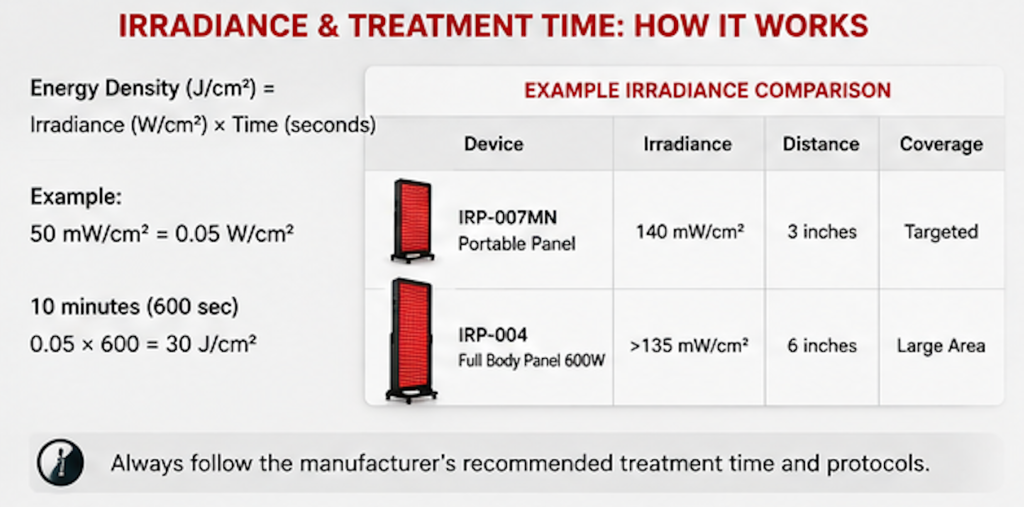
Energy Density (J/cm²) = Irradiance (W/cm²) × Time (seconds)
For example, if a device delivers 50 mW/cm²:
50 mW/cm² = 0.05 W/cm²
A 10-minute session would theoretically deliver:
0.05 × 600 = 30 J/cm²
However, this calculation should not be treated as a universal treatment recommendation.
Different wavelengths, tissues, applications, devices, and protocols can produce different outcomes. Research in photobiomodulation also does not support a simple assumption that increasing exposure time or irradiance will always produce better results.
Therefore, professional users should follow the manufacturer’s recommended operating parameters and applicable protocols.
Why Irradiance Matters More Than Wattage Alone
A common mistake when comparing red light therapy panels is to look only at electrical wattage.
For example:
600W does not automatically mean better than 300W.
Wattage describes electrical power consumption or rated electrical output.
Irradiance describes optical power delivered to a treatment area.
Two devices with similar electrical wattage can have different:
- LED configurations
- Optical designs
- Beam angles
- Irradiance
- Treatment coverage
- Cooling systems
- Treatment distances
This is why professional buyers should compare:
Wattage + Irradiance + Distance + Coverage + Wavelength
rather than wattage alone.
For a deeper explanation, see our Red Light Therapy Irradiance Guide.
How Treatment Distance Affects Red Light Therapy
Treatment distance is another important factor.
The irradiance measured at 3 inches may be different from the irradiance measured at 6 inches or 12 inches.
For example, the website’s IRP-004 Full Body Red Light Therapy Panel is specified at more than 135 mW/cm² at 6 inches, while the compact IRP-007MN portable panel is specified at 140 mW/cm² at 3 inches. These measurements should be understood together with the measurement distance and device design rather than compared as standalone numbers.
When evaluating a commercial red light therapy panel, ask the manufacturer:
- What is the irradiance?
- At what distance was it measured?
- What measurement method was used?
- What is the recommended treatment distance?
- What is the treatment area?
This provides a much more useful comparison between devices.
How Wavelength Influences Device Selection
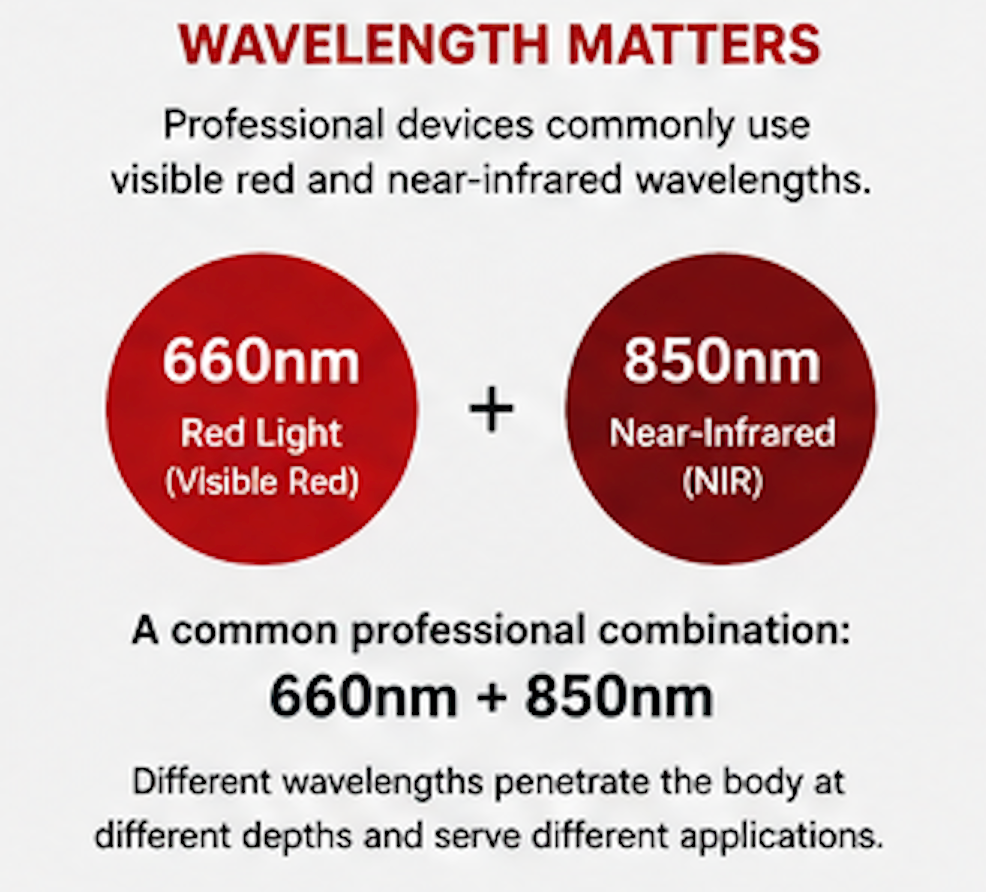
Professional red light therapy equipment commonly uses visible red and near-infrared wavelengths.
Common configurations include:
- 630nm
- 660nm
- 810nm
- 830nm
- 850nm
One frequently used commercial configuration is:
660nm + 850nm
660nm is a visible red wavelength, while 850nm is in the near-infrared spectrum.
The two wavelengths are often combined in professional systems because they provide different portions of the optical spectrum.
However, wavelength alone should not determine treatment time.
You should also consider:
- Irradiance
- Treatment distance
- Energy density
- Treatment area
- Device design
- Intended application
Read our detailed 660nm vs 850nm Red Light Therapy guide for a deeper comparison.
How Long Should a Red Light Therapy Session Last?
There is no single session duration that works for every red light therapy device.
A manufacturer may recommend a particular session duration based on:
- Device irradiance
- Wavelength
- Treatment distance
- Target area
- Intended application
- Device design
- Recommended dose
For example, a high-irradiance targeted panel may require a different exposure time than a lower-output full-body system.
A practical commercial approach is:
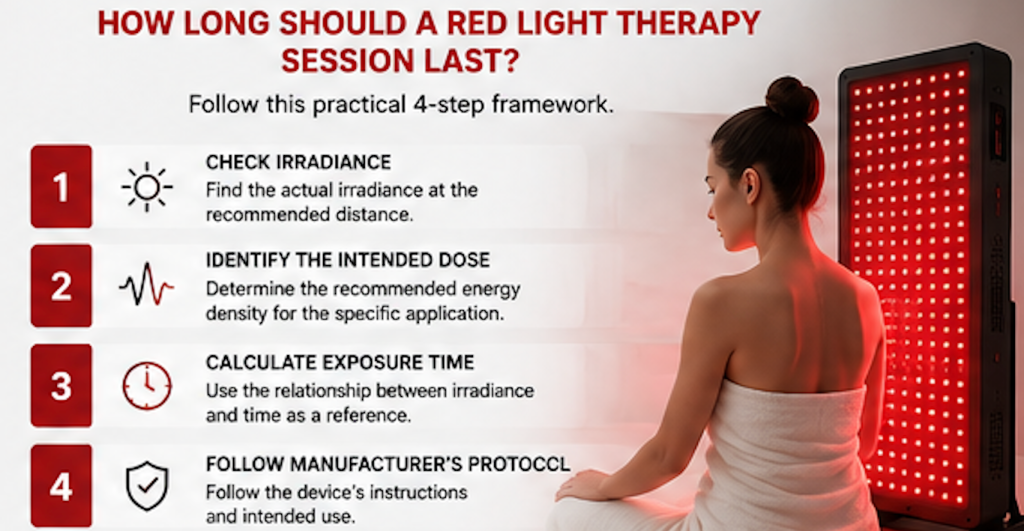
Step 1: Check Irradiance
Find the actual irradiance at the recommended treatment distance.
Step 2: Identify the Intended Dose
Determine the recommended energy density or treatment protocol for the specific application.
Step 3: Calculate Exposure Time
Use the relationship between irradiance and time as a reference.
Step 4: Follow the Manufacturer’s Protocol
The final treatment duration should follow the device’s instructions and intended use.
Our dedicated Red Light Therapy Treatment Time Guide provides additional information about treatment duration.
Full-Body vs Targeted Red Light Therapy Treatment Time
Device coverage can significantly affect how a business thinks about treatment time.
Full-Body Red Light Therapy Panels
Full-body panels are designed to cover larger areas.
They can be useful for:
- Wellness centers
- Recovery facilities
- Clinics
- Fitness centers
- Performance facilities
The benefit of larger coverage is that a greater body area can be exposed during one session.
The US Red Light Therapy product portfolio includes full-body systems such as the 600W IRP-004, 1600W IRP010-05L, and 1700W IRP010-06L.
View Full-Body Red Light Therapy Panels
Targeted Red Light Therapy Panels
Targeted panels are designed for localized applications.
They can be useful for:
- Shoulders
- Arms
- Legs
- Back
- Joints
- Facial applications
- Smaller treatment areas
For example, the IRP010-04T is listed as a 300W targeted red light therapy panel.
Targeted systems can be particularly useful for clinics and beauty businesses where treatment rooms may have limited space.
Choosing the Right Red Light Therapy Device
The correct device depends on the business application.
Instead of asking:
“Which panel is the most powerful?”
A better question is:
“Which device provides the right coverage, irradiance, wavelength, and workflow for my business?”
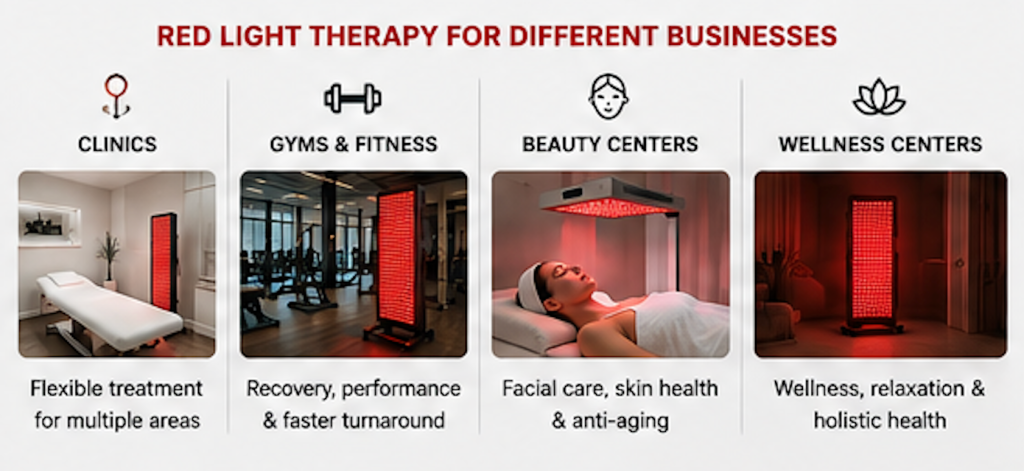
Red Light Therapy Device Selection for Clinics
Clinics often need flexible equipment that can support different treatment areas.
A clinic may consider:
- Targeted panels
- Tabletop panels
- Large panels
- Full-body systems
- Multi-panel systems
Important specifications include:
- Wavelength
- Irradiance
- Treatment distance
- Treatment area
- Session duration
- Device size
- Controls
- Cooling
- Cleaning
- Durability
- Warranty
- Technical support
The dedicated Red Light Therapy Solutions for Clinics page is built around these considerations, including treatment area, wavelength, irradiance, treatment distance, session duration, operator workflow, and daily usage.
For clinics, the goal should be consistent and application-appropriate light delivery rather than simply maximum output.
Red Light Therapy Device Selection for Gyms
Gyms and fitness centers often prioritize:
- Large treatment coverage
- Easy operation
- Customer flow
- Durability
- Cooling
- Treatment speed
- Available floor space
A gym may use a full-body system to create a dedicated recovery area.
A smaller fitness studio may prefer one or more targeted panels.
A gym can also consider combining different formats:
Full-Body Panel + Targeted Panel + Red Light Therapy Mat
This provides flexibility for different customer experiences.
Red Light Therapy Device Selection for Beauty Centers
Beauty businesses often have smaller treatment rooms and more specialized customer workflows.
Suitable equipment may include:
- Facial LED devices
- Tabletop panels
- Targeted panels
- Professional panels
- Full-body systems
The Beauty Red Light Therapy Solutions page on the website currently covers facial devices, professional panels, full-body systems, mats, and multi-panel systems.
For beauty businesses, also consider:
- Device appearance
- Customer comfort
- Treatment positioning
- Treatment distance
- Eye protection
- Cleaning
- Noise
- Heat management
- Treatment room layout
See our Beauty Red Light Therapy Solutions page for more information.
Red Light Therapy Device Selection for Wellness Centers
Wellness centers often require flexible equipment configurations.
A wellness business may combine:
- Full-body panels
- Large panels
- Targeted panels
- Tabletop devices
- Red light therapy mats
The ideal configuration depends on:
Room Size + Customer Volume + Treatment Areas + Business Model
For example, a larger wellness center may create a dedicated full-body red light therapy room.
A smaller facility may use targeted and tabletop panels within existing treatment rooms.
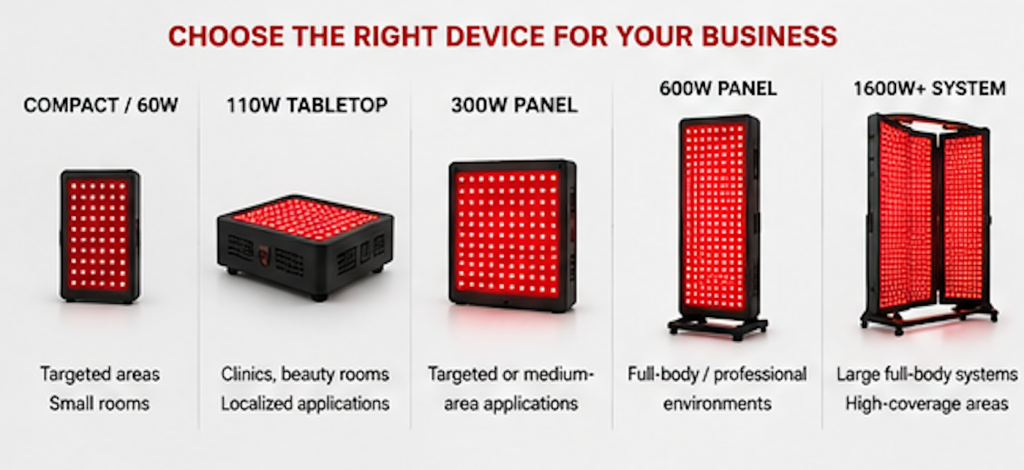
60W, 110W, 300W, 600W or 1600W: Which Power Level Should You Choose?
The answer depends on the application.
US Red Light Therapy currently lists multiple panel configurations, including 60W, 110W tabletop, 300W, 450W, 600W, 900W, 1600W and 1700W models.
A simplified selection framework is:
| Device Type | Typical Business Application |
|---|---|
| Compact / 60W | Targeted areas, small rooms |
| 110W Tabletop | Clinics, beauty rooms, localized applications |
| 300W | Targeted or medium-area applications |
| 450W | Larger treatment areas |
| 600W | Full-body / professional environments |
| 900W | Large-area commercial applications |
| 1600W+ | Large full-body systems / high-coverage environments |
These categories are only a starting point.
The actual selection should also consider irradiance, treatment distance, coverage, wavelength, cooling, controls, and intended use.
Treatment Time vs Device Type
A useful way to think about commercial device selection is:
Compact Targeted Device
Small area → Focused coverage → Flexible positioning
Suitable for smaller treatment rooms and localized applications.
Tabletop Panel
Medium/small area → Easy positioning → Professional treatment room
Suitable for beauty centers, clinics, and wellness environments.
Large Panel
Large area → Higher coverage → Commercial workflow
Suitable for clinics, fitness centers, wellness centers, and recovery environments.
Full-Body System
Maximum coverage → Dedicated treatment area → Commercial operation
Suitable for businesses that want to create a dedicated full-body service.
The important point is that larger does not automatically mean better.
The equipment should match the actual business application.
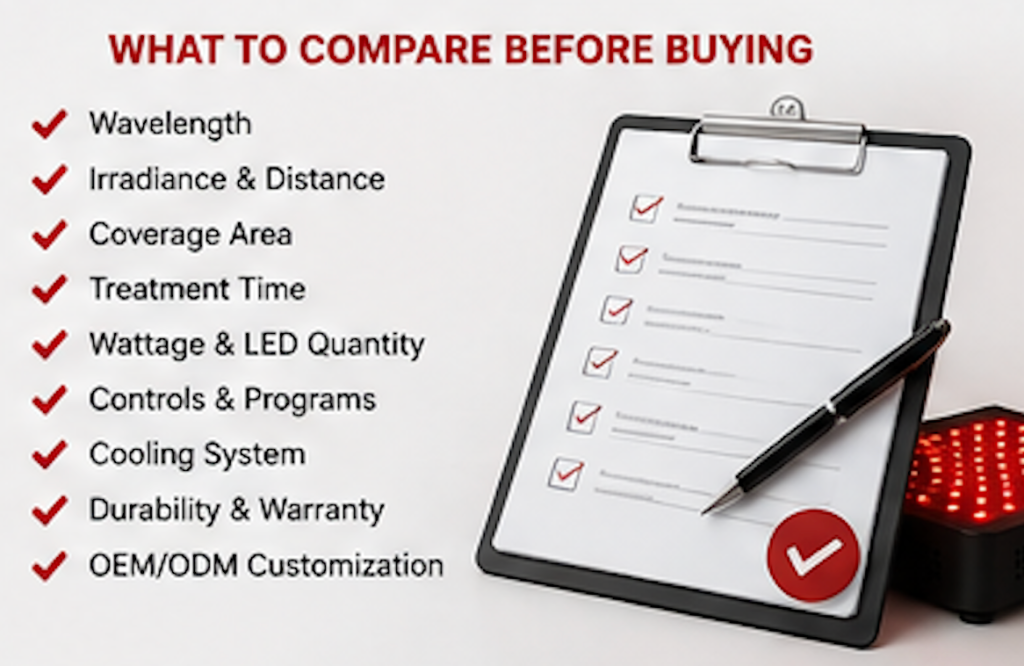
What Should You Compare Before Buying a Red Light Therapy Device?
Before placing a B2B order, create a technical comparison sheet.
| Specification | What to Ask |
|---|---|
| Wavelength | What exact wavelengths are used? |
| Irradiance | What is the measured mW/cm²? |
| Measurement Distance | At what distance is irradiance measured? |
| Coverage | What area can the device cover? |
| Wattage | What is the rated electrical power? |
| LED Quantity | How many LEDs are used? |
| Treatment Time | What does the manufacturer recommend? |
| Controls | Timer, intensity, pulse, programs? |
| Cooling | What cooling system is used? |
| Dimensions | Will it fit the treatment room? |
| Warranty | What warranty is provided? |
| Support | Is technical support available? |
| Customization | Can wavelength, housing, branding, etc. be customized? |
This comparison is more useful than comparing product prices alone.
For a more detailed buying framework, see How to Choose the Best Red Light Therapy Panel for Your Business.
Common Mistakes When Selecting Red Light Therapy Equipment
Mistake 1: Choosing Based Only on Wattage
Higher wattage does not automatically mean better optical performance.
Always compare irradiance and measurement distance.
Mistake 2: Ignoring Treatment Distance
An irradiance number without a measurement distance is difficult to use for product comparison.
Mistake 3: Assuming One Treatment Time Fits Every Device
Different devices have different irradiance and coverage.
Treatment time should follow the specific device protocol.
Mistake 4: Ignoring Treatment Area
A small panel may not be efficient for a business that needs full-body coverage.
Likewise, a large full-body system may be unnecessary for a small beauty treatment room.
Mistake 5: Selecting the Most Powerful Device
Maximum power is not necessarily the correct commercial solution.
The right combination is:
Application + Coverage + Wavelength + Irradiance + Treatment Distance + Workflow
Red Light Therapy Treatment Time: A Practical B2B Framework
For commercial buyers, the following framework can simplify the selection process:
1. Define the Application
Clinic, gym, beauty center, wellness center, rehabilitation facility, or home-use product?
2. Define the Treatment Area
Targeted, facial, large-area, or full-body?
3. Determine the Required Wavelength
For example:
660nm + 850nm
4. Compare Irradiance
Always request irradiance at a clearly defined distance.
5. Determine Treatment Time
Use the manufacturer’s recommended protocol and intended application.
6. Evaluate Customer Volume
A high-volume commercial facility may require stronger cooling, durable construction, easy controls, and efficient workflow.
7. Consider Future Growth
If you plan to build a private-label brand, consider OEM/ODM customization from the beginning.
OEM & ODM Red Light Therapy Device Selection
For distributors and brands, device selection can go beyond choosing an existing product.
OEM and ODM projects can potentially customize:
- Wavelength
- LED quantity
- Panel size
- Housing
- Irradiance target
- Control system
- Timer
- Operating modes
- Branding
- Packaging
- User manual
- Accessories
US Red Light Therapy currently provides B2B OEM/ODM solutions for global brands and businesses, including customization of product design, wavelengths, controls, branding, packaging, and other product requirements.
Explore Red Light Therapy OEM & ODM Solutions
For brands developing their own products, treatment time and device specifications should be considered during the product-development stage rather than after the hardware has already been finalized.
Frequently Asked Questions
How long should a red light therapy session last?
There is no universal session duration. Treatment time depends on irradiance, treatment distance, wavelength, treatment area, intended application, and the manufacturer’s recommended protocol.
Is 10 minutes enough for red light therapy?
It depends on the specific device and treatment protocol. A 10-minute session with one panel may deliver a different amount of optical energy than 10 minutes with another device.
Does higher irradiance mean shorter treatment time?
Potentially, but treatment protocols should not be determined by irradiance alone. Dose, wavelength, treatment area, intended application, and the manufacturer’s instructions should also be considered.
What irradiance should a red light therapy device have?
There is no universal “best” irradiance for every application. Published PBM protocols use a range of irradiance values, and the appropriate parameter depends on the wavelength, application, treatment distance, target tissue, and intended dose.
Is 660nm or 850nm better?
Neither wavelength should be considered universally better. They represent different portions of the spectrum and may be selected according to the intended application and device design.
What is more important: wattage or irradiance?
For comparing light delivery, irradiance is generally more informative than electrical wattage. However, buyers should evaluate both alongside wavelength, treatment distance, coverage, and device design.
Which red light therapy panel is suitable for a clinic?
Clinics can consider targeted panels, tabletop systems, large panels, or full-body systems depending on treatment areas, room size, customer volume, and intended applications.
Can a beauty center use a red light therapy panel?
Beauty centers can integrate suitable professional light-based equipment into beauty and wellness services according to the device’s intended use and applicable requirements. Compact, tabletop, targeted, and full-body configurations are available depending on the facility.
Can red light therapy equipment be customized?
Yes. Depending on the project, OEM/ODM customization can include wavelengths, LED configuration, housing, controls, branding, packaging, and other product specifications.
Final Thoughts: How to Choose the Right Red Light Therapy Device
Red light therapy treatment time should never be considered separately from the device specifications.
A professional buyer should evaluate:
Wavelength → Irradiance → Treatment Distance → Energy Density → Treatment Area → Session Duration → Device Design → Business Workflow
For a clinic, a targeted or tabletop panel may provide the flexibility required for smaller treatment rooms.
For a gym or wellness center, larger or full-body equipment may provide broader coverage.
For a beauty center, compact facial or tabletop systems may integrate more naturally into existing services.
For distributors and private-label brands, OEM/ODM customization can provide additional flexibility in product configuration and branding.
The goal is not to find the most powerful red light therapy device.
The goal is to find the right device for the right application.
Build Your Professional Red Light Therapy Solution
US Red Light Therapy provides professional red and near-infrared light therapy equipment for clinics, fitness centers, wellness businesses, beauty businesses, distributors, and global brands.
The product portfolio includes targeted panels, tabletop panels, large panels, full-body systems, red light therapy mats, and customized OEM/ODM solutions.
If you are selecting equipment for a new business, expanding an existing service, or developing your own red light therapy brand, share your:
- Business type
- Target market
- Treatment area
- Required wavelength
- Expected order quantity
- Desired device format
- OEM/ODM requirements
Our team can help you evaluate the appropriate red light therapy device configuration for your business.
Request a Professional Red Light Therapy Solution
Post time: 09-29-26