



How to Choose a Red Light Therapy Manufacturer
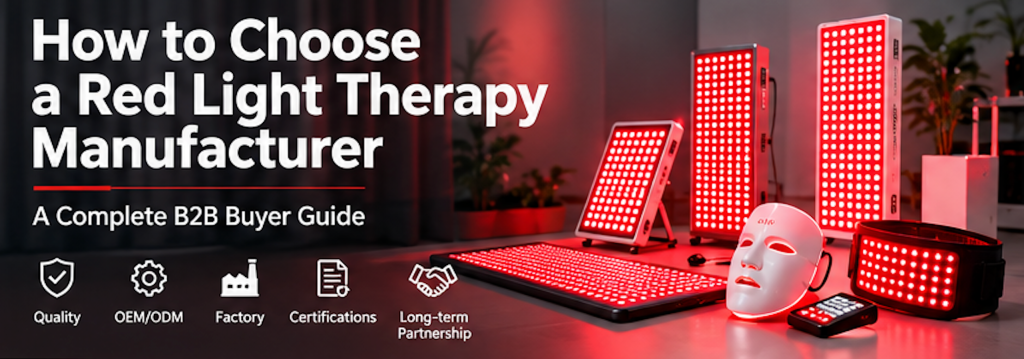
Choosing the right red light therapy manufacturer is one of the most important decisions for distributors, wellness brands, clinics, gyms, beauty businesses, and private-label companies entering the photobiomodulation equipment market.
At first, many buyers compare suppliers mainly by price.
That is understandable.
But price alone tells you very little about whether a manufacturer can provide stable product quality, accurate technical specifications, consistent production, suitable documentation, customization support, and reliable after-sales service.
A professional red light therapy project involves much more than installing red LEDs inside a metal housing.
Buyers may need to consider:
- Wavelength configuration
- Irradiance
- Treatment distance
- LED quantity
- Optical design
- Treatment coverage
- Cooling
- Power consumption
- Product structure
- Control functions
- Electrical design
- Packaging
- Branding
- Documentation
- Quality control
- Production consistency
If you are developing your own brand, the requirements become even more complicated.
You may also need logo customization, packaging, private labeling, custom wavelengths, control systems, product appearance, user manuals, accessories, or completely customized equipment.
This guide explains how B2B buyers can evaluate a red light therapy manufacturer before placing a sample order or starting an OEM/ODM project.
Why Choosing the Right Red Light Therapy Manufacturer Matters
A supplier does more than produce equipment.
For a B2B business, the manufacturer can directly affect:
- Product quality
- Brand reputation
- Customer experience
- Delivery schedule
- Product consistency
- Compliance preparation
- Warranty costs
- Repeat-order stability
- Long-term profitability
Imagine that you launch a private-label red light therapy panel.
Your first shipment looks good.
But the second shipment uses different LEDs, produces different irradiance, has a different housing finish, or has a higher failure rate.
That becomes a business problem.
The goal should therefore not be to find the cheapest supplier.
The goal is to find a manufacturing partner capable of delivering the same agreed product specification consistently.
For businesses developing customized equipment, you can also review our Red Light Therapy OEM & ODM Manufacturer solutions to understand what an OEM/ODM development process can include.
1. Determine Whether You Are Working With a Manufacturer or Trading Company
The first question is simple:
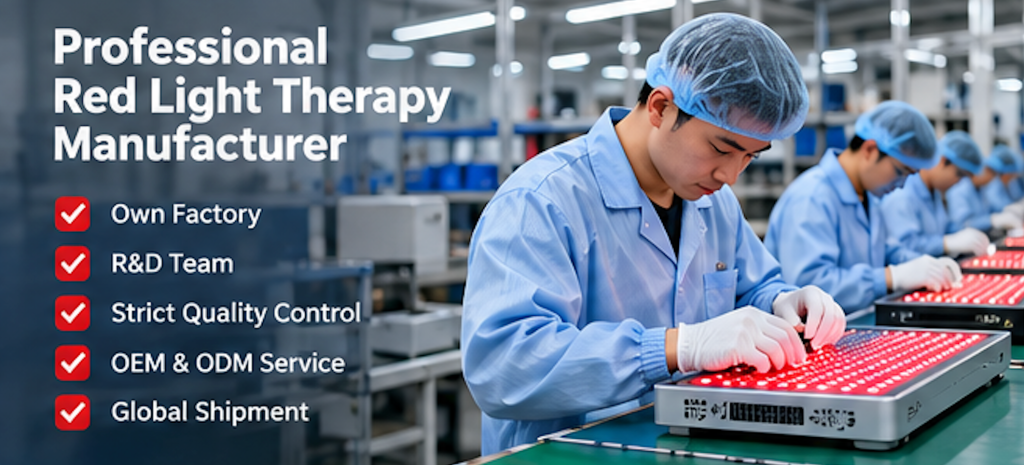
Who is actually making the product?
A trading company can still provide useful sourcing services, but buyers should understand the supply chain before placing an order.
When evaluating a potential red light therapy factory, ask:
- Do you manufacture the equipment yourself?
- Where is the production facility?
- Which production processes are completed in-house?
- Which processes are outsourced?
- Do you have an engineering team?
- Can you modify the hardware?
- Can you develop samples?
- Can you support mass production?
- Can you provide production and testing records?
Factory information, production capability, company background, and manufacturing experience should be easy to verify.
You can learn more about our company and manufacturing background on the About Us page.
Why Direct Manufacturing Capability Matters
Direct manufacturing becomes especially important when you require:
- Custom wavelengths
- Custom dimensions
- Private-label housing
- New LED configurations
- Modified controllers
- Different power supplies
- Customized packaging
- App or UI development
- New accessories
- Repeat production
If every technical change needs to be passed through several middlemen, product development usually becomes slower and communication becomes more difficult.
2. Evaluate the Manufacturer’s Product Range
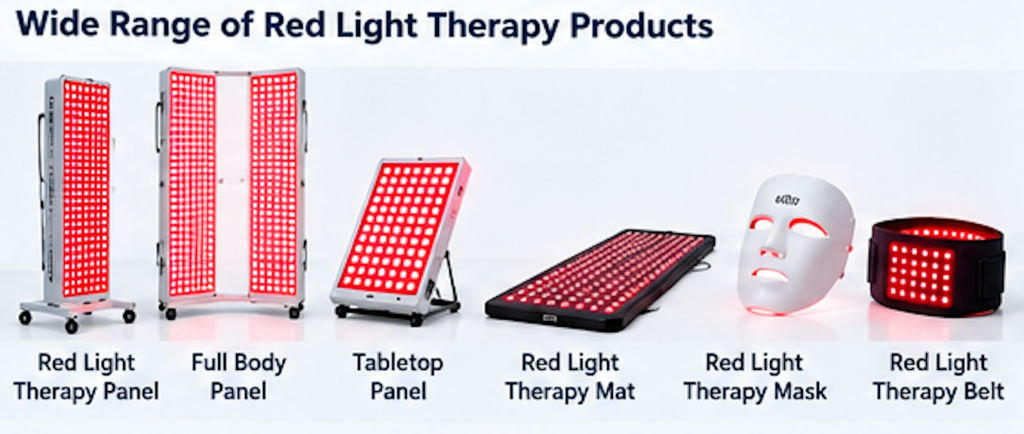
A manufacturer with experience in several equipment formats may be better positioned to help you choose the correct solution for your market.
Common red light therapy products include:
- Full-body panels
- Large panels
- Medium panels
- Tabletop panels
- Targeted panels
- Red light therapy mats
- Red light therapy belts
- LED facial devices
- Multi-panel systems
You can review different configurations in our Red Light Therapy Products section.
For businesses primarily sourcing panels, visit the Red Light Therapy Panel collection.
Do Not Choose a Product Only Because It Is Popular
The best-selling product in one market may not be appropriate for another.
For example:
A clinic may prioritize measurable specifications, treatment coverage, documentation, durability, and professional controls.
A gym may care more about full-body coverage, ease of operation, cooling, customer flow, and frequent daily use.
A beauty business may prefer a smaller system suitable for treatment rooms.
A private-label e-commerce brand may prioritize packaging, appearance, differentiation, shipping size, and consumer-friendly controls.
The correct product should match the customer and business model.
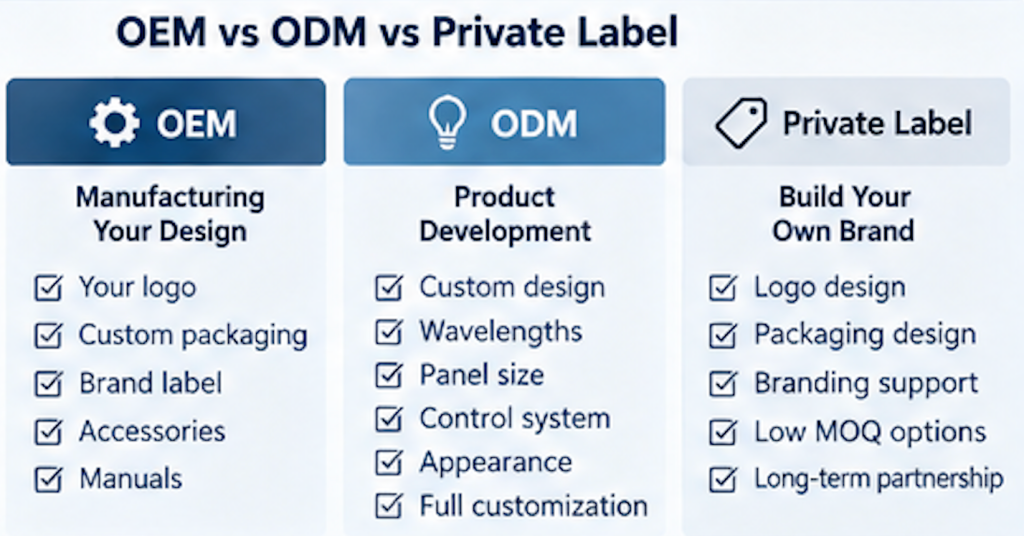
3. Check OEM, ODM, and Private-Label Capability
Not every buyer needs the same level of customization.
Understanding the difference between OEM and ODM will help you choose the correct manufacturer.
OEM Red Light Therapy Manufacturing
OEM is generally suitable when you already know what product you want and mainly require manufacturing and branding support.
Typical OEM options may include:
- Logo
- Product label
- Packaging
- Color
- Accessories
- Manual
- Carton design
- Branding
ODM Red Light Therapy Manufacturing
ODM becomes more relevant when the project requires deeper product development.
Customization may involve:
- Housing structure
- LED configuration
- Wavelength combination
- Panel dimensions
- Power requirements
- Irradiance targets
- Controller
- Firmware
- Timer functions
- Pulse modes
- Cooling design
- Mounting options
- Accessories
If you are planning to build your own brand, read our Red Light Therapy OEM & ODM Manufacturer and Private Label Solutions page.
Questions to Ask an OEM/ODM Manufacturer
Before requesting a quotation, ask:
- What can be customized?
- What is the MOQ for standard products?
- What is the MOQ for customized products?
- Is there a sample or development fee?
- Who owns the tooling?
- Can wavelengths be customized?
- Can the housing be changed?
- Can the controller be customized?
- Can packaging and manuals be customized?
- How long does sample development take?
Clear answers at this stage can prevent misunderstandings later.
4. Compare Wavelength Specifications
Wavelength is one of the most important technical parameters in a red light therapy device.
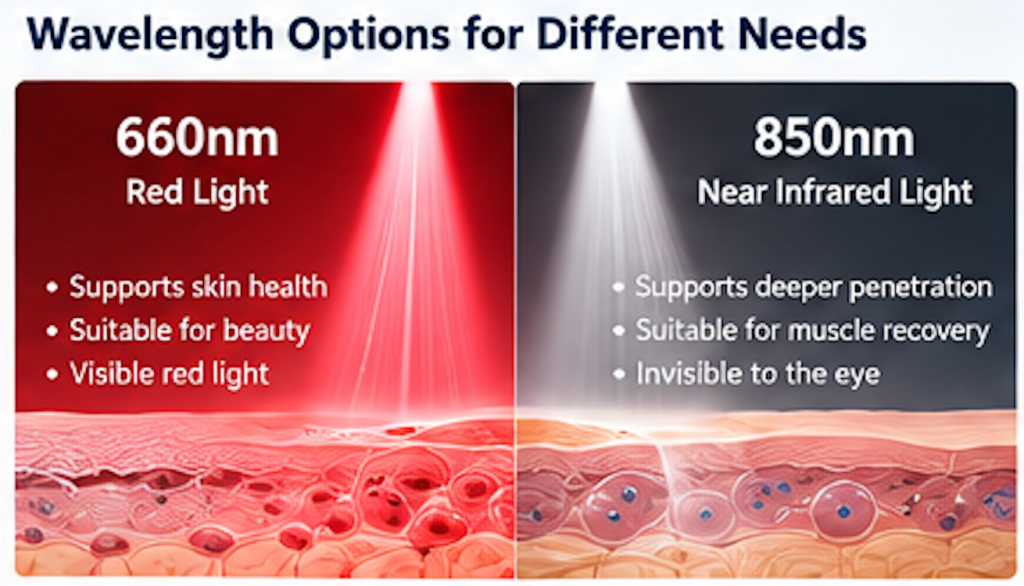
Common configurations may use visible red light and near-infrared light.
Examples include:
- 630 nm
- 660 nm
- 810 nm
- 830 nm
- 850 nm
Many commercial systems combine more than one wavelength.
One common example is:
660 nm + 850 nm
However, buyers should not assume that a device is automatically better simply because it contains more wavelengths.
The correct configuration depends on the product design, intended use, optical output, and target market.
For a more detailed technical comparison, read:
660nm vs 850nm Red Light Therapy: Which Wavelength Is Right for Your Business?
What to Ask the Manufacturer
Ask the supplier to provide:
- Exact wavelengths
- LED configuration
- Wavelength tolerance
- LED supplier information where relevant
- Spectral test data if available
- Ratio between wavelengths
- Whether wavelengths can operate independently
A specification saying only “red + infrared” is not detailed enough for a professional B2B comparison.
5. Check Irradiance — Not Just Wattage
This is one of the most common mistakes when sourcing red light therapy panels.
A buyer sees:
300W vs 600W vs 900W
and assumes the 900W panel must provide three times the usable light output of the 300W system.
That conclusion is not necessarily correct.
Electrical wattage and optical irradiance describe different things.
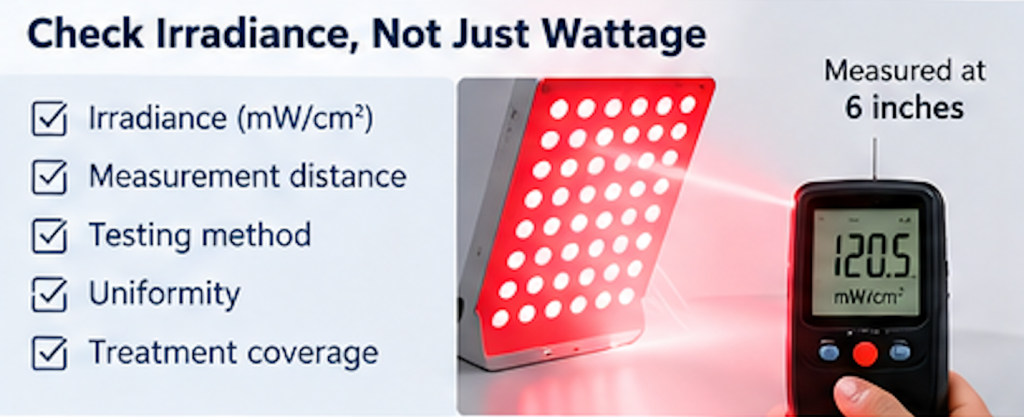
What Is Irradiance?
Irradiance describes optical power delivered over an area and is commonly expressed as:
mW/cm²
When comparing a panel, buyers should ask:
- What is the irradiance?
- At what distance?
- How was it measured?
- Where on the panel was it measured?
- What wavelengths were active?
- What measurement instrument was used?
An irradiance number without a measurement distance provides limited value.
For example:
120 mW/cm² at 3 inches
cannot automatically be compared with:
120 mW/cm² at 12 inches
For a deeper explanation, read our Red Light Therapy Irradiance Guide.
You can also compare the difference between electrical input and optical output in:
Red Light Therapy Panel Wattage vs Irradiance: What Should You Compare?
6. Evaluate Treatment Coverage, Not Just Peak Irradiance
A strong number measured in the center of a panel does not necessarily mean the entire treatment area receives the same optical output.
This is especially important for larger commercial panels.
Ask the manufacturer about:
- Treatment area
- Beam angle
- LED spacing
- Panel dimensions
- Edge output
- Center output
- Recommended operating distance
- Irradiance uniformity
For full-body applications, coverage can be just as important as peak irradiance.
A panel with very high center irradiance but poor edge coverage may not be ideal for a commercial environment.
This is why professional buyers should evaluate the complete optical design rather than focusing on a single specification.
7. Inspect Build Quality and Thermal Management
Red light therapy equipment generates heat.
The manufacturer therefore needs an effective thermal-management strategy.
Depending on the product, this may involve:
- Heat sinks
- Fans
- Ventilation
- Aluminum housing
- PCB design
- Internal airflow
- Temperature protection
Commercial equipment can also operate more frequently than typical home-use equipment.
That makes component quality important.
Ask about:
- LED lifetime
- Fan quality
- Power supply
- PCB
- Connectors
- Controller
- Housing material
- Cable quality
- Mounting hardware
- Operating temperature
Why Cooling Matters
Heat can affect:
- Component lifespan
- LED stability
- User comfort
- Reliability
- Continuous operating capability
If you are buying equipment for a professional environment, ask how the system performs during repeated daily operation.
8. Review Quality Control Procedures
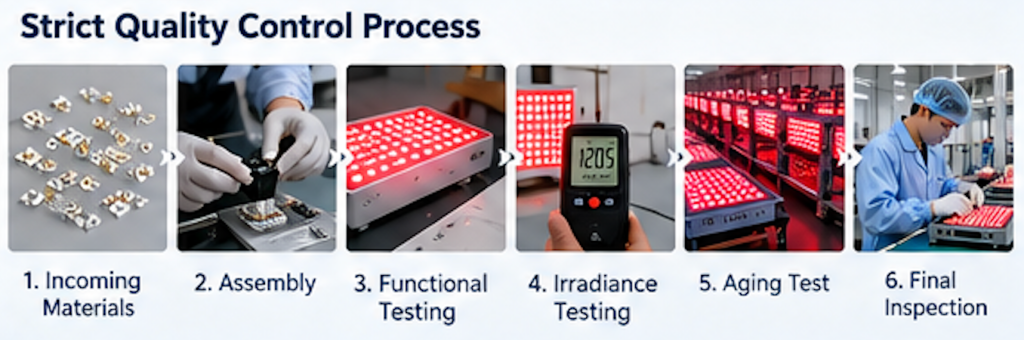
A professional red light therapy manufacturer should have a repeatable quality-control process.
You should understand what happens between component sourcing and final shipment.
A basic process may include:
Incoming Materials → Assembly → Functional Testing → Optical Testing → Aging Test → Safety Inspection → Appearance Inspection → Packaging → Final Inspection
Important QC Questions
Ask:
- Are all units tested before shipment?
- Is irradiance tested?
- Is wavelength verified?
- Is electrical function tested?
- Are controllers tested?
- Are fans checked?
- Is an aging test performed?
- Are packaging inspections performed?
- Can inspection reports be provided?
- Can third-party inspections be arranged?
For larger orders, consider using:
- Pre-production samples
- Golden samples
- Pre-shipment inspection
- Third-party inspection
- Batch testing
A golden sample is particularly useful because it establishes a physical reference for mass production.
9. Verify Certifications and Documentation Carefully
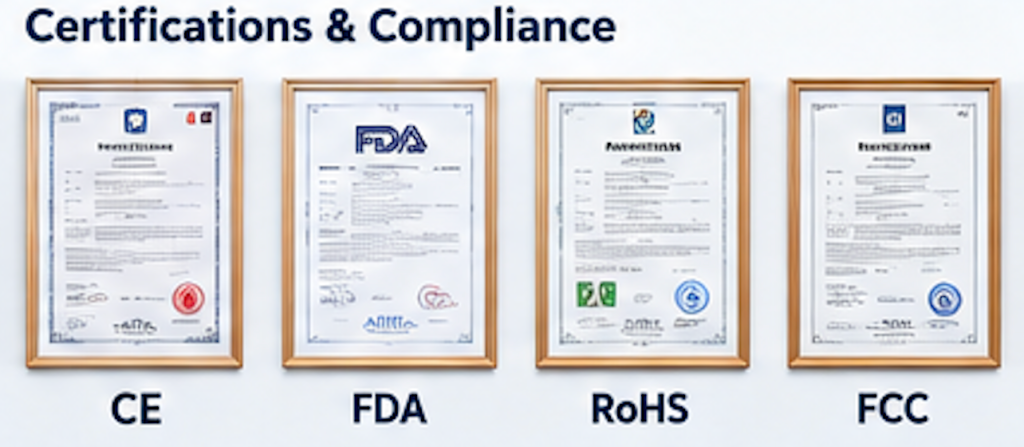
Do not select a supplier simply because several certification logos appear on a website or product image.
Ask for documentation that applies to the specific model you intend to purchase.
Depending on product type and destination market, buyers may need to evaluate documents related to:
- Electrical safety
- EMC
- RoHS
- FCC requirements
- CE requirements
- Product labeling
- User manuals
- Test reports
- Material compliance
- Market-specific regulatory requirements
Requirements vary depending on the product, intended use, claims, market, and regulatory classification.
Ask for the Actual Report
Do not ask only:
“Do you have CE?”
Ask:
“Can you send the applicable report or certificate for this exact model?”
Then verify:
- Model number
- Applicant
- Manufacturer
- Test standard
- Laboratory
- Issue date
- Scope
This is especially important for businesses selling into regulated markets.
The buyer remains responsible for determining which regulatory requirements apply in the destination market.
10. Compare MOQ and Sample Policy
MOQ can be important for startups and new private-label brands.
But the lowest MOQ should not automatically determine your supplier choice.
A manufacturer may have different MOQ levels for:
- Standard products
- Logo customization
- Packaging customization
- Custom colors
- New housings
- Custom PCBs
- New tooling
- Custom wavelength configurations
Start With a Sample
For most B2B projects, it is sensible to evaluate a sample before committing to mass production.
A professional sample evaluation can include:
- Product appearance
- Dimensions
- Weight
- Controls
- Wavelength
- Irradiance
- Treatment coverage
- Noise
- Cooling
- Packaging
- Accessories
- Documentation
The sample should become the reference for the production order.
11. Evaluate Production Capacity and Lead Time
A supplier that can produce 50 units does not necessarily have the same systems required to produce 5,000 units consistently.
If your business plans to scale, ask about:
- Monthly capacity
- Production lines
- Equipment
- Employee count
- Peak-season capacity
- Component supply
- Lead time
- Safety stock
- Repeat-order lead time
Ask About Component Continuity
A common B2B problem occurs when components change between production batches.
For example:
Batch 1 uses LED A.
Batch 2 uses LED B.
The product may look identical, but its optical characteristics may change.
Ask the manufacturer:
Will components or specifications be changed without written approval?
For serious OEM projects, specification-change control should be part of the agreement.
12. Check Warranty and After-Sales Support
The real test of a supplier often happens after the shipment leaves the factory.
Ask:
- What is the warranty period?
- What does the warranty cover?
- Who pays freight for replacements?
- Are spare parts available?
- Can controllers be replaced?
- Can fans be replaced?
- Can power supplies be replaced?
- How are defective units handled?
- Is technical troubleshooting available?
For distributors, clinics, and large B2B customers, spare-part availability can be particularly important.
A product that cannot be repaired easily can create unnecessary long-term costs.
13. Evaluate Communication Quality
Do not underestimate communication.
OEM projects involve many details.
A supplier may need to coordinate:
- Product specifications
- Samples
- Packaging
- Labels
- Manuals
- Artwork
- Production
- Inspection
- Shipping
- After-sales support
Slow or unclear communication before the order can become an even bigger problem after payment.
A Good Supplier Should Be Able to Explain Technical Details
Ask several specific questions.
For example:
What irradiance does this panel provide at 6 inches?
Which wavelength LEDs are installed?
Can you provide the LED ratio?
What happens if I need custom packaging?
Can you change the timer program?
How is every unit tested before shipment?
A professional supplier should give clear answers instead of avoiding technical questions.
14. Choose a Manufacturer Based on Your Target Market
There is no single configuration suitable for every buyer.
Your target market should determine the product.
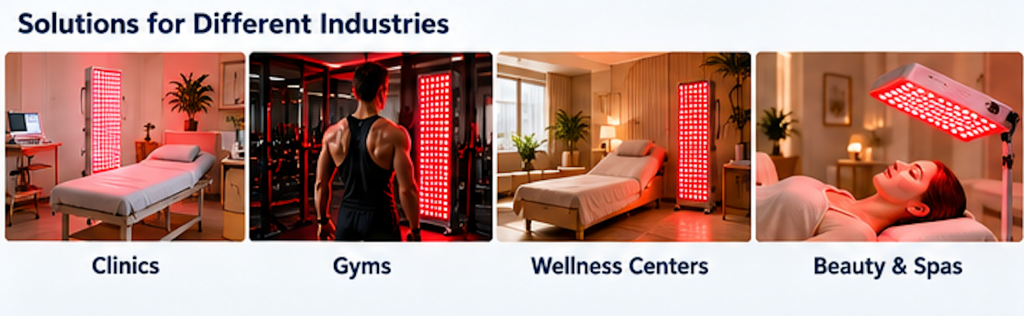
For Clinics
Clinics may prioritize:
- Technical specifications
- Repeatable operation
- Treatment coverage
- Documentation
- Durability
- Technical support
- Easy cleaning
- Professional controls
See our Red Light Therapy Solutions for Clinics for examples of professional PBM equipment configurations.
For Gyms and Fitness Centers
Gyms may prioritize:
- Full-body coverage
- Durability
- Cooling
- Simple controls
- Customer throughput
- Space efficiency
Explore our Red Light Therapy Solutions for Gyms.
For Wellness Centers
Wellness businesses may need several product formats.
A possible configuration could include:
Full-Body Panel + Targeted Panel + Red Light Therapy Mat
Learn more from our Health Center Red Light Therapy Solutions.
For Beauty Businesses
Beauty clinics, salons, and spas may focus on:
- Facial applications
- Compact equipment
- Design
- User comfort
- Simple operation
- Treatment-room integration
Explore our Beauty Red Light Therapy Solutions.
15. Compare the Complete Cost — Not Only the Unit Price
A lower purchase price does not always mean a lower total cost.
Consider:
Product Cost + Customization + Packaging + Inspection + Freight + Duties + Warranty + Defects + Spare Parts + After-Sales Cost
Imagine two suppliers.
Supplier A
Unit price: $300
Defect rate: high
Replacement support: limited
Technical documentation: poor
Supplier B
Unit price: $330
Defect rate: lower
Replacement parts: available
Technical support: better
Quality control: documented
Supplier B may produce a lower total business cost even though the initial unit price is higher.
For B2B sourcing, compare total project value, not only EXW unit price.
Red Light Therapy Manufacturer Evaluation Checklist
Before selecting a manufacturer, use this checklist:
| Area | What to Check |
|---|---|
| Company | Manufacturer or trader |
| Experience | Relevant red light therapy manufacturing |
| Products | Panels, mats, masks, belts, full-body systems |
| OEM | Logo, packaging, labels, colors |
| ODM | Hardware, housing, wavelengths, controls |
| Wavelength | Exact wavelength configuration |
| Irradiance | mW/cm² at defined distance |
| Coverage | Treatment area and uniformity |
| Cooling | Fans, heat management, housing |
| Quality Control | Incoming, functional, optical and final inspection |
| Documentation | Applicable reports and certifications |
| MOQ | Standard and customized MOQ |
| Samples | Sample availability and approval |
| Production | Capacity and lead time |
| Warranty | Coverage and replacement policy |
| Spare Parts | Long-term availability |
| Communication | Technical response quality |
| After-Sales | Troubleshooting and ongoing support |
Questions to Ask a Red Light Therapy Manufacturer Before Ordering
Send these questions to every supplier you are comparing:
- Are you the manufacturer of this product?
- How long have you manufactured red light therapy equipment?
- What product categories do you manufacture?
- What wavelengths are available?
- Can wavelengths be customized?
- What irradiance does the device provide?
- At what distance was irradiance measured?
- Can you provide optical test data?
- What is the actual power consumption?
- What is the treatment coverage?
- Which OEM options are available?
- Which ODM options are available?
- What is the MOQ?
- Can I order a sample?
- What quality tests are performed?
- What documentation is available for this model?
- What is the production lead time?
- What is the warranty?
- Are spare parts available?
- What happens if a unit fails after delivery?
A supplier who can answer these questions clearly is much easier to evaluate.
Red Flags When Choosing a Red Light Therapy Supplier
Be cautious if a supplier:
- Cannot explain irradiance
- Provides irradiance without measurement distance
- Focuses only on wattage
- Cannot identify the wavelength configuration
- Refuses to provide applicable documentation
- Changes specifications frequently
- Cannot explain quality-control procedures
- Offers unrealistic lead times
- Makes exaggerated product claims
- Has no clear warranty policy
- Cannot support spare parts
- Avoids sample testing
- Provides inconsistent answers
One red flag does not automatically mean a supplier is unsuitable.
But several together should trigger a deeper review.
How to Start a Red Light Therapy OEM Project
A structured process can reduce risk.
Step 1: Define Your Market
Determine whether you are selling to:
- Consumers
- Clinics
- Gyms
- Wellness centers
- Beauty businesses
- Distributors
Step 2: Define the Product
Choose:
- Panel
- Mat
- Belt
- Mask
- Targeted device
- Full-body system
Step 3: Define Technical Requirements
Specify:
- Wavelength
- Irradiance
- Treatment area
- Size
- Controls
- Timer
- Cooling
- Accessories
Step 4: Define Branding
Prepare:
- Logo
- Product colors
- Packaging
- User manual
- Labels
- Brand requirements
Step 5: Produce a Sample
Evaluate and approve the final sample.
Step 6: Confirm Mass-Production Specifications
Document everything.
Step 7: Inspect Production
Perform internal or third-party inspection where appropriate.
Step 8: Ship and Monitor Quality
Record feedback from the first production batch before scaling.
For a deeper look at product selection, you can also read How to Choose the Best Red Light Therapy Panel for Your Business in 2026.
Frequently Asked Questions
How Do I Find a Reliable Red Light Therapy Manufacturer?
Start by verifying manufacturing capability, technical knowledge, product range, quality-control procedures, OEM/ODM capability, documentation, sample quality, communication, warranty, and after-sales support.
Do not choose a supplier based only on price.
What Should I Ask a Red Light Therapy Panel Manufacturer?
Ask for the wavelength configuration, irradiance and measurement distance, actual power consumption, LED configuration, treatment area, cooling method, certifications or test reports, warranty, MOQ, customization options, and sample availability.
What Is the Difference Between OEM and ODM Red Light Therapy?
OEM generally involves producing or branding an existing product according to agreed specifications.
ODM involves deeper product customization or development, which may include housing design, LED configuration, wavelengths, controls, electronics, accessories, or product appearance.
Can I Private Label Red Light Therapy Devices?
Yes. Depending on the manufacturer and project, private-label services may include logos, packaging, manuals, product labels, colors, accessories, and other brand elements.
For deeper customization, visit our Red Light Therapy OEM & ODM Manufacturer page.
Should I Choose a Red Light Therapy Panel Based on Wattage?
No.
Wattage is only one specification.
Professional buyers should compare wavelength, irradiance, treatment distance, treatment coverage, LED configuration, optical design, cooling, controls, construction, and actual power consumption together.
Read our Wattage vs Irradiance Guide for more information.
Should I Order a Sample Before Mass Production?
For most B2B projects, yes.
A sample gives you an opportunity to evaluate construction, optical specifications, controls, packaging, documentation, and overall product quality before committing to a larger order.
Final Thoughts: How to Choose the Right Red Light Therapy Manufacturer
Choosing a red light therapy manufacturer should be treated as a long-term supply-chain decision rather than a simple price comparison.
The strongest manufacturing partner should be able to help you evaluate:
Product + Wavelength + Irradiance + Coverage + Quality + Compliance + Customization + Production + Warranty + Support
Before placing a large order:
- Verify the manufacturer
- Review the technical specifications
- Ask for measurement conditions
- Evaluate a sample
- Confirm the exact customization scope
- Review applicable documentation
- Define quality standards
- Confirm the warranty
- Establish mass-production specifications
If you are building a red light therapy brand, sourcing commercial equipment, or developing a customized product, US Red Light Therapy provides B2B product manufacturing and OEM/ODM options for different business applications.
Explore our Red Light Therapy Panels or review our OEM & ODM Red Light Therapy Solutions.
Ready to Discuss Your Red Light Therapy Project?
Tell us:
- Your target market
- Product type
- Preferred wavelengths
- Target size
- Expected order quantity
- Branding requirements
- Customization needs
Our team can help you evaluate an appropriate product and manufacturing approach for your project.

Contact US Red Light Therapy
View Red Light Therapy Products
Explore OEM/ODM Solutions
Post time: 09-29-26