

Choosing between full body vs targeted red light therapy panels is an important decision for clinics, gyms, wellness centers, beauty businesses, equipment distributors, and private-label brands.
Both types of equipment use red or near-infrared light, but they are designed for different coverage requirements and operating environments.
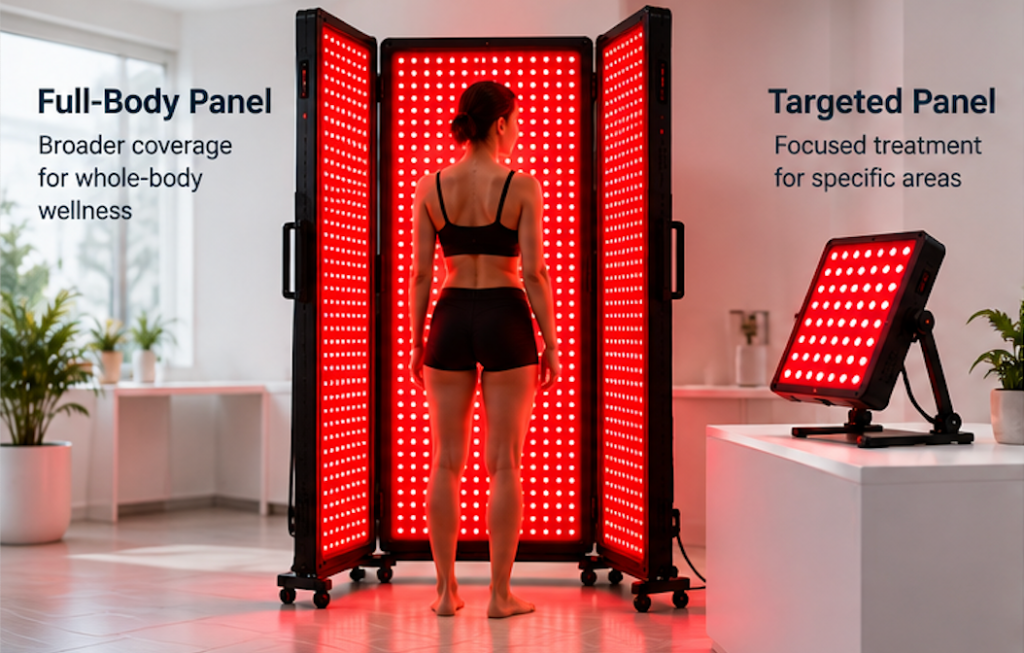
A full-body panel can illuminate a larger area during one session, while a targeted red light therapy panel offers flexible positioning for smaller treatment areas.
But is a larger panel always better? Does higher wattage mean stronger light output? And which type provides the best value for your business?
This guide compares full-body and targeted red light therapy panels based on coverage, irradiance, wavelength, space requirements, operating costs, technical specifications, and OEM/ODM customization.
If you are comparing commercial equipment, explore our professional red light therapy panels.
What Is the Difference Between Full Body and Targeted Red Light Therapy Panels?
The main difference is the area each device is designed to illuminate.
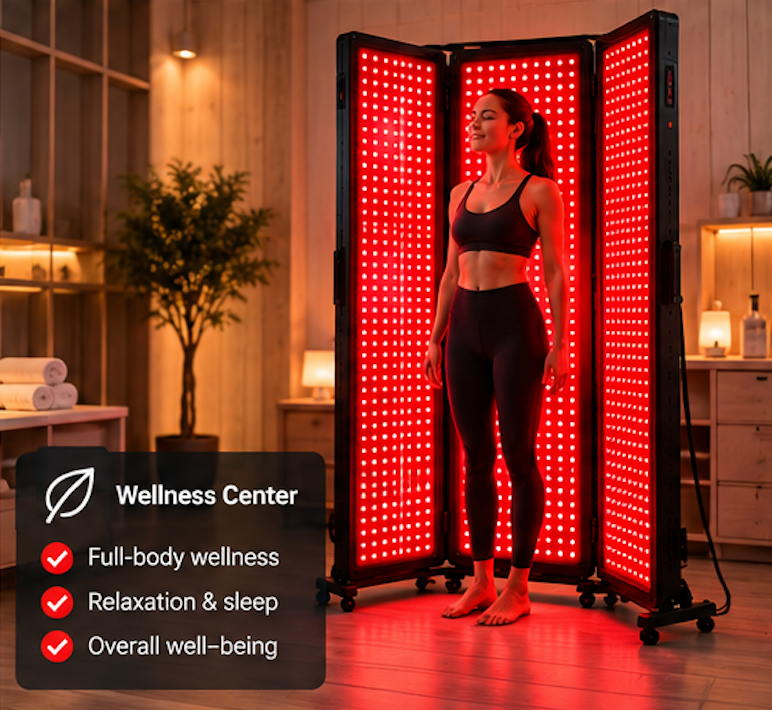
Full-body red light therapy panels provide broader illumination and are often used in dedicated wellness or recovery spaces.
Targeted red light therapy panels are smaller and designed for localized applications where flexible positioning is important.
Full Body vs Targeted Red Light Therapy Panels Comparison
| Feature | Full-Body Panel | Targeted Panel |
|---|---|---|
| Coverage | Large body areas | Smaller, localized areas |
| Equipment size | Generally larger | Generally compact |
| Space requirements | More floor or wall space | Easier to fit into small rooms |
| Positioning | Fixed, wall-mounted, or mobile stand | Tabletop, stand-mounted, or portable |
| Typical business use | Wellness centers, gyms, larger clinics | Clinics, beauty centers, compact studios |
| Purchase cost | Often higher for larger systems | Often lower for compact models |
| Electrical demand | Depends on model; often higher | Depends on model; often lower |
| Coverage uniformity | Important across a broad area | Important within the smaller target area |
| OEM customization | Size, configuration, controls, branding | Optics, size, controls, branding |
| Best selection factor | Broad coverage and workflow | Flexible positioning and localized coverage |
These are general product-design differences. Actual performance depends on the individual model.
Neither format is universally more effective.
What Is a Full Body Red Light Therapy Panel?
A full-body red light therapy panel is designed to illuminate a relatively large area of the body.
These devices may use tall vertical panels, multiple connected modules, or other large-area configurations.
How Full-Body Panels Work
A full-body system uses an array of LEDs to deliver visible red light, near-infrared light, or a combination of both.
Depending on the design, the panel may be positioned vertically, mounted on a wall, or supported by a mobile stand.
The illuminated area depends on panel dimensions, LED arrangement, optics, and operating distance.
A larger physical panel does not automatically provide uniform optical output across the entire body.
Advantages of Full-Body Red Light Therapy Panels
1. Broader Coverage
Larger panels can illuminate more of the body from one position.
2. Dedicated Commercial Service
Full-body systems can help businesses create a designated red light therapy station.
3. Less Repositioning
A broader illuminated area may reduce the need to move a compact device repeatedly.
4. Flexible Equipment Configurations
Some systems can be configured with multiple panels or adjustable stands.
5. Suitable for Larger Facilities
Gyms, wellness centers, and recovery studios may prefer larger systems when sufficient space is available.
Limitations of Full-Body Panels
Full-body panels may also require:
- Higher initial equipment investment
- More floor or wall space
- Additional installation planning
- Greater electrical capacity
- Appropriate cooling and ventilation
- More complex transport and handling
The exact requirements depend on the equipment design.
What Is a Targeted Red Light Therapy Panel?
A targeted red light therapy panel is designed to illuminate a smaller, defined area.
It may be used in settings where precise positioning, compact dimensions, and flexibility are priorities.
Common Targeted Panel Formats
Targeted systems may include:
- Tabletop red light therapy panels
- Compact stand-mounted panels
- Portable LED panels
- Adjustable treatment-area panels
- Smaller professional red and near-infrared systems
Advantages of Targeted Red Light Therapy Panels
1. Compact Size
Smaller panels can fit into limited treatment-room spaces.
2. Flexible Positioning
A targeted device may be repositioned for different body areas or service setups.
3. Lower Space Requirements
Compact equipment can be integrated into existing rooms without a dedicated full-body station.
4. Flexible Product Offering
Targeted panels may be suitable for distributors offering smaller entry-level products.
5. Potentially Lower Initial Investment
Compact models may require less upfront equipment expenditure, although actual pricing varies by specifications and supplier.
Limitations of Targeted Panels
Targeted devices may require more repositioning when the business wants to illuminate multiple body areas.
They may also provide less coverage per session than larger panels.
A smaller device is not necessarily less powerful at its measurement surface. Irradiance must be evaluated separately.
Full Body vs Targeted Panels: Which Provides Better Light Coverage?
Coverage is one of the most important differences between these two product categories.
Full-Body Coverage
A full-body panel may illuminate the torso, legs, or multiple body regions depending on panel dimensions and positioning.
However, panel height alone does not establish effective coverage.
Professional buyers should ask for the measured illumination area at the intended operating distance.
Targeted Coverage
Targeted panels are designed for smaller regions.
A compact panel may provide convenient positioning for localized wellness or aesthetic applications.
Why Uniformity Matters
Light distribution can vary across the illuminated surface.
For large panels, a high center-point irradiance value does not necessarily mean the edges receive the same optical power.
For smaller panels, the illuminated area and beam angle also affect practical coverage.
A scientific review titled Review of Light Parameters and Photobiomodulation Efficacy explains why optical parameters must be evaluated together rather than relying on a single performance number.
Full Body vs Targeted Panels: Irradiance Comparison
Irradiance describes the optical power arriving at a surface per unit area.
It is commonly expressed in:
mW/cm² — milliwatts per square centimeter.
Both full-body and targeted panels may deliver different irradiance values depending on their design.
Does a Larger Panel Have Higher Irradiance?
Not necessarily.
A large panel may distribute optical power across a wider area.
A smaller panel may concentrate its output within a more limited region.
Therefore, physical size alone does not establish irradiance.
What Should Buyers Compare?
Ask manufacturers to provide:
- Center irradiance
- Average irradiance across a defined area
- Measurement distance
- Wavelength configuration
- Optical measurement instrument
- Measurement grid
- Operating mode
- Calibration information
For further technical details, read our Red Light Therapy Panel Irradiance Guide.
Why Measurement Standards Matter
Research on photobiomodulation devices has identified inconsistent reporting of important parameters.
A systematic review of photobiomodulation devices discusses differences in reported wavelength, power density, energy density, treatment area, and exposure time.
Although the review focuses on brain photobiomodulation, it illustrates why complete technical reporting is important when comparing optical devices.
Full Body vs Targeted Red Light Therapy: Wattage Comparison
Wattage is commonly used in red light therapy product marketing.
You may encounter panels advertised as 100W, 300W, 600W, 900W, or 1600W.
However, advertised wattage may refer to different electrical specifications.
Electrical Wattage Is Not Irradiance
Electrical wattage describes electrical power or a manufacturer’s stated electrical rating.
Irradiance describes optical power arriving at a surface.
A 600W panel does not automatically deliver twice the irradiance of a 300W panel.
Actual performance depends on:
- LED efficiency
- Electrical drive conditions
- Optical lenses
- LED spacing
- Measurement distance
- Thermal management
- Panel geometry
For more information, see our Red Light Therapy Panel Wattage vs Irradiance Guide.
How Do 660nm and 850nm Wavelengths Affect Panel Selection?
Many professional red light therapy panels combine two wavelengths:
660nm visible red light
850nm near-infrared light
These wavelengths have different optical characteristics.
660nm Red Light
660nm is commonly used in devices designed for visible red-light exposure.
It is frequently discussed in research involving skin and relatively superficial tissues.
850nm Near-Infrared Light
850nm is a near-infrared wavelength.
Under comparable conditions, it generally has greater tissue penetration potential than 660nm visible red light.
However, actual penetration depends on tissue properties, irradiance, geometry, and other factors.
Should Full-Body Panels Use Both Wavelengths?
A dual-wavelength configuration may offer additional flexibility, but it is not automatically superior.
The appropriate design depends on the intended application and supporting evidence.
A systematic review of photobiomodulation dose parameters discusses how optical transport, wavelength, and tissue characteristics influence delivered light exposure.
For a more detailed explanation, read our 660nm vs 850nm Red Light Therapy Comparison.
Treatment Time: Are Full-Body Panels Faster Than Targeted Panels?
A full-body panel can illuminate a larger area at once.
This may reduce repositioning time when broad coverage is required.
However, it does not automatically mean that a full-body device requires a shorter exposure time.
What Determines Treatment Time?
Important factors include:
- Wavelength
- Irradiance
- Operating distance
- Intended radiant exposure
- Coverage
- Device settings
- Intended application
- Manufacturer instructions
Understanding Radiant Exposure
Radiant exposure is commonly expressed in joules per square centimeter (J/cm²).
For constant irradiance at a defined surface:
Radiant Exposure (J/cm²) = Irradiance (mW/cm²) × Time (minutes) × 0.06
For example, at a constant irradiance of 50 mW/cm² over 10 minutes:
50 × 10 × 0.06 = 30 J/cm²
This is a mathematical example, not a universal recommended treatment dose.
Does More Exposure Mean Better Results?
Not necessarily.
The peer-reviewed paper Biphasic Dose Response in Low Level Light Therapy — An Update discusses how biological responses to photobiomodulation may vary with dose.
A higher exposure does not automatically produce a better result.
Read our Red Light Therapy Treatment Time & Device Selection Guide for additional information.
Which Red Light Therapy Panel Is Better for Clinics?
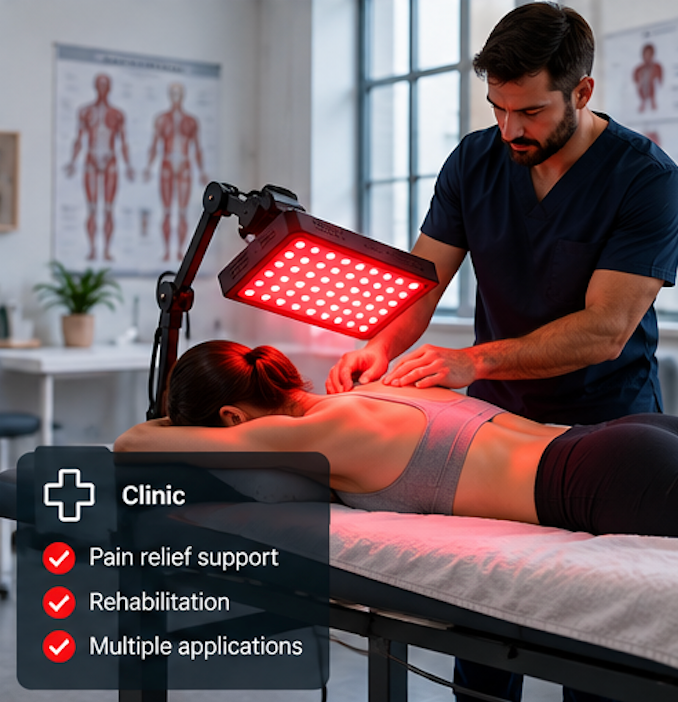
Clinics may require equipment for different treatment areas and workflows.
A targeted panel can be useful when:
- Treatment rooms are small.
- Flexible positioning is required.
- Equipment needs to move between rooms.
- The intended application involves a defined area.
A full-body panel may be considered when:
- Larger coverage is required.
- A dedicated equipment station is available.
- The clinic has sufficient space.
- The intended service model supports broader-area exposure.
Clinical Evidence and Device Selection
Professional buyers should distinguish equipment specifications from evidence supporting particular medical uses.
The World Association for Photobiomodulation Therapy (WALT) position paper discusses photobiomodulation parameters for specific complications associated with cancer therapy.
Its recommendations are application-specific and should not be treated as universal protocols for commercial full-body LED panels.
For equipment and service considerations, explore our Red Light Therapy Solutions for Clinics.
Which Red Light Therapy Panel Is Better for Gyms and Fitness Centers?
Gyms may consider red light therapy equipment as part of a wellness or recovery-oriented service.
Full-Body Panels for Fitness Facilities
A full-body system may be suitable when a gym:
- Has a dedicated wellness area.
- Wants broader body coverage.
- Has sufficient installation space.
- Prefers a fixed or semi-fixed station.
- Wants to minimize repeated repositioning.
Targeted Panels for Fitness Studios
A targeted system may be practical when a gym:
- Has limited space.
- Wants portable equipment.
- Offers shorter, localized wellness sessions.
- Needs flexible room arrangements.
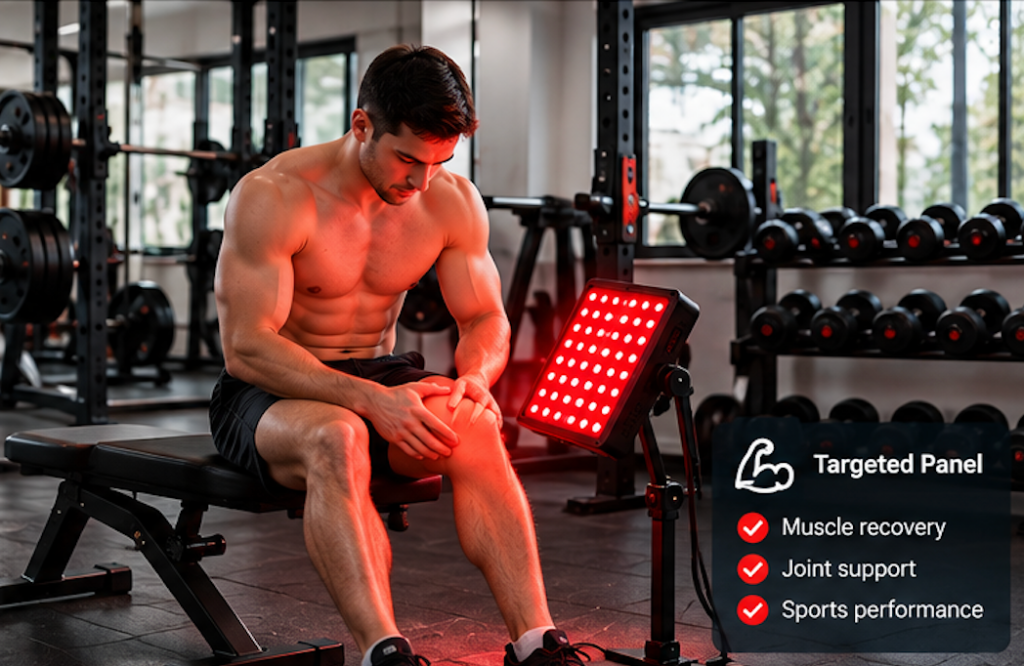
What Does Research Say About Muscle Applications?
Photobiomodulation has been studied in musculoskeletal and exercise-related contexts, but protocols and evidence vary.
A systematic review of photobiomodulation dosimetry demonstrates the diversity of light sources, wavelengths, and exposure parameters reported across research applications.
These findings should not be interpreted as proof that every commercial red light therapy panel improves athletic performance.
Which Red Light Therapy Panel Is Better for Beauty Centers?
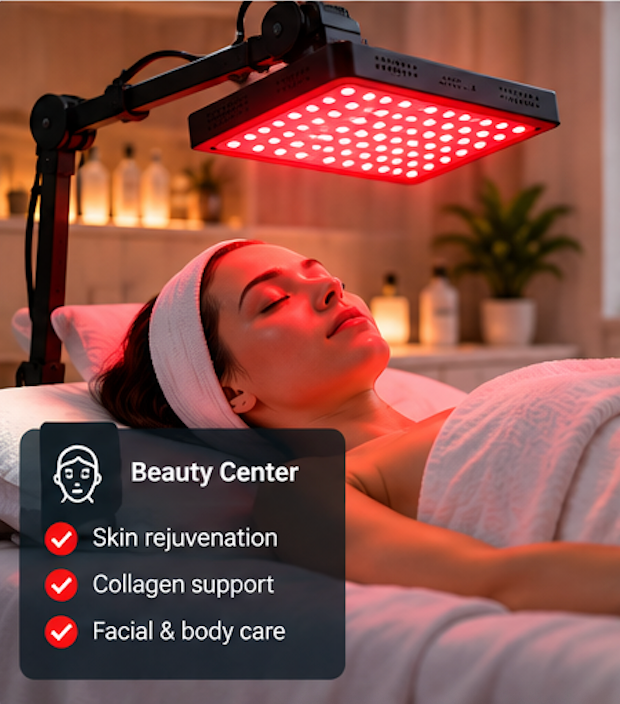
Beauty businesses often prioritize equipment size, positioning, appearance, and customer comfort.
Targeted Panels for Beauty Businesses
Targeted panels may be useful for:
- Compact treatment rooms
- Facial and aesthetic equipment setups
- Adjustable positioning
- Smaller treatment areas
- Flexible service layouts
Full-Body Panels for Spas
Larger panels may be considered by spas that want to offer broader-area wellness services.
However, larger equipment requires more room planning and may not be necessary for every service.
What Does the Research Show?
A systematic review of photobiomodulation in facial aesthetic surgery discusses potential applications and limitations of the evidence.
The review notes that treatment parameters vary and that further high-quality studies are needed.
Businesses should therefore avoid promising specific cosmetic or medical outcomes solely because a device emits red or near-infrared light.
Which Red Light Therapy Panel Is Better for Wellness Centers?
Wellness centers may benefit from offering different equipment formats.
Full-Body Wellness Stations
A large panel can support a dedicated red light therapy room.
This may be useful for facilities with:
- Larger treatment areas
- Dedicated equipment space
- Multiple wellness services
- Higher anticipated customer volume
Flexible Targeted Systems
Targeted panels can support compact spaces and flexible equipment positioning.
Some businesses may choose a combination of full-body and targeted devices rather than relying on one format.
Example Equipment Strategy
A wellness center could consider:
One Full-Body Panel + One Targeted Panel
This provides two different coverage options.
The most appropriate configuration depends on actual customer demand, floor space, budget, and operating requirements.
Full Body vs Targeted Red Light Therapy Panels: Cost Comparison
Cost is an important consideration for commercial equipment buyers.
In general, larger systems may require higher initial investment because of their dimensions, component requirements, construction, and shipping needs.
However, actual pricing depends on the product design and order terms.
Cost Factors to Compare
| Cost Factor | Full-Body Panel | Targeted Panel |
|---|---|---|
| Equipment purchase | Often higher | Often lower |
| Shipping | May require larger packaging | Often more compact |
| Installation | May need additional planning | Often simpler |
| Space requirement | Generally higher | Generally lower |
| Electricity use | Model-dependent | Model-dependent |
| Maintenance | Depends on design | Depends on design |
| Custom packaging | Larger packaging may cost more | Often smaller packaging |
| OEM tooling | Depends on customization | Depends on customization |
These are general tendencies, not supplier quotations.
Which Has a Better Return on Investment?
Return on investment depends on the business model.
A full-body system may support a higher-value dedicated service, but that does not guarantee greater profitability.
A targeted panel may require less initial investment and fit into an existing treatment room.
For a basic financial evaluation, calculate:
Monthly Contribution = Session Revenue − Variable Operating Costs
Then estimate:
Simple Payback Period = Initial Investment ÷ Monthly Contribution
This is a simplified planning model. It does not include every business expense, financing cost, tax, or depreciation.
Buyers should use realistic local demand and operating assumptions.
How to Choose the Right Panel for Your Business
Before purchasing, define your actual equipment requirements.
Step 1: Identify Your Primary Application
Is the equipment intended for:
- Broad-area wellness services?
- Localized applications?
- Facial and aesthetic services?
- Fitness facilities?
- Professional clinics?
- Product distribution?
Step 2: Measure Available Space
Confirm the treatment room dimensions and safe equipment clearances.
Step 3: Define Coverage Requirements
Determine whether broad or localized illumination is more important.
Step 4: Compare Optical Specifications
Review wavelength, irradiance, measurement distance, and coverage uniformity.
Step 5: Evaluate Controls
Check timers, intensity settings, independent wavelength controls, and operating modes.
Step 6: Review Safety and Compliance
Ask about electrical safety, optical safety, product instructions, and market-specific regulatory documentation.
The U.S. FDA draft guidance for photobiomodulation devices discusses testing and labeling considerations for certain regulated PBM medical devices.
It is draft guidance, not a universal approval requirement for every general-wellness product.
Step 7: Request a Sample or Technical Evaluation
Where practical, verify the device’s performance before a large purchase.
Step 8: Review Commercial Terms
Confirm minimum order quantity, production lead time, warranty, packaging, and after-sales support.
OEM & ODM Full-Body and Targeted Red Light Therapy Panels
For distributors and private-label brands, both equipment formats may offer customization opportunities.
Depending on engineering feasibility, OEM/ODM projects may involve:
- Panel dimensions
- LED quantity and arrangement
- 660nm and 850nm configurations
- Optical lenses
- Irradiance targets
- Electrical power design
- Cooling systems
- Controller functions
- Housing design
- Logo customization
- Packaging
- User manuals
- Accessories
OEM Customization for Full-Body Panels
Full-body customization may focus on:
- Modular panel configurations
- Larger housing structures
- Mounting and stand options
- Multi-panel controls
- Coverage and uniformity
- Commercial operating requirements
OEM Customization for Targeted Panels
Targeted customization may focus on:
- Compact housing
- Adjustable stands
- Specific beam angles
- Tabletop formats
- Portable product designs
- Branding and retail packaging
What Should OEM Buyers Ask?
Before requesting a quotation, prepare:
- Preferred panel format
- Required wavelengths
- Target irradiance and measurement distance
- Intended coverage area
- Target market
- Estimated order quantity
- Branding and packaging requirements
- Required documentation
- Target delivery schedule
Explore our Red Light Therapy OEM & ODM Solutions to learn more about private-label product development.
B2B Buying Checklist: Full-Body vs Targeted Panels
| Evaluation Item | Questions to Ask |
|---|---|
| Coverage | How large is the illuminated area? |
| Irradiance | What is the measured output at the intended distance? |
| Uniformity | Are multiple measurement points available? |
| Wavelength | What wavelengths does the device use? |
| Wattage | Is the stated rating actual consumption or nominal capacity? |
| Controls | Are timer and intensity settings adjustable? |
| Cooling | Is the device designed for repeated commercial use? |
| Installation | What mounting or stand options are available? |
| Safety | What test reports and instructions are provided? |
| Warranty | What are the support and replacement terms? |
| OEM/ODM | Which specifications can be customized? |
| MOQ | What is the minimum order quantity? |
| Lead Time | How long will samples and production take? |
Frequently Asked Questions
Is a full-body red light therapy panel better than a targeted panel?
Not necessarily. A full-body panel provides broader coverage, while a targeted panel offers compact size and flexible positioning. The better option depends on the intended application.
What is the main difference between full-body and targeted red light therapy panels?
The primary difference is illumination coverage. Full-body systems are designed for larger areas, while targeted systems are designed for smaller, localized areas.
Do full-body panels have higher irradiance?
Not always. Irradiance depends on LED design, optics, operating conditions, and measurement distance, not simply panel size.
Is a 600W red light therapy panel better than a 300W panel?
Not automatically. Advertised wattage does not directly establish optical output or treatment effectiveness.
Which panel is better for a small clinic?
A targeted or tabletop panel may be more convenient for small rooms and localized applications. The decision should also consider the clinic’s intended use and technical requirements.
Which panel is better for a gym?
A full-body panel may suit a dedicated wellness station, while targeted panels can be useful in smaller fitness studios.
Can beauty centers use full-body panels?
Yes, depending on the device’s intended use, room layout, and applicable requirements. However, targeted devices may be more convenient for compact treatment areas.
How long should a red light therapy session last?
There is no universal session duration. It depends on the device, wavelength, irradiance, operating distance, and intended application.
Can I combine full-body and targeted panels in one business?
Yes. Some businesses may benefit from offering both broad-area and localized equipment options.
Can full-body and targeted panels be customized for private-label brands?
Depending on the supplier and engineering feasibility, customization may include wavelengths, LED configurations, housing, controls, branding, packaging, and accessories.
Conclusion: Full Body vs Targeted Red Light Therapy Panels
Choosing the right red light therapy panel requires more than comparing device size or electrical wattage.
Full-body panels may be appropriate when broad coverage and dedicated commercial stations are priorities.
Targeted panels may be more suitable when compact dimensions, flexible positioning, and localized illumination are important.
For professional buyers, the most useful comparison is:
Application → Coverage → Wavelength → Irradiance → Distance → Controls → Safety → Total Cost
By evaluating these factors, clinics, gyms, wellness centers, beauty businesses, and equipment distributors can make more informed purchasing decisions.
Request a Full-Body or Targeted Red Light Therapy Panel Quote
Looking for professional red light therapy panels or customized OEM/ODM equipment?
US Red Light Therapy provides red and near-infrared light therapy products and B2B customization options.
Tell us about your project:
- Full-body or targeted panel
- Intended application
- Required panel dimensions
- Wavelength configuration
- Target irradiance
- Operating distance
- Estimated order quantity
- Branding and packaging requirements
- Destination market
Our team can discuss available equipment configurations and customization feasibility.
Explore Products: Professional Red Light Therapy Panels
Explore Customization: Red Light Therapy OEM & ODM Solutions
Request a Quote: Contact US Red Light Therapy
Post time: 10-14-26