

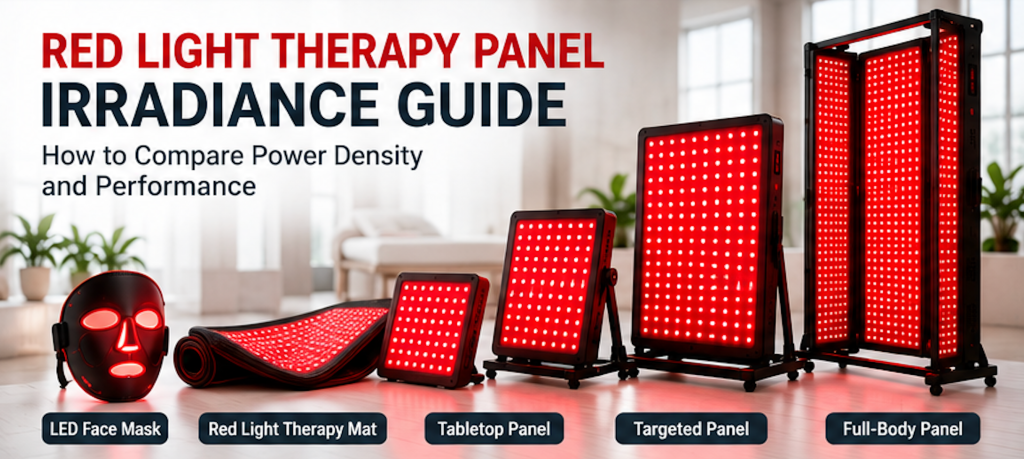
When purchasing a professional red light therapy panel, one of the most important technical specifications to understand is irradiance.
Whether you are a clinic owner, gym operator, wellness center, beauty equipment distributor, or private-label brand, knowing how to evaluate red light therapy panel irradiance can help you make better purchasing decisions.
You may encounter product specifications such as:
- 80 mW/cm² at 6 inches
- 120 mW/cm² at 6 inches
- 150 mW/cm² at 3 inches
But what do these numbers mean?
Does higher irradiance always mean better performance? How do you compare measurements from different manufacturers? And how does irradiance affect treatment time?
This guide explains how to evaluate irradiance, measurement methods, treatment distance, coverage uniformity, wavelengths, and device specifications when choosing professional red light therapy panels.
If you are sourcing equipment for commercial applications, explore our Professional Red Light Therapy Panels.
What Is Red Light Therapy Panel Irradiance?
Irradiance describes the amount of optical power reaching a surface per unit area.
It is commonly expressed as:
mW/cm² — milliwatts per square centimeter.
For example, an irradiance value of 100 mW/cm² means that optical power is reaching the measured surface at a rate of 100 milliwatts per square centimeter.
Irradiance is sometimes called power density in the red light therapy industry.
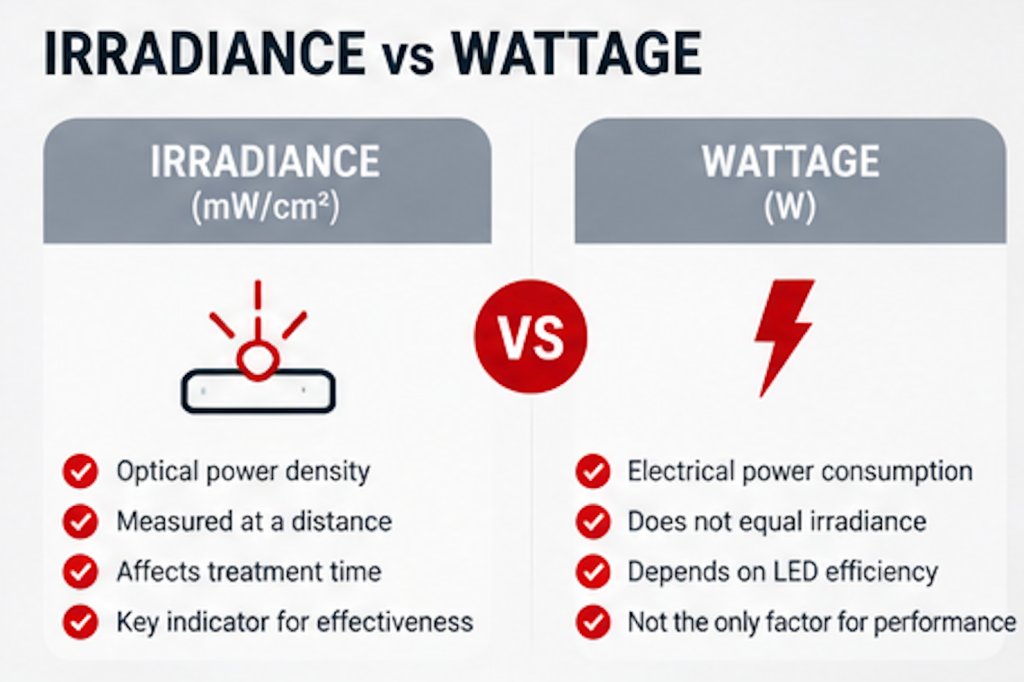
However, irradiance should not be confused with electrical wattage or total light energy.
Irradiance vs Electrical Wattage
Electrical wattage describes the electrical power consumed or rated for a device, depending on the manufacturer’s specification.
Irradiance describes the optical power arriving at a defined surface area.
These are different measurements.
A panel advertised as 600W does not automatically deliver twice the irradiance of a 300W panel.
Actual irradiance depends on LED efficiency, optical design, distance, wavelength, and other factors.
For a detailed comparison, read our Red Light Therapy Panel Wattage vs Irradiance Guide.
Why Is Irradiance Important When Choosing a Red Light Therapy Panel?
Irradiance helps buyers understand how optical power is distributed at the intended treatment surface.
For professional equipment, this matters because two panels can have similar electrical specifications but different optical performance.
A meaningful evaluation should consider:
- Irradiance at a specified distance
- Wavelength configuration
- Treatment coverage
- Center and average irradiance
- Light distribution uniformity
- Exposure time
- Measurement method
- Device operating conditions
For example, a panel with high irradiance in a small central area may not provide uniform illumination across a larger treatment surface.
For clinics, gyms, and wellness businesses, the intended coverage area can be just as important as the maximum advertised irradiance.
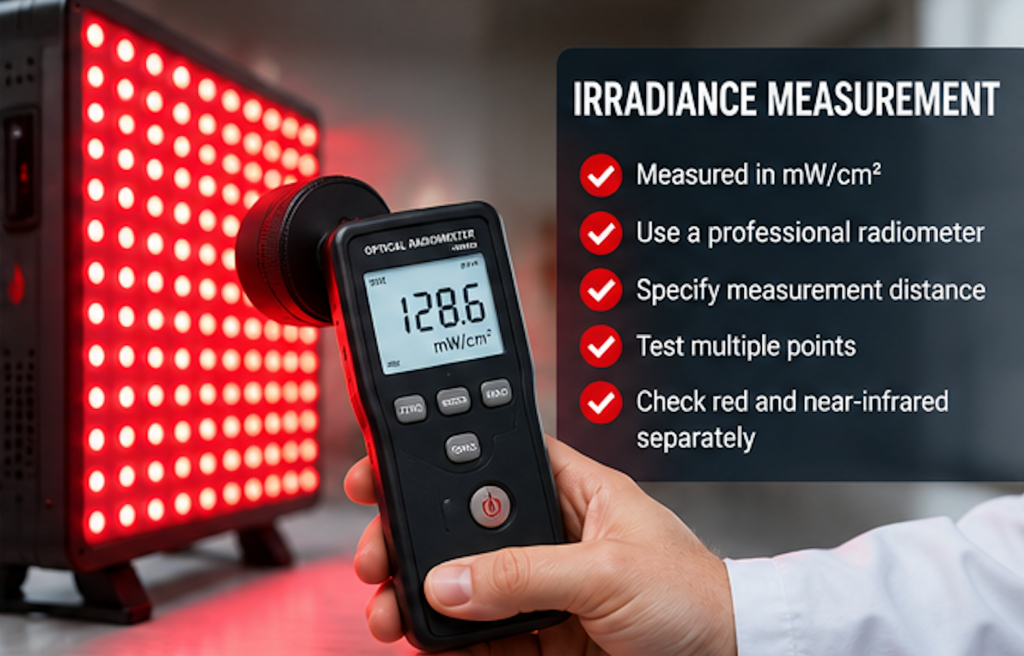
How Is Red Light Therapy Panel Irradiance Measured?
Irradiance measurements should be performed using appropriate optical measurement equipment.
For reliable product comparison, the measurement procedure should document the conditions under which the readings were obtained.
1. Measurement Distance
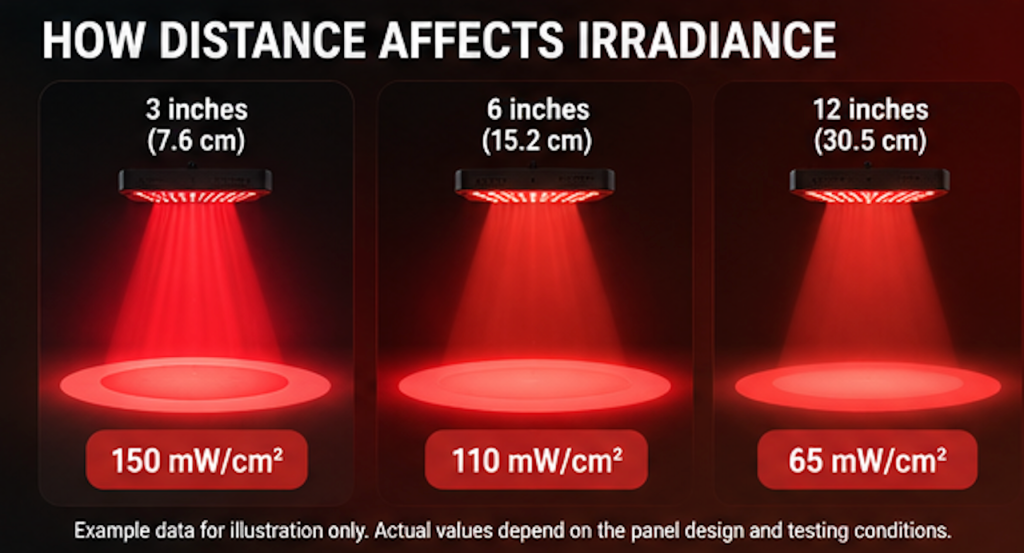
The distance between the panel and measurement surface affects irradiance.
Common testing distances may include:
- 3 inches (7.6 cm)
- 6 inches (15.2 cm)
- 12 inches (30.5 cm)
These are examples of measurement distances, not universal recommended treatment distances.
For example:
150 mW/cm² at 3 inches
and
150 mW/cm² at 6 inches
are not equivalent product specifications unless the relevant measurement conditions are also considered.
Always ask the manufacturer to provide the exact distance.
2. Measurement Equipment
Appropriate radiometric instruments can be used to measure optical irradiance.
Depending on the measurement objective, instruments may include calibrated optical power meters, radiometers, or spectroradiometers with suitable wavelength coverage.
The instrument should be appropriate for the panel’s red and near-infrared spectrum.
Ordinary lux meters are not suitable for measuring total red and near-infrared irradiance.
Some inexpensive solar power meters can provide comparative readings, but their absolute accuracy for narrow-band LED devices may be limited by spectral calibration.
For professional sourcing, request the instrument model, calibration information, and measurement procedure.
3. Measurement Position
Red light therapy panels contain multiple LEDs.
The optical output is not necessarily uniform across the entire illuminated area.
A manufacturer may measure irradiance:
- At the center
- Near the edges
- At multiple grid points
- Across a defined treatment surface
A single center-point reading cannot establish uniform coverage.
4. Operating Conditions
Measurement results can also depend on:
- LED operating mode
- Brightness setting
- Active wavelengths
- Warm-up time
- Ambient light
- Sensor orientation
- Measurement geometry
Professional testing should document these conditions.
Center Irradiance vs Average Irradiance: Which Is More Useful?
This is one of the most important distinctions for B2B buyers.
Center Irradiance
Center irradiance measures optical power at a central point in the treatment area.
It can help identify the output at that location.
However, it does not describe the entire illuminated area.
Average Irradiance
Average irradiance represents the mean of measurements across a defined surface.
For large-area equipment, average irradiance can provide additional information about overall light distribution.
However, the averaging area and measurement grid must be specified.
Example: Comparing Two Panels
Consider two hypothetical panels measured using the same procedure at the same distance.
| Specification | Panel A | Panel B |
|---|---|---|
| Center Irradiance | 160 mW/cm² | 130 mW/cm² |
| Average Irradiance | 75 mW/cm² | 105 mW/cm² |
| Measurement Distance | 6 inches | 6 inches |
| Coverage Area | Same defined area | Same defined area |
These values are illustrative, not actual product specifications.
Panel A has higher center irradiance.
Panel B has higher average irradiance across the defined measurement area.
For applications requiring broad, relatively uniform coverage, Panel B may be worth further evaluation.
The right choice depends on the intended application and complete optical specifications.
How Does Distance Affect Red Light Therapy Irradiance?
As the distance between the panel and target changes, irradiance and beam overlap can also change.
However, LED panels contain multiple light sources, and their optical distribution depends on lens design, beam angle, spacing, and geometry.
Therefore, the simple inverse-square relationship for a point source should not automatically be applied to a nearby LED panel.
Example Irradiance Measurements
The following table illustrates a possible distance-dependent measurement pattern for a hypothetical panel.
| Distance | Illustrative Center Irradiance |
|---|---|
| 3 inches | 150 mW/cm² |
| 6 inches | 110 mW/cm² |
| 12 inches | 65 mW/cm² |
These values are examples only and do not describe any specific product.
The actual irradiance-distance relationship must be measured.
Why Distance Matters for B2B Buyers
A professional buyer should request irradiance data at the intended operating distance.
For example, if a clinic plans to position a panel 6 inches from the treatment surface, measurements taken only at 3 inches may not provide sufficient information.
Ask for data that matches the intended setup.
How Does Irradiance Affect Red Light Therapy Dosage?
Irradiance and exposure time are related to radiant exposure, often called fluence in photobiomodulation discussions.
The basic formula is:
Radiant Exposure (J/cm²) = Irradiance (W/cm²) × Exposure Time (seconds)
Example Calculation
Assume a panel delivers 50 mW/cm² at the measurement surface.
Convert the irradiance:
50 mW/cm² = 0.05 W/cm²
For a 10-minute exposure:
10 minutes = 600 seconds
Therefore:
0.05 × 600 = 30 J/cm²
This is the calculated radiant exposure at that surface under the assumed constant irradiance.
It is not a universal recommended therapeutic dose.
The calculation does not establish how much energy reaches a particular depth inside tissue or whether the exposure is effective for a specific condition.
Does Higher Irradiance Mean Better Results?
Not necessarily.
Photobiomodulation outcomes depend on multiple factors, including wavelength, irradiance, radiant exposure, tissue characteristics, treatment protocol, and intended application.
Increasing irradiance or exposure time does not automatically improve results.
For professional use, follow the device’s validated instructions and applicable protocols.
For more information, see our Red Light Therapy Treatment Time & Device Selection Guide.
What Is a Good Irradiance for a Red Light Therapy Panel?
There is no single irradiance value that is ideal for every red light therapy panel or application.
The appropriate output depends on:
- Wavelength
- Intended use
- Treatment distance
- Exposure duration
- Target area
- Device configuration
- Applicable protocol
A compact panel designed for a small treatment area and a large full-body panel may have different optical requirements.
Rather than searching for the highest advertised number, buyers should ask whether the manufacturer’s measurements are reliable, relevant, and repeatable.
What Should Professional Buyers Look For?
A useful irradiance specification should include:
Irradiance + Measurement Distance + Wavelength + Measurement Method + Coverage Area
For example, a technical report that documents irradiance at several points across a defined treatment surface is more informative than a marketing claim that provides only a peak value.
Red Light Therapy Panel Irradiance vs Wattage
When comparing commercial panels, wattage and irradiance should be evaluated together.
| Specification | Meaning | Buyer Consideration |
|---|---|---|
| Rated Wattage | Manufacturer’s stated electrical rating | Clarify its definition |
| Actual Power Consumption | Electrical power drawn during operation | Operating requirements |
| Irradiance | Optical power per unit area | Light delivered at the surface |
| Wavelength | Spectral output | Intended application |
| Distance | Measurement or operating distance | Valid comparison |
| Coverage | Illuminated area | Treatment area |
| Uniformity | Variation across the surface | Consistency of illumination |
| Cooling | Thermal management | Commercial operation |
A higher-wattage device may cover a larger area without necessarily delivering higher irradiance at every point.
For B2B buyers, the complete optical performance is more important than one isolated specification.
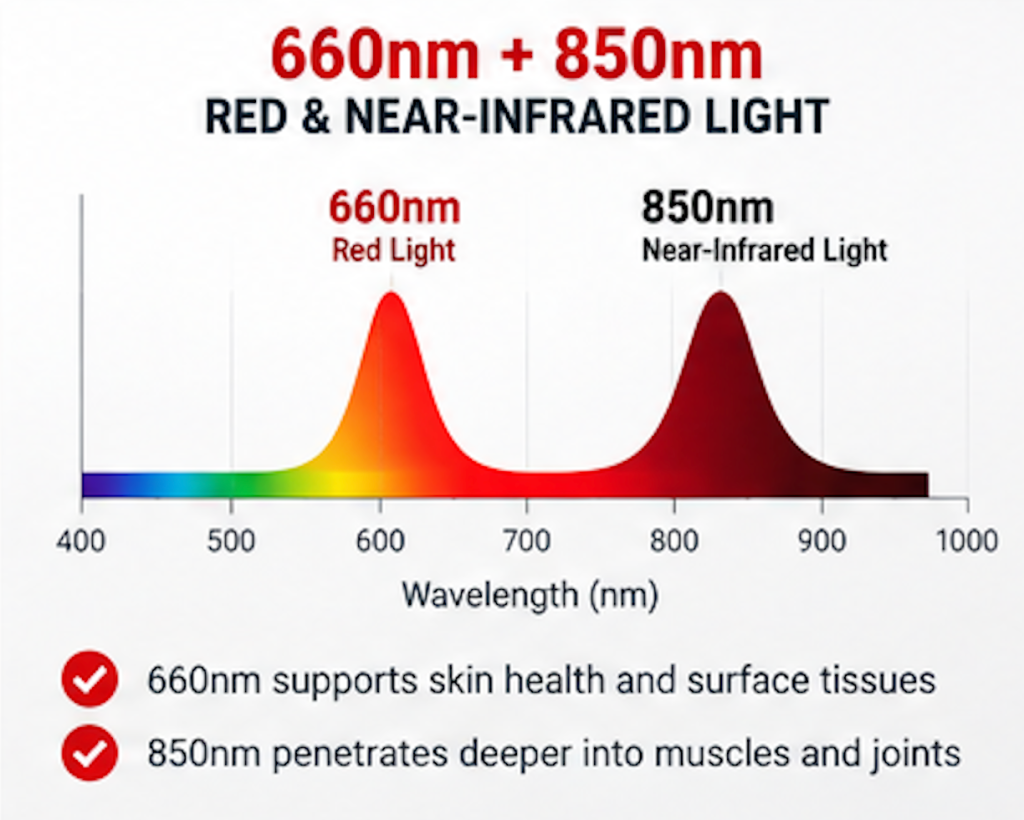
How Do 660nm and 850nm Affect Irradiance Comparison?
Many red light therapy panels use a combination of visible red and near-infrared LEDs.
Two commonly used wavelengths are:
660nm Red Light
850nm Near-Infrared Light
These wavelengths have different optical properties.
When comparing dual-wavelength panels, ask whether the irradiance value represents:
- Red LEDs only
- Near-infrared LEDs only
- Both wavelengths operating together
A combined irradiance measurement does not necessarily reveal how much optical power is delivered at each wavelength.
Why Separate Wavelength Measurements Matter
For example, two panels may advertise the same combined irradiance but use different proportions of red and near-infrared LEDs.
Their spectral output may therefore differ.
For professional procurement, consider requesting wavelength-specific optical data.
Read our 660nm vs 850nm Red Light Therapy Guide to learn more about wavelength selection.
Full-Body vs Targeted Red Light Therapy Panel Irradiance
Different panel formats are designed for different coverage requirements.
Targeted Red Light Therapy Panels
Targeted panels are designed to illuminate smaller areas.
They may be considered for:
- Compact treatment rooms
- Localized applications
- Tabletop use
- Facial and aesthetic equipment setups
- Flexible positioning
Important selection factors include irradiance, beam angle, treatment distance, and positioning.
Full-Body Red Light Therapy Panels
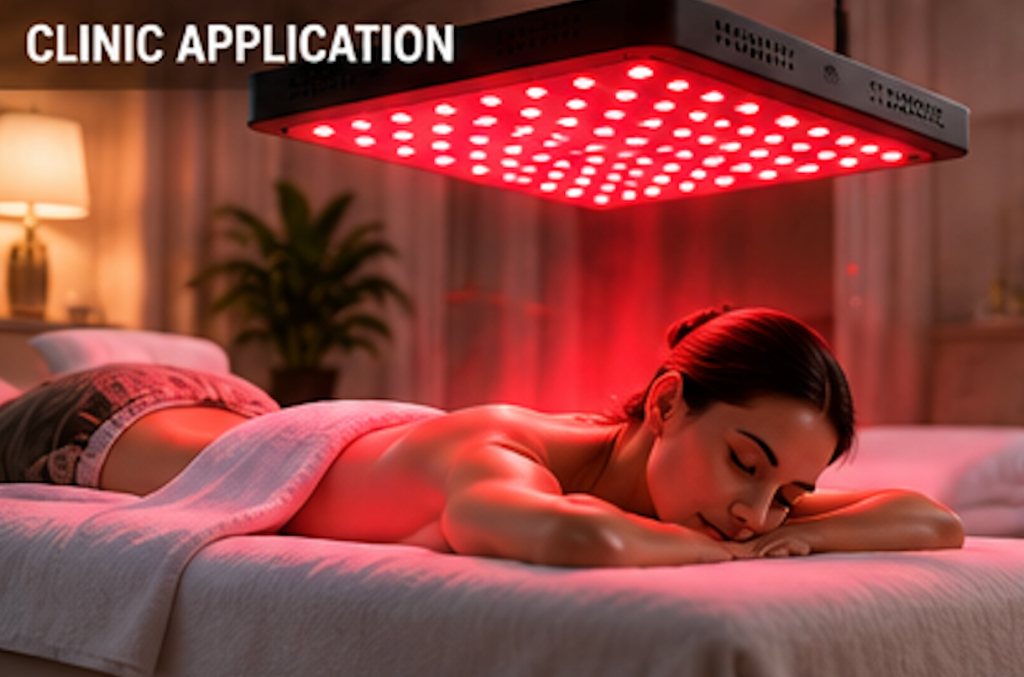
Larger panels are designed to illuminate broader areas.
They may be considered for:
- Wellness centers
- Gyms
- Recovery facilities
- Professional treatment rooms
- Full-body wellness services
For these systems, coverage uniformity becomes especially important.
A high center-point irradiance reading does not necessarily demonstrate consistent output across the body.
Learn more in our Full-Body vs Targeted Red Light Therapy Panels Guide.
How to Choose Irradiance Specifications for Different Businesses
Clinics
Clinics should evaluate device specifications according to the intended application and applicable professional requirements.
Important factors include:
- Repeatable optical output
- Defined treatment distance
- Appropriate coverage
- Reliable controls
- Cleaning and maintenance
- Product documentation
- Applicable regulatory requirements
Explore our Red Light Therapy Solutions for Clinics.
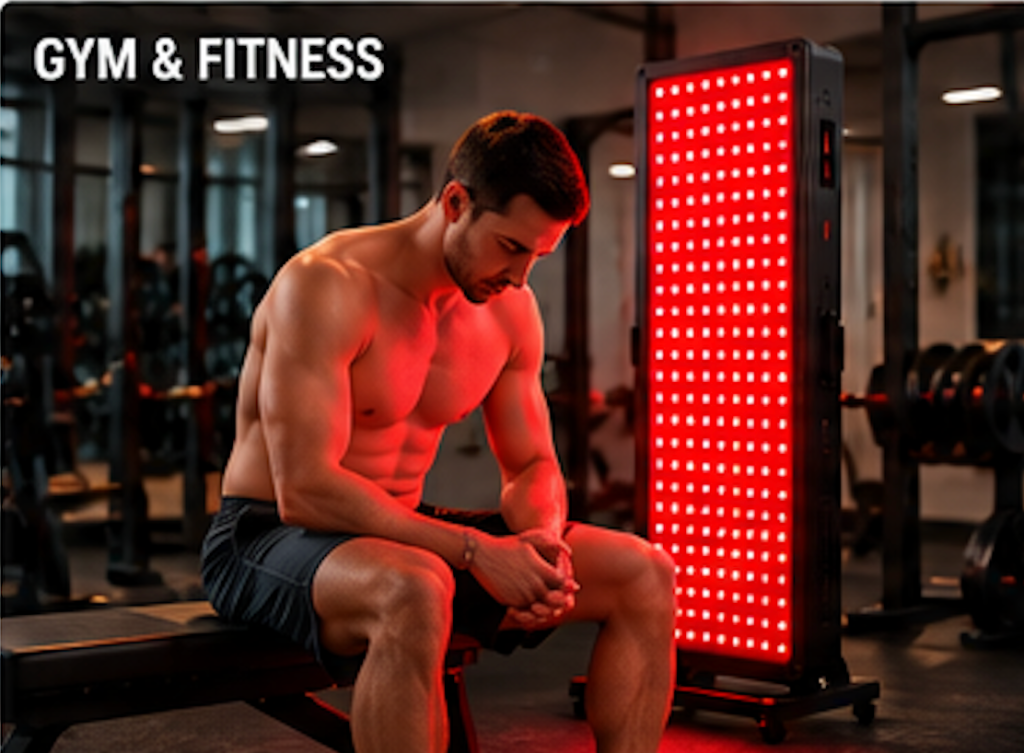
Gyms and Fitness Centers
Gyms may prioritize larger coverage, straightforward operation, durable equipment, and efficient customer flow.
A large panel with well-documented coverage may be more suitable than a smaller device with a higher center-only irradiance claim.
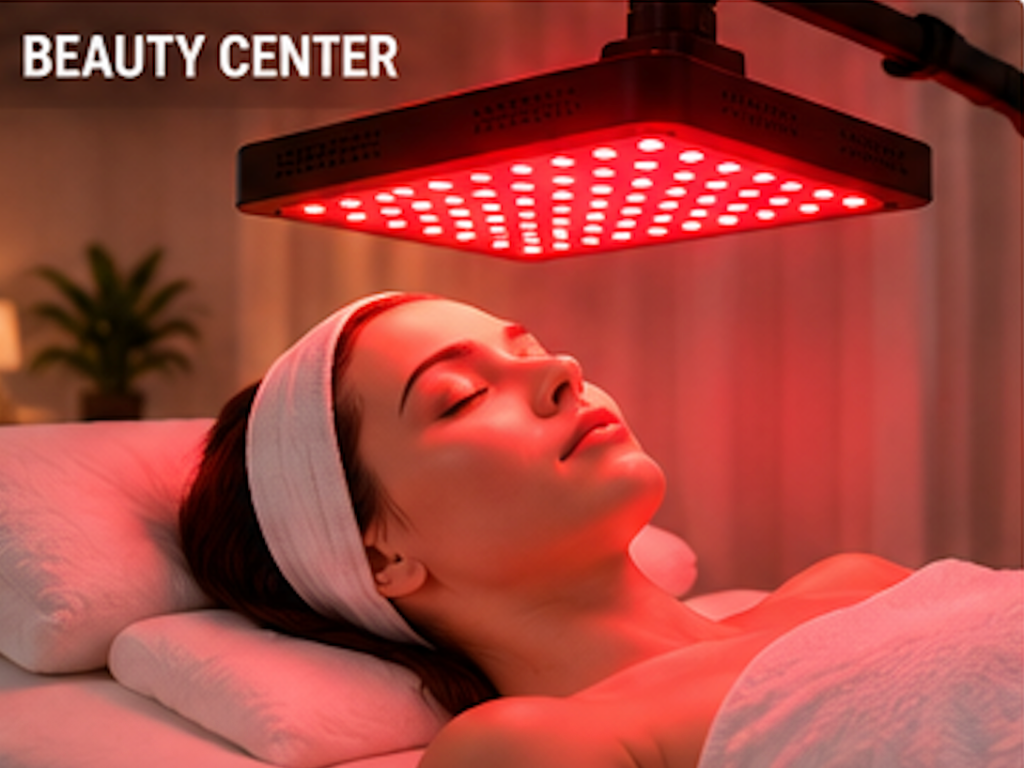
Beauty Centers
Beauty businesses may prefer compact or tabletop equipment.
Important considerations include:
- Device positioning
- Treatment distance
- Optical output
- Customer comfort
- Eye safety
- Applicable intended-use requirements
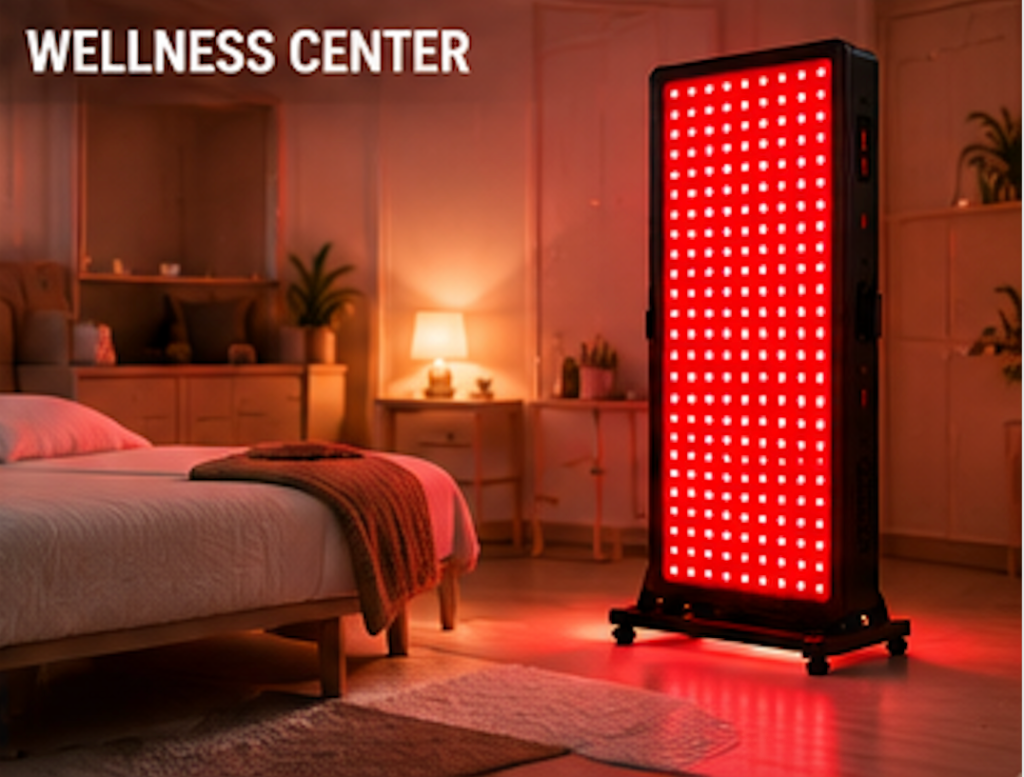
Wellness Centers
Wellness facilities may compare targeted and full-body systems based on room size, service format, coverage, and operating requirements.
For all these businesses, purchasing decisions should be based on verified specifications rather than unsupported performance claims.
How to Compare Irradiance Data From Different Manufacturers
When evaluating suppliers, create a standardized comparison sheet.
Step 1: Confirm the Wavelength Configuration
Ask which wavelengths are included and whether they can operate independently.
Step 2: Confirm the Measurement Distance
Compare readings obtained at the same distance whenever possible.
Step 3: Request the Measurement Method
Ask which instrument was used and whether the measurements were calibrated appropriately.
Step 4: Compare Center and Average Irradiance
For large panels, request multiple measurement points across the intended coverage area.
Step 5: Confirm Operating Conditions
Check brightness settings, active wavelengths, and operating mode.
Step 6: Evaluate Treatment Coverage
A higher peak irradiance is not always more useful than broader, more uniform coverage.
Step 7: Review Product Quality and Compliance
Ask about electrical safety, thermal management, quality control, warranty, and applicable market documentation.
Step 8: Evaluate a Sample
Where practical, verify the optical specifications using an appropriate independent testing method before mass production.
For additional sourcing advice, read our Red Light Therapy Panel Manufacturer Guide.
Red Light Therapy Panel Irradiance Testing Checklist
Before placing a wholesale or OEM order, ask your supplier the following questions.
| Question | Why It Matters |
|---|---|
| What wavelengths are used? | Identifies spectral configuration |
| What is the irradiance? | Describes optical power per area |
| At what distance was it measured? | Enables meaningful comparison |
| Is the value peak or average? | Clarifies measurement scope |
| What is the measurement area? | Defines coverage |
| What instrument was used? | Helps assess measurement reliability |
| Are red and NIR measured separately? | Clarifies spectral output |
| What operating mode was used? | Supports repeatability |
| Is a test report available? | Supports technical verification |
| Can samples be tested? | Supports purchasing confidence |
This checklist is particularly useful when comparing multiple suppliers.
OEM & ODM Red Light Therapy Panel Irradiance Customization
For brands and distributors, irradiance can be an important part of product development.
Depending on the existing platform and engineering requirements, an OEM or ODM project may involve changes to:
- LED configuration
- Wavelength combination
- LED spacing
- Optical lenses
- PCB design
- Power supply
- Cooling system
- Panel dimensions
- Controller functions
- Housing design
However, changing one component can affect other parts of the optical and thermal system.
For example, modifying the LED configuration may change irradiance distribution, heat generation, electrical requirements, and testing needs.
Therefore, custom irradiance targets should be established during the product specification stage.
Brands should also define how optical performance will be measured and accepted during production.
Explore our Red Light Therapy OEM & ODM Manufacturing Solutions.
Common Mistakes When Comparing Red Light Therapy Panel Irradiance
Mistake 1: Comparing Irradiance at Different Distances
A reading at 3 inches should not be directly compared with a reading at 12 inches without accounting for the different conditions.
Mistake 2: Looking Only at Peak Irradiance
Peak output does not describe uniformity across the treatment area.
Mistake 3: Confusing Wattage With Irradiance
Electrical power consumption is not equivalent to optical power delivered to the treatment surface.
Mistake 4: Ignoring Wavelength Configuration
Combined red and near-infrared readings may hide differences in spectral output.
Mistake 5: Using Inappropriate Measurement Instruments
Lux meters and uncorrected broadband meters may produce misleading results for narrow-band LED panels.
Mistake 6: Assuming Higher Irradiance Always Means Better Results
Optical output must be evaluated in the context of the intended application and protocol.
Mistake 7: Accepting Claims Without Test Conditions
An irradiance claim is more useful when supported by a documented measurement procedure.
Frequently Asked Questions
What does mW/cm² mean in red light therapy?
mW/cm² means milliwatts per square centimeter. It is a unit used to describe irradiance, or optical power reaching a surface per unit area.
Is 100 mW/cm² good for red light therapy?
A value of 100 mW/cm² describes irradiance at a particular measurement location. Whether it is appropriate depends on the wavelength, distance, exposure time, intended application, and device protocol.
Is higher irradiance always better?
No. Higher irradiance does not automatically mean better treatment outcomes or a better commercial device. Coverage, wavelength, measurement quality, and intended use also matter.
What is the difference between irradiance and dosage?
Irradiance describes the rate of optical power delivered per area. Radiant exposure, commonly expressed in J/cm², describes energy delivered per area over time.
Does irradiance decrease with distance?
Irradiance generally changes with distance, but the exact relationship depends on the LED arrangement, optics, and measurement geometry. It should be measured for the specific panel.
How can I compare irradiance between manufacturers?
Compare measurements taken at equivalent distances, wavelengths, operating settings, and measurement positions using appropriately calibrated equipment.
Does a 600W panel have higher irradiance than a 300W panel?
Not necessarily. Electrical wattage does not directly determine irradiance at a given surface.
Why should buyers request an irradiance test report?
A test report can document the measurement method, distance, operating conditions, and optical output, making technical comparison more reliable.
Can irradiance be customized in OEM red light therapy panels?
Depending on the design, manufacturers may be able to modify LED configuration, optics, electrical design, or other components to meet defined performance targets. Feasibility should be confirmed through engineering and testing.
Final Thoughts: How to Evaluate Red Light Therapy Panel Irradiance
Understanding irradiance is essential when comparing professional red light therapy panels.
However, a single mW/cm² number does not describe the complete performance of a device.
For meaningful comparison, evaluate:
Wavelength → Irradiance → Measurement Distance → Coverage → Uniformity → Exposure Time → Product Quality
For clinics, gyms, wellness centers, beauty businesses, distributors, and private-label brands, documented optical performance can help support more informed purchasing decisions.
The goal is not simply to purchase the panel with the highest advertised irradiance.
The goal is to select equipment with appropriate, verifiable specifications for the intended application.
Request a Professional Red Light Therapy Panel Quote
US Red Light Therapy offers red and near-infrared light therapy equipment and OEM/ODM customization options for professional buyers, distributors, and private-label brands.
If you are comparing red light therapy panels or developing a customized product, share your:
- Preferred panel size
- Wavelength configuration
- Intended application
- Irradiance requirements
- Treatment distance
- Estimated order quantity
- Branding requirements
- Target market
Our team can discuss available product configurations and technical requirements for your project.
Explore Our Products:
Professional Red Light Therapy Panels
Explore Customization:
Red Light Therapy OEM & ODM Manufacturer
Request a Quote:
Contact US Red Light Therapy
Post time: 10-10-26