


Red Light Therapy Panel Manufacturer Guide: How to Choose the Right Supplier
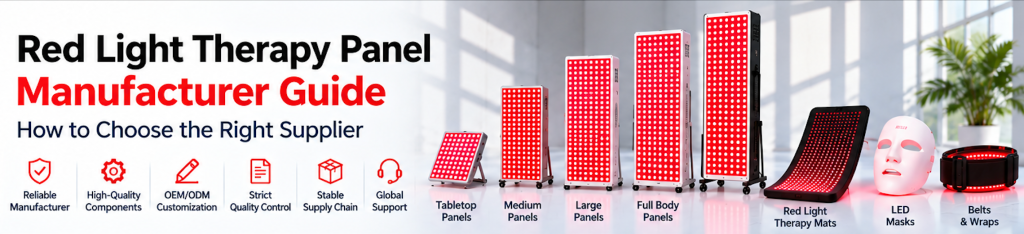
Choosing the right red light therapy panel manufacturer involves much more than comparing prices.
For distributors, clinics, gyms, wellness centers, beauty businesses and private-label brands, the manufacturer can directly affect product quality, technical performance, supply consistency, customization capability and long-term after-sales support.
A professional red light therapy panel combines several systems:
- LED modules
- Red and near-infrared wavelengths
- Optical lenses
- Power supply
- PCB
- Cooling system
- Controller
- Housing
- Mounting hardware
- Firmware or software
- Packaging
Two panels may look almost identical in a product photo while having very different technical specifications and manufacturing quality.
That is why B2B buyers should evaluate the complete product rather than focusing only on wattage or LED quantity.
This guide explains how to compare a red light therapy panel manufacturer, what technical information to request, which customization options matter and how to reduce sourcing risk before mass production.
If you are already comparing products, start with our Red Light Therapy Panel Collection.
What Does a Red Light Therapy Panel Manufacturer Do?
A professional manufacturer does more than assemble LEDs into a metal enclosure.
Depending on its capabilities, a manufacturer may support:
- Product design
- LED configuration
- Wavelength selection
- PCB development
- Optical design
- Thermal management
- Housing production
- Controller development
- Sample production
- Quality control
- OEM branding
- ODM development
- Private labeling
- Packaging
- Mass production
For brands developing customized products, manufacturing capability becomes even more important.
You may need changes to:
- Panel dimensions
- LED quantity
- Wavelength ratio
- Irradiance
- Housing
- Control system
- Timer
- Intensity levels
- Pulse modes
- Mounting system
- App or UI
- Packaging
If your project requires customization, review our Red Light Therapy OEM & ODM Manufacturer Solutions.
Why Choosing the Right Panel Manufacturer Matters
A red light therapy panel may remain in your product line for years.
The wrong supplier can create problems such as:
- Inconsistent LED output
- Specification changes
- High defect rates
- Poor cooling
- Unstable controllers
- Delayed production
- Packaging damage
- Inconsistent appearance
- Limited spare parts
- Weak after-sales support
These problems become more expensive as your order quantity increases.
A professional B2B buyer should therefore ask:
Can this manufacturer supply the same agreed product consistently over multiple production batches?
That question is usually more important than:
Who offers the lowest unit price?
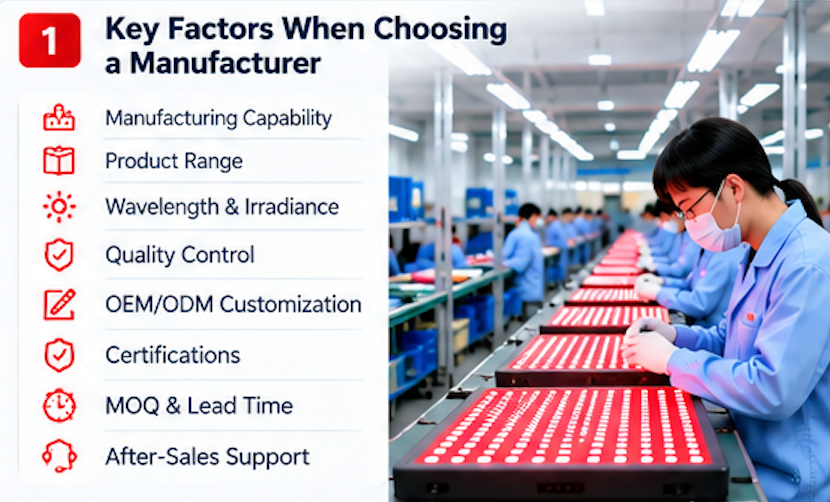
1. Verify That You Are Working With a Real Manufacturer
The first step is understanding who actually produces the equipment.
Ask the supplier:
- Do you own or operate the production facility?
- Which production processes are performed in-house?
- Do you have an engineering team?
- Can you develop customized samples?
- Can you modify electronics?
- Can you change panel dimensions?
- Can you customize controllers?
- How is quality inspection managed?
- What is your monthly production capacity?
A manufacturer with direct engineering and production capabilities can usually respond more effectively when a project requires technical changes.
You can also review company and manufacturing information through the About Us page.
2. Compare the Manufacturer’s Red Light Therapy Panel Range
A manufacturer should ideally provide more than one panel size.
Different markets require different equipment.
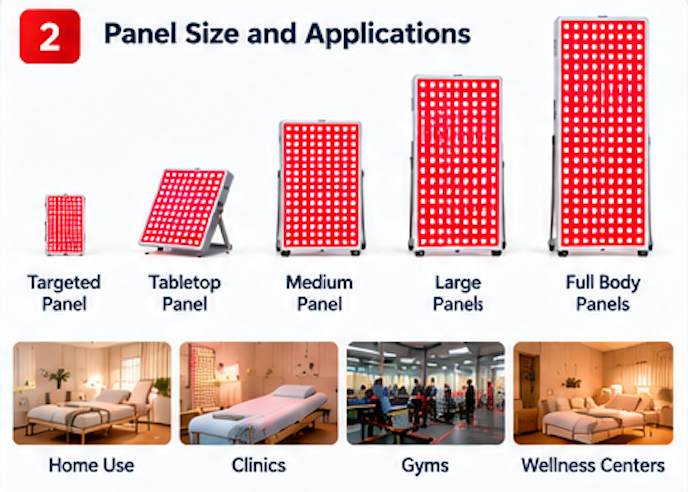
Common panel formats include:
Targeted Panels
Suitable for smaller treatment areas and compact spaces.
Tabletop Panels
Suitable for:
- Clinics
- Beauty rooms
- Wellness spaces
- Home wellness brands
- Targeted applications
Medium Panels
Useful when buyers need more coverage without installing a full-body system.
Large Panels
Can provide greater treatment coverage for professional environments.
Full-Body Panels
Designed for broader coverage and commercial installations.
Multi-Panel Systems
Multiple panels can be combined when a business requires a larger treatment area.
You can compare existing options in our Red Light Therapy Panel Collection.
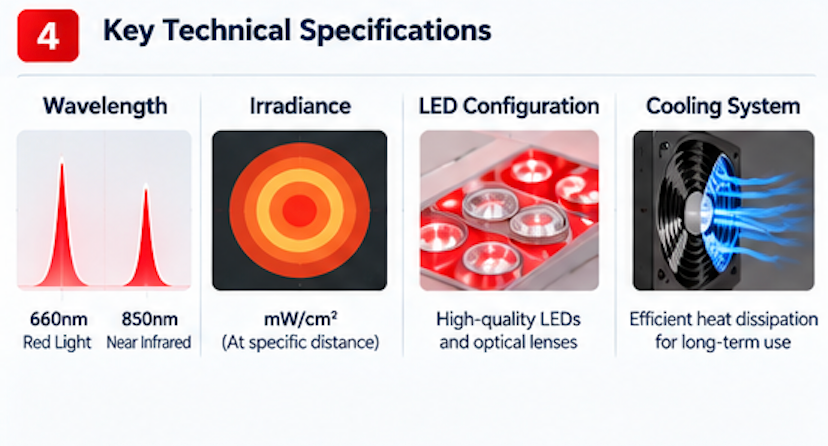
3. Check the Wavelength Configuration
Wavelength is one of the first specifications B2B buyers should review.
Common wavelengths used in red and near-infrared systems can include:
- 630nm
- 660nm
- 810nm
- 830nm
- 850nm
A widely used configuration combines:
660nm red light + 850nm near-infrared light
However, more wavelengths do not automatically mean a better panel.
The configuration should match:
- Intended product design
- Customer group
- Application
- Irradiance
- Treatment distance
- Optical design
Questions to Ask Your Manufacturer
Ask:
- What wavelengths are installed?
- What is the LED ratio?
- Are wavelengths independently controllable?
- Can the wavelength configuration be customized?
- What wavelength tolerance applies?
- Can you provide spectral data where available?
For more detail, read our 660nm vs 850nm Red Light Therapy Guide.
4. Compare Irradiance, Not Just Wattage
One of the biggest mistakes buyers make is comparing panels only by wattage.
For example:
300W
600W
900W
1600W
These numbers can help describe the general equipment class, but wattage does not directly tell you how much optical power reaches the treatment area.
That is where irradiance becomes important.
What Is Irradiance?
Irradiance describes optical power delivered per unit area.
It is normally expressed in:
mW/cm²
But an irradiance number is not useful without measurement conditions.
If a supplier says:
Irradiance: 150 mW/cm²
you should immediately ask:
At what distance?
A professional specification should provide information such as:
Irradiance measured at 3 inches or 6 inches under defined operating conditions.
For a deeper explanation, read our Red Light Therapy Irradiance Guide.
Wattage vs Irradiance
These specifications describe different things.
| Specification | What It Tells You |
|---|---|
| Wattage | Electrical power / equipment power class |
| Irradiance | Optical power delivered per unit area |
| Wavelength | Spectrum of light produced |
| Treatment Distance | Distance between device and target |
| Coverage | Area illuminated by the panel |
Therefore:
Higher wattage ≠ automatically higher useful optical output.
Two panels with the same wattage may use different:
- LEDs
- Optics
- Beam angles
- Power supplies
- LED layouts
- Cooling systems
and produce different irradiance.
Read our detailed Red Light Therapy Panel Wattage vs Irradiance Guide before comparing suppliers.
5. Evaluate Treatment Coverage
Peak irradiance is only part of the picture.
Imagine a manufacturer measures very high irradiance directly in the center of the panel.
But output drops significantly toward the edges.
The advertised number may look impressive while real treatment coverage is less uniform.
Ask about:
- Panel dimensions
- Illuminated area
- LED spacing
- Beam angle
- Center irradiance
- Edge irradiance
- Recommended treatment distance
- Irradiance uniformity
For full-body commercial equipment, coverage can be just as important as peak output.
6. Compare Panel Size Based on the Application
There is no single panel size suitable for every buyer.
Small Panels
Best suited for:
- Targeted areas
- Small rooms
- Portable setups
- Entry-level products
Tabletop Panels
Useful for:
- Beauty facilities
- Small wellness rooms
- Clinics
- Targeted applications
For example, your supplier should clearly specify panel dimensions, wavelength configuration, irradiance and recommended operating distance.
Medium Panels
Suitable when buyers need a balance between:
Coverage + Cost + Space
Large Panels
Suitable for:
- Professional wellness rooms
- Fitness facilities
- Clinics
- Larger treatment areas
Full-Body Panels
Useful when businesses want broader coverage and fewer repositioning requirements.
If you are choosing a panel for a commercial facility, see How to Choose the Best Red Light Therapy Panel for Your Business.
7. Evaluate LED Configuration
The number of LEDs can help describe a panel, but LED quantity alone does not determine quality.
Buyers should consider:
LED Quantity
Wavelength
LED Power
Optics
Spacing
Irradiance
Coverage
A panel with more LEDs is not automatically better if the optical design is poor.
Questions to Ask
- Which LEDs are used?
- How many LEDs are installed?
- Are they single-chip or multi-chip?
- What wavelengths are used?
- What is the wavelength ratio?
- What beam angle is used?
- How are LEDs positioned?
These questions give you a better understanding of the actual panel design.
8. Check the Cooling System
LED panels generate heat.
Professional equipment therefore requires suitable thermal management.
Depending on the design, this may include:
- Fans
- Heat sinks
- Aluminum housing
- Ventilation
- Internal airflow
- Temperature management
Commercial equipment may operate multiple times per day.
Poor thermal management can affect:
- Component life
- Power supplies
- LED stability
- Controllers
- Noise
- Reliability
Ask whether the manufacturer performs extended-operation or aging tests.
9. Review the Control System
A commercial panel should be easy to operate.
Depending on the model, controls may include:
- On/off
- Timer
- Intensity adjustment
- Red-light control
- NIR control
- Pulse mode
- Preset programs
- Remote control
- Touchscreen
- App control
For a private-label or ODM project, control-system customization can become an important differentiator.
For example, brands may request:
- Customized startup screen
- Custom UI
- Preset operating modes
- Different timer intervals
- App interface
- Branded remote control
These requirements should be discussed before sample development.
10. Evaluate Housing and Mechanical Design
Professional panels need more than attractive appearance.
The housing should support:
- Structural strength
- Cooling
- Installation
- Cleaning
- Transportation
- Long-term operation
Ask about:
- Housing material
- Surface finish
- Panel thickness
- Ventilation
- Handles
- Mounting points
- Stand compatibility
- Wheels
- Horizontal installation
- Vertical installation
The mounting system is particularly important for large or full-body panels.
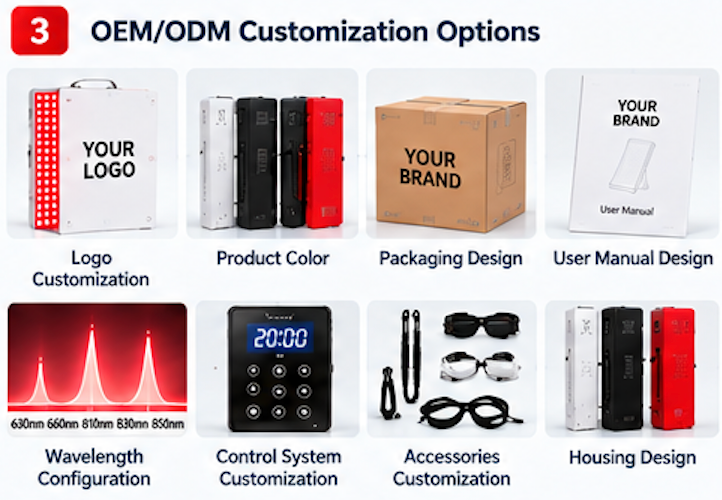
11. Check OEM Red Light Therapy Panel Capability
If you are building your own brand, ask the manufacturer exactly what can be customized.
OEM options may include:
Logo
Add your brand to the housing.
Product Label
Use your own:
- Model number
- Brand
- Specifications
Packaging
Customize:
- Carton
- Retail box
- Foam
- Inserts
- Product graphics
User Manual
Create a branded user manual.
Product Color
Depending on MOQ and production method, housing colors may be customized.
Accessories
Possible options include:
- Goggles
- Stands
- Hanging systems
- Remote controls
- Cables
- Mounting accessories
If private labeling is part of your strategy, see our complete OEM, ODM & Private Label Red Light Therapy Solutions.
12. Evaluate ODM Capability for Custom Panels
ODM becomes relevant when you want more than branding.
A deeper custom project may involve:
- New panel dimensions
- New housing
- LED layout
- Custom PCB
- Different wavelength ratio
- Modified irradiance target
- Custom controller
- Software
- Firmware
- New mounting system
- New accessories
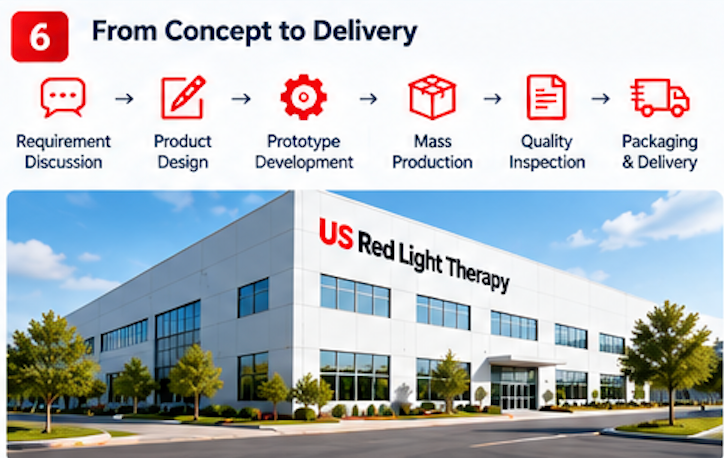
ODM development generally requires:
Requirement Definition
→
Engineering
→
Prototype
→
Testing
→
Revision
→
Sample Approval
→
Mass Production
More customization normally means more development time and a larger engineering commitment.
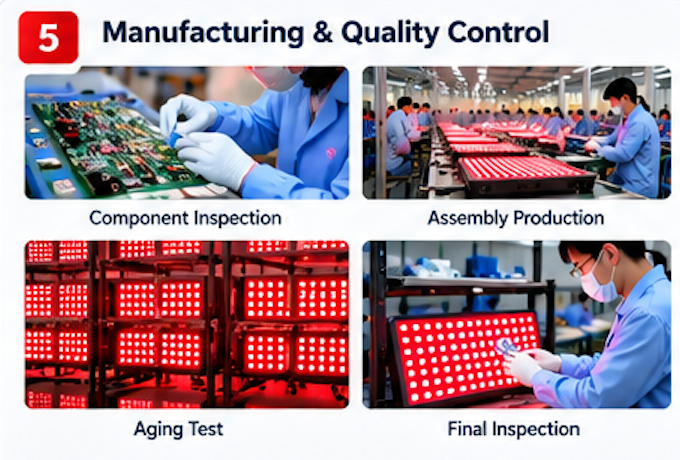
13. Review the Quality Control Process
A professional red light therapy panel manufacturer should be able to explain how products are inspected.
A typical quality workflow may include:
Step 1 — Incoming Material Inspection
Inspect:
- LEDs
- PCBs
- Housing
- Power supplies
- Controllers
- Cables
- Accessories
Step 2 — Assembly Inspection
Check product assembly against the approved specifications.
Step 3 — Functional Testing
Verify:
- Power
- Controller
- Timer
- Light modes
- Remote
- Display
Step 4 — Optical Testing
Depending on the manufacturer’s process, testing may include:
- Wavelength
- Irradiance
- Output consistency
Step 5 — Aging Test
Operate equipment for a defined period to identify early component failures.
Step 6 — Appearance Inspection
Check:
- Scratches
- Surface finish
- Logo
- Labels
- Assembly quality
Step 7 — Packaging Inspection
Confirm:
- Accessories
- Manual
- Packaging
- Labels
- Carton
Step 8 — Final Inspection
Confirm that the production unit matches the approved requirements.
14. Create a Golden Sample Before Mass Production
This is one of the most important steps in an OEM project.
A golden sample is the final approved product that becomes the reference for production.
Document:
| Specification | Approved Requirement |
|---|---|
| Panel Size | Confirmed |
| Wavelength | Confirmed |
| LED Quantity | Confirmed |
| Irradiance | Confirmed test conditions |
| Housing | Confirmed |
| Color | Confirmed |
| Controller | Confirmed |
| Logo | Confirmed |
| Packaging | Confirmed |
| Accessories | Confirmed |
| Manual | Confirmed |
Mass production should follow the agreed sample and specification sheet.
15. Review Certifications and Test Documentation
Do not evaluate certification by looking only at logos on a website or catalogue.
Ask which documents apply to the specific product model you want to purchase.
Depending on product type and destination market, relevant documentation may involve areas such as:
- Electrical safety
- EMC
- RoHS
- FCC requirements
- CE requirements
- Product testing
- Labeling
- Manuals
The exact requirements depend on:
- Destination country
- Device
- Intended use
- Marketing claims
- Regulatory classification
Ask for the Actual Documentation
Check:
- Product model
- Applicant
- Manufacturer
- Test standard
- Laboratory
- Issue date
- Scope
Do not assume that documentation for one model automatically applies to every panel in a manufacturer’s catalog.
16. Ask About MOQ
MOQ is especially important for:
- Startups
- New brands
- Distributors testing a market
- New product launches
But MOQ depends heavily on the customization level.
Standard Product
Usually simpler.
Logo Customization
May require a different MOQ.
Custom Packaging
Packaging printers may impose their own minimum quantity.
Custom Color
May increase MOQ.
Custom Wavelength
Can depend on component requirements.
New Housing
May require tooling and higher project volume.
Instead of asking:
What is your MOQ?
ask:
What is the MOQ for this exact product and customization package?
17. Order a Sample Before a Large Purchase
For B2B procurement, sample evaluation can reduce risk.
Check:
Product Appearance
- Housing
- Finish
- Dimensions
- Branding
Technical Specifications
- Wavelength
- Irradiance
- Treatment distance
- LED quantity
- Controls
Operating Experience
- Fan noise
- Heat
- Timer
- Intensity
- Remote
- App
Accessories
- Stand
- Hanging system
- Cables
- Goggles
- Manual
Packaging
Evaluate both presentation and shipping protection.
Never approve a product based only on catalogue specifications.
18. Evaluate Production Capacity
If your business grows, your manufacturer must be able to grow with you.
Ask:
- What is the normal lead time?
- What is peak-season lead time?
- What is monthly capacity?
- How many production lines are available?
- Which components have longer lead times?
- How are repeat orders managed?
- Can specifications be kept consistent?
A supplier may be excellent for 20 units but not prepared for 2,000 units.
Production scalability should therefore be evaluated before your sales volume increases.
19. Require Change Control
Component substitutions can create problems.
For example:
Your approved sample uses:
LED Supplier A
But later production uses:
LED Supplier B
without informing you.
The product may look identical while performance changes.
For OEM projects, agree that important changes to:
- LED
- Power supply
- PCB
- Controller
- Housing
- Optical lens
- Firmware
require approval before production.
This is especially important when you sell the product under your own brand.
20. Review Warranty and Spare Parts
After-sales support affects long-term cost.
Ask:
- What is the warranty period?
- What is covered?
- How are defects handled?
- Can replacement power supplies be provided?
- Are fans replaceable?
- Can controllers be replaced?
- Are cables available?
- Are LED modules repairable?
- Is technical troubleshooting available?
For distributors and commercial buyers, spare parts can be more valuable than simply replacing complete units.
Choosing a Panel Manufacturer for Clinics
Clinics can have different requirements from home users.
Important considerations may include:
- Clearly defined wavelength specifications
- Irradiance
- Treatment coverage
- Equipment durability
- Controls
- Documentation
- Maintenance
- Warranty support
A small clinic might choose a tabletop or targeted panel.
A larger facility may use:
Medium Panel + Full-Body Panel
or a multi-panel system.
For more information, visit our Red Light Therapy Solutions for Clinics.
Choosing a Panel Manufacturer for Gyms
Gym equipment may operate repeatedly throughout the day.
Important considerations include:
- Large treatment coverage
- Durable housing
- Cooling
- Easy controls
- Fast setup
- Warranty
- Replacement parts
- Full-body configurations
Large panels can be useful when a gym wants to build a dedicated recovery or wellness zone.
Explore our Red Light Therapy Solutions for Gyms.
Choosing Panels for Wellness Centers
Wellness centers may need greater flexibility.
A possible equipment mix is:
Tabletop Panel
Medium Panel
Full-Body Panel
This allows the facility to serve different room sizes and service formats.
See our Red Light Therapy Solutions for Health & Wellness Centers.
Red Light Therapy Panel Manufacturer Comparison Checklist
When comparing suppliers, build a table like this:
| Area | What to Compare |
|---|---|
| Manufacturer | Factory or trading company |
| Experience | Relevant panel production |
| Product Range | Targeted to full-body |
| Wavelength | Exact wavelength configuration |
| Irradiance | mW/cm² |
| Test Distance | Clearly defined |
| Coverage | Treatment area |
| LEDs | Quantity and configuration |
| Beam Angle | Defined |
| Cooling | Fan / thermal design |
| Housing | Material and durability |
| Controls | Timer, intensity, modes |
| OEM | Logo, packaging, manuals |
| ODM | Hardware and software customization |
| Quality Control | Production inspection process |
| Documentation | Model-specific reports |
| MOQ | Standard/custom |
| Sample | Available |
| Capacity | Scalable production |
| Warranty | Clearly defined |
| Spare Parts | Available |
| Technical Support | Available |
20 Questions to Ask a Red Light Therapy Panel Manufacturer
Before selecting a supplier, ask:
- Are you the direct manufacturer?
- Which panel sizes do you produce?
- Which wavelengths are available?
- Can wavelengths be customized?
- What LED configurations are available?
- What irradiance does the panel provide?
- At what distance is irradiance measured?
- Which measurement method is used?
- What is the treatment coverage?
- What beam angle is used?
- What is the actual electrical consumption?
- How is the panel cooled?
- Which controls are included?
- What OEM options are available?
- What ODM options are available?
- What is the MOQ?
- Can I order a sample?
- What quality-control tests are performed?
- What is the warranty?
- What spare parts and technical support are available?
If the supplier cannot clearly answer basic technical questions, perform additional due diligence before ordering.
Common Mistakes When Buying Red Light Therapy Panels
Mistake 1: Comparing Only Wattage
A larger wattage number does not automatically mean better optical performance.
Compare Wattage vs Irradiance first.
Mistake 2: Ignoring Measurement Distance
An irradiance value without measurement distance is difficult to compare.
Mistake 3: Choosing the Largest Panel
The largest panel is not always appropriate.
Match size to:
- Customer
- Facility
- Space
- Coverage requirements
- Budget
Mistake 4: Skipping Sample Testing
Always evaluate a physical sample before a major private-label order.
Mistake 5: Ignoring Quality Control
Do not assume every production unit will automatically match the sample.
Mistake 6: Selecting Only by Price
Cheap equipment can become expensive if it creates:
- Warranty claims
- Returns
- Poor reviews
- Replacement costs
- Brand damage
Frequently Asked Questions
How Do I Choose a Red Light Therapy Panel Manufacturer?
Evaluate the manufacturer based on:
- Manufacturing capability
- Panel range
- Wavelength
- Irradiance
- Coverage
- Quality control
- OEM/ODM capability
- Documentation
- MOQ
- Samples
- Warranty
- After-sales support
Do not select a supplier based only on unit price.
What Should a Red Light Therapy Panel Manufacturer Provide?
A professional manufacturer should be able to provide clear product specifications including wavelength, panel dimensions, LED configuration, operating functions and relevant measurement conditions.
For B2B projects, manufacturers should also be able to explain sample development, production, quality control and customization.
Can Red Light Therapy Panels Be Private Labeled?
Yes.
Depending on the manufacturer, private-label customization may include:
- Logo
- Product label
- Packaging
- Manual
- Color
- Accessories
More advanced OEM/ODM projects may involve wavelengths, housing, controls and other technical changes.
See our OEM & ODM Solutions.
What Is the Best Wavelength for a Red Light Therapy Panel?
There is no single wavelength that is automatically best for every product or application.
Professional systems may use red and near-infrared wavelengths such as 630nm, 660nm, 810nm, 830nm and 850nm.
The correct configuration depends on product design and intended application.
Is Higher Wattage Better?
Not necessarily.
Wattage is related to electrical power, while irradiance describes optical power delivered per unit area.
When comparing panels, review wattage together with:
- Irradiance
- Wavelength
- Treatment distance
- Coverage
- LED configuration
What Does Irradiance Mean?
Irradiance describes optical power delivered to an area and is commonly expressed in:
mW/cm²
When comparing irradiance, always check measurement distance and method.
Read our complete Red Light Therapy Irradiance Guide.
Should I Order a Sample Before Mass Production?
Yes.
For most B2B and private-label projects, a sample provides an opportunity to verify:
- Appearance
- Specifications
- Controls
- Branding
- Accessories
- Packaging
before committing to mass production.
Final Thoughts: How to Choose a Red Light Therapy Panel Manufacturer
Choosing a red light therapy panel manufacturer should be treated as a long-term supply-chain decision.
Do not evaluate a supplier using only:
Price
or
Wattage
or
LED Quantity
Instead, compare the complete system:
Manufacturer
Wavelength
Irradiance
Treatment Distance
Coverage
LED Configuration
Cooling
Controls
Quality Control
OEM/ODM
Documentation
Warranty
Support
A reliable manufacturing partner should be able to clearly explain its product specifications, manufacturing process, quality controls and customization capability.
Before placing a large order:
- Define your market.
- Choose the correct panel size.
- Confirm wavelength.
- Verify irradiance and measurement distance.
- Evaluate coverage.
- Review controls and cooling.
- Confirm customization.
- Order a sample.
- Create a golden sample.
- Confirm quality standards.
- Review documentation.
- Inspect mass production.
This process can significantly reduce sourcing risk and make it easier to build a scalable red light therapy product line.
Looking for a Red Light Therapy Panel Manufacturer?
If you are sourcing professional red light therapy panels for:
- Your own brand
- Distribution
- Clinics
- Gyms
- Wellness centers
- Beauty businesses
- Commercial facilities
start by defining:
- Panel size
- Required wavelengths
- Irradiance requirements
- Target market
- Expected order quantity
- Logo requirements
- Packaging
- Controls
- OEM/ODM requirements
Then compare suitable configurations.
Explore OEM & ODM Red Light Therapy Solutions
Read the Red Light Therapy Irradiance Guide
View Red Light Therapy Solutions for Clinics
View Red Light Therapy Solutions for Gyms
View Health & Wellness Center Solutions
Post time: 09-30-26