

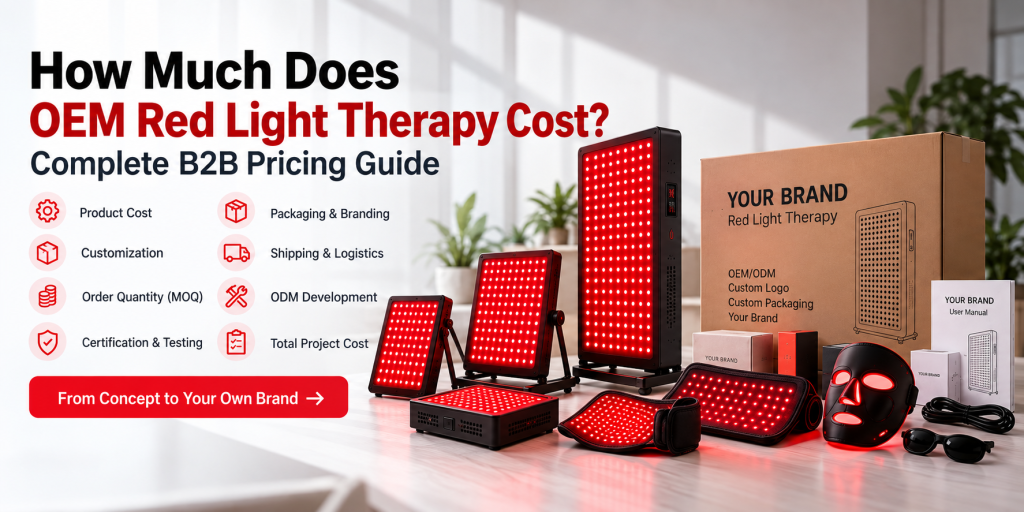
If you are planning to launch a red light therapy brand, one of the first questions you will probably ask is:
How much does OEM red light therapy cost?
The short answer is:
There is no single fixed OEM price.
The total cost of an OEM red light therapy project depends on the product type, order quantity, level of customization, wavelengths, LED configuration, packaging, accessories, testing requirements, certification requirements, shipping destination, and whether you choose OEM, private label, or a deeper ODM development project.
A simple private-label project using an existing red light therapy panel can require significantly less upfront development than creating a completely customized device.
For B2B buyers, the better question is therefore:
What determines the total cost of an OEM red light therapy project?
This guide breaks down the major cost factors so brands, distributors, clinics, wellness businesses, beauty companies, and online retailers can build a more realistic sourcing budget.
What Does OEM Red Light Therapy Mean?
OEM stands for Original Equipment Manufacturing.
In the red light therapy industry, an OEM project often starts with an existing product platform and modifies it according to a buyer’s requirements.
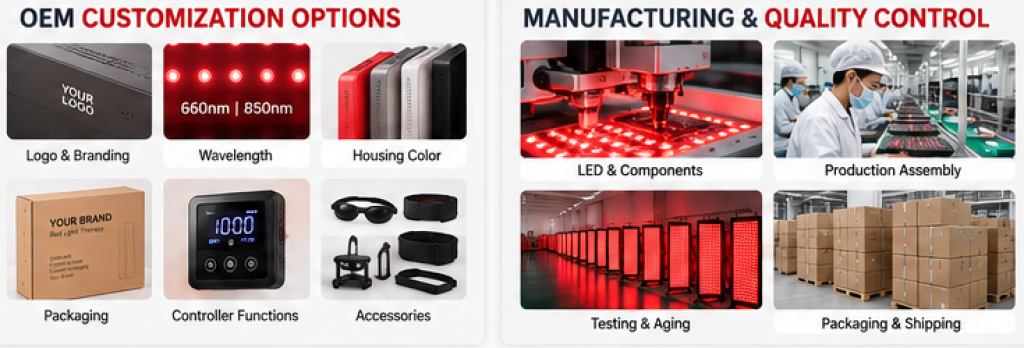
Depending on the product and manufacturer, customization may include:
- Brand logo
- Product label
- Housing color
- Custom packaging
- User manual
- Accessories
- Plug type
- Wavelength configuration
- LED configuration
- Controller functions
- Product specifications
For example, you might choose an existing professional red light therapy panel and add your own logo, packaging, manual, accessories, and selected technical options.
This approach can allow a business to launch its own branded product without developing the complete device from the ground up.
For deeper customization, an ODM project may involve changes to the product structure, dimensions, electronics, LED layout, controller, housing, cooling system, or other engineering elements.
Related:
Red Light Therapy OEM & ODM Manufacturer
How Much Does OEM Red Light Therapy Cost?
There is no universal price because every project has different requirements.
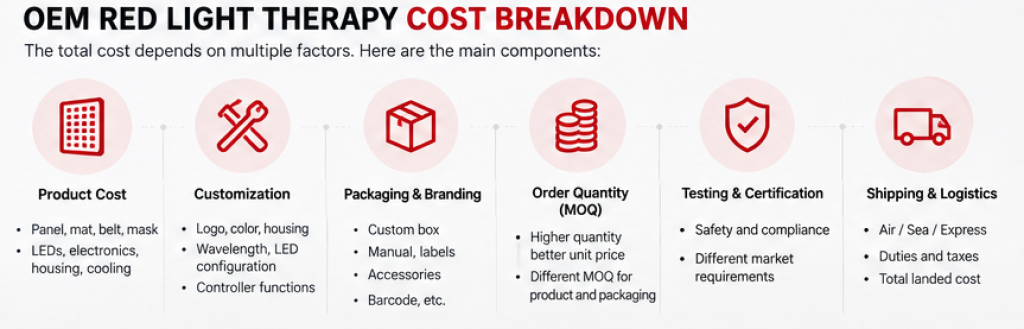
The total project cost can generally be divided into several categories:
| Cost Category | What It May Include |
|---|---|
| Product Cost | Base device and components |
| Sample Cost | Prototype or pre-production sample |
| Logo & Branding | Logo printing, labels, nameplates |
| Packaging | Custom boxes, cartons, inserts |
| Product Customization | Wavelength, LEDs, controller, housing |
| Engineering | ODM development and technical changes |
| Tooling | Molds or specialized production tooling |
| Testing | Product and performance testing |
| Certification | Market-specific testing/documentation |
| Accessories | Stands, goggles, cables, mounting systems |
| Inspection | Pre-shipment or third-party inspection |
| Freight | Air, sea, express or other shipping |
| Import Costs | Duties and taxes depending on destination |
| After-Sales | Spare parts and warranty planning |
This is why comparing only the factory’s unit price can be misleading.
The lowest quoted product price does not necessarily mean the lowest total landed cost.
1. Product Type Is the First Major Cost Factor
Different red light therapy products have very different component, manufacturing, packaging, and shipping requirements.
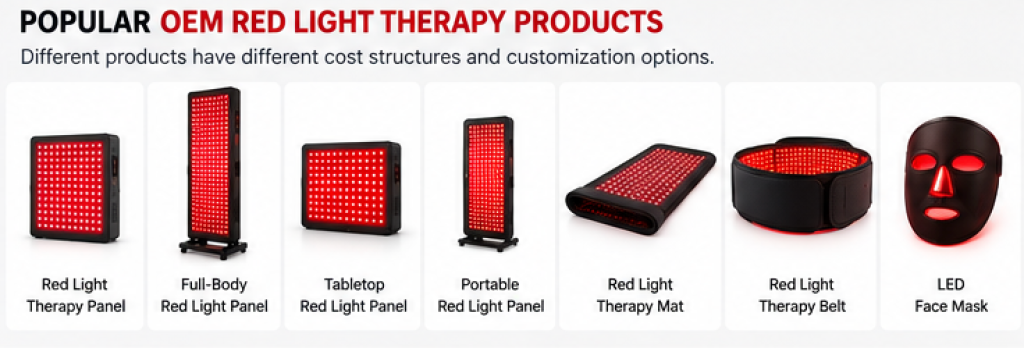
Common OEM product categories include:
- Red light therapy panels
- Full-body red light therapy panels
- Tabletop panels
- Portable panels
- Red light therapy mats
- Red light therapy belts
- Red light therapy wraps
- LED face masks
A compact targeted panel will generally have a very different cost structure from a large full-body commercial system.
US Red Light Therapy currently offers multiple panel formats ranging from compact 60W and tabletop models to 300W targeted panels, 600W professional/full-body panels, 900W large panels, and 1600W–1700W full-body systems.
Explore:
Red Light Therapy Panels
2. Order Quantity and MOQ Affect Unit Cost
MOQ stands for Minimum Order Quantity.
It is one of the most important factors affecting OEM pricing.
In general:
Higher order quantity → better ability to spread fixed customization costs across each unit.
For example, custom packaging may require its own minimum production quantity.
Logo printing, customized components, packaging materials, manuals, labels, and accessories can also have separate MOQ requirements.
This means:
Product MOQ does not always equal packaging MOQ.
A manufacturer may be able to produce a certain number of devices while the packaging supplier requires a larger quantity of printed boxes.
For buyers, it is useful to ask separately:
- What is the product MOQ?
- What is the logo MOQ?
- What is the packaging MOQ?
- What is the custom-color MOQ?
- What is the technical customization MOQ?
- Are there separate component MOQs?
US Red Light Therapy states that MOQ depends on the product model and customization level, with simple private-label projects potentially differing from fully customized ODM projects.
Read:
Private Label Red Light Therapy Guide
3. Private Label Is Usually the Lowest-Complexity Entry Point
If budget is limited, private labeling is often the simplest way to enter the market.
A typical private-label project may use an existing product and customize:
- Logo
- Product name
- Labels
- Packaging
- User manual
- Brand graphics
Because the underlying hardware already exists, there may be less engineering work than with a fully customized product.
This can reduce:
- Development complexity
- Prototype requirements
- Engineering cost
- Tooling requirements
- Development time
- Initial investment
Private label can therefore be attractive for startups and brands that want to validate market demand before investing in a more customized product.
4. Logo and Branding Costs
Logo customization is usually one of the simpler parts of an OEM project.
Depending on the product, branding may involve:
- Silk-screen printing
- Laser marking
- Labels
- Nameplates
- Printed controllers
- Branded accessories
- Product model numbers
The exact cost depends on the printing method, product material, logo size, quantity, and number of branded components.
A buyer should clearly specify where the logo needs to appear.
For example:
Device + Controller + Stand + Packaging + Manual
will involve more customization than simply adding one logo to the device.
5. Custom Packaging Can Significantly Affect the Budget
Packaging is often underestimated when calculating private-label costs.
Custom packaging can include:
- Retail box
- Shipping carton
- Foam inserts
- EVA inserts
- Product labels
- Warning labels
- User manual
- Quick-start guide
- Warranty card
- Brand graphics
- Barcodes
- Product information
Packaging costs depend heavily on:
Size + Material + Printing + Quantity + Internal Protection
Large full-body panels require much stronger and larger packaging than small tabletop devices.
Shipping protection is particularly important for larger equipment.
A beautiful retail package that does not protect the device during international transportation can create much higher costs through damaged products and returns.
6. Wavelength Customization Can Change OEM Cost
Wavelength configuration is another important technical factor.
Common red and near-infrared wavelengths may include:
- 630nm
- 660nm
- 810nm
- 830nm
- 850nm
Many professional systems use combinations such as:
660nm + 850nm
However, brands may request different wavelength combinations depending on their product positioning.
Changing the wavelength configuration can potentially affect:
- LED sourcing
- PCB configuration
- LED ratios
- Optical design
- Testing
- Inventory
- MOQ
Therefore, custom wavelength requirements should be confirmed before requesting the final quotation.
7. LED Quantity and Configuration Affect Product Cost
The number and type of LEDs can have a significant impact on manufacturing cost.
Buyers should consider:
- Number of LEDs
- LED power
- Single-chip vs multi-chip design
- Wavelength configuration
- LED layout
- Beam angle
- Optical lens
- Irradiance requirements
A higher LED count does not automatically mean a better product.
Professional buyers should evaluate the complete optical system.
This includes:
Wavelength + Irradiance + Treatment Distance + Coverage + LED Configuration
rather than simply comparing LED quantity.
8. Irradiance Requirements Can Affect Development Cost
Irradiance is commonly expressed in:
mW/cm²
If you require a specific irradiance target, the manufacturer may need to evaluate:
- LED selection
- PCB design
- Power supply
- Beam angle
- Lens
- Cooling
- LED spacing
- Housing
- Treatment distance
Higher output may also increase thermal-management requirements.
This is one reason why professional OEM projects should define performance requirements before requesting a quotation.
Do not simply ask:
“How much is a 300W red light therapy panel?”
Instead ask:
“What is the irradiance at the recommended treatment distance, wavelength configuration, coverage area, and LED configuration?”
This produces a much more useful product comparison.
9. Controller and Software Functions Affect Cost
Another major variable is the control system.
Basic products may include:
- On/off control
- Timer
- Brightness adjustment
More advanced products may include:
- Multiple intensity levels
- Pulse modes
- Independent wavelength control
- Touchscreen
- Remote control
- Preset programs
- Bluetooth
- Mobile app
- Customized UI
The more customized the electronics, firmware, interface, or software becomes, the more development resources may be required.
For brands testing the market, using an existing controller can help reduce initial development complexity.
For established brands seeking product differentiation, customized controls may be worth considering.
10. Housing and Structural Customization
Changing a logo is very different from changing the physical structure of a product.
Housing customization may involve:
- Dimensions
- Materials
- Color
- Surface finish
- Ventilation
- Handles
- Mounting points
- Stand compatibility
- Cooling structure
- Industrial design
Minor cosmetic modifications may be relatively straightforward.
A completely new housing may require:
- Industrial design
- Engineering
- Prototype development
- Tooling
- Mold development
- Structural testing
- Additional sampling
This is where a simple OEM project can begin to move toward ODM.
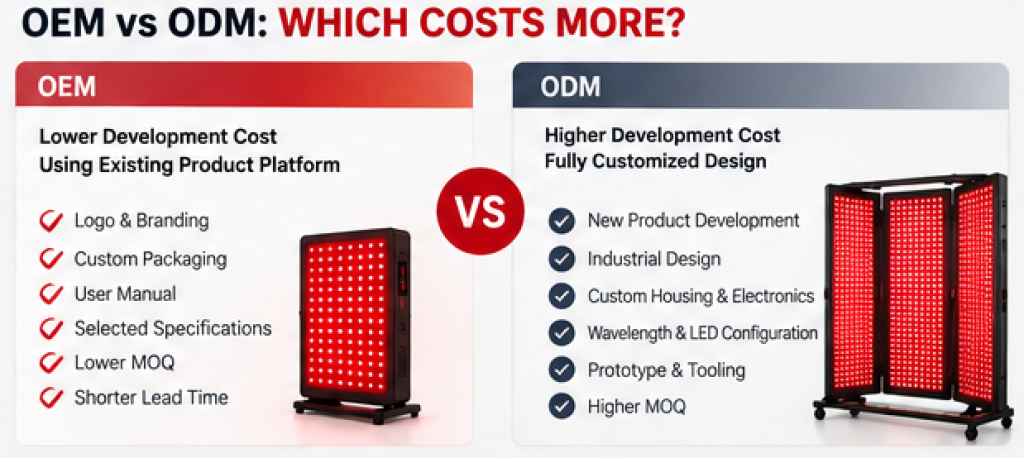
OEM vs ODM: Which Costs More?
In general, ODM requires more upfront development resources than simple OEM or private labeling.
OEM May Include:
Existing product
- Logo
- Packaging
- Manual
- Selected technical changes
ODM May Include:
New product concept
- Engineering
- Industrial design
- Electronics
- LED configuration
- Structural development
- Controller development
- Prototype
- Tooling
- Testing
- Packaging
Because of this, ODM projects may involve additional:
- Engineering fees
- Prototype costs
- Tooling costs
- Testing costs
- Longer development cycles
- Higher MOQ requirements
However, ODM can provide greater product differentiation.
The correct choice depends on your business strategy.
Read the full comparison:
Red Light Therapy OEM vs ODM
Sample Cost: Why You Should Budget for Samples
For B2B buyers, samples should be viewed as part of the sourcing process rather than an unnecessary expense.
Before mass production, a sample can help verify:
- Product appearance
- Dimensions
- Wavelength
- Irradiance
- Controls
- Accessories
- Logo
- Packaging
- Build quality
- User experience
For customized projects, multiple sample rounds may be required.
For example:
Sample 1 → Technical evaluation
Sample 2 → Branding and packaging confirmation
Final sample → Golden sample for mass production
The number of sample rounds depends on project complexity.
A simple private-label product may require much less development than a new ODM device.
Certification and Testing Costs
Another important budget category is certification and compliance.
Requirements depend on:
- Product
- Target market
- Intended use
- Electrical configuration
- Applicable regulations
- Sales channel
A product being sold in the United States may have different requirements from a product being sold in Europe or another market.
Certification should therefore be discussed before mass production, not after the products are already manufactured.
Buyers should ask:
- Which documents are available for this exact model?
- Which certifications apply to my destination market?
- Does customization affect existing testing?
- Will new testing be required?
- Who is responsible for testing costs?
Never assume that documentation for one model automatically applies to another customized product.
Shipping: The OEM Cost Buyers Often Forget
Factory price is not the same as landed cost.
A complete sourcing budget should consider logistics.
Shipping costs depend on:
- Product dimensions
- Product weight
- Packaging size
- Number of cartons
- Destination
- Shipping method
- Incoterms
Possible shipping methods include:
- Express
- Air freight
- Sea freight
Large full-body red light therapy panels can have much higher logistics costs than compact tabletop devices or belts.
This means product design can influence shipping economics.
For e-commerce brands in particular, package dimensions and weight can affect long-term fulfillment costs.
EXW, FOB, CIF and DDP: Compare Quotes Correctly
When comparing suppliers, make sure the quotations use comparable Incoterms.
For example:
EXW generally means the buyer assumes transportation responsibility from the factory.
FOB generally includes delivery to the agreed port and export handling according to the agreed terms.
CIF generally includes cost, insurance and freight to the named destination port under the applicable Incoterm.
DDP generally places more delivery-related responsibilities on the seller, subject to the agreed contract and destination requirements.
Therefore:
$200 EXW ≠ $200 DDP
Always ask suppliers to clearly state the Incoterm and named place used in the quotation.
The Real OEM Cost Formula
For budgeting purposes, think about OEM cost using this framework:
Total OEM Project Cost =
Product Cost
- Branding
- Packaging
- Development
- Samples
- Tooling
- Testing/Certification
- Inspection
- Accessories
- Freight
- Import Costs
- Warranty/Spare Parts
- Other Project-Specific Costs
Then calculate:
Estimated Landed Cost Per Unit = Total Landed Project Cost ÷ Sellable Units
This is much more useful than comparing factory unit prices alone.
Example: Basic Private Label vs Advanced OEM vs ODM
Consider three hypothetical projects.
Option A: Basic Private Label
The buyer selects an existing red light therapy panel.
Customization includes:
- Logo
- Product label
- Standard specifications
- Custom manual
- Custom packaging
This usually has the lowest development complexity.
Best For:
- Startups
- New brands
- Market testing
- E-commerce sellers
- Distributors
Option B: Advanced OEM
The buyer uses an existing product platform but changes:
- Wavelength configuration
- LED ratio
- Housing color
- Controller
- Accessories
- Packaging
- Branding
Development complexity is higher.
Best For:
- Growing brands
- Distributors
- Professional equipment companies
- Brands seeking differentiation
Option C: Custom ODM
The buyer wants a more unique device.
Development may involve:
- Custom dimensions
- New housing
- New LED layout
- Custom wavelengths
- Custom electronics
- Custom controller
- New mounting system
- Custom packaging
This typically requires the highest upfront development effort.
Best For:
- Established brands
- Large distributors
- Companies building proprietary product lines
- Businesses with clear differentiation strategies
How to Reduce OEM Red Light Therapy Costs
Reducing cost does not necessarily mean choosing the cheapest components.
A better strategy is reducing unnecessary development complexity.
1. Start With an Existing Product Platform
If you are launching your first product, an existing manufacturing platform can reduce engineering and tooling requirements.
2. Customize Branding First
Start with:
- Logo
- Packaging
- Manual
- Product labels
Then introduce deeper technical customization after validating demand.
3. Avoid Unnecessary Tooling
A completely new housing may create significant upfront development costs.
Use an existing housing when product differentiation does not require a new structure.
4. Consolidate Product Specifications
Changing specifications after sampling can increase cost and extend the development schedule.
Create a detailed specification sheet before development begins.
5. Plan Packaging Early
Do not leave packaging until the final stage.
Packaging affects branding, MOQ, protection, carton size, and shipping costs.
6. Tell the Manufacturer Your Target Market
The destination market may influence:
- Plug
- Voltage
- Label
- Manual
- Packaging
- Documentation
- Testing requirements
Providing this information early can reduce expensive changes later.
How to Request an Accurate OEM Red Light Therapy Quote
Instead of sending:
“How much is your red light therapy panel?”
send a detailed RFQ.
Include:
Product
- Product type
- Preferred model
- Dimensions
- Target application
Technical Requirements
- Wavelength
- LED configuration
- Irradiance requirements
- Power
- Controller
- Timer
- Pulse modes
Branding
- Logo
- Product color
- Label
- Model number
Packaging
- Custom box
- Manual
- Inserts
- Accessories
Commercial Information
- Target market
- Expected order quantity
- Annual forecast
- Shipping destination
- Required Incoterm
Compliance
- Required certification/testing
- Required documentation
The more complete your RFQ is, the more meaningful the quotation will be.
What Should Be Included in an OEM Quotation?
A professional quotation should make the cost structure clear.
Ask for:
| Item | Information Required |
|---|---|
| Product | Model and specifications |
| Unit Price | Price by quantity |
| MOQ | Minimum order quantity |
| Logo | Method and cost |
| Packaging | MOQ and cost |
| Sample | Sample price |
| Tooling | If applicable |
| Engineering | If applicable |
| Certification | Included or additional |
| Accessories | Included or optional |
| Lead Time | Sample and production |
| Warranty | Terms |
| Shipping | Incoterm |
| Quote Validity | Valid period |
This makes supplier comparison much easier.
Is the Cheapest OEM Supplier the Best Choice?
Usually, price should not be the only selection criterion.
A lower unit price may become expensive if the project experiences:
- High defect rates
- Inconsistent LED output
- Poor thermal management
- Packaging damage
- Production delays
- Specification changes
- Weak quality control
- Limited spare parts
- Poor after-sales support
For long-term brands, consistency between production batches can be more important than saving a small amount on the first order.
When choosing a supplier, evaluate:
Price + Quality + Manufacturing Capability + Technical Support + Consistency + Delivery + After-Sales Support
For a complete supplier evaluation framework, read our:
Red Light Therapy Panel Manufacturer Guide
How Much Budget Should a New Red Light Therapy Brand Prepare?
Instead of starting with an arbitrary budget number, build your budget backward from your business model.
Consider:
Initial Product Cost
How many units will you order?
Samples
How many models need evaluation?
Branding
Logo only or complete private-label identity?
Packaging
Standard packaging or fully customized retail packaging?
Certification
What does your target market require?
Logistics
Air or sea freight?
Marketing
Website, photography, advertising, marketplaces, and content?
Inventory
How much stock do you need for launch?
Warranty Reserve
How will replacements and after-sales service be handled?
A brand that spends its entire budget on inventory and leaves nothing for logistics, marketing, warranty, and customer acquisition may have a much harder launch.
Frequently Asked Questions About OEM Red Light Therapy Cost
How much does private label red light therapy cost?
There is no fixed price. Cost depends on the product, quantity, logo method, packaging, accessories, and customization requirements.
What is the MOQ for OEM red light therapy?
MOQ varies by product and customization level. Simple branding projects can have different minimum requirements from custom packaging or fully customized ODM projects.
Is OEM cheaper than ODM?
OEM generally requires less product development and can therefore have lower upfront development costs. ODM may require engineering, prototypes, tooling, testing, and deeper customization.
Does custom packaging increase MOQ?
It can. Packaging suppliers may have separate minimum production quantities, so packaging MOQ should be confirmed independently from device MOQ.
Can I put my own logo on a red light therapy panel?
Depending on the product and project requirements, private-label and OEM services can include logo printing, labels, manuals, packaging, and other branding elements.
Can wavelengths be customized?
Depending on the product platform, wavelength configurations may be customizable. Common options can include 630nm, 660nm, 810nm, 830nm, 850nm, and combinations.
Should I order a sample before mass production?
Yes. Sample evaluation helps confirm product quality, technical specifications, controls, branding, packaging, and accessories before a larger production run.
Why can’t a manufacturer give an OEM price immediately?
An accurate OEM quotation requires information about the product, quantity, customization, packaging, target market, technical specifications, and delivery requirements.
Final Thoughts: What Does OEM Red Light Therapy Really Cost?
There is no meaningful one-price answer to:
“How much does OEM red light therapy cost?”
The final cost depends on the complete project.
For a simple private-label project, the main costs may be:
Product + Logo + Packaging + Shipping
For an advanced OEM project:
Product + Technical Customization + Branding + Packaging + Testing + Shipping
For a full ODM project:
Engineering + Prototype + Tooling + Product + Testing + Packaging + Certification + Production + Shipping
For most buyers, the best sourcing strategy is not simply to find the lowest factory price.
It is to find the right balance between:
Product Quality + Customization + MOQ + Total Landed Cost + Market Differentiation + Long-Term Supply Stability
Get an OEM Red Light Therapy Quote
US Red Light Therapy provides OEM, ODM, private-label and wholesale manufacturing services for global brands, distributors, clinics, fitness companies, wellness businesses, beauty brands, and professional equipment suppliers.
OEM/ODM customization can include:
- Logo and branding
- Private-label packaging
- Wavelength configuration
- LED configuration
- Product color
- Housing
- Controller functions
- Accessories
- Manuals and labels
- Product development
To receive a more accurate quotation, prepare:
Product Type + Quantity + Target Market + Customization + Packaging + Technical Requirements + Delivery Destination
Then our team can evaluate whether an existing OEM platform or a deeper ODM solution is more suitable for your project.
Explore Our Red Light Therapy OEM & ODM Solutions
View Red Light Therapy Products
Post time: 10-08-26