

Developing a custom red light therapy mat involves more than adding a logo to an existing product. For wellness brands, fitness businesses, distributors, and private-label retailers, decisions about mat size, LED arrangement, wavelength configuration, controller functions, and materials can affect the finished product’s usability, performance, cost, and quality requirements.
A well-planned red light therapy mat OEM project starts with clear product specifications and a defined target market.
Should you choose a compact mat or a full-body model? How many LEDs do you need? Is a 660nm and 850nm combination suitable? Which timer, intensity, and pulse options should your controller include?
This guide explains the major OEM and ODM customization options for red light therapy mats and how to prepare a practical specification for sampling, production, and wholesale purchasing.
What Can You Customize in a Red Light Therapy Mat OEM Project?
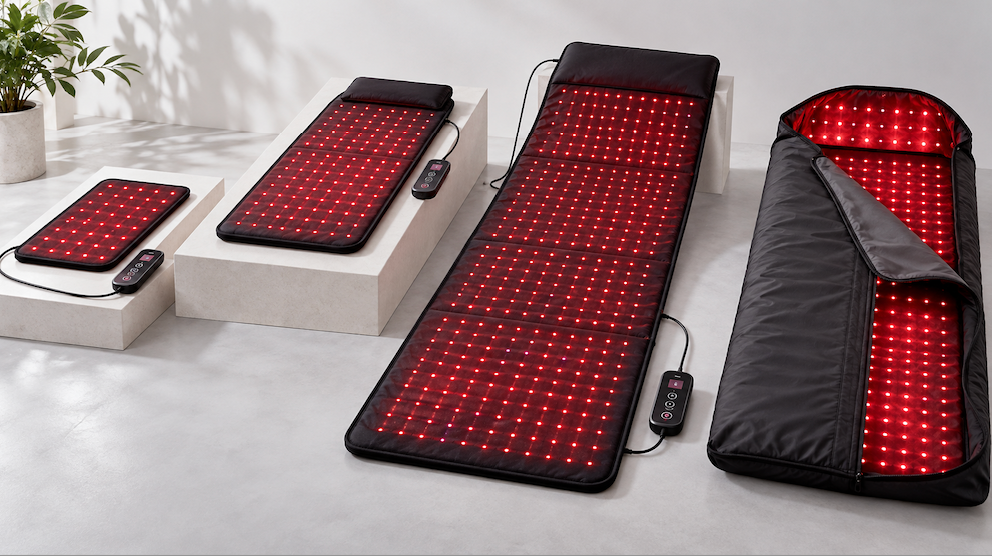
Red light therapy mats are flexible products that incorporate red and/or near-infrared LED light sources into a textile or similar flexible structure.
Depending on the product platform and engineering requirements, OEM customization may include:
- Mat dimensions and shape
- LED quantity, density, and layout
- Red and near-infrared wavelength combinations
- LED zoning and circuit configuration
- Irradiance and optical performance targets
- Controller design and operating functions
- Timer and intensity settings
- Pulse modes
- Exterior fabrics and materials
- Product color and branding
- Power adapters and connectors
- Packaging, manuals, and accessories
Not every existing product supports every modification. Changes to electronics, materials, structure, or optical performance may require additional design work, testing, and approval.
For businesses comparing standard customization with deeper product development, explore our Red Light Therapy OEM & ODM Services.
1. Custom Red Light Therapy Mat Sizes: How to Choose the Right Format
One of the first decisions in a custom red light therapy mat project is the product size.
Dimensions influence the illuminated coverage area, user positioning, LED requirements, folded dimensions, product weight, and shipping cost.
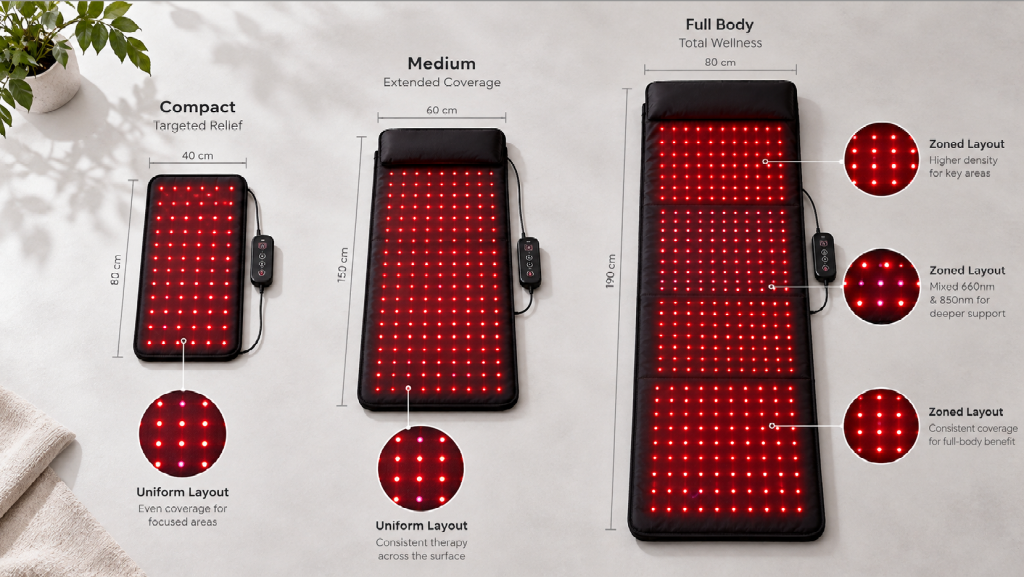
Compact and Targeted Red Light Therapy Mats
Compact mats are designed around smaller coverage areas.
Potential product concepts include mats intended for localized positioning, small wellness spaces, or portable consumer product lines.
They may be suitable for brands prioritizing:
- Compact storage
- Easier transportation
- Smaller retail packaging
- Simpler operating functions
- Lower initial product complexity
However, smaller products still require appropriate electrical, optical, material, and safety evaluation.
Medium-Sized Red Light Therapy Mats
Medium formats may appeal to wellness and fitness brands seeking a balance between coverage and portability.
These products can be designed around a wider treatment surface while remaining manageable for storage and shipping.
Buyers should consider the user’s intended position, product stability, cable placement, cleaning requirements, and the actual illuminated area.
Full-Body Red Light Therapy Mats
A full-body red light therapy mat is designed for larger-area light exposure.
Full-body products generally require more careful planning around:
- Total mat length and width
- LED placement and edge margins
- Structural flexibility
- Power distribution
- Connector placement
- Temperature management
- Controller operation
- Storage and folding methods
A larger mat does not automatically deliver higher irradiance or better clinical outcomes.
Example: Full-Body Product Dimensions
Our website currently lists the IRWS-022M full-body red light therapy sleeping bag with the following published specifications:
| Parameter | Published Specification |
|---|---|
| Product model | IRWS-022M |
| Dimensions | 180 × 80 cm |
| Wavelengths | 660nm red + 850nm near-infrared |
| LED quantity | 2,520 LEDs |
| Rated power | 255W |
| Timer | 10–90 minutes |
| Intensity | Five levels |
| Operating modes | Continuous and selectable pulse modes |
These are specifications for a listed product, not universal values for all custom mats. Buyers should confirm the current revision, technical documentation, and available customization options before ordering.
View the Full-Body Red Light Therapy Sleeping Bag.
What Size Should Your Brand Choose?
| Product Format | Main Design Priority | Potential Buyer |
|---|---|---|
| Compact mat | Portability and smaller coverage | E-commerce wellness brands |
| Medium mat | Balance of coverage and storage | Fitness and lifestyle brands |
| Full-body mat | Larger illuminated area | Wellness retailers and commercial buyers |
| Sleeping bag format | Enclosed flexible design | Spas and wellness businesses |
| Custom-shaped mat | Specific positioning or application | ODM product developers |
The final choice should reflect customer requirements, product dimensions, electrical design, and manufacturing feasibility.
2. Custom LED Layouts: Quantity, Density, and Coverage
LED layout is a major part of red light therapy mat design.
Two mats with identical dimensions can perform differently if their LED arrangement, drive current, wavelength mix, optical distribution, or material construction varies.
What Does LED Density Mean?
LED density describes how many LED packages or emitters are arranged within a defined area.
It may be expressed as LEDs per square centimeter or another stated area unit.
A higher LED count does not automatically mean higher measured irradiance.
LED output depends on the complete optical and electrical design.
For OEM buyers, it is useful to compare both the LED arrangement and measured optical performance.
Common LED Layout Approaches
Uniform LED Grid
LEDs are arranged at relatively consistent intervals across a defined surface.
This layout may be useful when the design goal is relatively even optical coverage.
Zoned LED Layout
LEDs are arranged into separate zones that may be controlled independently.
Zoning can support selected operating functions, but it requires suitable circuitry, controller logic, and additional testing.
Mixed-Wavelength Layout
Red and near-infrared emitters are distributed across the mat.
For example, a design may combine nominal 660nm red LEDs with nominal 850nm near-infrared LEDs.
The arrangement should be evaluated to understand the resulting optical output and spatial distribution.
Custom-Shaped LED Layout
A more specialized product may require LED positioning around seams, connectors, structural supports, or areas that must remain flexible.
Such changes should be reviewed during the engineering and sampling stages.
What Should an OEM LED Layout Drawing Include?
Before approving production, buyers should request:
- Overall mat dimensions
- Active illuminated area
- LED quantity and package specification
- LED pitch or spacing
- Wavelength distribution
- Electrical zone configuration
- Circuit and connector locations
- Areas without LEDs
- Approved optical measurement points
- Mechanical bending and handling requirements
A complete design drawing can help reduce misunderstandings before manufacturing begins.
Why Measurement Matters More Than LED Count Alone
When evaluating the optical performance of a red light therapy mat, buyers should consider:
- Irradiance at the intended measurement surface
- Spectral output
- Spatial consistency
- Operating mode
- Measurement equipment
- Test conditions
- Temperature behavior
An LED quantity claim is useful, but it is not a replacement for an appropriate optical test report.
Scientific reporting literature emphasizes the importance of accurately documenting wavelength, irradiance, illuminated area, and operating conditions to make photobiomodulation parameters more reproducible.
Industry research: Proposed Guidelines for Reporting Parameters and Procedures of High- and Low-Level Laser Therapy in Medical Research Articles (2025).
These are proposed reporting guidelines, not a clinical validation of any particular mat or LED layout.
3. Choosing Wavelengths for a Red Light Therapy Mat
Wavelength configuration is another important consideration in a red light therapy mat OEM project.
Many commercial products use visible red and near-infrared LEDs.
Common nominal configurations include:
- 660nm red light
- 850nm near-infrared light
- Combined 660nm + 850nm
- Other wavelength combinations subject to engineering evaluation
660nm Red Light
660nm is within the visible red portion of the optical spectrum.
It is frequently used in commercial photobiomodulation equipment.
However, the presence of 660nm LEDs does not establish that a particular product can deliver a specific clinical outcome.
850nm Near-Infrared Light
850nm is within the near-infrared spectrum and is commonly included in flexible LED therapy products.
Near-infrared light is not reliably assessed by visual brightness.
Therefore, manufacturers should verify the spectral output using equipment appropriate for the relevant wavelengths.
Dual-Wavelength Configurations
A 660nm + 850nm combination allows a product to deliver light in two spectral regions.
Depending on the electrical and controller design, possible operating modes may include:
- Red only
- Near-infrared only
- Both wavelengths simultaneously
These functions must be supported by the hardware and verified during testing.
What Should Buyers Confirm?
Ask for:
- Nominal peak wavelengths
- Approved wavelength tolerances
- LED component specifications
- Red-to-NIR emitter distribution
- Available wavelength-selection modes
- Spectral measurement results
Wavelength selection should be based on the intended application, technical requirements, and applicable evidence rather than assuming one configuration is universally superior.
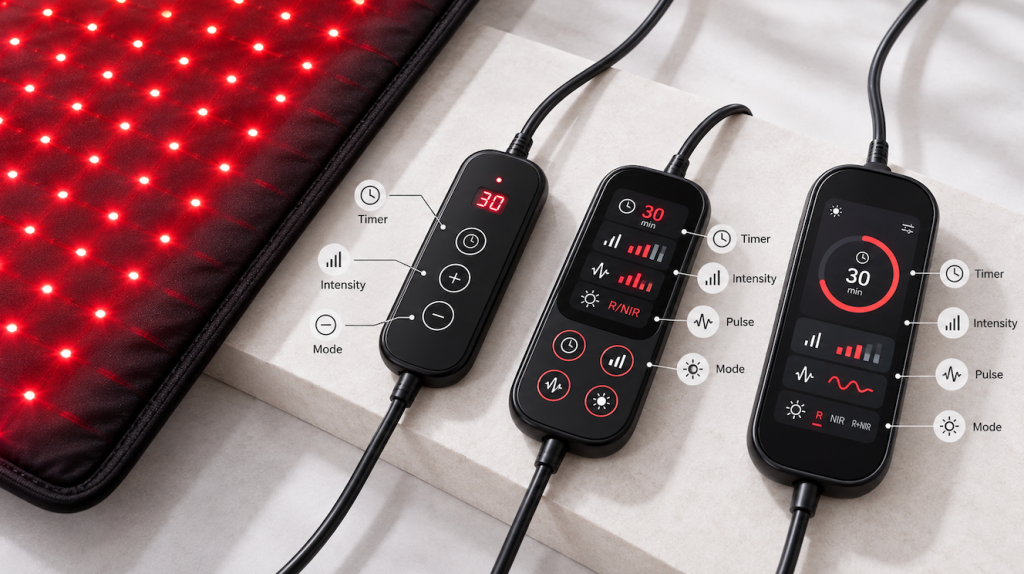
4. Red Light Therapy Mat Controller Options
The controller is one of the most visible and frequently used parts of a red light therapy mat.
For private-label brands, it affects the customer experience, operating convenience, and product differentiation.
Timer Functions
A controller may offer fixed or adjustable operating durations.
Possible OEM options include:
- Preset timer buttons
- Adjustable session duration
- Countdown display
- Automatic shutoff
- Timer memory functions
The appropriate operating range should be determined through product design and safety evaluation.
Timer availability does not establish a medically recommended treatment duration.
Adjustable Intensity Levels
Some red light therapy mat controllers offer multiple output levels.
For example, a five-level controller may allow users to select from P1 to P5.
However, an intensity setting should not be interpreted as a specific optical dose without actual measurement data.
Buyers should confirm how output changes between levels and whether the settings are repeatable.
Red and Near-Infrared Mode Selection
For a dual-wavelength product, buyers may request independent controls for the red and NIR channels.
This can support different product operating configurations.
Pulse and Continuous Modes
Some red light therapy mats offer:
- Continuous output
- 10Hz pulse setting
- 40Hz pulse setting
- Other pulse configurations
Whether these options can be offered depends on the controller and electrical platform.
Pulse frequency alone does not establish clinical effectiveness.
For pulsed operation, technical documentation should identify relevant pulse parameters, such as duty cycle and how average irradiance is measured.
Smart Controllers and Custom Interfaces
More advanced ODM projects may explore:
- Digital displays
- Custom button layouts
- Brand-specific startup screens
- Multilingual user interfaces
- Program memory
- Wired or wireless control
These features may increase engineering, validation, and production costs.
Availability must be confirmed for the actual product platform.
OEM Controller Comparison
| Controller Feature | Basic OEM Option | Advanced ODM Option |
|---|---|---|
| On/off | Standard | Standard |
| Timer | Preset durations | More flexible programming |
| Intensity | Fixed or adjustable levels | Customized control logic |
| Wavelength selection | Model-dependent | Custom channel control |
| Pulse mode | Available on selected models | Customizable within design limits |
| Display | Simple display or indicators | Custom interface |
| Branding | Printed logo or label | Custom housing and UI |
| Engineering complexity | Usually lower | Usually higher |
For a new brand, a reliable controller with easy-to-understand functions may be more practical than a complicated interface with numerous features.
5. Materials and Flexible Mat Construction
A red light therapy mat combines electronic components with materials that may come into direct or indirect contact with the user’s body.
This makes material selection an important part of OEM development.
Exterior Fabric and Surface Materials
Potential customization areas include:
- Fabric appearance and texture
- Outer color
- Protective layers
- Stitching
- Edge finishing
- Removable covers, where supported
- Carrying and storage accessories
Materials should be selected according to the product’s intended environment and cleaning requirements.
A material should not be marketed as medical-grade, hypoallergenic, waterproof, or antimicrobial without suitable supporting evidence.
Flexibility and Durability
Flexible electronic products must be designed around appropriate mechanical limits.
Buyers should discuss:
- Allowable bending radius
- Folded storage dimensions
- Connector strain relief
- Cable routing
- Seam durability
- LED circuit protection
- Cleaning limitations
- Durability testing conditions
The product should not be folded, washed, or handled in a way that has not been validated for its design.
Skin-Contact Material Considerations
If a product is marketed for direct skin contact, buyers should review the material characteristics and applicable safety requirements.
For medical devices, the ISO 10993 series provides a framework for biological evaluation of relevant patient-contacting materials.
Whether the standard applies depends on the product’s regulatory status, material contact type, and intended use.
Industry reference: ISO 10993-1:2025 — Biological Evaluation of Medical Devices.
This does not mean every consumer wellness mat must undergo the same biological testing as a medical device.
6. Electrical, Optical, and Thermal Safety Requirements
Customizing a mat’s LED count, size, or controller can affect the electrical and thermal design.
Safety should be evaluated as part of product development rather than added at the end.
Electrical Safety
Relevant considerations may include:
- Approved input voltage and power supply
- Electrical insulation
- Wiring and connector integrity
- Protection against abnormal conditions
- Power adapter compatibility
- Temperature-related safeguards
- Appropriate instructions and warnings
The applicable testing and acceptance criteria depend on the product design, intended use, and destination market.
Photobiological Safety
LED systems emit optical radiation, and safety evaluation may need to consider the emitted spectrum, exposure conditions, and intended use.
Industry standard: IEC 62471 — Photobiological Safety of Lamps and Lamp Systems.
IEC 62471 describes methods and criteria for evaluating specified photobiological hazards from relevant non-laser optical sources, including LEDs.
Home Light Therapy Equipment
When a product is classified as medical electrical home light therapy equipment, additional product-specific requirements may apply.
Industry standard: IEC 60601-2-83 — Home Light Therapy Equipment.
The applicability of this standard must be assessed for the specific device. It should not be treated as a universal certification requirement for every wellness mat.
Thermal Performance
For flexible mats, buyers should verify operating temperatures under defined conditions.
A larger LED array or different operating mode may affect thermal behavior.
Testing should include relevant scenarios based on the approved product design and applicable safety requirements.
7. Private Label Red Light Therapy Mat Branding and Packaging
For a wellness or fitness brand, product appearance and packaging are important parts of the customer experience.
Private label customization may include:
- Custom printed logo
- Brand-specific product name
- Mat color and appearance
- Branded controller
- Retail packaging
- User manual
- Warning labels
- Product identification
- Carrying bag
- Accessories
OEM Branding vs Full ODM Development
A private-label project using an existing approved product platform may involve fewer engineering changes than a fully customized product.
For example:
Basic Private Label Project
Existing mat design + custom logo + branded packaging + user manual
Advanced OEM/ODM Project
Custom dimensions + revised LED layout + custom controller + material selection + branded packaging
The second option may require additional engineering, validation, testing, and tooling.
For businesses developing a new product brand, read our Private Label Red Light Therapy Guide.
8. How Much Does Custom Red Light Therapy Mat OEM Cost?
There is no universal price for custom red light therapy mats.
Pricing depends on the specific configuration and commercial agreement.
Main Cost Factors
| Cost Factor | Why It Matters |
|---|---|
| Mat dimensions | Affects materials, construction, and packaging |
| LED quantity | Influences component and assembly requirements |
| Wavelength configuration | Influences component selection and validation |
| LED layout | May require circuit design changes |
| Controller | Additional functions may increase development complexity |
| Exterior materials | Different materials have different sourcing and processing costs |
| Logo customization | May involve printing setup and material costs |
| Packaging | Custom cartons, inserts, and manuals add cost |
| Testing | Depends on technical and market requirements |
| Order quantity | Affects production planning and unit cost |
| Shipping destination | Affects packing, freight and import arrangements |
What Is the MOQ for Red Light Therapy Mat OEM?
MOQ depends on:
- Existing product platform
- Available components
- Logo and packaging requirements
- Custom electronics
- Material sourcing
- Development and tooling requirements
There is no reliable industry-wide MOQ that applies to every red light therapy mat.
Buyers should request separate quotations for standard private-label products and more customized configurations.
For more information, read our Red Light Therapy MOQ Guide.
9. Red Light Therapy Mat OEM Development Process
A structured development process helps brands clarify their requirements before committing to a larger order.
Step 1: Define Your Target Market
Decide whether the product is intended for:
- Home wellness brands
- Fitness and sports recovery retailers
- Spas and wellness centers
- E-commerce brands
- Equipment distributors
- Professional facilities
The intended use may affect design decisions, marketing claims, and regulatory requirements.
Step 2: Choose the Mat Format
Define the preferred:
- Length and width
- Flexible mat or sleeping bag structure
- Storage requirements
- Illuminated area
- Material characteristics
Step 3: Confirm LED Specifications
Discuss:
- Wavelength configuration
- LED quantity and layout
- Electrical requirements
- Optical output targets
- Relevant measurement conditions
Step 4: Select Controller Functions
Define the required timer, intensity, wavelength-selection, and other operating functions.
Step 5: Approve Branding and Packaging
Provide the logo artwork, packaging requirements, user manual language, and other specifications.
Step 6: Develop and Evaluate a Sample
Before approving production, evaluate the sample against the agreed requirements.
This may include:
- Dimensions and appearance
- LED functionality
- Optical output
- Controller behavior
- Electrical and thermal performance
- Material quality
- Mechanical durability
- Labels and packaging
Step 7: Confirm the Production Specification
Once the sample is approved, prepare a controlled specification that documents the accepted components, construction, functions, and quality criteria.
Step 8: Production and Pre-Shipment Quality Control
Inspect production according to an agreed quality plan and resolve nonconformities before shipment.
Our Red Light Therapy OEM Quality Control Checklist explains additional inspection considerations for bulk buyers.
10. How to Select a Red Light Therapy Mat OEM Partner
Selecting a suitable sourcing and manufacturing partner involves more than comparing unit prices.
A reliable partner should be able to explain the available product platform, manufacturing responsibilities, testing requirements, and customization limitations.
Questions to Ask Before Ordering
- Which mat dimensions are available?
- Can the LED layout or density be changed?
- Which wavelengths are supported?
- Can the red and near-infrared channels operate independently?
- What controller options are available?
- Can the materials or exterior design be customized?
- What is the MOQ for each customization level?
- Is sample development required?
- What testing records can be provided?
- Who performs manufacturing and quality inspection?
- What is the process for engineering changes?
- What warranty and after-sales support are available?
For larger procurement projects, buyers may also consider independent product inspection.
Verify Technical and Regulatory Claims
Before using a customized product in a particular market, confirm the regulatory status and evidence supporting the intended claims.
For U.S. buyers, the FDA provides guidance on the distinction between certain general wellness products and medical devices.
Regulatory reference: FDA — General Wellness: Policy for Low Risk Devices.
For health-related advertising, the U.S. Federal Trade Commission also requires objective claims to be adequately supported by reliable evidence.
Industry reference: FTC — Health Products Compliance Guidance.
For EU markets, electrical and electronic equipment may also be subject to requirements such as the European Commission’s RoHS Directive.
A product’s compliance status should be verified for the exact model, intended use, and market rather than inferred from a generic certificate or supplier statement.
11. Custom Red Light Therapy Mat OEM Specification Checklist
Before requesting a quotation, buyers can use the following checklist.
| Specification | Buyer Requirement |
|---|---|
| Product type | Flexible mat / Full-body mat / Sleeping bag |
| Target market | Country or region |
| Intended use | Home wellness / Commercial / Other |
| Product dimensions | Length × width |
| Active light area | Defined coverage dimensions |
| LED quantity | Preferred range or target |
| LED layout | Uniform / Zoned / Custom |
| Wavelength | 660nm / 850nm / Other |
| Optical output | Target and measurement method |
| Controller | Basic / Digital / Customized |
| Timer | Required settings |
| Intensity | Required number of levels |
| Pulse mode | Yes / No / Specific requirements |
| Power supply | Destination-market requirements |
| Materials | Preferred surface and construction |
| Branding | Logo / Color / Labels |
| Packaging | Standard / Custom retail box |
| Documentation | Manuals, testing and compliance evidence |
| Sample quantity | Required number |
| Bulk quantity | Estimated order quantity |
| Inspection plan | Required acceptance criteria |
| Delivery destination | Country and delivery terms |
A completed specification helps the supplier determine feasibility and provide a more meaningful quotation.
Frequently Asked Questions About Red Light Therapy Mat OEM
Can I Customize the Size of a Red Light Therapy Mat?
Yes, size customization may be possible depending on the product platform and development requirements. Changes to dimensions may also require revisions to the LED layout, structure, power distribution, and packaging.
What Is a Custom Red Light Therapy Mat?
A custom red light therapy mat is a flexible red and/or near-infrared LED product developed or modified according to specific buyer requirements. Customization can include dimensions, LED arrangement, wavelengths, controls, materials, and branding.
Can I Customize the Number of LEDs?
LED quantity and arrangement can be customized on suitable projects, subject to electrical, optical, structural, and manufacturing feasibility.
Which Wavelengths Are Commonly Used in Red Light Therapy Mats?
660nm red light and 850nm near-infrared light are common configurations. Other wavelengths may be considered according to the product’s intended use and technical design.
Can a Red Light Therapy Mat Have Adjustable Intensity?
Yes. Some product platforms support multiple intensity settings. Buyers should confirm how the settings affect measured optical output.
Can I Add My Logo to a Red Light Therapy Mat?
Private-label projects may include custom logos, labels, packaging, manuals, and selected appearance modifications.
What Is the MOQ for a Custom Red Light Therapy Mat?
MOQ depends on the selected model, component sourcing, branding requirements, and extent of customization. The exact requirement should be confirmed with the supplier.
Is a Full-Body Red Light Therapy Mat Better Than a Smaller Mat?
Not necessarily. The appropriate size depends on coverage requirements, user positioning, storage, operating environment, and commercial goals. Larger size alone does not establish superior treatment effectiveness.
Do Custom Red Light Therapy Mats Require Testing?
Yes. The type and extent of testing should reflect the product’s design, intended use, electrical and optical characteristics, materials, and applicable market requirements.
Can I Request Samples Before Bulk Production?
Yes. Sample evaluation is an important step before approving a custom product for mass production. Buyers should establish written acceptance criteria before evaluating the sample.
Conclusion: Build a Custom Red Light Therapy Mat That Fits Your Brand
A successful custom red light therapy mat project begins with choosing the right product format and defining measurable requirements.
For B2B buyers, the most important decisions usually involve:
- Mat size and illuminated coverage
- LED quantity, arrangement, and wavelengths
- Controller functions and operating modes
- Materials, durability, and power design
- Branding and private-label packaging
- Testing, documentation, and quality control
- MOQ, sampling, and production requirements
Rather than choosing a mat only because it has a higher LED count or more controller features, buyers should evaluate how the entire product configuration meets their commercial and technical needs.
A well-documented red light therapy mat OEM specification also makes it easier to compare suppliers, approve samples, and maintain product consistency across repeat orders.
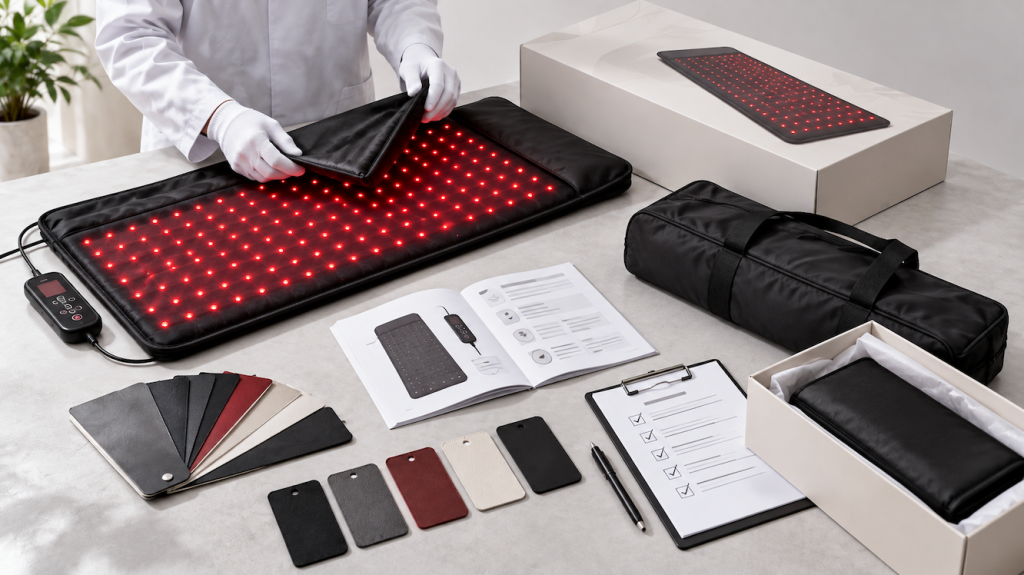
Start Your Custom Red Light Therapy Mat OEM Project
US Red Light Therapy supports B2B sourcing, OEM/ODM customization, private labeling, and wholesale purchasing for red and near-infrared light therapy products.
Whether you are developing a compact wellness mat, sourcing a full-body red light therapy mat, or planning a branded product line, our team can discuss available product options and customization requirements.
Tell us about your project:
- Preferred mat size
- LED count and wavelength requirements
- Controller functions
- Branding and packaging needs
- Target country
- Estimated order quantity
- Sample and inspection requirements
We can help you review available product configurations and discuss an appropriate sourcing or customization approach.
Explore Red Light Therapy Mat Products
Explore Red Light Therapy OEM & ODM Services
Contact Us for a Custom Red Light Therapy Mat Quote
US Red Light Therapy — Red and Near-Infrared Light Therapy OEM/ODM Solutions for Global Brands and Businesses.
Post time: 10-28-26