


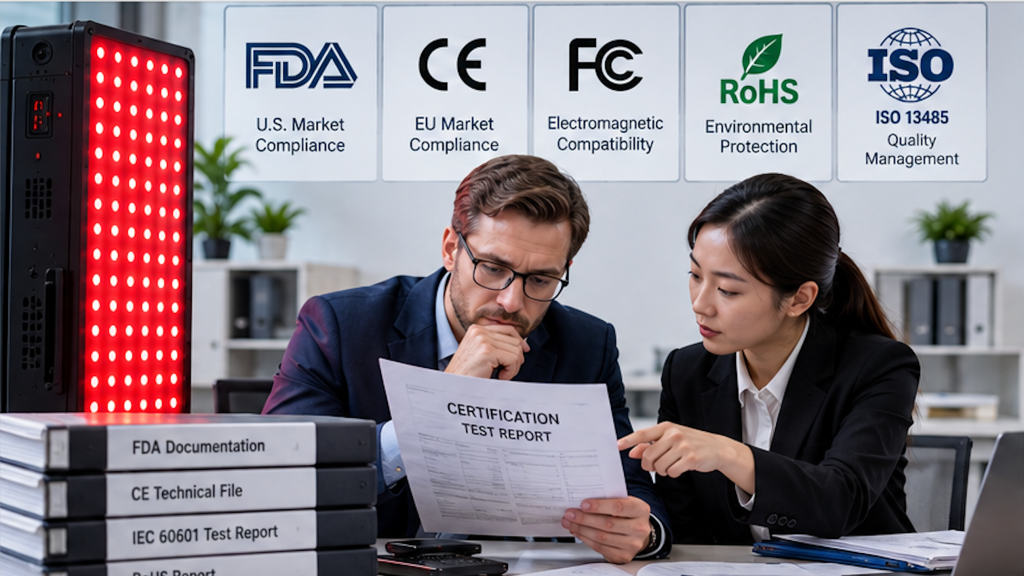
Buying red light therapy devices in bulk involves more than comparing prices, wavelengths, irradiance, and minimum order quantities.
For importers, distributors, clinics, wellness brands, and private-label businesses, verifying red light therapy device certifications is an essential part of supplier due diligence.
A manufacturer may advertise FDA, CE, FCC, RoHS, IEC, or ISO credentials. However, these terms represent different regulatory requirements, standards, testing processes, and quality management systems.
A certificate displayed on a supplier’s website does not automatically prove that every product model is compliant with the requirements of your destination market.
Before placing a wholesale or OEM/ODM order, buyers should verify the exact product model, manufacturer, test report, applicable standards, and regulatory status.
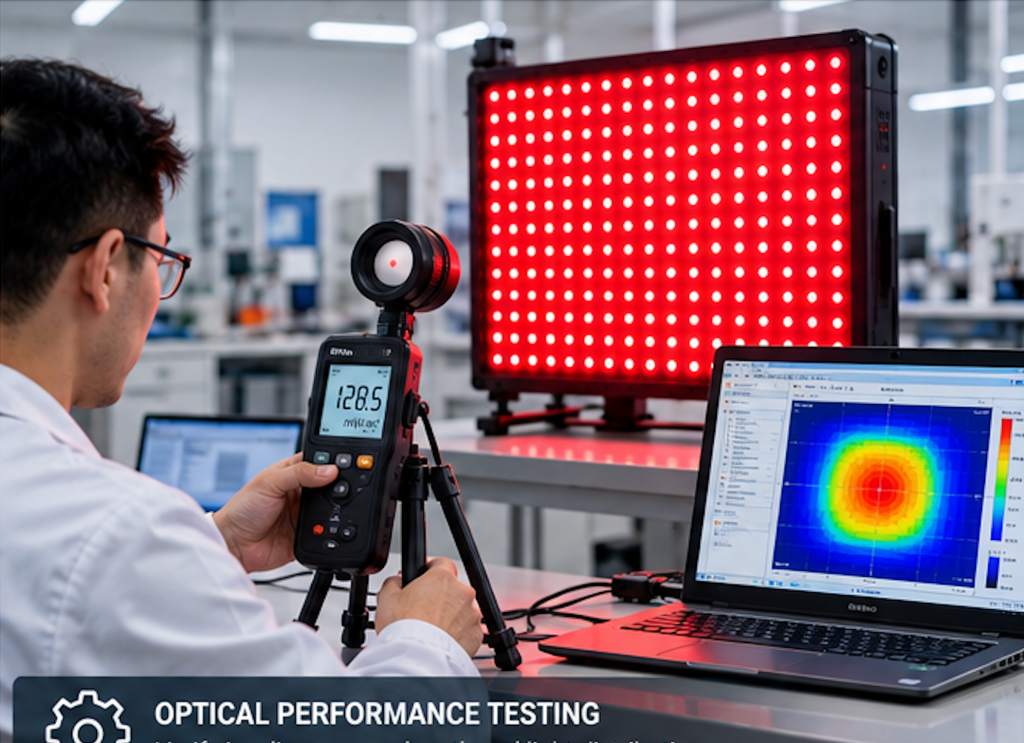
This guide explains how to check red light therapy equipment documentation, identify suspicious certificates, and reduce compliance risks before mass production.
If you are comparing suppliers, start with our How to Choose a Red Light Therapy Manufacturer guide.
Why Certification Verification Matters Before Bulk Ordering
Red light therapy equipment may be marketed for general wellness, cosmetic applications, or medical purposes.
These intended uses can lead to different regulatory requirements.
For example, a device marketed for general wellness may have a different regulatory pathway from one promoted for treating a diagnosed medical condition.
Requirements also vary by country.
A product intended for the United States may need different documentation from a product intended for the European Union.
What Can Happen If Certifications Are Incorrect?
Insufficient documentation may result in:
- Import or customs delays
- Regulatory investigations
- Product relabeling
- Additional testing costs
- Shipment rejection
- Product recalls
- Marketplace listing problems
- Contract disputes
- Financial losses
- Damage to brand reputation
Certification verification should therefore take place before the buyer approves mass production, not after the goods are ready to ship.
What Certifications and Compliance Documents Should Red Light Therapy Buyers Check?
There is no universal certification package that applies to every red light therapy device.
The correct requirements depend on the product’s intended use, technical design, claims, classification, and destination market.
Red Light Therapy Certification Comparison Table
| Document or Requirement | Primary Purpose | Important Buyer Consideration |
|---|---|---|
| FDA registration and listing | U.S. establishment and device listing requirements, where applicable | Registration does not mean FDA clearance or approval |
| FDA 510(k) clearance | U.S. premarket clearance for devices requiring this pathway | Verify the exact device and cleared intended use |
| CE marking | Conformity with applicable EU legislation | Verify the correct conformity assessment route |
| EU MDR documentation | Medical-device regulatory requirements in the EU | Applies where the product qualifies as a medical device |
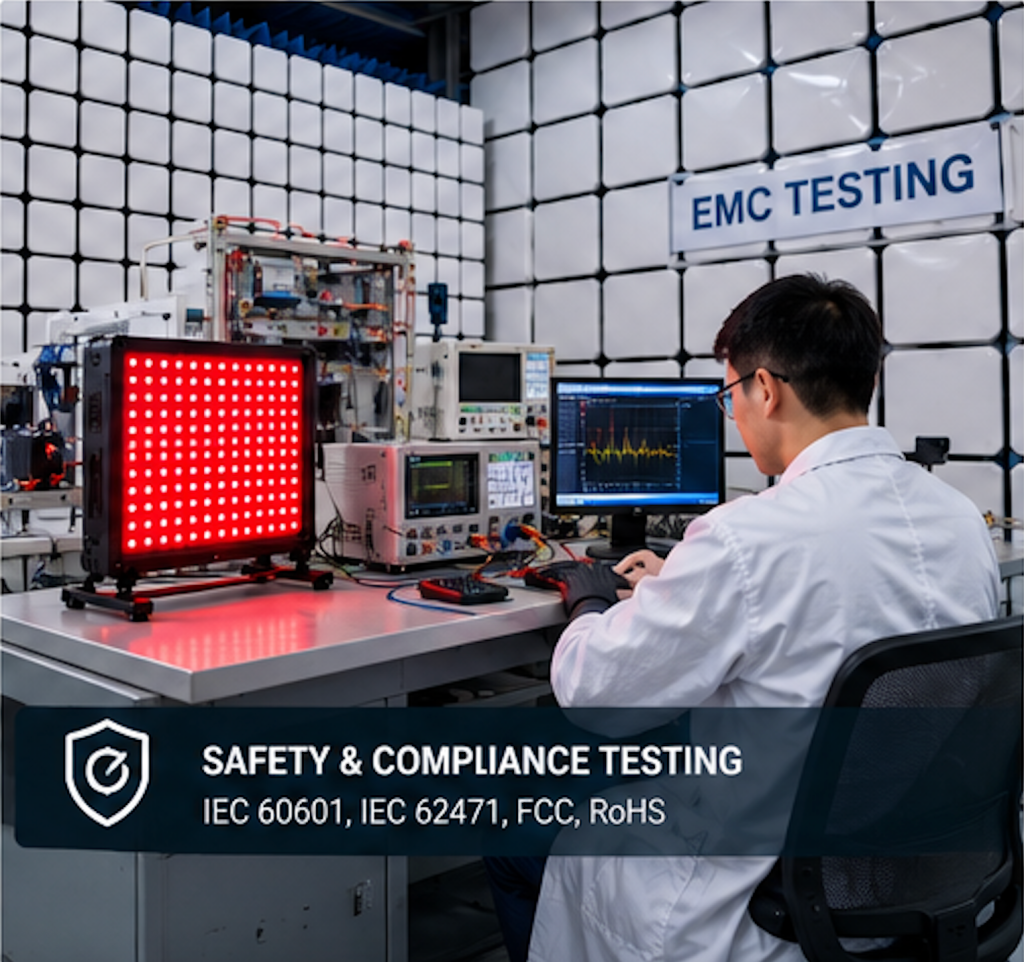
| FCC compliance | Applicable U.S. radiofrequency and electromagnetic requirements | Not every product requires an FCC ID |
| RoHS documentation | Restrictions on certain hazardous substances in applicable electrical products | Verify material and product scope |
| IEC 60601 series | Safety and essential-performance standards for applicable medical electrical equipment | A test report is not automatically regulatory authorization |
| IEC 62471 | Photobiological safety assessment for lamps and lamp systems | Relevance depends on device design and applicable requirements |
| ISO 13485 | Quality management system for medical-device organizations | A company-level certification, not product approval |
| ISO/IEC 17025 | Competence of testing and calibration laboratories | Check laboratory accreditation and scope |
Buyers should not assume that every item in this table is mandatory for every product.
The first step is to determine which requirements actually apply.
Step 1: Determine the Device’s Intended Use and Target Market
Before requesting certificates, define what the product is and how it will be marketed.
Ask:
- Is the device intended for general wellness, cosmetic use, or a medical purpose?
- What claims will appear on the website, packaging, and instructions?
- Is the product intended for home or professional use?
- Which countries will receive the product?
- Does the device include wireless connectivity?
- Is the design an existing model or a customized OEM/ODM product?
These answers influence the regulatory pathway.
Why Marketing Claims Matter
A red light therapy panel advertised for general relaxation may be evaluated differently from a device marketed to treat a specific disease.
Changing the marketing claims can change the regulatory assessment, even when the physical hardware is similar.
A supplier’s statement that a product is “FDA certified” or “medical grade” should never replace an actual regulatory review.
For broader product selection considerations, read our Red Light Therapy Panel Manufacturer Guide.
Step 2: How to Verify FDA Claims for Red Light Therapy Devices
FDA terminology is one of the most frequently misunderstood areas in medical-device sourcing.
There are important differences between:
- FDA establishment registration
- FDA device listing
- FDA 510(k) clearance
- FDA De Novo authorization
- FDA premarket approval (PMA)
These are not interchangeable.
FDA Registered vs FDA Cleared vs FDA Approved
FDA registered generally refers to an establishment’s registration status.
FDA listed refers to device listing information submitted under applicable requirements.
FDA cleared typically refers to a device receiving clearance through the 510(k) process.
FDA approved generally refers to an applicable approval pathway, such as PMA.
The FDA explicitly explains that registration and listing do not establish clearance or approval.
Read the official FDA explanation:
FDA: Are There FDA Registered or FDA Certified Medical Devices?
How to Check FDA Registration and Listing
Use the official FDA Establishment Registration & Device Listing Database.
Search by available identifiers, such as:
- Manufacturer name
- Establishment name
- Device name
- Registration number
- Product code
Compare the database record with the supplier’s documents.
Remember that registration does not establish that FDA has reviewed the device’s safety or effectiveness.
How to Verify FDA 510(k) Clearance
If a supplier claims FDA 510(k) clearance, request the K-number.
Then use the official FDA 510(k) Database.
Check:
- 510(k) number
- Applicant
- Device name
- Product code
- Decision
- Cleared indications for use
- Relevant device description
A 510(k) clearance associated with one device should not automatically be assumed to cover a different product or a materially modified OEM model.
FDA Verification Red Flags
Be cautious if a supplier:
- Claims “FDA certified” without explaining the regulatory status
- Provides only a commercial registration certificate
- Cannot identify the applicable device listing or authorization
- Uses another company’s 510(k) without explaining the legal and technical relationship
- Makes treatment claims that do not match the applicable authorization
Not every device requires 510(k) clearance. Buyers must first determine the correct classification and regulatory pathway.
Step 3: How to Verify CE Marking for Red Light Therapy Equipment
CE marking indicates that a manufacturer declares a product conforms to applicable EU requirements.
It is not a single universal certificate issued by the European Commission.
The appropriate conformity assessment procedure depends on which EU legislation applies.
Does Every CE-Marked Device Need a Notified Body?
No.
Some products may follow a conformity assessment procedure without a notified body.
Other products, including certain medical devices, require notified-body involvement.
Buyers should determine the applicable legislation and assessment route rather than demanding the same certificate for every product.
The official European Commission CE Marking Guidance explains manufacturer responsibilities and conformity assessment.
Documents to Request for CE Verification
Depending on the product, request:
- EU Declaration of Conformity
- Manufacturer’s legal name and address
- Product name and model
- Applicable EU legislation
- Relevant harmonized standards
- Supporting test reports
- Notified-body certificate, where required
- Product labeling and instructions
How to Check a Medical-Device Certificate in EUDAMED
For applicable EU medical-device certificates, consult the European Commission’s EUDAMED Notified Bodies and Certificates Module.
Where a notified-body certificate is required, check:
- Certificate number
- Manufacturer
- Notified body
- Certificate type
- Product scope
- Validity and status
- Relevant restrictions or changes
You should also verify that the notified body is designated for the relevant regulatory scope.
What If the Product Is Not a Medical Device?
A red light therapy product outside the medical-device regulatory definition may still be subject to other applicable EU product rules.
Buyers should assess electrical safety, electromagnetic compatibility, hazardous substances, and other relevant requirements according to the product design.
A medical-device CE certificate should not be requested merely because the product emits red light.
Step 4: How to Verify FCC Compliance
FCC requirements may apply to red light therapy devices sold in the United States, depending on their electronic and radiofrequency characteristics.
For example, a device may contain digital control circuitry, a wireless module, or other components subject to FCC rules.
Does Every Red Light Therapy Panel Need an FCC ID?
No.
An FCC ID is associated with equipment subject to FCC certification requirements.
Other equipment may follow a different applicable authorization procedure, such as Supplier’s Declaration of Conformity.
Therefore, the absence of an FCC ID does not automatically mean a device is noncompliant.
What Should Buyers Verify?
Ask the supplier:
- Which FCC rules apply?
- Which authorization procedure was used?
- Does the device include Bluetooth or Wi-Fi?
- Is there an FCC ID for any device requiring certification?
- Are applicable test reports available?
- Does the supplied model match the tested configuration?
Use the FCC Office of Engineering and Technology resources to investigate equipment authorization requirements and records.
FCC compliance should not be described as medical-device approval.
Step 5: How to Check RoHS Documentation
RoHS refers to restrictions on certain hazardous substances in applicable electrical and electronic equipment.
For products sold in the EU, buyers should determine whether RoHS requirements apply.
What Should a RoHS Report Include?
Relevant documentation may include:
- Product identification
- Tested materials or components
- Applicable requirements
- Laboratory information
- Test methods
- Results
- Report date
Buyers should check whether the tested materials and components correspond to the actual production design.
A RoHS report does not prove that a red light therapy panel is clinically effective or electrically safe.
For official EU product compliance information, consult the European Commission’s RoHS Policy.
Step 6: Understand IEC 60601 and IEC 62471 Test Reports
Some suppliers advertise IEC 60601 or IEC 62471 compliance.
These standards address different technical risks.
What Is IEC 60601?
The IEC 60601 series concerns medical electrical equipment, including applicable basic safety and essential-performance requirements.
Its relevance depends on whether the product is medical electrical equipment and which particular and collateral standards apply.
A supplier should identify the specific standards and editions used in testing.
What Is IEC 62471?
IEC 62471 addresses photobiological safety of lamps and lamp systems.
For red and near-infrared equipment, optical safety assessment can be relevant, particularly when evaluating potential eye and skin exposure hazards.
Are IEC Test Reports the Same as Product Approval?
No.
A laboratory report indicating testing against a technical standard does not automatically establish permission to market a device in every country.
Buyers should verify the applicable regulatory pathway and the report’s actual scope.
For technical background, consult the International Electrotechnical Commission (IEC).
Step 7: Verify ISO 13485 and Manufacturer Quality Management
ISO 13485 is an internationally recognized quality management system standard for organizations involved in the medical-device sector.
It addresses organizational processes rather than granting approval to a particular red light therapy product.
The official ISO 13485 Medical Devices Resource explains the standard and its role in quality management.
What Should Buyers Check?
If a supplier provides an ISO 13485 certificate, verify:
- Certified legal entity
- Manufacturing site
- Certificate number
- Certification body
- Scope of certification
- Issue and expiry dates
- Current certificate status
Ask the certification body to confirm authenticity when necessary.
Does ISO 13485 Guarantee Product Compliance?
No.
ISO 13485 certification does not automatically prove that a specific product meets FDA, CE, FCC, or other applicable requirements.
It should be considered one element of a broader supplier evaluation.
Step 8: Verify the Testing Laboratory
A professional-looking test report is not sufficient evidence by itself.
The issuing laboratory should be identifiable and competent for the relevant testing.
What Is ISO/IEC 17025 Accreditation?
ISO/IEC 17025 is a standard used to evaluate the competence of testing and calibration laboratories.
However, buyers should check whether the laboratory’s accreditation covers the specific test performed.
How to Verify Laboratory Accreditation
Use the International Laboratory Accreditation Cooperation (ILAC) Signatory Search to locate recognized accreditation bodies.
Then consult the relevant accreditation body’s directory to check the laboratory and its scope.
Verify:
- Laboratory name
- Accreditation number
- Current accreditation status
- Scope of accreditation
- Relevant testing method
- Report number and authenticity
An accredited laboratory may be competent for certain tests but not necessarily every test mentioned in a supplier’s documentation.
Step 9: Match Every Certificate to the Exact Product Model
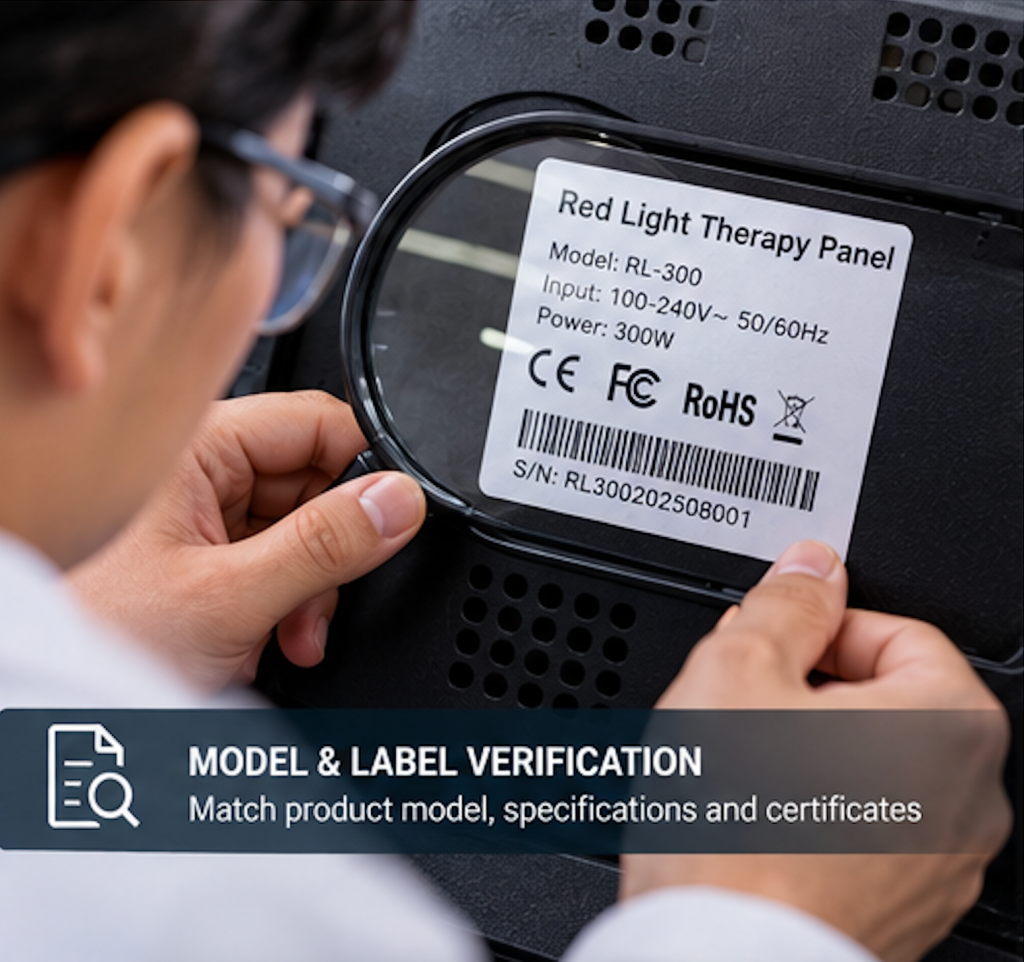
This is one of the most important steps in red light therapy bulk-order verification.
A manufacturer may sell several products with similar names but different designs.
For example:
- 110W tabletop panel
- 300W targeted panel
- 600W medium panel
- 900W large panel
- Full-body panel system
- Red light therapy mat
A report for one product should not automatically be assumed to cover another.
Product Model Verification Checklist
| Item | What to Compare |
|---|---|
| Model number | Product label, report, invoice and specification sheet |
| Manufacturer | Legal entity and production site |
| Product photographs | Housing and construction |
| Electrical ratings | Voltage, frequency and power |
| LED configuration | Quantity, wavelength and arrangement |
| Controller | Hardware and software configuration |
| Power supply | Model and technical specifications |
| Accessories | Relevant tested configurations |
| Intended use | Labeling and marketing claims |
| Report scope | Covered models and variants |
Can One Certificate Cover Multiple Models?
Sometimes, depending on the applicable scheme, technical assessment, and documented product-family coverage.
However, the supplier must provide evidence that the specific model or variant is included.
Do not assume that all products in a catalog share the same certification status.
Step 10: Recheck Compliance After OEM or ODM Customization
Certification verification becomes especially important when buyers customize existing red light therapy equipment.
Common customization requests include:
- Logo and product labeling
- Housing design
- LED wavelength configuration
- LED quantity
- Optical lenses
- Power supply
- Controller
- Wireless connectivity
- Cooling system
- Packaging
- User instructions
Some changes may affect product safety, electromagnetic compatibility, optical performance, labeling, or regulatory status.
Does Private Labeling Require New Testing?
Not always.
The answer depends on the regulatory framework, the responsible economic operator, the nature of the change, and the existing documentation.
Simple branding changes may have different implications from modifying electrical components or the optical system.
Why Technical Changes Matter
For example, replacing a power supply or changing the controller may affect electrical safety or EMC performance.
Changing the LED configuration or optical lenses may affect irradiance and photobiological safety.
Before approving a customized design, request a written assessment of whether additional testing or documentation is required.
Learn more in our Red Light Therapy OEM vs ODM Guide and Private Label Red Light Therapy Guide.
Red Light Therapy Bulk Order Certification Checklist
Before making a significant payment, complete the following supplier review.
| Verification Item | Required Action |
|---|---|
| Destination market | Identify countries where products will be sold |
| Intended use | Confirm wellness, cosmetic or medical claims |
| Regulatory classification | Determine applicable product rules |
| Manufacturer identity | Verify legal entity and manufacturing site |
| Model number | Match all reports to the exact product |
| FDA status | Check registration, listing or applicable authorization |
| CE documentation | Review Declaration of Conformity and applicable assessment |
| FCC documentation | Confirm applicable authorization procedure |
| RoHS | Review relevant material compliance evidence |
| Safety testing | Review applicable electrical and optical reports |
| ISO 13485 | Verify certification where claimed |
| Laboratory | Confirm accreditation and testing scope |
| OEM changes | Assess need for updated testing |
| Labeling | Review warnings, instructions and claims |
| Sample | Approve a production-representative sample |
| Shipment | Confirm final goods match the approved configuration |
How to Identify Fake or Misleading Certificates
Warning signs may include:
1. The Supplier Only Sends a Logo
A CE, FDA, or FCC logo alone is not sufficient evidence of compliance.
2. The Certificate Belongs to Another Company
Ask the supplier to explain the relationship between the named manufacturer, applicant, certificate holder, and your actual product.
3. The Model Number Does Not Match
A report for an unrelated device should not be used as evidence for the product being purchased.
4. The Supplier Cannot Provide a Complete Report
A cover page may omit important limitations, test conditions, or product-family details.
5. The Laboratory Cannot Be Verified
Contact the laboratory or relevant accreditation body when authenticity is uncertain.
6. The Certificate Is Expired or Has an Unclear Status
Check whether the document remains valid and whether there have been relevant changes or restrictions.
7. The Supplier Claims One Certification Covers Every Market
Regulatory requirements differ across jurisdictions.
8. The Supplier Promises That Any Medical Claim Is Allowed
Marketing claims must be supported by evidence and comply with applicable regulations.
How to Include Certification Requirements in a Bulk Purchase Agreement
Document verification should be part of the purchasing process.
Before mass production, agree on:
- Exact product model and specifications
- Applicable destination-market requirements
- Required documents and test reports
- Responsible manufacturer and importer
- Approved product labeling
- Permitted customization
- Change-control procedure
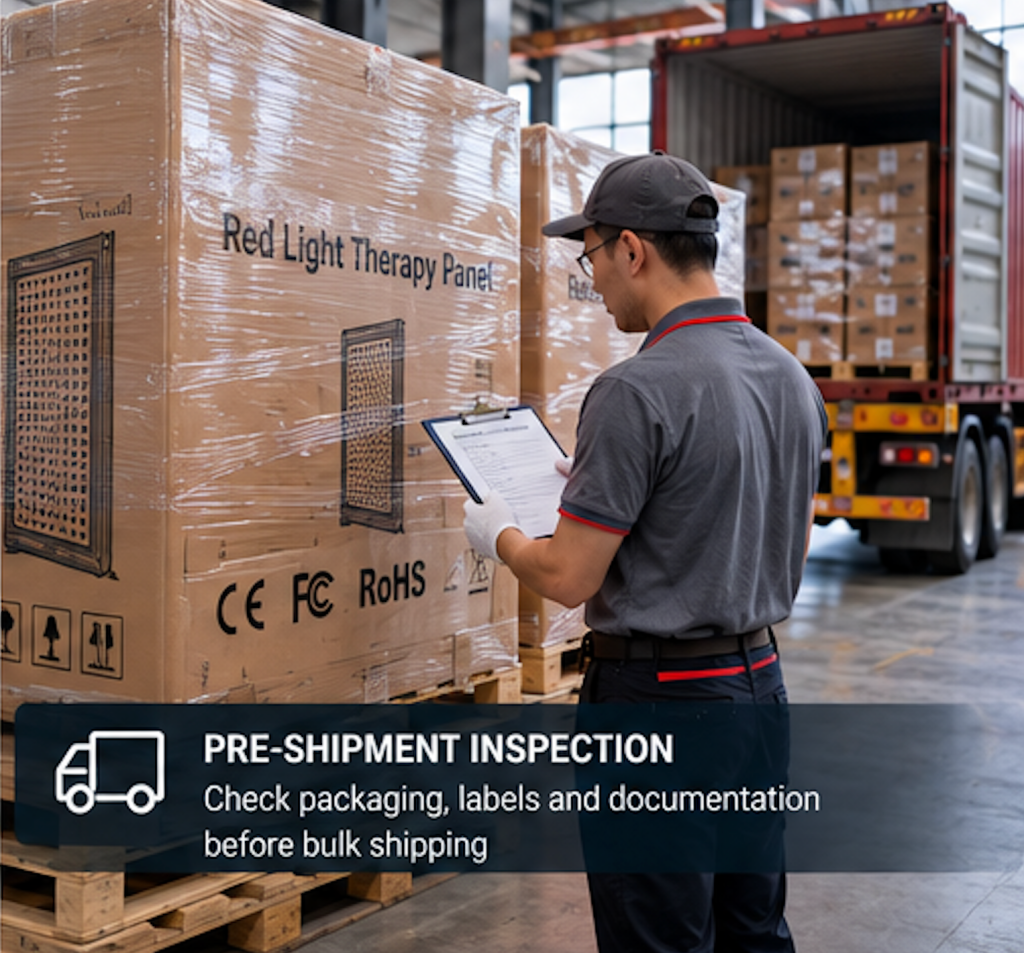
- Pre-shipment inspection requirements
- Handling of nonconforming goods
- Warranty and corrective-action responsibilities
Use a Golden Sample
A golden sample is an approved physical reference for production.
It can help verify:
- Housing
- LEDs
- Power supply
- Controller
- Labels
- Accessories
- Packaging
- Optical specifications
The golden sample should be supported by an agreed specification sheet and relevant compliance documentation.
For additional supplier evaluation, read our Red Light Therapy Panel Manufacturer Guide.
Questions to Ask a Red Light Therapy Supplier Before Bulk Ordering
Ask the supplier these questions:
- Which regulatory requirements apply to this model in my target market?
- What is the exact product model number?
- Who is the legal manufacturer?
- What FDA status, if any, applies to this device?
- Can you provide the applicable EU Declaration of Conformity?
- Is notified-body involvement required for this product?
- What FCC authorization procedure applies?
- Are RoHS documents available where relevant?
- Which IEC standards were used for testing?
- Which laboratory issued the reports?
- Can the laboratory confirm report authenticity?
- Does ISO 13485 certification cover the relevant manufacturing activity?
- Are the certificates and reports valid for my customized version?
- Who is responsible for regulatory documentation after private labeling?
- Can I inspect the production sample before bulk manufacturing?
- Will any component changes be communicated and approved?
- What happens if the shipment fails an agreed compliance requirement?
- Can you provide the required labeling and user instructions?
Clear, verifiable answers are more useful than a long list of certification logos.
Frequently Asked Questions
Are all red light therapy devices FDA approved?
No. Regulatory status depends on the product’s intended use, classification, and applicable pathway. Some devices may require clearance or approval, while others may be subject to different requirements.
Does FDA registration mean a red light therapy device is approved?
No. FDA establishment registration and device listing do not constitute FDA approval or clearance.
How can I verify FDA 510(k) clearance?
Request the K-number and search the official FDA 510(k) database. Compare the applicant, device name, product code, and cleared indications for use.
Is CE marking required for red light therapy devices sold in Europe?
Products subject to applicable EU CE-marking legislation generally require conformity assessment and CE marking. The specific requirements depend on the product and relevant legislation.
Can I verify a CE medical-device certificate online?
For applicable certificates, use EUDAMED and relevant notified-body information. Also review the Declaration of Conformity and the applicable regulatory scope.
Does every red light therapy device require an FCC ID?
No. The applicable FCC authorization procedure depends on the device’s electronic and radiofrequency characteristics.
What does ISO 13485 certification mean?
It concerns an organization’s medical-device quality management system. It does not automatically approve every product manufactured by that organization.
Does IEC 62471 certification prove that a device is safe for all uses?
No. Relevant optical safety testing must be interpreted according to the product, exposure conditions, applicable requirements, and intended use.
Can I use an existing certificate for an OEM red light therapy panel?
Possibly, but only where the specific configuration is appropriately covered and the applicable regulatory obligations are satisfied. Customization may require additional assessment.
What should I do if a supplier refuses to share test reports?
Ask for a reasonable verification method, such as direct laboratory confirmation, controlled document review, or a confidentiality agreement. If essential evidence cannot be verified, do not assume compliance.
Conclusion: Verify Before You Buy
Red light therapy device certification verification should be a standard part of every B2B sourcing process.
The most important principle is simple:
Do not verify a logo. Verify the product, the manufacturer, the applicable requirements, and the supporting evidence.
Before bulk ordering, follow this process:
Target Market → Intended Use → Regulatory Requirements → Manufacturer Verification → Document Review → Laboratory Verification → Sample Approval → Mass Production
For distributors, clinics, wellness brands, and private-label companies, a structured verification process can help reduce sourcing risks and support more reliable product launches.
Request Red Light Therapy Product Documentation and an OEM/ODM Quote
Planning to purchase red light therapy panels, full-body systems, or customized equipment in bulk?
US Red Light Therapy offers red and near-infrared light therapy products and OEM/ODM customization options for business buyers.
Tell us about your project:
- Target country or market
- Product type
- Required model or specifications
- Intended application
- Estimated order quantity
- Logo and packaging requirements
- Required compliance documentation
- Customization requirements
Our team can discuss available product configurations and documentation for the specific model and market.
Explore Products: Professional Red Light Therapy Panels
OEM/ODM Solutions: Red Light Therapy OEM & ODM Manufacturer
Request Documentation and a Quote: Contact US Red Light Therapy
Post time: 10-15-26