

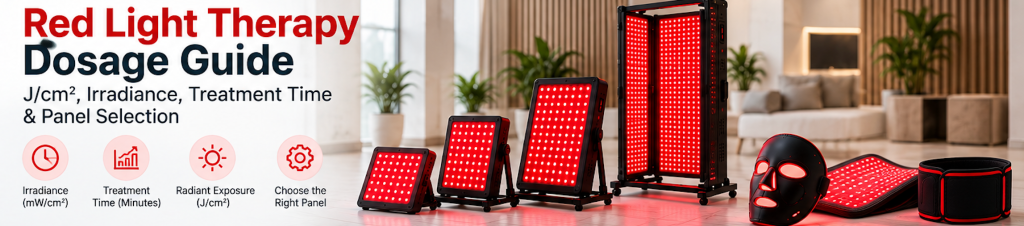
Understanding red light therapy dosage is important when comparing LED therapy devices, evaluating treatment parameters, or purchasing professional equipment.
Many red light therapy panels advertise specifications such as 50 mW/cm², 100 mW/cm², 660nm, 850nm, and adjustable treatment timers. However, these numbers do not independently tell you how much optical energy reaches the treatment surface.
So, how do you calculate red light therapy dosage? What does J/cm² mean? And does a higher dose always deliver better results?
This guide explains red light therapy dosage, irradiance, treatment time, wavelength, and measurement distance. It also includes a dosage calculation chart, references to published research, and practical advice for clinics, gyms, wellness centers, distributors, and private-label brands.
For businesses comparing equipment, explore our professional red light therapy panels.
What Is Red Light Therapy Dosage?
Red light therapy dosage generally refers to the amount of optical energy delivered during light exposure.
In photobiomodulation (PBM), one commonly reported parameter is radiant exposure, expressed in joules per square centimeter (J/cm²).
Radiant exposure describes the amount of optical energy arriving at a defined surface area over time.
However, it does not describe every aspect of a treatment.
A complete photobiomodulation protocol may include:
- Wavelength (nm)
- Irradiance (mW/cm²)
- Radiant exposure (J/cm²)
- Exposure duration
- Treatment distance
- Illuminated area
- Continuous or pulsed operation
- Number and frequency of sessions
- Target tissue and intended application
The scientific review Review of Light Parameters and Photobiomodulation Efficacy discusses why these parameters must be considered together when evaluating photobiomodulation research.
What Does J/cm² Mean in Red Light Therapy?
J/cm² means joules per square centimeter.
It is a unit of radiant exposure.
For example, if a panel delivers a constant irradiance of 50 mW/cm² for 10 minutes, the calculated radiant exposure at the measured surface is 30 J/cm².
That value does not mean 30 J/cm² reaches every layer of tissue.
Some light is reflected, scattered, or absorbed before reaching deeper structures.
Irradiance vs Dosage
Irradiance and radiant exposure are related, but they are not the same measurement.
| Parameter | Unit | Meaning |
|---|---|---|
| Irradiance | mW/cm² | Optical power arriving per unit area |
| Radiant Exposure | J/cm² | Optical energy delivered per unit area over time |
| Wavelength | nm | Spectral characteristic of the light |
| Exposure Time | Seconds or minutes | Duration of exposure |
| Distance | cm or inches | Separation between the light source and measurement surface |
For a detailed explanation of power density, read our Red Light Therapy Irradiance Guide.
How to Calculate Red Light Therapy Dosage
For a constant irradiance at a defined surface, the basic formula is:
Radiant Exposure (J/cm²) = Irradiance (W/cm²) × Exposure Time (seconds)
When irradiance is expressed in mW/cm² and time in minutes, use:
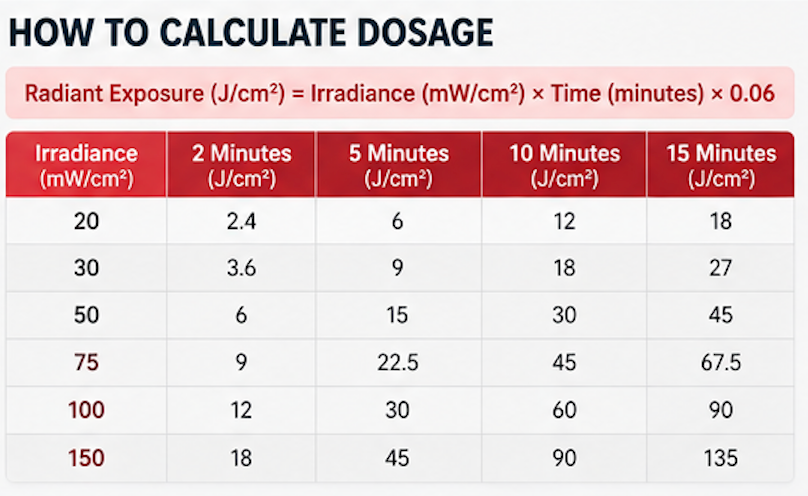
Radiant Exposure (J/cm²) = Irradiance (mW/cm²) × Time (minutes) × 0.06
This formula estimates incident radiant exposure at the measurement surface.
It is not a formula for determining the ideal clinical dose.
Example 1: 50 mW/cm² for 10 Minutes
Assume a panel delivers 50 mW/cm² at a specified distance.
Convert irradiance:
50 mW/cm² = 0.05 W/cm²
Convert exposure time:
10 minutes = 600 seconds
Calculate:
0.05 × 600 = 30 J/cm²
Calculated surface radiant exposure: 30 J/cm².
Example 2: 100 mW/cm² for 5 Minutes
100 mW/cm² = 0.1 W/cm²
5 minutes = 300 seconds
0.1 × 300 = 30 J/cm²
Calculated surface radiant exposure: 30 J/cm².
Although these examples produce the same calculated radiant exposure, they do not necessarily produce identical biological effects.
Irradiance, exposure duration, wavelength, and tissue response can influence outcomes independently.
Red Light Therapy Dosage Chart: J/cm² by Irradiance and Time
The following red light therapy dosage chart illustrates how optical energy accumulates over time.
Red Light Therapy Dosage Calculation Table
| Irradiance | 2 Minutes | 5 Minutes | 10 Minutes | 15 Minutes |
|---|---|---|---|---|
| 20 mW/cm² | 2.4 J/cm² | 6 J/cm² | 12 J/cm² | 18 J/cm² |
| 30 mW/cm² | 3.6 J/cm² | 9 J/cm² | 18 J/cm² | 27 J/cm² |
| 50 mW/cm² | 6 J/cm² | 15 J/cm² | 30 J/cm² | 45 J/cm² |
| 75 mW/cm² | 9 J/cm² | 22.5 J/cm² | 45 J/cm² | 67.5 J/cm² |
| 100 mW/cm² | 12 J/cm² | 30 J/cm² | 60 J/cm² | 90 J/cm² |
| 150 mW/cm² | 18 J/cm² | 45 J/cm² | 90 J/cm² | 135 J/cm² |
Important: These values are mathematical examples, not recommended treatment doses.
The chart assumes constant irradiance at the measurement surface. It does not account for tissue absorption, scattering, device movement, or variation in optical output.
How Should Professional Buyers Use This Chart?
The chart can help buyers:
- Verify basic dosage calculations.
- Compare irradiance and exposure time.
- Evaluate timer and intensity-control features.
- Understand differences between product specifications.
- Ask suppliers more precise technical questions.
A calculated J/cm² value should never be presented as proof of clinical effectiveness without application-specific evidence.
What Is the Best Red Light Therapy Dosage?
There is no universal best red light therapy dosage.
Different photobiomodulation studies use different wavelengths, power densities, exposure durations, treatment areas, and protocols.
The appropriate parameters depend on the specific intended application.
What Does Scientific Research Say?
A peer-reviewed paper, Biphasic Dose Response in Low Level Light Therapy – An Update, discusses how biological responses to light can vary with exposure parameters.
One important concept is the biphasic dose response.
In simplified terms:
- Insufficient exposure may produce little or no measurable response.
- An appropriate exposure may produce a biological response.
- Excessive exposure may fail to improve the response and can sometimes reduce it.
This helps explain why higher irradiance or longer treatment time is not automatically better.
Does WALT Recommend a Universal Red Light Therapy Dose?
No.
The World Association for Photobiomodulation Therapy (WALT) publishes recommendations for specific photobiomodulation applications and device categories.
These recommendations can be useful when reviewing the scientific literature.
However, some WALT tables address particular laser wavelengths, treatment points, and clinical conditions.
They should not be applied automatically to every LED panel, full-body system, or consumer device.
Professional users should consult the guidance relevant to their device and intended application.
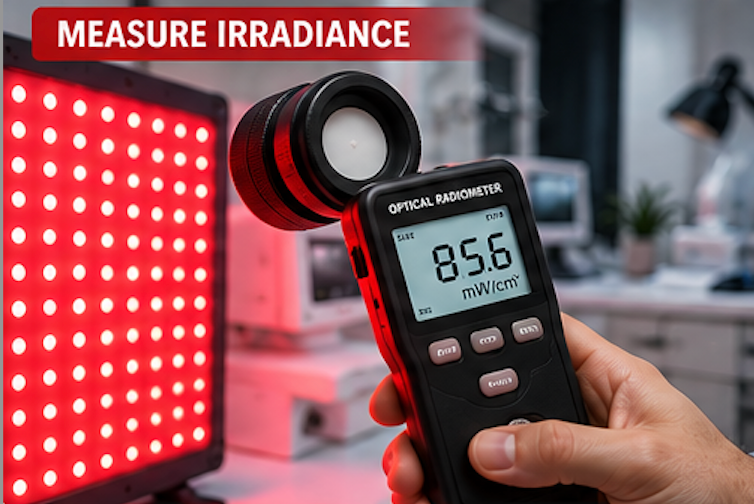
How Does Irradiance Affect Red Light Therapy Dosage?
Irradiance describes how quickly optical energy arrives at a surface.
If irradiance is constant, longer exposure increases calculated radiant exposure.
However, higher irradiance is not automatically more effective.
For example:
| Panel | Irradiance | Exposure Time | Calculated Exposure |
|---|---|---|---|
| Panel A | 50 mW/cm² | 10 minutes | 30 J/cm² |
| Panel B | 100 mW/cm² | 5 minutes | 30 J/cm² |
These hypothetical panels deliver the same calculated surface radiant exposure.
Nevertheless, different irradiance and time combinations may produce different biological responses.
A scientific review titled Photobiomodulation Use in Ophthalmology – An Overview of Translational Research discusses the importance of accurate radiometry, dosimetry, and dose-response relationships.
For device selection, review our Red Light Therapy Panel Irradiance Guide.
How Does Treatment Distance Affect Dosage?
The distance between the red light therapy device and the illuminated surface can significantly affect irradiance.
For example, a manufacturer might report:
- Irradiance at 3 inches
- Irradiance at 6 inches
- Irradiance at 12 inches
These measurements should not be treated as interchangeable.
Why Does Distance Matter?
As distance changes, the distribution and overlap of light from individual LEDs may also change.
For multi-LED panels, the relationship is influenced by:
- LED arrangement
- Optical lenses
- Beam angle
- Panel dimensions
- Measurement geometry
The simple inverse-square law for a point source does not necessarily describe the near-field behavior of an LED panel.
What Should Buyers Request?
Ask the manufacturer for irradiance measurements at the intended operating distance.
For larger panels, request multiple measurement points across the treatment area rather than relying only on a peak center reading.
This can provide a clearer picture of actual optical coverage.
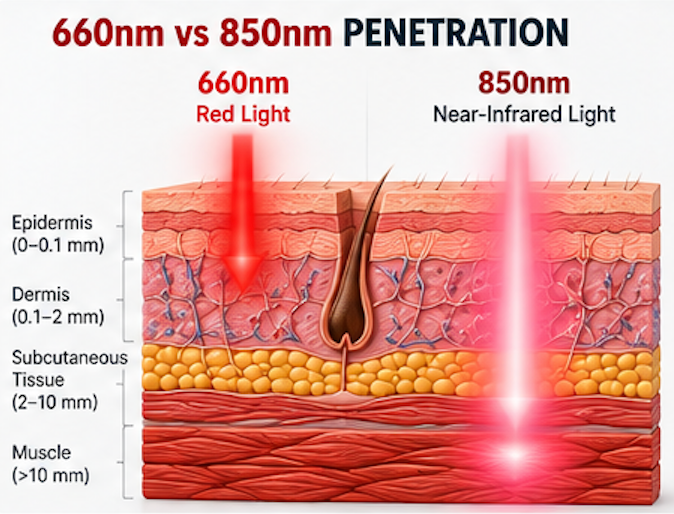
Does 660nm vs 850nm Affect Red Light Therapy Dosage?
Yes. Wavelength is an important variable when evaluating light exposure.
Two wavelengths commonly used in red light therapy devices are:
660nm visible red light
850nm near-infrared light
660nm Red Light
660nm is within the visible red spectrum.
It is commonly included in photobiomodulation devices and research involving relatively superficial tissues.
850nm Near-Infrared Light
850nm is within the near-infrared spectrum.
Under comparable conditions, it generally has greater tissue penetration potential than 660nm visible red light.
However, actual light penetration depends on tissue characteristics and optical conditions.
Can Both Wavelengths Use the Same J/cm²?
The same surface radiant exposure can be calculated for both wavelengths.
However, that does not mean the two wavelengths produce equivalent biological effects.
Differences in tissue absorption, scattering, and biological response can influence outcomes.
For a complete wavelength comparison, read our 660nm vs 850nm Red Light Therapy Guide.
Red Light Therapy Dosage for Different Applications
There is no single dose that can be recommended across all professional settings.
Different businesses should evaluate devices according to their intended use, technical requirements, and available evidence.
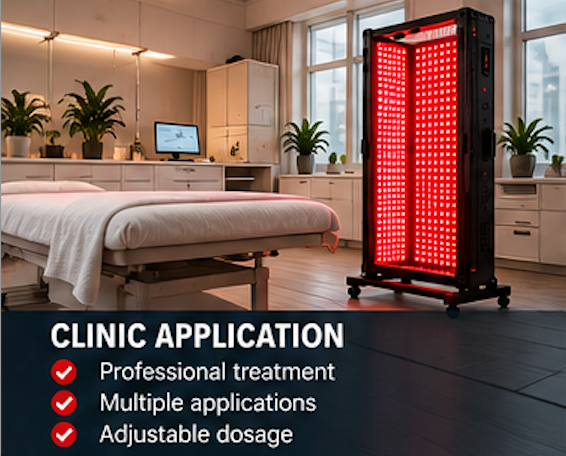
Red Light Therapy Dosage for Clinics
Clinics may need equipment with clearly documented optical specifications and validated operating procedures.
Important considerations include:
- Intended clinical application
- Wavelength
- Irradiance
- Treatment distance
- Exposure time
- Treatment area
- Safety documentation
- Applicable regulatory requirements
A clinic should not choose a protocol based solely on a generic online dosage chart.
Explore our Red Light Therapy Solutions for Clinics.
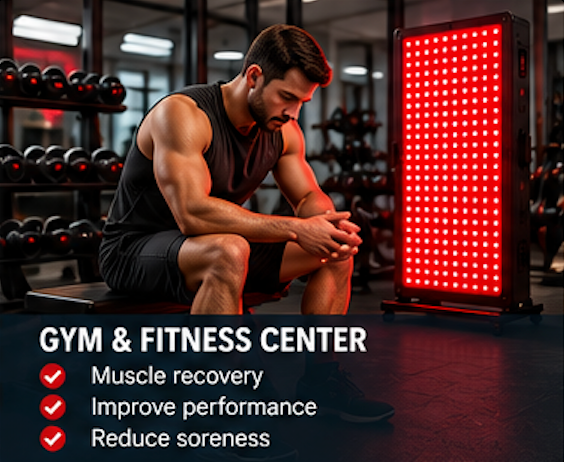
Red Light Therapy Dosage for Gyms and Fitness Centers
Fitness businesses often evaluate equipment for wellness and recovery-oriented services.
Important product considerations include:
- Panel size
- Coverage area
- Timer settings
- Irradiance
- Ease of operation
- Commercial durability
- Maintenance requirements
A larger panel may provide broader illumination, but that does not automatically establish a better treatment dose.
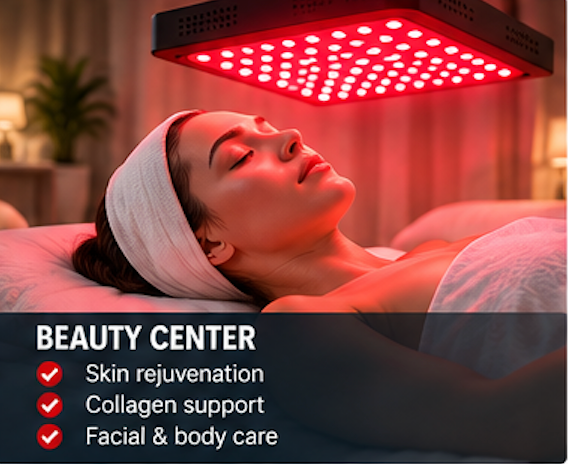
Red Light Therapy Dosage for Beauty Centers
Beauty centers may evaluate compact or targeted devices for cosmetic and wellness applications.
Key considerations include:
- Wavelength configuration
- Uniformity of illumination
- Positioning
- Exposure controls
- Eye protection
- Cleaning procedures
- Device instructions
- Applicable cosmetic or medical-device regulations
Red Light Therapy Dosage for Wellness Centers
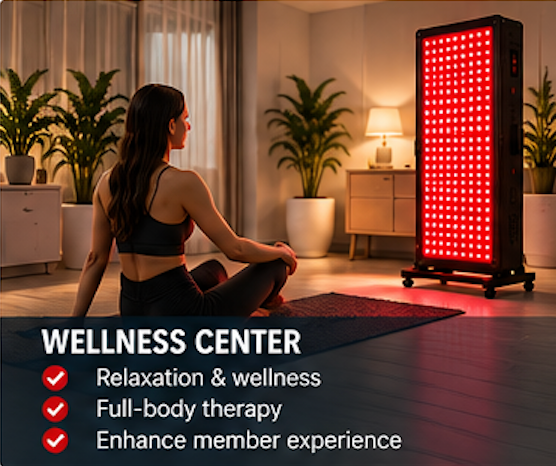
Wellness facilities may compare tabletop panels, targeted systems, and full-body devices.
For larger equipment, optical coverage and uniformity can be as important as center-point irradiance.
The most suitable configuration depends on the service format, operating environment, and intended use.
Red Light Therapy Dosage Safety: What Should Users Know?
Light exposure should follow the device’s instructions and any applicable professional protocol.
Higher irradiance, longer sessions, and repeated exposure should not be assumed to provide greater benefits.
Eye Protection and Photosensitivity
Appropriate eye safety precautions are important, especially for high-output visible red and near-infrared devices.
Near-infrared light can be difficult to perceive visually, so brightness alone is not a reliable indicator of exposure.
The U.S. Food and Drug Administration (FDA) provides safety information for certain light-based aesthetic procedures, including eye protection and circumstances that require additional caution.
The FDA page addresses specific device applications; it should not be interpreted as blanket clearance or approval of all red light therapy products.
Avoid Unsupported Medical Claims
Manufacturers and distributors should ensure that marketing claims match the product’s intended use, available evidence, and applicable regulations.
A device emitting 660nm or 850nm light is not automatically approved to treat a medical condition.
How to Choose a Red Light Therapy Panel Based on Dosage Specifications
When purchasing professional red light therapy equipment, evaluate the complete optical specification.
Step 1: Confirm the Wavelength
Check the nominal wavelength and any relevant tolerances.
Step 2: Verify Irradiance
Ask for irradiance values in mW/cm² at specified measurement distances.
Step 3: Review the Measurement Method
Request information about the measurement instrument, calibration, and operating conditions.
Step 4: Evaluate Treatment Coverage
Compare center irradiance, average irradiance, and uniformity where relevant.
Step 5: Check Timer and Intensity Controls
Professional equipment may benefit from adjustable timers and output settings.
Step 6: Confirm Safety and Quality Documentation
Review available electrical safety, optical testing, and market-specific compliance documents.
Step 7: Request a Sample or Technical Evaluation
Where practical, verify the specifications before committing to a large purchase.
For more sourcing guidance, explore our Red Light Therapy Panel Manufacturer Guide.
OEM & ODM Red Light Therapy Dosage Customization
For distributors, wellness brands, and private-label businesses, optical performance can be part of the product development process.
Depending on the platform and engineering feasibility, OEM or ODM projects may involve:
- Wavelength combinations
- LED quantity and configuration
- Panel dimensions
- Optical lenses
- Output controls
- Timer functions
- Continuous or pulsed modes
- Cooling systems
- Product housing
- Branding and packaging
Why Technical Specifications Matter for OEM Buyers
A custom product should not be developed using a target J/cm² number alone.
The technical specification should also define:
- Target irradiance
- Measurement distance
- Wavelength configuration
- Treatment area
- Measurement conditions
- Acceptable performance tolerances
- Safety and compliance requirements
This helps buyers and suppliers establish measurable product acceptance criteria.
Explore our Red Light Therapy OEM & ODM Manufacturer Solutions for private-label and customized product development.
Common Red Light Therapy Dosage Mistakes
Mistake 1: Assuming More J/cm² Is Always Better
A higher calculated radiant exposure does not automatically improve outcomes.
Mistake 2: Confusing Wattage With Irradiance
Electrical power consumption is not the same as optical power delivered to the treatment surface.
Mistake 3: Ignoring Measurement Distance
An irradiance measurement is incomplete without its distance and testing conditions.
Mistake 4: Using One Dosage for Every Wavelength
Equal surface radiant exposure does not guarantee equal biological effects across wavelengths.
Mistake 5: Treating a Calculation Chart as a Medical Protocol
A dosage chart can explain the mathematics, but it cannot establish an appropriate treatment for every condition.
Mistake 6: Ignoring Coverage Uniformity
A high center-point irradiance reading does not establish uniform optical exposure across a large treatment area.
Mistake 7: Assuming a Research Study Applies to Every Commercial Device
Research protocols may use different devices, wavelengths, measurement methods, and treatment settings.
Frequently Asked Questions About Red Light Therapy Dosage
What is the recommended red light therapy dosage in J/cm²?
There is no universal recommended J/cm² value. Appropriate exposure parameters depend on the intended application, wavelength, irradiance, treatment area, and supporting evidence.
How do you calculate red light therapy dosage?
For constant irradiance:
Radiant Exposure (J/cm²) = Irradiance (mW/cm²) × Time (minutes) × 0.06.
Is 10 J/cm² enough for red light therapy?
10 J/cm² is a radiant exposure value, not a universal effectiveness threshold. Whether it is appropriate depends on the intended application and protocol.
Is 30 J/cm² too much?
A value of 30 J/cm² cannot be judged in isolation. Wavelength, irradiance, treatment duration, target tissue, and device characteristics must also be considered.
Is higher irradiance better?
Not necessarily. Higher irradiance increases the rate of optical energy delivery, but it does not automatically improve biological outcomes.
Does red light therapy dosage change with distance?
Yes. If irradiance changes with distance, the calculated surface radiant exposure for a fixed exposure time changes accordingly.
Is 660nm dosage the same as 850nm dosage?
Both wavelengths use the same physical units, but equal radiant exposure does not imply identical tissue distribution or biological effects.
Can red light therapy panels deliver the same J/cm² in different times?
Yes. Different irradiance and exposure-time combinations can produce the same calculated surface radiant exposure, although their biological effects may differ.
How can I verify a manufacturer’s dosage claims?
Request documented irradiance measurements, testing distance, wavelength information, measurement method, operating conditions, and relevant technical reports.
Conclusion: Understanding Red Light Therapy Dosage Before Buying
Red light therapy dosage is an important technical concept, but it should never be evaluated using J/cm² alone.
A meaningful comparison requires:
Wavelength → Irradiance → Distance → Exposure Time → Radiant Exposure → Coverage → Intended Application
Scientific literature shows that photobiomodulation responses can depend on multiple parameters and that higher exposure is not necessarily better.
For clinics, gyms, beauty centers, wellness businesses, distributors, and private-label brands, transparent optical specifications are essential when comparing equipment.
Rather than selecting the panel with the highest advertised wattage or irradiance, focus on documented performance, appropriate device design, and the requirements of your intended application.
Request a Professional Red Light Therapy Panel Quote
Looking for professional red light therapy panels or customized OEM/ODM equipment?
US Red Light Therapy offers red and near-infrared light therapy products and customization options for B2B buyers.
Share your requirements, including:
- Preferred product type
- Wavelength configuration
- Panel size
- Irradiance requirements
- Intended operating distance
- Target market
- Estimated order quantity
- Logo and packaging requirements
Our team can discuss suitable product configurations, technical documentation, and customization feasibility.
Explore Products: Professional Red Light Therapy Panels
OEM/ODM Customization: Red Light Therapy OEM & ODM Manufacturer
Request a Quote: Contact US Red Light Therapy
Post time: 10-12-26