


For a red light therapy distributor, choosing the right supplier involves much more than comparing product prices, LED wavelengths, or panel sizes. Long-term product reliability, warranty coverage, replacement parts, and technical assistance can directly affect customer satisfaction and operating costs.
A competitive wholesale price may help you secure your first order. However, a clearly defined red light therapy panel warranty and reliable after-sales support can be equally important for building a sustainable distribution business.
Whether you sell professional panels to clinics and wellness centers or develop your own private-label red light therapy brand, understanding your supplier’s warranty terms is essential before placing a bulk order.
This guide explains what distributors should look for in a red light therapy panel warranty, how to evaluate after-sales support, and which questions to ask before committing to an OEM or wholesale partnership.
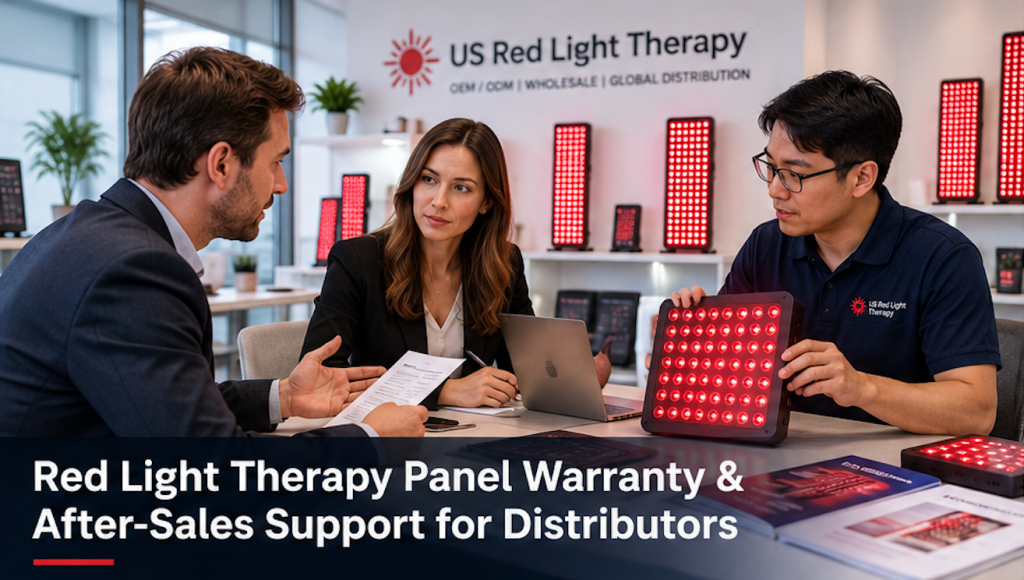
1. Why Does a Red Light Therapy Panel Warranty Matter for Distributors?
A red light therapy panel contains multiple electrical and optical components that must operate together.
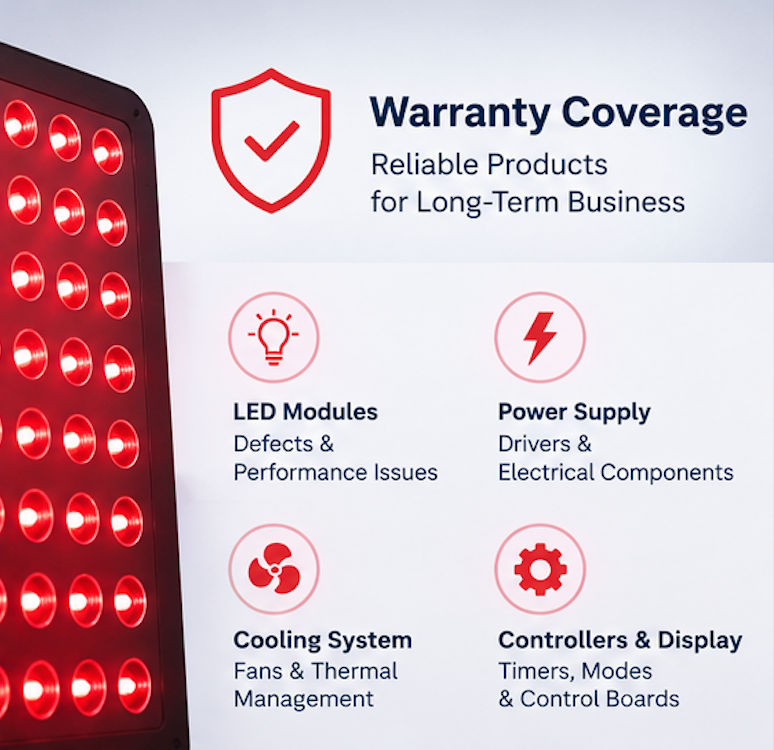
Depending on the model, these may include:
- Red and near-infrared LED modules
- Power supplies and electrical drivers
- Cooling fans and heat sinks
- Control boards and touchscreens
- Timers and operating-mode controls
- Power cables and connectors
- Metal housings and mounting accessories
A failure in one component may affect the performance or usability of the entire device.
For distributors, a product problem can create additional expenses beyond the original equipment cost.
These expenses may include replacement shipping, customer service, technical troubleshooting, repair labor, and returned inventory.
A well-defined warranty process helps distributors understand how these responsibilities will be handled.
Protecting Your Brand Reputation
Customers purchasing professional red light therapy equipment expect reliable operation and accessible support.
If a product fails, the distributor is often the first company the customer contacts, even when the device was produced by an external manufacturing partner.
A clear after-sales process helps distributors respond consistently, reduce uncertainty, and maintain customer confidence.
Reducing Unexpected Operating Costs
Consider two suppliers offering similar red light therapy panels.
Supplier A offers a lower initial price but provides limited information about replacement parts and warranty claims.
Supplier B offers a slightly higher price but provides documented warranty terms, troubleshooting procedures, and a defined replacement-parts process.
The better commercial choice depends on the complete cost of ownership, not simply the purchase price.
For additional supplier evaluation criteria, read our Red Light Therapy Panel Manufacturer Guide.
2. What Should a Red Light Therapy Panel Warranty Cover?
Not every red light therapy panel supplier offers the same warranty terms.
Before purchasing equipment in bulk, distributors should request a written warranty document that identifies covered components, exclusions, remedies, and claim procedures.
LED Modules and Light Output
LEDs are among the most important components of a red light therapy panel.
Potential problems may include individual LED failures, abnormal operation, or optical performance that no longer meets agreed product specifications.
Distributors should ask:
- Are individual LED failures covered?
- How is a defective LED module identified?
- Does the warranty cover complete LED boards or individual components?
- What happens if measured output falls outside the agreed specifications?
- Is repair or replacement available?
A warranty should not be interpreted as a guarantee that every LED will maintain identical output indefinitely.
Performance-related claims should be evaluated against documented test conditions and contractual acceptance criteria.
Power Supply and Electrical Components
Power supplies and drivers are essential to stable panel operation.
A distributor should clarify whether coverage includes:
- Power supply defects
- Driver failures
- Internal wiring faults
- Unexpected electrical shutdowns
- Defective switches or connectors
The agreement should also specify whether replacement components are supplied separately or whether the complete unit must be returned.
Cooling System
Many professional red light therapy panels use fans or other thermal-management components.
A cooling problem may cause abnormal noise, reduced reliability, or automatic shutdown.
Ask whether the warranty covers defective fans, thermal-control components, and failures caused by manufacturing defects.
Controllers and Displays
Some professional panels include digital controllers, timers, wavelength selection, intensity adjustment, or other operating modes.
The warranty should explain how defects involving these functions are handled.
For customized equipment, the approved controller specification and firmware version should also be documented.
3. How Long Should a Red Light Therapy Panel Warranty Last?
There is no single warranty duration that automatically applies to every red light therapy panel sold through B2B distribution channels.
The appropriate terms depend on the product, supplier agreement, intended market, and applicable law.
Instead of comparing warranty duration alone, distributors should evaluate the complete coverage.
| Warranty consideration | Questions distributors should ask |
|---|---|
| Warranty period | What is the exact duration for each model? |
| Starting date | Does coverage begin at shipment, delivery, resale, or end-customer purchase? |
| Covered components | Are LEDs, power supplies, fans, and controllers included? |
| Available remedies | Repair, replacement parts, complete-unit replacement, or another agreed remedy? |
| Shipping costs | Who pays freight, customs charges, and return shipping? |
| Labor costs | Are local repair expenses reimbursed? |
| Exclusions | What conditions are excluded from coverage? |
| Claim requirements | What evidence and documents must be submitted? |
| Transferability | Does coverage extend to the distributor’s end customer? |
Distributor Warranty vs. End-Customer Warranty
These two warranties should not be confused.
A distributor may receive a contractual warranty from its supplier while separately providing a retail or commercial warranty to its customers.
For example, a distributor may hold inventory before selling it.
If the supplier’s warranty begins on the original shipment date, some of the coverage period may expire before the product reaches the final buyer.
Therefore, distributors should negotiate how warranty start dates, inventory holding periods, and end-customer obligations interact.
In the United States, the FTC Businessperson’s Guide to Federal Warranty Law explains important consumer-warranty principles and the scope of the Magnuson-Moss Warranty Act. Wholesale agreements and products sold for resale require separate contractual consideration.
For distributors selling to EU consumers, the European Commission’s consumer guarantee guidance explains the minimum two-year legal guarantee applicable to qualifying consumer sales.
These consumer protections should not be mistaken for a universal two-year manufacturer warranty on B2B wholesale purchases.
4. What Is Included in Red Light Therapy After-Sales Support?
A warranty defines contractual coverage. Red light therapy after-sales support describes the practical services available when customers need assistance.
For distributors, both are important.
Technical Troubleshooting
A reliable support process should help identify problems before a product is returned internationally.
Typical troubleshooting may involve:
- Confirming the model and serial number.
- Reviewing the reported malfunction.
- Checking operating conditions and power requirements.
- Collecting photographs or videos.
- Determining whether the issue involves an accessory, controller, or internal component.
- Recommending an appropriate next step.
Electrical repairs and internal servicing should only be performed by appropriately qualified personnel following approved instructions.
Replacement Parts Availability
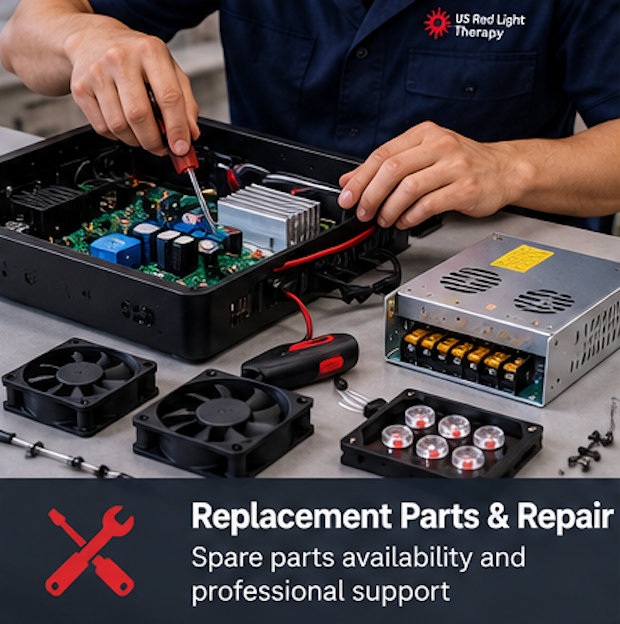
Replacement parts can be especially valuable for distributors selling large or commercial red light therapy panels.
Common spare-part categories may include:
- Power supplies
- Cooling fans
- Controllers
- Power cords
- Mounting brackets
- Compatible LED modules
- Remote controls and accessories
Before placing a wholesale order, confirm which parts are replaceable, how they are ordered, and whether they will remain available after a model is updated or discontinued.
Repair and Replacement Procedures
Distributors should understand whether defective products can be repaired locally, must be returned to the supplier, or qualify for replacement.
These options can have very different costs.
For a large full-body panel, international return freight may be substantial. In some cases, supplying a compatible replacement component may be more practical, provided the repair is safe and authorized.
Explore the available equipment formats in our Red Light Therapy Panel Collection.
5. How Should Distributors Handle Warranty Claims and RMA Requests?
An RMA, or Return Merchandise Authorization, is a structured process for reviewing and managing returned or defective products.
A documented RMA procedure helps avoid unnecessary returns and inconsistent decisions.
Step 1: Collect Product Information
The distributor should record:
- Product model
- Serial or batch number
- Purchase order number
- Delivery or purchase date
- Description of the issue
- Photos or videos
- Relevant operating conditions
Step 2: Perform Initial Troubleshooting
The supplier and distributor review the information to determine whether the issue can be resolved without a physical return.
Step 3: Confirm Warranty Eligibility
The supplier evaluates the claim against the written warranty and agreed technical specifications.
The process should distinguish manufacturing defects from shipping damage, misuse, unauthorized modifications, and other causes according to the actual contract.
Step 4: Approve a Resolution
Possible outcomes include:
- Providing a replacement accessory
- Sending an approved replacement component
- Arranging qualified repair
- Replacing the defective unit
- Offering another remedy specified in the agreement
Step 5: Close the Claim and Record the Outcome
The distributor should document the final resolution, associated costs, and product failure category.
Over time, this information can help identify recurring issues and improve supplier performance.
Important: A suspected electrical, optical, or other safety-related hazard should be escalated immediately rather than treated as an ordinary warranty return. The affected equipment should not continue to be used until the risk has been appropriately assessed.
6. Why Spare Parts and Technical Documentation Matter
For a red light therapy distributor, a replacement-parts policy can be just as important as the warranty period.
This is particularly relevant for clinics, gyms, rehabilitation centers, and other businesses that depend on equipment availability.
Reducing Equipment Downtime
If a professional panel becomes unavailable, the customer may need to change its operating schedule or temporarily suspend the associated service.
A clear technical support and repair process can reduce unnecessary delays.
Supporting Local Service Teams
Distributors planning to provide local maintenance should request appropriate technical documentation.
Depending on the equipment, this may include:
- Approved troubleshooting instructions
- Replaceable-component lists
- Component compatibility information
- Electrical and optical safety precautions
- Installation and mounting instructions
- Authorized maintenance procedures
- Product revision information
Not all equipment is designed for user or distributor repair. The service scope must be agreed upon and should not compromise product safety or regulatory compliance.
Maintaining Product Traceability
Serial numbers, batch numbers, and component revisions help identify affected products when a recurring defect is discovered.
Traceability also supports corrective actions and more accurate warranty analysis.
For medical devices subject to applicable US requirements, the FDA’s guidance on recalls, corrections, and removals explains responsibilities related to certain safety and compliance issues.
Routine warranty service is not automatically a medical-device recall, and regulatory requirements depend on the product’s classification and circumstances.
7. How Product Quality Control Can Reduce Warranty Problems
A strong warranty policy is valuable, but preventing defects before shipment is equally important.
For OEM and wholesale red light therapy panels, quality-control activities may include:
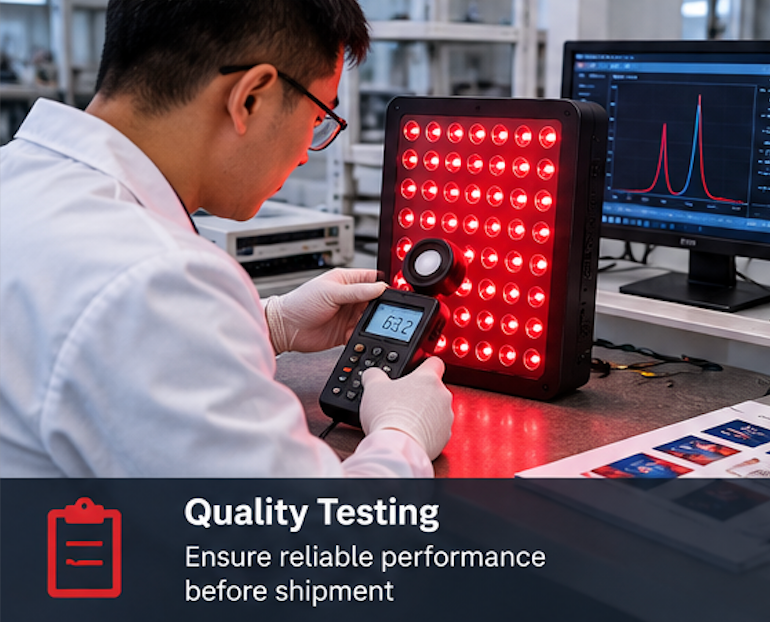
Electrical and Functional Testing
Check that the product operates according to its approved specifications, including power input, controller functions, timers, and required safety features.
LED and Optical Testing
Confirm the intended wavelength configuration and optical performance using appropriate measuring equipment.
For example, panels using nominal 660nm red light and 850nm near-infrared light should be evaluated against agreed specifications and tolerances.
Cooling and Reliability Testing
Review cooling performance, operating temperatures, and relevant reliability-test records.
Testing conditions should reflect the product design and intended use.
Pre-Shipment Inspection
Confirm the correct model, housing, accessories, packaging, labeling, and approved customization details.
Read our Red Light Therapy Quality Control: OEM Inspection Checklist for a more detailed procurement checklist.
Safety Documentation
Where applicable, suppliers should provide relevant safety-test evidence.
For example, IEC 62471:2006 addresses the photobiological safety evaluation of lamps and lamp systems, including LEDs.
However, a test report does not replace a warranty agreement, and conformity with one standard does not establish compliance with every requirement in a destination market.
For more information, see our Guide to Verifying Red Light Therapy Device Certifications.
8. Warranty Considerations for OEM and Private-Label Distributors
Distributors developing their own brands should pay special attention to after-sales responsibilities.
An OEM red light therapy panel may feature customized branding, housing, LED configurations, controllers, accessories, or packaging.
These changes can affect spare-part compatibility and warranty administration.
Clarify Responsibility Before Production
A private-label agreement should define:
- Who receives end-customer complaints
- Who investigates product defects
- Who approves replacement parts
- Who pays for covered repairs
- Who manages international shipping
- Who maintains product and batch records
- Who handles safety-related escalations
- How warranty support continues after model changes
Confirm Warranty Coverage for Customized Components
A standard product warranty may not automatically cover every customized component.
For example, a custom touchscreen, control board, or mounting structure may require specific service arrangements.
Ask the supplier to confirm coverage for the final approved product configuration.
Prepare Branded Warranty Documentation
A private-label distributor should have customer-facing documentation that accurately describes its actual warranty commitments.
This may include:
- Warranty terms and exclusions
- Product model identification
- Customer support contact information
- Claim submission instructions
- Safe-use and maintenance information
- Repair or replacement procedures
The FTC’s Guides for Advertising Warranties and Guarantees provide useful guidance on avoiding misleading warranty representations in consumer-facing marketing.
For customization possibilities, explore our Red Light Therapy OEM & ODM Solutions.
9. How to Compare Red Light Therapy Suppliers Beyond Price
Before selecting a long-term wholesale partner, distributors should evaluate the total support arrangement.
| Evaluation factor | What to verify | Why it matters |
|---|---|---|
| Written warranty | Exact coverage, duration, and exclusions | Reduces contractual uncertainty |
| Claim handling | RMA process and responsible contact | Makes issue resolution more predictable |
| Replacement parts | Availability, compatibility, and pricing | Supports maintenance and repair |
| Technical assistance | Troubleshooting and service documentation | Helps distributors support customers |
| Quality control | Inspection and testing records | Helps identify defects before shipment |
| Traceability | Model, batch, and serial records | Supports investigation and corrective action |
| OEM support | Coverage for customized components | Protects private-label operations |
| Shipping responsibility | Freight and customs cost allocation | Improves cost forecasting |
| Safety escalation | Procedures for potentially hazardous defects | Supports responsible product management |
A distributor should also ask for examples of the supplier’s claim documentation, without requesting confidential customer information.
Evaluate the Total Cost of Ownership
A useful commercial comparison considers more than unit price:
Total distribution cost = equipment purchase cost + logistics + service administration + repair and replacement expenses + other applicable operating costs.
Actual warranty expenses depend on the product’s failure history, customer usage, contract terms, and local service capabilities.
Distributors should request available reliability and claims data rather than assuming a fixed industry failure rate.
10. Questions Every Red Light Therapy Distributor Should Ask
Before placing a bulk order, send your potential supplier these questions:
- What is the written warranty period for each red light therapy panel model?
- When does the warranty period begin?
- Which electrical and optical components are covered?
- What problems are excluded?
- What is the procedure for submitting a warranty claim?
- Can you provide compatible replacement parts?
- Are local repairs permitted, and under what conditions?
- Who pays shipping costs for approved claims?
- How are defective-on-arrival products handled?
- What happens if multiple units from the same batch fail?
- Do customized OEM components have separate warranty terms?
- What technical documentation is available for distributors?
- How are discontinued models supported?
- How are safety-related complaints escalated?
- Can warranty responsibilities be included in the purchase agreement?
Clear answers help distributors compare suppliers based on operational reliability, not just marketing claims.
11. Frequently Asked Questions
What is a typical red light therapy panel warranty?
Warranty terms vary by supplier, product model, sales channel, and destination market. Distributors should request a written agreement identifying the exact coverage period, included components, exclusions, and available remedies.
Are LED failures covered under warranty?
They may be covered when the failure meets the agreed warranty conditions. Buyers should confirm whether the policy covers individual LEDs, complete LED boards, or optical performance outside specified tolerances.
Can distributors get replacement parts instead of returning a complete panel?
This depends on the supplier and product design. Some components may be replaceable, while others require authorized servicing or complete-unit replacement.
Does the warranty cover international shipping costs?
Not necessarily. Freight, customs, repair labor, and replacement shipping responsibilities should be specified in the wholesale agreement.
What is the difference between a manufacturer warranty and a distributor warranty?
A manufacturer or supplier warranty describes obligations owed by the warrantor under its applicable terms. A distributor may separately provide warranties to its customers. These obligations can differ and may also be affected by local consumer-protection law.
Do OEM red light therapy panels have different warranty requirements?
Customized products may require additional provisions covering proprietary components, firmware, replacement parts, product revisions, and private-label support.
What should I do if a red light therapy panel has a safety-related defect?
Stop using or distributing affected equipment as appropriate, preserve relevant records, and promptly contact the responsible supplier or qualified safety professional. Additional reporting or corrective-action obligations may apply depending on the product and market.
12. Work With a Red Light Therapy B2B Supply Partner
For distributors, a successful red light therapy business depends on consistent products, clear purchasing agreements, and practical support throughout the product lifecycle.
US Red Light Therapy supports global B2B customers with red and near-infrared light therapy equipment sourcing, wholesale supply, and OEM/ODM customization through established product and supply-chain resources.
Businesses can explore different panel configurations, branding options, packaging requirements, and project-specific support arrangements.
Looking for a red light therapy panel supplier for your distribution business?
Explore our Red Light Therapy Panel Collection or contact US Red Light Therapy to discuss wholesale requirements, OEM/ODM customization, and available warranty and after-sales terms for your selected products.
Before confirming an order, request the applicable written warranty policy and clarify all service responsibilities.

Conclusion
A red light therapy panel warranty should be evaluated as part of the complete supplier relationship.
For every red light therapy distributor, the most important considerations include transparent warranty coverage, accessible replacement parts, clear RMA procedures, reliable technical communication, and documented quality-control processes.
By reviewing these factors before placing a wholesale or OEM order, distributors can make better-informed purchasing decisions and build a stronger foundation for long-term customer support.
Post time: 10-30-26