

When sourcing professional red light therapy panels, one of the most important documents a supplier can provide is an irradiance test report.
However, a report showing an impressive number such as 150 mW/cm² does not automatically prove that a device delivers consistent or accurately measured optical performance.
For OEM buyers, wellness brands, clinics, and equipment distributors, understanding a red light therapy irradiance test is essential for evaluating product specifications and making informed purchasing decisions.
A reliable irradiance measurement should include more than a single number. It should explain the testing distance, equipment, wavelength configuration, measurement positions, operating conditions, and other information needed to interpret the results.
This guide explains how to read a red light therapy panel irradiance test report step by step, identify potentially misleading measurements, and evaluate optical performance before placing a wholesale or OEM order.
What Is a Red Light Therapy Panel Irradiance Test Report?
A red light therapy panel irradiance test report documents measurements of optical power arriving at a defined surface under specified testing conditions.
Irradiance is typically expressed in milliwatts per square centimeter (mW/cm²).
In simple terms, irradiance describes the rate at which radiant energy reaches a particular surface area.
For example, if a red light therapy panel is measured at 100 mW/cm² at a distance of 15 cm, that value describes the optical irradiance at the measured location and under the stated test conditions.
It does not necessarily represent the average irradiance across the entire treatment area.
Why Is Irradiance Testing Important for B2B Buyers?
A documented red light therapy irradiance test helps professional buyers:
- Verify optical performance claims.
- Compare products using equivalent measurement conditions.
- Evaluate the consistency of LED panel output.
- Understand differences between center and average irradiance.
- Check whether red and near-infrared wavelengths were included.
- Review product samples before approving OEM production.
- Establish measurable quality requirements for repeat orders.
A well-prepared test report also helps reduce misunderstandings between buyers and suppliers.
For more background on optical power density, read our Red Light Therapy Panel Irradiance Guide.
What Information Should an Irradiance Test Report Include?
Before reviewing the measured results, buyers should examine the report’s identification and testing information.
Essential Irradiance Test Report Checklist
| Report Information | What Buyers Should Verify |
|---|---|
| Manufacturer or supplier | Who supplied the tested device |
| Product model | Exact model and hardware revision |
| Sample identification | Serial number or traceable sample reference |
| Test date | When measurements were performed |
| Testing organization | In-house laboratory or independent laboratory |
| Instrument | Instrument type, manufacturer and model |
| Calibration | Calibration status, applicable spectral range and uncertainty |
| Measurement distance | Distance and reference surfaces used |
| Measurement positions | Center point or defined measurement grid |
| Wavelength configuration | Red, near-infrared or combined operation |
| Operating conditions | Brightness, pulse mode, warm-up and relevant environment |
| Irradiance results | Measured values and units |
| Acceptance criteria | Agreed limits where pass/fail evaluation is required |
| Report authorization | Responsible person and report identification |
These details help establish whether the measurements are traceable, repeatable, and relevant to the actual product.
A report that provides only a high irradiance value without supporting conditions is insufficient for rigorous technical comparison.
Step 1: Check the Product Model and Test Report Identification
The first step is to confirm that the report belongs to the product you intend to purchase.
What Should You Look For?
Check the following:
- Exact product model number
- Product revision or configuration
- Sample or serial number
- Report number
- Test date
- Testing organization
- Report version
For example, a test report for a 300W-class panel should not automatically be used to support the performance specifications of a different 600W-class panel.
Even products from the same product family can have different LED layouts, lenses, power systems, and optical characteristics.
Why Does Sample Traceability Matter?
For OEM and wholesale projects, the supplier may test a prototype or approved sample before mass production.
Buyers should confirm whether the report represents:
- A development prototype
- An approved pre-production sample
- A sample from a production batch
- A unit independently selected for inspection
The report should not be represented as proof that every manufactured unit has identical optical performance.
When reviewing an OEM project, compare the test report against the approved specifications and sample documentation.
Learn more about the process in our Red Light Therapy OEM & ODM Solutions.
Step 2: Understand Irradiance Measurement Units
The most common unit used in red light therapy panel reports is mW/cm².
It stands for milliwatts per square centimeter.
Common Irradiance Units
| Unit | Meaning |
|---|---|
| W | Watts of power |
| mW | Milliwatts of power |
| W/m² | Watts per square meter |
| mW/cm² | Milliwatts per square centimeter |
| J/cm² | Joules per square centimeter, a unit of radiant exposure |
| nm | Nanometers, used for wavelength |
These quantities should not be confused.
Irradiance vs Electrical Wattage
Electrical wattage and optical irradiance describe different characteristics.
A panel advertised as 600W does not necessarily deliver twice the irradiance of a 300W panel.
Optical performance also depends on:
- LED efficiency
- Lens design
- Electrical drive conditions
- LED arrangement
- Measurement distance
- Light distribution
- Wavelength configuration
Therefore, buyers should not use electrical wattage as a substitute for actual optical measurements.
Read our Red Light Therapy Wattage vs Irradiance Guide for a detailed comparison.
How Do You Convert Irradiance Units?
Useful conversions include:
1 mW/cm² = 10 W/m²
100 mW/cm² = 1,000 W/m²
When comparing reports using different units, convert them into the same units before evaluating their results.
Step 3: Verify the Irradiance Measurement Distance
Measurement distance is one of the most important details in an LED panel irradiance test.
The irradiance reaching a measurement surface changes with the geometry between the light source and the sensor.
Common testing distances include:
- 3 inches (approximately 7.6 cm)
- 6 inches (approximately 15.2 cm)
- 12 inches (approximately 30.5 cm)
These are examples of testing distances, not universal treatment recommendations.
Example: Why Test Distance Matters
Consider two hypothetical reports:
| Specification | Panel A | Panel B |
|---|---|---|
| Reported irradiance | 150 mW/cm² | 120 mW/cm² |
| Measurement distance | 3 inches | 6 inches |
| Measurement location | Center | Center |
| Operating conditions | Not fully documented | Not fully documented |
It would be incorrect to conclude that Panel A is the stronger device for every application.
The two measurements were taken at different distances, making direct comparison unreliable.
What Should Buyers Request?
A useful test report should specify:
- Distance from the defined source reference plane to the sensor’s measurement plane
- Sensor orientation
- Measurement positions
- Active LED modes
- Whether the values represent a single point or multiple positions
For professional purchasing, request measurements at the intended operating distance.
Important: The simple inverse-square law for a point source may not accurately describe the near-field behavior of a large multi-LED therapy panel. Actual measurements are preferable to unsupported distance extrapolations.
Step 4: Check the Irradiance Measurement Equipment
Reliable irradiance measurement requires an instrument suitable for the spectrum and measurement geometry of the device being tested.
Different optical instruments measure different quantities.
Common Optical Measurement Instruments
| Instrument | Main Use | Limitation |
|---|---|---|
| Calibrated radiometer | Measuring optical irradiance | Spectral and angular response must be appropriate |
| Spectroradiometer | Measuring wavelength-resolved optical radiation | Requires correct calibration and measurement setup |
| Optical power meter | Measuring optical power | Must use suitable detector geometry and area conversion for irradiance |
| Lux meter | Measuring visible-light illuminance | Not suitable for total red and near-infrared irradiance |
| General solar power meter | Measuring broad solar irradiance | May be inaccurate for narrow-band LED sources without suitable corrections |
Why Is Instrument Calibration Important?
Optical sensors do not necessarily respond equally to all wavelengths.
A measuring instrument calibrated for a different spectral distribution can give misleading results when used with narrow-band red and near-infrared LEDs.
For a professional report, buyers should verify:
- Instrument manufacturer and model
- Detector type
- Applicable wavelength range
- Calibration status
- Measurement uncertainty
- Spectral response suitability
- Relevant detector geometry
The National Institute of Standards and Technology (NIST) explains how photodetector sensitivity varies with wavelength and why spectral responsivity calibration matters.
Is a Handheld Irradiance Meter Accurate?
A handheld meter can be useful when its calibration, spectral response, detector geometry, and measurement limitations are suitable for the specific application.
However, a handheld reading should not automatically be considered an independent verification of a manufacturer’s absolute irradiance claim.
For important OEM orders, calibrated radiometric testing or competent independent laboratory verification may provide greater confidence.
Step 5: Read the Wavelength and Spectral Output Data
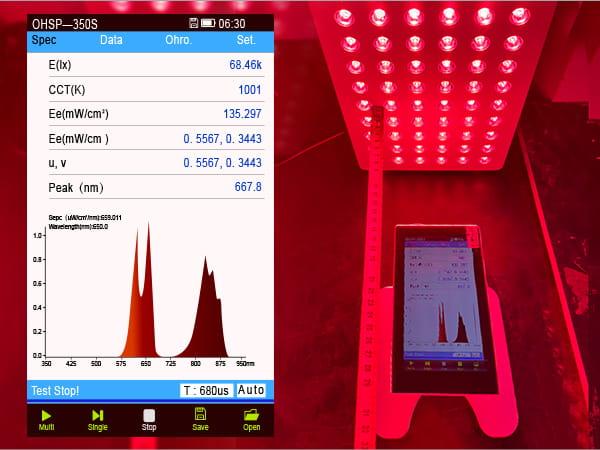
Many red light therapy panels combine visible red and near-infrared LEDs.
Common nominal wavelength configurations include:
- 660nm red light
- 850nm near-infrared light
- Combined 660nm + 850nm systems
- Customized multi-wavelength combinations
What Should a Spectral Test Report Show?
Depending on the test method, a detailed spectral report may include:
- Measured peak wavelength
- Spectral distribution
- Wavelength range
- Spectral irradiance
- Band-integrated irradiance
- Operating mode during measurement
For example, a device described as 660nm + 850nm should be evaluated against the agreed wavelength tolerances.
The nominal values do not mean that every LED emits at exactly 660.0nm or 850.0nm.
Separate vs Combined Wavelength Measurements
For dual-wavelength panels, buyers should ask:
- Was only the red channel operating?
- Was only the near-infrared channel operating?
- Were both channels operating simultaneously?
- Does the report show total or wavelength-specific irradiance?
These details matter because a combined output value does not reveal the contribution of each wavelength.
Moreover, adding separately measured red and NIR values may not reproduce the measured combined output if electrical loading or thermal conditions change when both channels are activated.
A report should identify the actual operating configuration used for each measurement.
Step 6: Understand Center, Peak, Average and Minimum Irradiance
A single-point irradiance measurement does not describe the optical distribution across the entire treatment surface.
This is especially important for large red light therapy panels.
Center Irradiance
Center irradiance describes the irradiance measured at the designated central position.
It is useful for understanding the output at that point.
However, it may not represent the full illuminated area.
Peak Irradiance
Peak irradiance may refer to the highest spatial reading, or in pulsed systems, a maximum value over time.
The report should clarify which meaning is intended.
Average Irradiance
Average irradiance may refer to the mean of multiple spatial readings or to an average over time.
A meaningful report must define the measurement area, sampling procedure, and averaging method.
Minimum Irradiance
The minimum measured value identifies the lowest reading within the sampled locations.
It can help reveal weaker regions of the measured area.
Why Irradiance Uniformity Matters
A panel may produce a high central reading while delivering considerably lower output near the edges.
For buyers evaluating broad-area illumination, spatial distribution can matter as much as the maximum reading.
A grid-based measurement is often more informative than a single center-point result.
Step 7: Learn to Interpret an Irradiance Measurement Grid
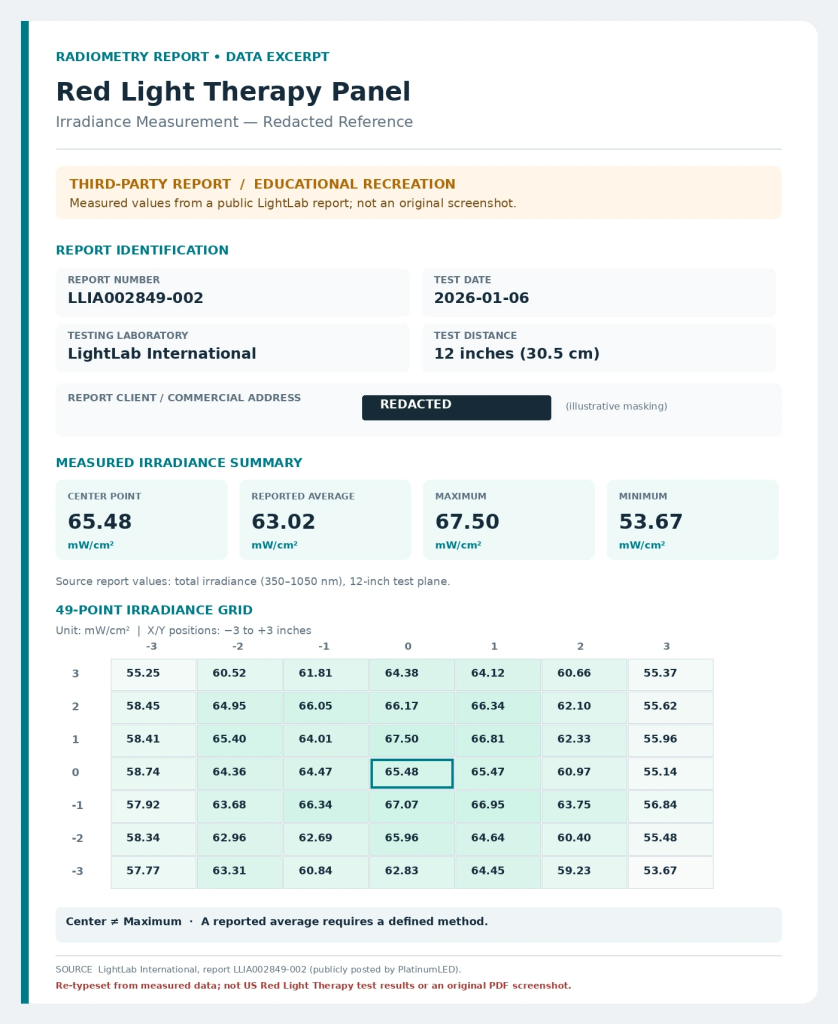
A measurement grid records irradiance at multiple positions within a defined surface.
Below is a hypothetical example of an irradiance test report.
Illustrative Example — Not Actual Product Test Data
| Report Parameter | Example Information |
|---|---|
| Device | Demo Red Light Therapy Panel A |
| Wavelength configuration | 660nm + 850nm |
| Measurement distance | 15 cm from a specified reference plane |
| Operating mode | Both channels, continuous, full output |
| Warm-up | 10 minutes |
| Measurement method | Nine equally weighted grid points |
| Unit | mW/cm² |
Example: Nine-Point Irradiance Measurement
| Upper Left | Upper Center | Upper Right |
|---|---|---|
| 78 | 91 | 80 |
| 88 | 112 | 90 |
| 76 | 87 | 79 |
All values in mW/cm². Each reading represents a different position on a defined measurement plane.
From these example readings:
- Center reading: 112 mW/cm²
- Highest reading: 112 mW/cm²
- Lowest reading: 76 mW/cm²
- Arithmetic mean of nine readings: approximately 86.8 mW/cm²
This example illustrates why reporting only the maximum value can be misleading.
The highest point measures 112 mW/cm², but the arithmetic mean of the nine sampled locations is approximately 86.8 mW/cm².
The mean of nine points should not automatically be described as the true average across the entire surface. That depends on the grid design, area weighting, sampling density, and measurement procedure.
What Can Buyers Learn From a Measurement Grid?
A defined grid can help buyers assess:
- Center-to-edge variation
- Potentially uneven LED output
- Spatial coverage
- Differences between product samples
- Consistency across production batches
There is no single universal uniformity threshold suitable for every red light therapy panel.
Acceptable output variation should be defined in the product specification and agreed quality plan.
Step 8: Check Operating Conditions and Measurement Uncertainty
Two reports may show different results even when testing nominally identical products.
Differences can arise from measurement methods rather than product performance alone.
Important Operating Conditions
A complete irradiance test report should document relevant conditions such as:
- Ambient temperature
- Device warm-up period
- Brightness settings
- Active wavelength channels
- Continuous or pulsed operation
- Power supply conditions
- Sensor alignment
- Detector distance
- Background-light correction
Continuous vs Pulsed Irradiance
Some red light therapy panels offer both continuous and pulsed modes.
For pulsed output, the report should state whether irradiance is:
- Time-averaged over a complete pulse cycle
- Measured during the pulse-on period
- A reported instantaneous or peak value
These measurements are not interchangeable.
When calculating radiant exposure from a pulsed device, a suitable time-averaged measurement or correctly integrated temporal output is needed.
What Is Measurement Uncertainty?
Measurement uncertainty describes the range of values reasonably associated with a measurement result under the stated method.
It is not necessarily the same as a manufacturer’s advertised production tolerance.
Uncertainty can be influenced by factors such as calibration, detector response, positioning, repeatability, and environmental conditions.
The NIST publication Principles of Optical Radiometry and Measurement Uncertainty provides additional technical background.
For demanding quality-control applications, buyers should ask how measurement uncertainty is handled when determining whether a product meets its specification.
Step 9: Understand Irradiance vs Radiant Exposure
Irradiance and radiant exposure are related but measure different quantities.
Irradiance describes incident optical power per unit area.
Radiant exposure describes incident optical energy per unit area accumulated over time.
For constant irradiance:
Radiant Exposure (J/cm²) = Irradiance (W/cm²) × Time (seconds)
Example Calculation
Suppose a panel produces a constant measured irradiance of 50 mW/cm² at a defined test surface.
Convert to W/cm²:
50 mW/cm² = 0.05 W/cm²
For a 10-minute exposure:
10 minutes = 600 seconds
Therefore:
0.05 × 600 = 30 J/cm²
The calculated surface radiant exposure is 30 J/cm².
This is an illustrative mathematical calculation, not a recommended therapeutic dose.
It does not establish how much energy reaches deeper tissues or whether a treatment is clinically effective.
For a more detailed explanation, visit our Red Light Therapy Dosage Guide.
Step 10: Identify Warning Signs in an Irradiance Test Report
Not every irradiance claim is supported by adequate testing information.
Professional buyers should investigate reports that contain the following warning signs.
Warning Sign 1: No Measurement Distance
A statement such as “150 mW/cm²” without a distance is incomplete for meaningful product comparison.
Warning Sign 2: No Instrument Details
If the testing equipment is not identified, it is difficult to evaluate the measurement method.
Warning Sign 3: No Calibration Information
An instrument name alone does not establish measurement accuracy.
Warning Sign 4: Only One High Center Reading
A single measurement does not demonstrate uniform irradiation across a large surface.
Warning Sign 5: Incorrect or Unclear Units
Confusing lux, wattage, optical power, and irradiance can result in misleading comparisons.
Warning Sign 6: No Wavelength Information
A combined optical value without a defined spectral configuration may be insufficient for technical comparison.
Warning Sign 7: No Sample or Batch Identification
A report without product traceability may not establish which device was actually tested.
Warning Sign 8: Results Without Acceptance Criteria
A numeric measurement alone is not a pass/fail result unless a relevant acceptance limit and decision rule have been defined.
An irradiance report also should not be treated as an electrical safety, photobiological safety, or complete product compliance certificate.
How Can OEM Buyers Compare Irradiance Reports From Different Suppliers?
A systematic comparison should use equivalent test conditions.
Supplier Comparison Checklist
| Evaluation Item | Supplier A | Supplier B |
|---|---|---|
| Exact model identified | Verify | Verify |
| Wavelength configuration | Verify | Verify |
| Measurement distance | Verify | Verify |
| Test equipment documented | Verify | Verify |
| Calibration status | Verify | Verify |
| Center irradiance | Compare | Compare |
| Defined spatial average | Compare | Compare |
| Measurement area | Compare | Compare |
| Operating mode | Compare | Compare |
| Measurement uncertainty | Review | Review |
| Current production sample | Confirm | Confirm |
| Independent verification | Request if needed | Request if needed |
When possible, request both suppliers to follow the same measurement protocol.
For large OEM purchases, buyers may arrange independent testing of representative samples.
A reasonable sourcing workflow is:
- Review supplier specifications.
- Request the original irradiance test report.
- Check test methods and sample traceability.
- Compare results using equivalent conditions.
- Verify critical claims on an approved sample.
- Agree on optical acceptance criteria.
- Define production inspection frequency.
- Confirm procedures for nonconforming results.
This makes the technical comparison more useful than relying only on advertised wattage or headline irradiance values.
For broader supplier evaluation, read our Red Light Therapy Panel Manufacturer Guide.
How Does Irradiance Testing Support OEM Quality Control?
For private label and OEM red light therapy projects, optical performance is an important part of product quality assurance.
When buyers approve a product sample, they should establish measurable requirements for the production process.
These may include:
- Nominal wavelengths and tolerances
- Defined irradiance measurement distance
- Specified operating modes
- Minimum acceptable irradiance
- Spatial uniformity criteria, if applicable
- Sampling and inspection procedures
- Instrument calibration requirements
- Traceability and documentation
- Corrective-action procedures
Pre-Production Testing
An approved sample helps establish the expected technical characteristics before mass production.
Production Quality Control
Production tests should be selected based on product specifications and risk.
Routine functional testing, sample-based optical measurements, and other verification procedures may have different frequencies.
Pre-Shipment Inspection
Before shipment, buyers can request inspection evidence showing that the production lot satisfies the agreed quality requirements.
For more information, see our Red Light Therapy Quality Control and OEM Inspection Checklist.
Frequently Asked Questions About Red Light Therapy Irradiance Testing
What Is a Red Light Therapy Irradiance Test?
A red light therapy irradiance test measures the optical power incident per unit area at a defined surface under specific operating and measurement conditions. The result is commonly expressed in mW/cm².
What Should an Irradiance Test Report Include?
A useful report should identify the tested product, measurement equipment, calibration status, wavelength configuration, measurement distance, sensor positions, operating conditions, results, and relevant uncertainty information.
Is Higher Irradiance Always Better?
No. Higher irradiance does not automatically mean better treatment performance or superior equipment quality. Intended use, wavelength, treatment area, optical uniformity, and supporting evidence also matter.
What Is the Best Distance for Irradiance Measurement?
There is no universal testing distance appropriate for every red light therapy panel. The test should use a clearly defined distance relevant to the product’s intended application and comparison requirements.
Can a Lux Meter Measure Red Light Therapy Irradiance?
An ordinary lux meter measures photometric illuminance, not total optical irradiance. It cannot reliably quantify combined visible red and near-infrared irradiance in mW/cm².
Why Are Manufacturer Irradiance Readings Sometimes Different?
Differences may result from testing distance, instrument calibration, spectral response, measurement position, device operating conditions, or actual product performance variation.
Should I Request Separate 660nm and 850nm Measurements?
Separate wavelength-band information can be helpful when evaluating dual-wavelength products. The report should also document combined-mode output if the device is intended to operate both channels simultaneously.
Does an Irradiance Test Report Prove Product Safety?
No. Irradiance measurements describe optical output under stated conditions. Product safety and regulatory compliance require separate assessment against applicable requirements.
Can OEM Buyers Request Independent Irradiance Testing?
Yes. Buyers can arrange testing through an appropriate independent laboratory or technical inspection service, subject to project requirements and supplier arrangements.
How Often Should Red Light Therapy Panels Be Tested During Production?
Testing frequency depends on the product’s risk, specifications, manufacturing process, and agreed quality plan. Buyers should not assume that one prototype report verifies all later production batches.
Conclusion: How to Evaluate a Red Light Therapy Irradiance Test Report
A reliable red light therapy irradiance test report should provide more than an impressive irradiance number.
For professional buyers, the most important factors include:
- Product and sample identification
- Measurement distance
- Suitable and calibrated equipment
- Wavelength configuration
- Center and spatial irradiance measurements
- Operating conditions
- Measurement uncertainty
- Defined acceptance requirements
By reviewing these elements, buyers can better understand the actual meaning of an irradiance measurement and evaluate supplier claims more consistently.
Whether sourcing commercial red light therapy panels or developing a private label product line, transparent optical testing can support more informed purchasing decisions and clearer OEM quality requirements.
Looking for Red Light Therapy Panels and OEM/ODM Solutions?
At US Red Light Therapy, we provide B2B sourcing, wholesale, and OEM/ODM customization solutions for businesses looking to develop red light therapy products.
Our product categories include compact red light therapy panels, targeted devices, full-body panels, and other red and near-infrared light therapy equipment.
If your project requires specific wavelengths, optical performance targets, panel dimensions, branding, or packaging, our team can discuss the technical requirements and available customization options.
For a potential OEM order, buyers are encouraged to request the product-specific specifications, relevant optical testing evidence, and agreed inspection requirements before finalizing production.
Explore our solutions or contact our team to discuss your next project.
Browse Red Light Therapy Panels
Explore OEM & ODM Customization Services
Contact US Red Light Therapy for a Quote
Post time: 10-27-26