

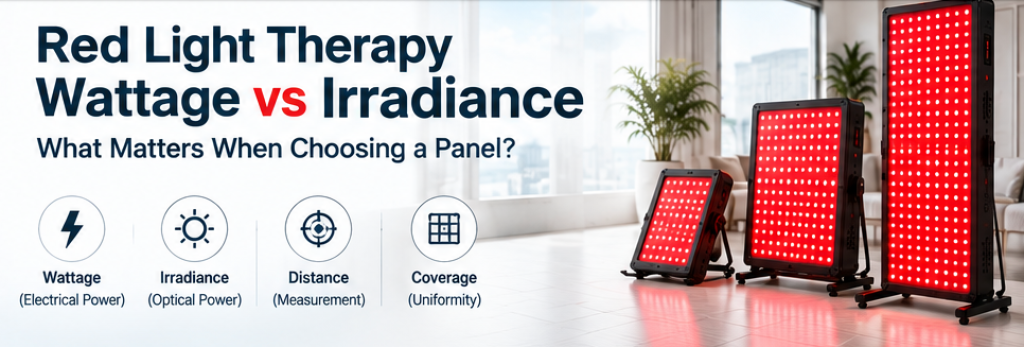
When comparing red light therapy panels, many buyers focus on one specification first: wattage.
You may see products advertised as 150W, 300W, 600W, 900W, or even 1600W red light therapy panels.
But does a 600W red light therapy panel deliver twice the light intensity of a 300W panel?
Not necessarily.
Electrical wattage and optical irradiance are two different measurements. Understanding the difference is essential when selecting red light therapy equipment for clinics, gyms, wellness centers, beauty businesses, distributors, and private-label brands.
A higher advertised wattage does not automatically mean higher irradiance, better coverage, or improved treatment outcomes.
This guide explains red light therapy wattage vs irradiance, how manufacturers measure optical output, what scientific research says about light exposure, and how professional buyers can compare LED therapy panels more accurately.
If you are sourcing equipment for commercial use, explore our professional red light therapy panel collection.
What Is Wattage in a Red Light Therapy Panel?
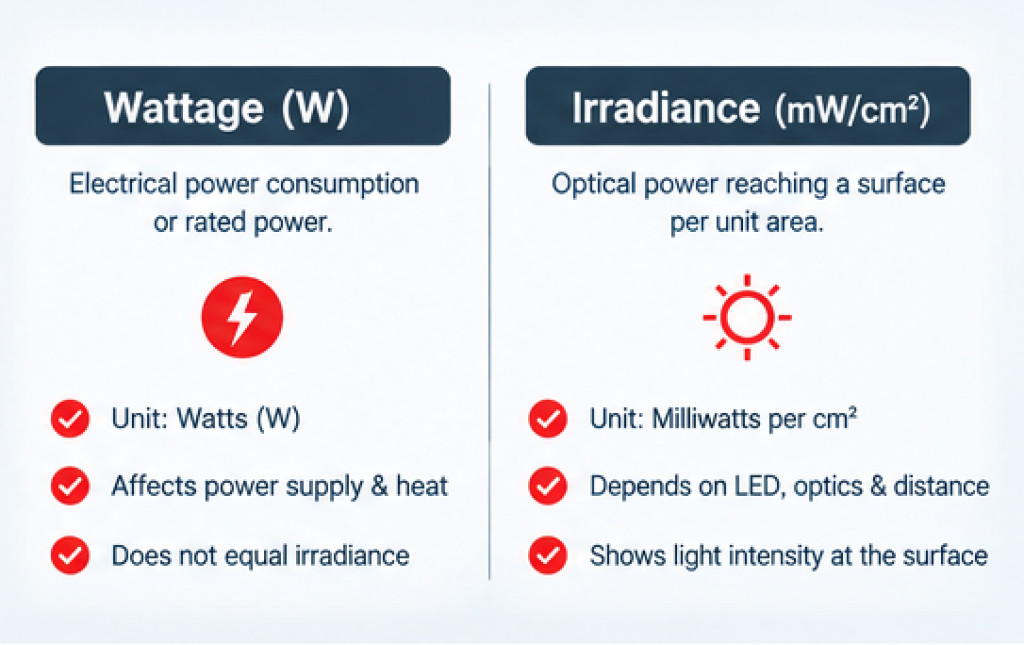
Wattage is a unit of power, expressed in watts (W).
In the red light therapy industry, the term can refer to different specifications depending on the manufacturer.
These may include:
- Rated electrical power
- Maximum electrical input power
- Actual operating power consumption
- Combined nominal ratings of individual LEDs
These values should not automatically be treated as equivalent.
Rated Wattage vs Actual Power Consumption
A manufacturer might advertise a panel as a 600W device.
However, that description alone does not establish whether the panel actually consumes 600 watts during normal operation.
For example, a panel containing 120 LEDs described as 5W components may be marketed as a 600W model even if the LEDs operate below their nominal maximum ratings.
Illustrative example only: The actual electrical consumption must be measured or confirmed through reliable technical documentation.
Before comparing suppliers, ask:
“Is your advertised wattage the rated LED capacity, maximum input power, or measured operating consumption?”
This simple question can reveal important differences between product specifications.
Why Electrical Wattage Matters
Electrical wattage remains relevant for commercial buyers because it can affect:
- Electricity requirements
- Operating costs
- Heat generation
- Power supply design
- Installation planning
- Thermal management
- Facility electrical capacity
However, wattage does not directly tell you how much optical power reaches the intended treatment surface.
What Is Irradiance in Red Light Therapy?
Irradiance is the optical power incident on a surface per unit area.
It is commonly expressed as:
mW/cm² — milliwatts per square centimeter.
For example, an irradiance of 100 mW/cm² means that 100 milliwatts of optical power arrive at each square centimeter of the measured surface, under the stated measurement conditions.
Irradiance is often called power density in red light therapy product descriptions.
The National Institute of Standards and Technology (NIST) explains the distinction between radiometric measurements, which quantify optical radiation, and photometric measurements, which describe light according to human visual sensitivity.
Irradiance vs Optical Power
Optical power describes the rate at which light energy is emitted or delivered.
Irradiance describes how that power is distributed over an area.
For a uniformly illuminated surface:
Irradiance = Incident Optical Power ÷ Illuminated Area
For a real LED panel, the light distribution may not be uniform. Irradiance can therefore vary significantly between the center and edges of the treatment area.
To understand this specification in more detail, read our Red Light Therapy Panel Irradiance Guide.
Red Light Therapy Wattage vs Irradiance: Key Differences
The following table summarizes the most important distinctions.
| Specification | Wattage | Irradiance |
|---|---|---|
| Typical unit | W | mW/cm² |
| What it describes | Electrical power, depending on the stated rating | Optical power arriving per unit area |
| Primary purpose | Electrical and operating requirements | Optical output at the target surface |
| Affected by | Power supply, LED drive, electronics | LEDs, optics, distance, geometry, operating mode |
| Requires distance to interpret? | No | Yes, for meaningful panel comparisons |
| Indicates coverage uniformity? | No | Only when measured across multiple points |
| Determines treatment results alone? | No | No |
The Most Important Difference
Wattage tells you about electrical power. Irradiance tells you about optical power arriving at a surface.
Neither value independently establishes the effectiveness or suitability of a treatment device.
A professional purchasing decision should consider both, along with wavelength, distance, coverage, safety, and intended use.
Does Higher Wattage Mean Higher Irradiance?
Not necessarily.
A higher-wattage panel may deliver more total optical output, illuminate a larger area, or simply consume more electrical power.
Its measured irradiance at a specific location depends on the complete optical system.
Example: Comparing Two 300W Panels
Consider two hypothetical products.
| Specification | Panel A | Panel B |
|---|---|---|
| Advertised wattage | 300W | 300W |
| Center irradiance | 85 mW/cm² | 125 mW/cm² |
| Measurement distance | 6 inches | 6 inches |
| Wavelengths | 660nm + 850nm | 660nm + 850nm |
These figures are illustrative and are not actual specifications for US Red Light Therapy products.
Both panels have the same advertised wattage, but their center irradiance measurements differ.
Possible reasons include differences in LED efficiency, optical lenses, LED spacing, electrical drive settings, or measurement methods.
However, Panel B should not automatically be considered superior.
Buyers also need to compare the average irradiance, coverage area, wavelength-specific output, and measurement reliability.
What About 300W vs 600W Red Light Therapy Panels?
A 600W panel may be larger or designed for broader coverage than a 300W panel.
But a larger panel does not necessarily produce twice the irradiance at the treatment surface.
For example, a larger device may distribute more total optical power across a wider area.
The appropriate choice depends on whether your business needs targeted illumination or broader treatment coverage.
Explore our Full-Body vs Targeted Red Light Therapy Panels Guide for more information.
Why LED Efficiency and Optical Design Matter
A red light therapy panel is not simply a collection of LEDs connected to a power supply.
It is an integrated electrical, optical, and thermal system.
1. LED Efficiency
LEDs convert electrical energy into optical radiation and heat.
The proportion converted into optical radiation depends on the LED design, wavelength, drive conditions, and operating temperature.
Two panels consuming similar electrical power may therefore emit different amounts of optical radiation.
2. Optical Lenses and Beam Angle
Optical lenses affect how light is distributed.
A narrower beam may concentrate light within a smaller area, while a wider beam may spread illumination across a broader surface.
A high center-point irradiance measurement does not necessarily indicate better overall coverage.
3. LED Arrangement
LED spacing and panel geometry affect the overlap of light emitted by individual LEDs.
This can influence the uniformity of illumination at different distances.
4. Thermal Management
LED performance can change with operating temperature.
Heat sinks, fans, enclosure design, and electrical controls all contribute to thermal performance.
For professional equipment, stable operation under the manufacturer’s stated conditions is important.
A scientific review, The Nuts and Bolts of Low-Level Laser (Light) Therapy, discusses the technical principles of photobiomodulation, including light sources and treatment parameters.
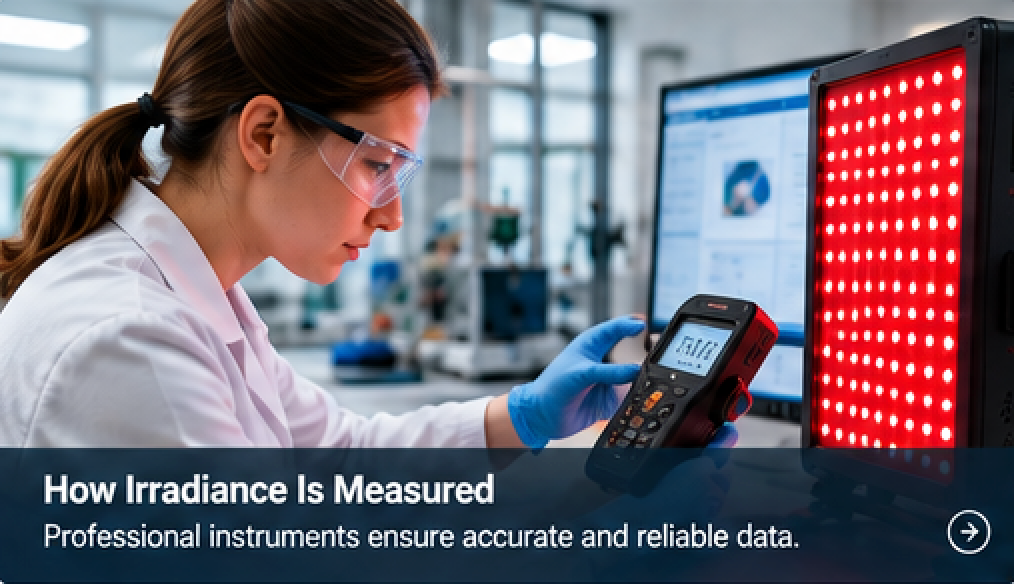
How Is Red Light Therapy Irradiance Measured?
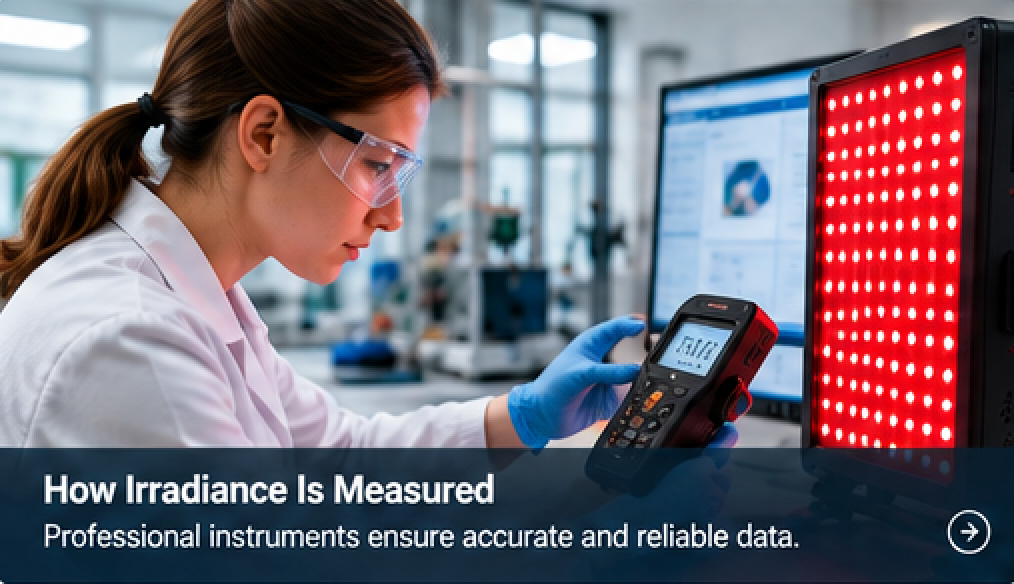
For meaningful comparison, irradiance should be measured using an appropriate optical instrument under documented conditions.
Measurement Distance
Manufacturers may report irradiance at distances such as:
- 3 inches (7.6 cm)
- 6 inches (15.2 cm)
- 12 inches (30.5 cm)
These are examples of testing distances, not universal recommended treatment distances.
An irradiance reading at 3 inches cannot be directly compared with a reading at 12 inches.
Measurement Instruments
Depending on the testing objective, manufacturers may use:
- Calibrated optical radiometers
- Spectroradiometers
- Optical power meters with appropriate detectors
The instrument should have suitable spectral sensitivity for the wavelengths being measured.
A lux meter is not appropriate for measuring the total optical irradiance of a dual-wavelength red and near-infrared panel.
The NIST radiometry reference explains radiometric quantities and how optical power measurements depend on geometry and measurement conditions.
Center Irradiance vs Average Irradiance
A single center-point reading can be useful, but it does not describe the entire treatment area.
For professional panels, buyers should consider requesting:
- Center irradiance
- Average irradiance across a defined area
- Minimum and maximum measured values
- Measurement grid dimensions
- Measurement distance
- Instrument model and calibration details
For large panels, average irradiance and uniformity can be particularly important.
Why Irradiance Changes With Distance
The irradiance reaching a surface generally changes when the distance between the panel and surface changes.
However, the relationship depends on the panel’s geometry and optical design.
A nearby LED array should not automatically be modeled as a single point source.
Example of Distance-Dependent Measurements
The following hypothetical values illustrate why distance matters.
| Measurement Distance | Example Center Irradiance |
|---|---|
| 3 inches | 150 mW/cm² |
| 6 inches | 105 mW/cm² |
| 12 inches | 60 mW/cm² |
These are illustrative values, not tested product data.
A buyer planning to use a panel at 12 inches should request data at that distance rather than relying only on a 3-inch specification.
Why Consistent Testing Matters
If two manufacturers use different distances, instruments, operating modes, or measurement locations, their reported numbers may not be directly comparable.
For a useful purchasing comparison, request measurements performed under equivalent conditions.
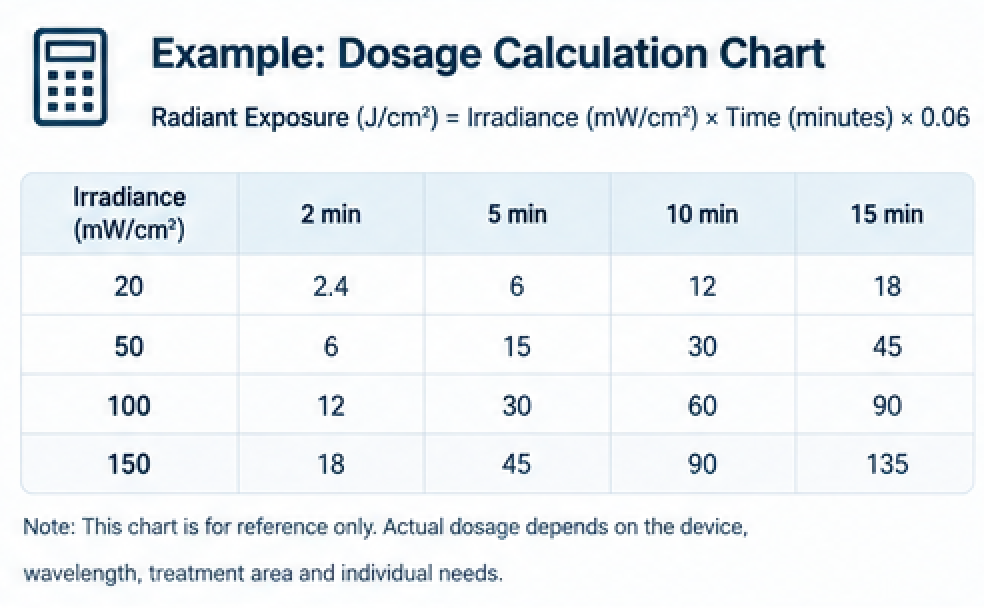
Irradiance vs Dosage: How Much Energy Reaches the Surface?
Irradiance describes the rate of optical energy delivery.
Radiant exposure describes the accumulated energy delivered per unit area over time.
Radiant exposure is commonly expressed in:
J/cm² — joules per square centimeter.
For constant irradiance:
Radiant Exposure (J/cm²) = Irradiance (W/cm²) × Time (seconds)
Or, using mW/cm² and minutes:
Radiant Exposure (J/cm²) = Irradiance (mW/cm²) × Time (minutes) × 0.06
Example: 50 mW/cm² for 10 Minutes
50 mW/cm² = 0.05 W/cm²
10 minutes = 600 seconds
0.05 × 600 = 30 J/cm²
The calculated surface radiant exposure is:
30 J/cm²
This is a mathematical example, not a recommended treatment dose.
Does Higher Irradiance Mean Better Results?
No.
Photobiomodulation research has identified complex dose-response relationships.
The peer-reviewed paper Biphasic Dose Response in Low Level Light Therapy — An Update discusses why increasing light exposure does not necessarily produce a proportionally greater biological response.
This is an important reason not to judge a red light therapy panel solely by the highest advertised irradiance.
For more information, read our Red Light Therapy Treatment Time & Device Selection Guide.
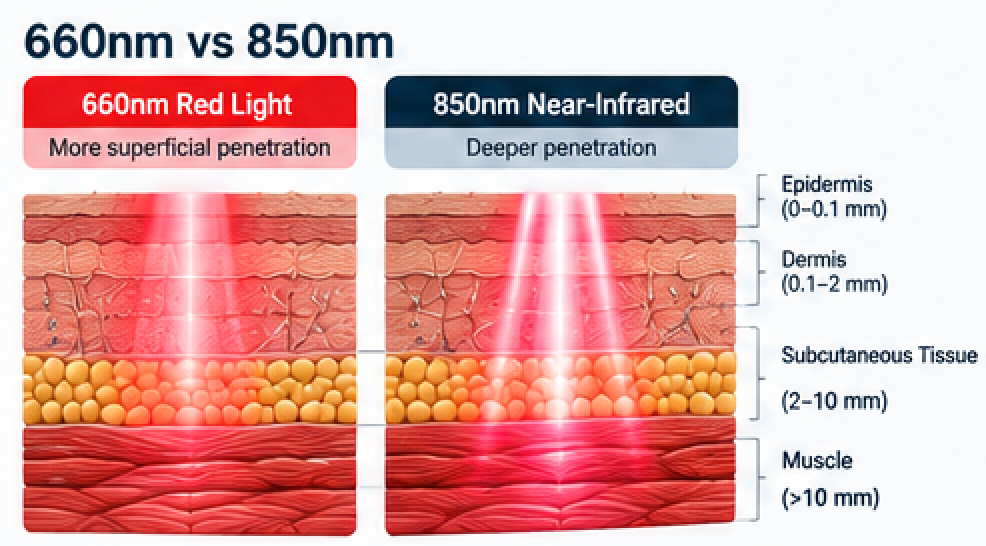
660nm vs 850nm: Does Wavelength Affect Irradiance Comparison?
Yes.
Two commonly used wavelengths in commercial red light therapy panels are:
- 660nm visible red light
- 850nm near-infrared light
These wavelengths have different optical characteristics and interact with biological tissue differently.
Why Combined Irradiance Can Be Misleading
A manufacturer may report one irradiance number for a dual-wavelength panel.
However, that number may represent the combined output of both wavelength groups.
It may not reveal how much optical power is delivered by the 660nm LEDs versus the 850nm LEDs.
For professional purchasing, consider asking for:
- Total irradiance
- Red-only irradiance
- Near-infrared-only irradiance
- Spectral output information
- Testing conditions for each measurement
Does LED Quantity Reveal Optical Output?
No.
A panel with equal numbers of 660nm and 850nm LEDs does not necessarily deliver equal optical power at both wavelengths.
LED efficiency and operating conditions can differ.
Learn more in our 660nm vs 850nm Red Light Therapy Comparison.
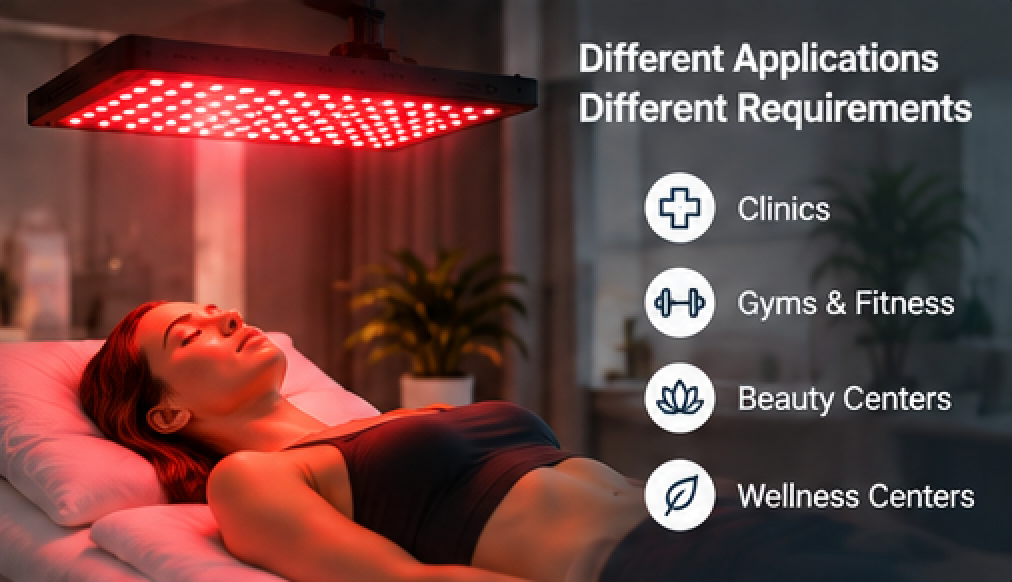
What Do Scientific Research and Industry Guidelines Say?
Reliable technical documentation should describe more than electrical wattage.
The scientific and regulatory literature consistently emphasizes the importance of specifying the conditions under which light is delivered.
Reporting Optical Parameters
A 2025 research article, Proposed Guidelines for Reporting Parameters and Procedures of High- and Low-Level Laser Therapy in Medical Research Articles, recommends detailed reporting of parameters such as wavelength, irradiance, beam characteristics, exposure duration, and energy density.
Although its primary focus is laser research reporting, the principle of documenting optical measurement conditions is also useful when evaluating LED therapy equipment.
Clinical Guidance Is Application-Specific
The World Association for Photobiomodulation Therapy (WALT) position paper discusses specific photobiomodulation applications and technical treatment parameters.
These recommendations should not be interpreted as universal protocols for every commercial LED panel.
They illustrate why wavelength, irradiance, and dosage must be evaluated in the context of a particular application.
Regulatory Considerations
The U.S. Food and Drug Administration’s draft guidance for photobiomodulation devices discusses testing, clinical evidence, and labeling considerations for certain regulated PBM devices.
This document is draft guidance and is not a blanket approval of red light therapy products.
Professional buyers should verify applicable regulatory requirements for the device’s intended use and destination market.
How to Choose a Red Light Therapy Panel for Different Businesses
Different commercial environments require different equipment configurations.
Red Light Therapy Panels for Clinics
Clinics may prioritize:
- Defined optical specifications
- Repeatable irradiance measurements
- Appropriate wavelength selection
- Adjustable controls
- Documented operating instructions
- Safety and regulatory documentation
- Reliable maintenance support
For clinical applications, equipment selection and treatment protocols should be consistent with the device’s intended use and applicable professional requirements.
Explore our Red Light Therapy Solutions for Clinics.
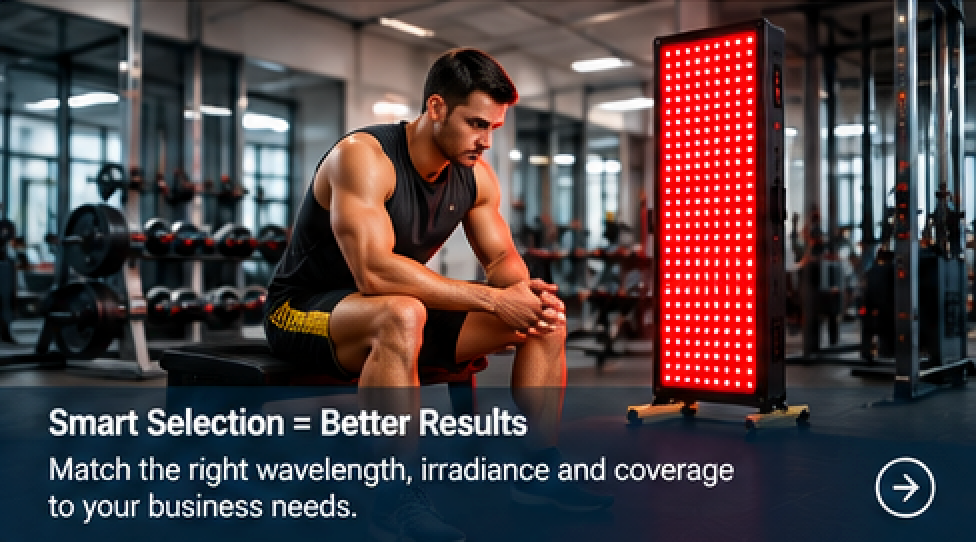
Red Light Therapy Panels for Gyms
Fitness businesses may prioritize:
- Larger coverage areas
- Easy operation
- Durable construction
- Convenient installation
- Timer controls
- Thermal management
- Commercial warranty support
A larger panel can be useful when the business needs broad-area illumination, but higher wattage alone does not guarantee better performance.
Red Light Therapy Panels for Beauty Centers
Beauty businesses may prefer compact or targeted systems.
Important factors include:
- Panel dimensions
- Positioning flexibility
- Wavelength configuration
- Irradiance
- Coverage uniformity
- Customer comfort
- Eye safety
- Cleaning and maintenance
Red Light Therapy Panels for Wellness Centers
Wellness centers may compare tabletop panels, medium-size systems, and full-body panels.
The most suitable configuration depends on room size, customer flow, equipment positioning, and the intended service model.
For additional purchasing guidance, read How to Choose a Red Light Therapy Device for Clinics, Gyms & Wellness Centers.
Red Light Therapy Panel Safety: Why High Output Requires Careful Evaluation
High optical output should not be confused with proven clinical effectiveness or automatic safety.
Professional buyers should evaluate eye safety, operating instructions, electrical safety, thermal design, and relevant product documentation.
The FDA’s information on non-invasive body contouring technologies discusses photobiomodulation in certain aesthetic applications and highlights safety considerations, including eye protection.
This guidance relates to particular technologies and procedures; it does not establish the safety or effectiveness of every red light therapy panel.
For business use, ask the supplier to provide appropriate safety instructions and evidence supporting the product’s intended claims.
OEM & ODM Red Light Therapy Panel Customization
For distributors, private-label brands, and commercial equipment buyers, wattage and irradiance may both be important product-development specifications.
Depending on the platform and engineering feasibility, customization options may include:
- LED wavelength combinations
- LED quantity and arrangement
- Optical lens configuration
- Panel dimensions
- Electrical power design
- Irradiance targets
- Timer and intensity controls
- Cooling systems
- Housing design
- Logo and packaging
- User manuals and accessories
Why OEM Buyers Should Define Irradiance Requirements
A request for a “600W red light therapy panel” may not be sufficiently precise.
A stronger technical specification would include:
- Target wavelength configuration
- Intended coverage area
- Target irradiance
- Measurement distance
- Measurement method
- Acceptable output tolerance
- Electrical power requirements
- Product dimensions
- Safety and compliance requirements
This helps both buyers and suppliers evaluate whether the requested configuration is technically feasible.
Explore our Red Light Therapy OEM & ODM Manufacturing Solutions.
B2B Red Light Therapy Panel Comparison Checklist
Before ordering a sample or placing a wholesale order, request the following information.
| Technical Item | What to Ask the Supplier |
|---|---|
| Advertised wattage | What exactly does this number represent? |
| Actual consumption | What is the measured operating input power? |
| Wavelengths | Which wavelengths are included? |
| Irradiance | What is the measured output in mW/cm²? |
| Measurement distance | At what distance was irradiance measured? |
| Measurement equipment | Which calibrated instrument was used? |
| Coverage | What area is illuminated? |
| Uniformity | Are multi-point measurements available? |
| Operating conditions | Which modes and settings were used? |
| Cooling | How is operating temperature managed? |
| Safety | What documentation is available? |
| OEM options | Which specifications can be customized? |
| MOQ | What is the minimum order quantity for this configuration? |
| Warranty | What support and replacement terms apply? |
For more detailed supplier evaluation, read our Red Light Therapy Panel Manufacturer Guide.
Common Mistakes When Comparing Wattage and Irradiance
Mistake 1: Assuming Higher Wattage Means Better Performance
Electrical wattage does not directly establish optical performance at the treatment surface.
Mistake 2: Comparing Irradiance at Different Distances
Measurements should be compared under equivalent conditions.
Mistake 3: Looking Only at Peak Irradiance
A center-point reading does not describe the entire treatment area.
Mistake 4: Ignoring Wavelength Configuration
Combined red and near-infrared measurements may conceal differences in spectral output.
Mistake 5: Confusing Rated LED Power With Actual Consumption
Advertised LED ratings do not necessarily equal measured electrical input.
Mistake 6: Treating Irradiance as Proof of Effectiveness
Higher irradiance does not automatically produce better clinical or wellness outcomes.
Mistake 7: Ignoring Test Reports
Product specifications are more useful when supported by documented measurement methods and operating conditions.
Frequently Asked Questions
Is wattage or irradiance more important for red light therapy?
Irradiance is more directly relevant when evaluating optical power reaching a surface. Wattage remains important for electrical requirements and device design. Both should be considered with wavelength, coverage, distance, and intended use.
Does a 600W red light therapy panel have higher irradiance than a 300W panel?
Not necessarily. A 600W panel may have greater coverage or electrical consumption without delivering higher irradiance at every point.
What does mW/cm² mean in red light therapy?
It means milliwatts per square centimeter, a unit used to express irradiance.
What is a good irradiance for a red light therapy panel?
There is no universal value suitable for every application. Appropriate irradiance depends on wavelength, exposure duration, treatment area, device configuration, and intended use.
Is 100 mW/cm² better than 50 mW/cm²?
Not automatically. Higher irradiance delivers optical energy faster at the measured surface, but it does not necessarily lead to better outcomes.
How can I verify a manufacturer’s irradiance claims?
Request measurement distance, instrument information, operating conditions, wavelength data, and multi-point results where appropriate.
Does the number of LEDs determine irradiance?
No. LED efficiency, drive settings, optics, spacing, and measurement geometry also influence irradiance.
Can OEM manufacturers customize irradiance?
Depending on the product design, irradiance may be influenced through LED configuration, optical design, electrical controls, and other engineering changes. Custom targets should be verified through testing.
Why is average irradiance important?
Average irradiance can help describe optical power distribution across a defined area, particularly for larger panels. The averaging method and measurement area must be specified.
Can higher irradiance reduce treatment time?
Higher irradiance can deliver the same calculated surface radiant exposure in less time, but that does not establish that the resulting biological effects are equivalent or that the shorter exposure is clinically appropriate.
Conclusion: Wattage vs Irradiance — What Should B2B Buyers Compare?
When selecting a professional red light therapy panel, wattage and irradiance should not be treated as interchangeable specifications.
Wattage describes electrical power.
Irradiance describes optical power arriving at a surface per unit area.
Neither specification alone determines whether a device is suitable for a particular application.
For a more complete evaluation, compare:
Wattage → Wavelength → Irradiance → Distance → Coverage → Uniformity → Safety → Intended Use
For clinics, gyms, wellness centers, beauty businesses, distributors, and private-label brands, reliable technical documentation is more valuable than an isolated high-power marketing claim.
Request a Professional Red Light Therapy Panel Quote
Looking for professional red light therapy panels or customized OEM/ODM equipment?
US Red Light Therapy offers red and near-infrared light therapy equipment and customization options for B2B buyers.
Share your project requirements:
- Preferred panel size
- Target wavelengths
- Required irradiance
- Measurement distance
- Electrical power requirements
- Intended application
- Target market
- Estimated order quantity
- Logo and packaging requirements
Our team can discuss available configurations, technical requirements, and customization feasibility.
Explore Products: Professional Red Light Therapy Panels
Explore Customization: Red Light Therapy OEM & ODM Manufacturer
Request a Quote: Contact US Red Light Therapy
Post time: 10-12-26